
What if the primary obstacle to your laboratory’s analytical precision isn’t the physical age of your electron column, but the digital isolation of its control systems? Many industry professionals currently face the compounding challenges of frequent vacuum system failures and the total unavailability of critical replacement parts for legacy systems. You likely understand that maintaining competitive imaging standards requires a decisive shift away from these obsolete frameworks, particularly as modern data protocols now necessitate full Windows 11 compatibility and adherence to the February 2, 2026, FDA Quality Management System Regulation deadline.
Upgrading an older sem has evolved beyond simple hardware maintenance into a strategic alignment of technical capability with global industrial performance. This guide provides an expert technical analysis and an ROI-driven framework to help you navigate the transition from legacy hardware to high-performance systems, such as the Veritas Series or the Cube II Benchtop SEM. We’ll evaluate the critical decision points between retrofitting existing infrastructure and integrating modernized solutions to restore imaging precision, improve workflow efficiency, and guarantee long-term serviceability for your facility.
Key Takeaways
- Identify the critical thresholds of system obsolescence by analyzing manufacturer support notifications and the progressive decline of vacuum stability within legacy hardware.
- Examine the specific technical determinants of performance loss, focusing on the mechanical fatigue of aging vacuum components and the accumulation of contaminants in the electron column.
- Establish a strategic framework for upgrading an older sem that evaluates the fiscal and operational advantages of transitioning to advanced platforms like the Veritas Series or Genesis Tabletop SEM.
- Perform a detailed lifecycle assessment to calculate the total cost of ownership, ensuring your laboratory’s imaging precision aligns with modern industrial resolution requirements.
- Determine the optimal path for modernization by assessing the role of professionally refurbished SEM units in maintaining high-end analytical standards while optimizing capital expenditure.
Identifying the Threshold of Obsolescence in Electron Microscopy
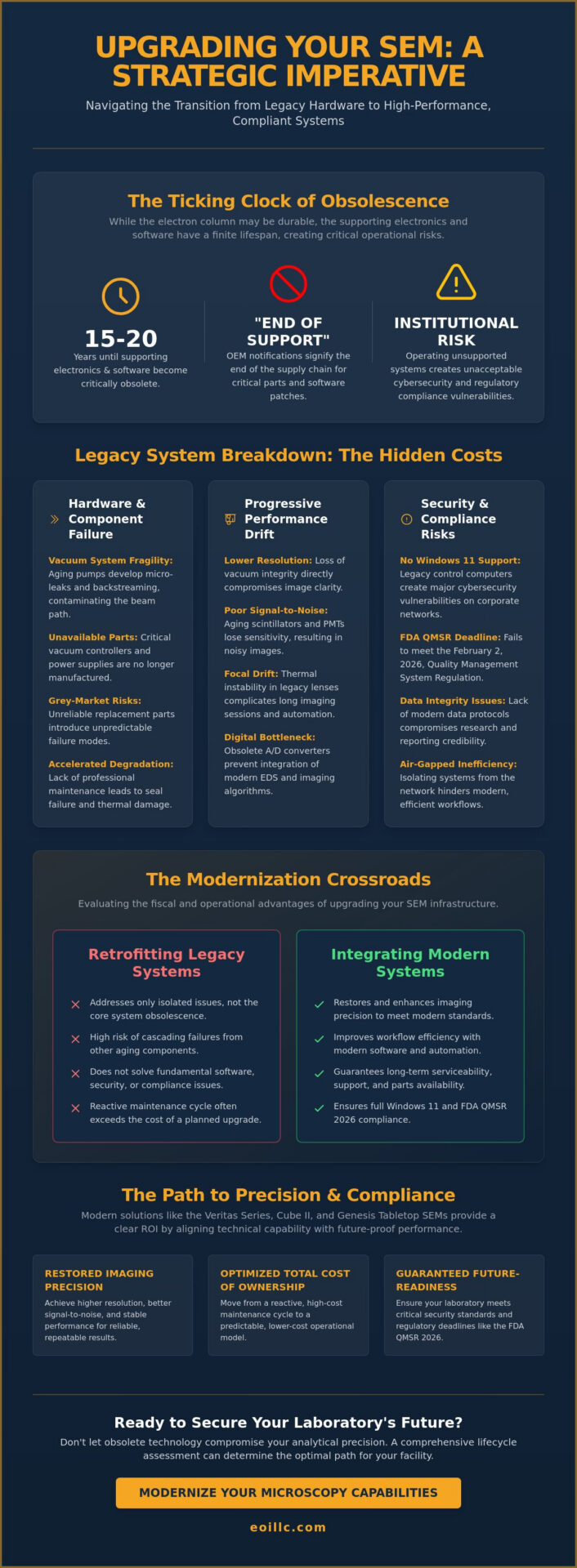
The operational longevity of a Scanning Electron Microscope (SEM) often masks the underlying obsolescence of its internal architecture. While the electron column itself may remain physically intact, the supporting electronics and software frameworks typically reach a critical threshold of irrelevance within fifteen to twenty years. Upgrading an older sem becomes a strategic necessity when Original Equipment Manufacturer (OEM) “End of Support” notifications transition from theoretical warnings to practical roadblocks. These notifications signify more than the cessation of software patches; they represent the total evaporation of the specialized supply chain required to maintain high-vacuum integrity and beam stability.
Legacy systems frequently rely on proprietary analog-to-digital conversion assemblies that lack the sampling rates and bit-depth necessary for modern high-resolution imaging. This hardware limitation creates a digital bottleneck, preventing the integration of advanced Energy Dispersive Spectroscopy (EDS) systems or modern image processing algorithms. The inability of legacy control computers to support Windows 11 creates significant vulnerabilities in corporate networking environments. In 2026, the intersection of cybersecurity requirements and the FDA’s modernized Quality Management System Regulation (QMSR) makes the continued operation of air-gapped, legacy-OS systems an unacceptable institutional risk.
The ‘End of Support’ Crisis in Legacy Labs
Systems reaching the two-decade mark often face a component vacuum where critical vacuum controllers and high-voltage power supplies are no longer manufactured. Relying on grey-market replacement parts introduces unpredictable failure modes and may compromise the delicate alignment of the electron optics. Without consistent, professional SEM maintenance, these aging systems suffer from accelerated thermal degradation and seal failure. This decline often forces lab managers into a reactive maintenance cycle that consumes more capital than a planned transition to a modern platform like the Veritas Series.
Quantifying Performance Drift
Performance degradation in aging electron microscopes is rarely a binary failure; it’s a progressive drift. You might observe a steady decline in the signal-to-noise ratio as aging scintillators and photomultiplier tubes lose sensitivity. Thermal instability in legacy electromagnetic lenses can lead to focal drift during extended imaging sessions, complicating automated workflows. Older lab environments also struggle to shield these sensitive legacy columns from modern levels of electromagnetic interference and floor vibration. Identifying these subtle shifts in precision is the first step toward justifying the investment in upgrading an older sem to a high-performance benchtop or full-scale system.
Technical Determinants of Performance Degradation in Aging Systems
The physical integrity of an electron microscope is subject to the relentless laws of thermodynamics and material science. While the primary electron column is often viewed as a static component, its performance is inextricably linked to the dynamic health of its vacuum and electronic subsystems. Understanding how electron microscopes work at a fundamental level reveals that even minor mechanical fatigue in legacy diffusion or turbomolecular pumps can introduce catastrophic imaging artifacts. These aging vacuum components often develop micro-leaks or backstreaming issues that compromise the beam path, leading to a noticeable loss in resolution that cannot be corrected by software alone. In many cases, the cost of maintaining these legacy mechanical systems exceeds the investment required for upgrading an older sem to a more efficient platform.
Vacuum System Fragility and Contamination
Maintaining a pristine SEM vacuum system is the foundational requirement for all high-resolution electron optics. In aging systems, the cumulative effect of hydrocarbon contamination within the chamber and on aperture assemblies creates a “charging” effect that deflects the electron beam. This contamination often originates from degraded viton O-rings or legacy pump oils, forming a thin layer of carbonaceous material on the sample surface during observation. Such degradation significantly reduces detector sensitivity and prevents the laboratory from achieving the sub-nanometer precision expected in modern industrial applications. Furthermore, oxidation on internal column components can lead to beam instability and increased astigmatism.
Electronics and Software Bottlenecks
The transition toward 2026 cybersecurity standards has rendered proprietary PC-based controller cards and legacy bus architectures functionally obsolete. These older electronics utilize low-bitrate image acquisition protocols that fail to capture the nuanced topographical data required for sophisticated failure analysis. Legacy software environments often prevent the deployment of advanced SEM techniques, such as automated large-area mapping or high-speed EDS acquisition. Modern Energy Dispersive Spectroscopy (EDS) Systems require high-speed pulse processors and integrated software environments that legacy hardware simply cannot sustain, leading to significant delays in elemental quantification.
Precision in failure analysis and materials characterization depends on the synergy between a stable electron source and high-speed data processing. Upgrading to a platform such as the Veritas Pro SEM ensures that your laboratory circumvents these technical bottlenecks, replacing fatigued mechanical components with reliable, modern alternatives that meet today’s rigorous throughput demands. This strategic modernization restores analytical accuracy while providing the software compatibility necessary for secure, networked laboratory environments.
The Strategic Evaluation: Component Retrofitting vs. Benchtop Transition
Deciding between a comprehensive electronics retrofit and a full system replacement is a pivotal moment for any laboratory director. Upgrading an older sem through component retrofitting aims to salvage the high-voltage column and vacuum chamber while replacing the obsolete control interface. This path is often chosen when the existing hardware possesses specialized large-chamber capabilities or high-voltage ranges that are difficult to replicate in compact models. However, the strategic evaluation must account for more than just initial capital expenditure. It’s essential to analyze the long-term serviceability of the platform, especially as proprietary architectures from the late 20th century become increasingly difficult to support with modern software integration.
Retrofitting Legacy Floor Models
Retrofitting allows a facility to retain its existing electron optics while modernizing the user interface and data acquisition systems. This approach preserves the ability to analyze oversized or heavy samples that require the expansive stage travel of a traditional floor model. Despite these benefits, labs must weigh the risks of creating “Frankenstein” systems where mismatched hardware and software lead to unpredictable downtime. The integration process often requires significant periods of inactivity, during which the laboratory loses its primary analytical capability. Additionally, while the electronics may be new, the underlying mechanical fatigue of the original column remains a persistent variable in the reliability equation.
The Evolution of Benchtop SEM Performance
A significant shift in 2026 is the technical parity achieved by modern desktop SEM systems. Many industrial facilities now find that the resolution and analytical depth of a compact unit, such as the Genesis Tabletop SEM, meet or exceed the performance of their aging floor-standing predecessors. These newer systems offer massive throughput gains through automated vacuum cycles and simplified user workflows that reduce the learning curve for new operators.
The Cube II Benchtop SEM represents the current standard for industrial quality control, providing integrated Energy Dispersive Spectroscopy (EDS) and low-vacuum modes in a footprint that’s a fraction of legacy systems. Transitioning to a benchtop platform often results in a 30% to 70% reduction in initial capital expenditure when compared to a new mid-range field emission system, while simultaneously reducing power consumption by up to 70%. This synergy between industrial performance and ecological responsibility makes the benchtop transition a compelling alternative to the complexities of upgrading an older sem column that’s nearing the end of its mechanical lifecycle.
Executing a Comprehensive SEM Lifecycle Assessment
Rigorous institutional oversight requires a methodical audit of current imaging requirements before any capital commitment is finalized. Laboratories often discover that their resolution needs have transitioned toward the sub-nanometer scale since the original instrument was commissioned, rendering legacy hardware fundamentally incapable of supporting modern research objectives. The decision-making process for upgrading an older sem must be anchored in a Total Cost of Ownership (TCO) analysis that extends beyond the initial invoice to include long-term maintenance, power consumption, and the availability of specialized technical support. A comprehensive lifecycle assessment serves as the mandatory prerequisite for any capital expenditure in 2026, ensuring that the chosen modernization path aligns with both fiscal constraints and technical imperatives.
A critical component of this assessment involves verifying the availability of professional SEM training for existing staff. As systems transition from manual, analog-heavy operations to streamlined digital interfaces, the learning curve can impact laboratory throughput. Modernizing your facility with a platform like the Veritas Plus SEM ensures that your team leverages the full potential of high-performance electronics while maintaining the rigorous standards required for international production and logistical excellence. This foresight prevents the common pitfall of acquiring advanced hardware that remains underutilized due to a lack of institutional knowledge.
Calculating the ROI of Modernization
Quantifying the return on investment requires a meticulous comparison of the electron microscope cost against the escalating expenses of repeated repairs for legacy systems. Modernization often results in profound productivity gains, as newer systems feature significantly faster sample exchange cycles and automated imaging routines that reduce operator fatigue. For example, modernizing the electronics of an existing column can reduce power consumption by up to 70%, lowering both the laboratory’s carbon footprint and its annual operating costs. Facilities should also consult with financial advisors regarding the tax implications of capital equipment depreciation versus the immediate deduction of service expenses associated with upgrading an older sem.
Technical Feasibility and Facility Requirements
Facility managers must evaluate the physical requirements of new versus upgraded units, particularly concerning power, cooling, and floor space. Transitioning to a compact Genesis Tabletop SEM can reclaim valuable laboratory real estate, whereas upgrading a legacy floor model may require maintaining existing specialized infrastructure. Planning for the decommissioning and professional relocation of legacy optics is equally vital to prevent environmental contamination and ensure compliance with industrial safety standards. If your facility requires a balance of high-end performance and budget optimization, exploring our range of Refurbished SEM Units provides a strategic middle ground that delivers modern precision without the full expenditure of a new system.
Advanced Solutions for Modernizing Industrial Microscopy Capabilities
Achieving a seamless transition from legacy hardware to modern analytical standards requires more than a simple equipment purchase. It demands a partnership with a seasoned global innovator capable of navigating the intricate technical integration of advanced hardware into existing workflows. Leveraging over 30 years of specialized expertise, our technical team assists laboratories in determining the optimal trajectory for upgrading an older sem, ensuring that every strategic decision enhances the synergy between industrial performance and ecological responsibility. For budget-conscious facilities, high-quality Refurbished SEM Units represent a sophisticated alternative, providing restored precision and guaranteed serviceability at a reduced capital threshold compared to entirely new installations.
Modern material characterization depends on the integration of state-of-the-art EDS (Energy Dispersive Spectroscopy) Systems. These assemblies allow for comprehensive elemental mapping and quantification that legacy pulse processors simply cannot achieve. To ensure operational continuity, we offer customized service contracts and rigorous Preventative Maintenance Visits, which act as recurring anchors for laboratory reliability. The capital expenditure associated with upgrading an older sem is often offset by the rapid restoration of imaging precision and the elimination of the service isolation common with unsupported OEM models.
The Cube II and Genesis Advantage
The Cube II Benchtop SEM is specifically engineered for high-resolution industrial applications, featuring technical specifications that streamline the failure analysis workflow through superior automation. These tabletop units provide a centralized solution for quality assurance where speed and accuracy are paramount. By transitioning to a Genesis Tabletop SEM, laboratories benefit from a significant reduction in footprint without compromising on the analytical depth required for complex sample characterization. On-site training is a critical component of our deployment strategy, ensuring that your staff can maximize equipment utility and maintain meticulous standards from the first day of operation.
Partnering for Long-Term Precision
Professional installation and calibration aren’t optional; they’re non-negotiable requirements for any upgraded system to ensure the accuracy of sub-nanometer measurements. A multi-brand service provider offers distinct value for diverse laboratory fleets, maintaining a steady, expert-driven narrative across various hardware platforms while providing a single point of accountability for SEM Filaments and Consumables. This holistic approach to laboratory management ensures that internal processes remain as rigorous as the external demands of the global market. To begin the transformation of your laboratory capabilities, contact our technical team to evaluate your current SEM inventory and identify the most sustainable path for your facility’s growth.
Strategic Realignment of Electron Microscopy Infrastructure
The successful modernization of laboratory infrastructure in 2026 requires a meticulous approach to technological integration and a clear understanding of the threshold of obsolescence. As we’ve analyzed, the transition from legacy hardware to high-performance systems like the Veritas Series or the Cube II Benchtop SEM is a strategic necessity driven by the requirements of regulatory compliance and the restoration of imaging precision. Upgrading an older sem serves as a critical pivot for facilities that prioritize long-term serviceability and institutional reliability over the mounting costs of reactive maintenance. By executing a comprehensive lifecycle assessment, your laboratory can secure a future defined by analytical accuracy and operational stability.
Leveraging over 30 years of industry experience in electron optics, we provide the technical authority necessary to navigate these complex transitions. As the sole US distributor for EmCraft Scanning Electron Microscopes and a provider of comprehensive service for all major SEM manufacturers, we’re uniquely positioned to support your facility’s growth. We invite you to Request a Technical Consultation for Your SEM Modernization Project to ensure your laboratory capabilities align with the highest global standards. Securing the future of your research starts with a visionary commitment to precision and reliability.
Frequently Asked Questions
What are the first signs that my older SEM needs an upgrade?
The primary indicators include a noticeable increase in vacuum recovery times and the frequent occurrence of “End of Support” notifications from the OEM. You may also observe a subtle but persistent decline in image resolution and signal-to-noise ratio that standard maintenance no longer corrects. These technical hurdles signify that the internal architecture is reaching its threshold of obsolescence, necessitating a strategic evaluation of your current imaging capabilities.
Is it more cost-effective to upgrade an old SEM or buy a new benchtop model?
The fiscal decision between upgrading an older sem and purchasing a new benchtop model depends on your specific resolution and chamber volume requirements. While retrofitting legacy electronics typically requires a lower initial capital expenditure, a new platform like the Cube II Benchtop SEM provides a full manufacturer’s warranty and significantly lower power consumption. Laboratories must weigh the long-term ROI of a modern, integrated system against the potential for continued mechanical fatigue in a retrofitted legacy column.
Can I add modern EDS capabilities to a 15-year-old scanning electron microscope?
Integrating modern Energy Dispersive Spectroscopy (EDS) Systems into a 15-year-old microscope is technically feasible provided the control electronics are modernized to support high-speed data acquisition. Legacy pulse processors often lack the sampling rates required for sophisticated elemental mapping. Upgrading the interface to a Windows 11-compatible environment allows for the seamless integration of state-of-the-art detectors, restoring the analytical precision required for comprehensive material characterization in industrial environments.
How long does the typical upgrade or retrofitting process take?
The timeline for a professional modernization project varies based on the complexity of the technical integration. A standard electronics retrofit may require several days to a week of on-site calibration and testing to ensure beam stability. Conversely, the installation of a new Genesis Tabletop SEM is often completed within a single day. Planning for these operational pauses is essential to maintain laboratory throughput during the transition to higher performance standards.
Will my existing lab staff need extensive training for a new benchtop SEM?
Modern benchtop systems are specifically engineered to minimize the learning curve for new operators through intuitive, software-driven interfaces. While legacy floor models often require specialized expertise to manage manual alignment and vacuum cycles, systems like the Veritas Series utilize automated routines that streamline the workflow. Most laboratories find that minimal on-site training is sufficient to achieve peak equipment utility, allowing staff to focus on data analysis rather than hardware management.
What happens to the vacuum system performance in a legacy SEM over time?
Vacuum system performance in legacy models degrades through the mechanical fatigue of turbomolecular pumps and the progressive oxidation of internal seals. Over time, these factors lead to micro-leaks and hydrocarbon contamination that compromise the electron beam path. This degradation results in increased astigmatism and reduced detector sensitivity. Regular preventative maintenance can delay these effects, but it’s likely the vacuum architecture will eventually require a comprehensive overhaul to maintain industrial imaging standards.
Are replacement parts still available for SEM models from the early 2000s?
Sourcing replacement parts for SEM models from the early 2000s has become increasingly difficult as specialized supply chains evaporate. Many OEMs have officially transitioned these systems to “End of Life” status, meaning critical components like vacuum controllers and proprietary boards are no longer manufactured. This scarcity often forces laboratories to rely on unreliable grey-market parts, which introduces significant institutional risk and complicates the long-term serviceability of the instrument.
How does upgrading an SEM affect my laboratory’s data security and networking?
Modernizing your SEM architecture is a critical requirement for maintaining data security and networking integrity in 2026. Legacy systems running obsolete operating systems are vulnerable to cybersecurity threats and often can’t be integrated into secure corporate networks. Upgrading to a Windows 11-based control system ensures compliance with modern data protocols and facilitates the secure, remote operation of the instrument, which is vital for international production and logistical excellence.