
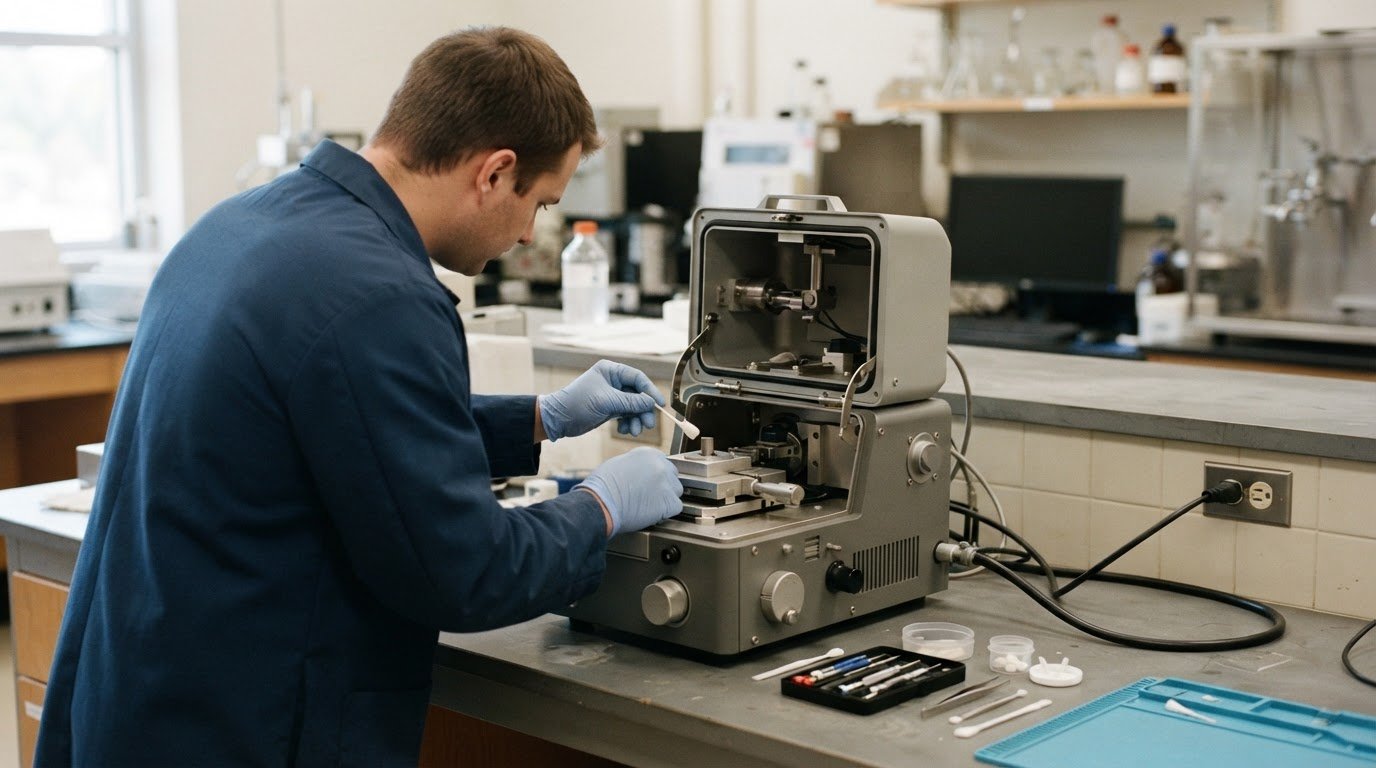
An SEM’s purchase price is only one part of its operating cost. When comparing operational costs of different SEM models, include the electron source, maintenance and service, power, consumables, and facility requirements. The balance depends on the instrument’s configuration and how your team will use it.
It is easy to focus on acquisition cost, but ongoing requirements shape the longer-term cost of ownership. Compare how the electron source affects replacement needs, how maintenance arrangements affect recurring expenses, and how power and consumables contribute to the total.
Benchtop and tabletop SEMs can have different facility demands from floor-model systems. Assess these alongside your workload, analytical requirements, and available laboratory space to make a practical comparison.
Key Takeaways
- Compare electron sources by both replacement needs and imaging requirements: lower-cost options may involve trade-offs in resolution and upkeep.
- Assess total ownership cost across the instrument’s lifetime, including installation needs, service arrangements, consumables, and operating demands.
- Include power use and lab infrastructure in the comparison; benchtop and floor-model SEMs can create different facility requirements.
- For results supporting accredited testing or reporting, account for ISO/IEC 17025, an accreditation standard relevant to that work according to the International Organization for Standardization (ISO) and International Electrote.
Electron source replacement costs and lifespans
Electron-source selection affects replacement needs, image resolution, and the total cost of an SEM. The right balance depends on your application requirements and how often the instrument will operate.
Source Types and Ownership Costs
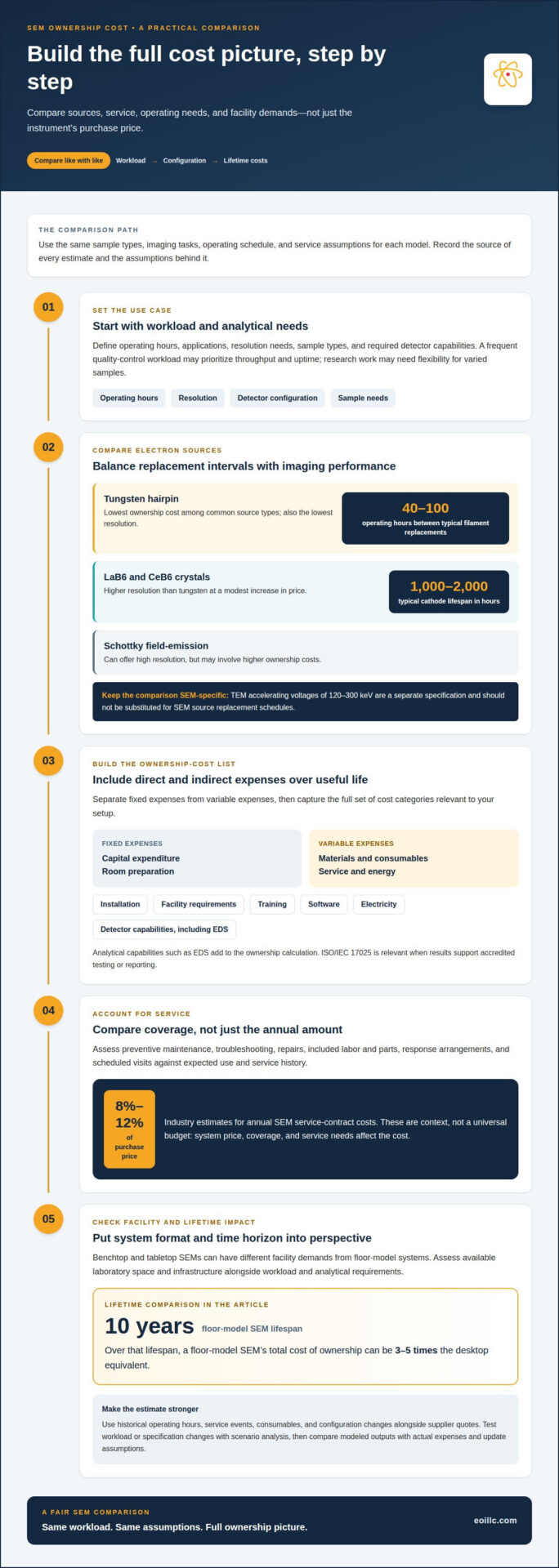
Electron-source ownership cost combines replacement needs with the imaging performance each source provides. Tungsten hairpin emitters have the lowest ownership cost among common source types, but also the lowest resolution. Their filaments typically require replacement every 40 to 100 operating hours, so frequent use makes replacement intervals a practical budget factor.
LaB6 and CeB6 crystals provide higher resolution than tungsten at a modest increase in price, and their cathodes typically last 1,000 to 2,000 hours. Schottky field-emission sources can offer high resolution, but may involve higher ownership costs. Compare these trade-offs against the applications and resolution your work actually requires.
Accelerating Voltage and Source Costs
Accelerating voltage describes the energy applied to electrons, while the source generates the electron beam. TEM and scanning electron instruments use distinct imaging configurations, so TEM source assumptions shouldn’t be substituted for SEM replacement schedules. TEM accelerating voltages can range from 120 to 300 keV, a separate specification to consider when evaluating TEM operating requirements.
Detector configuration also shapes system cost: analytical capabilities, including EDS, add to the ownership calculation. ISO/IEC 17025 is an accreditation standard relevant when microscope results support accredited testing or reporting, according to the International Organization for Standardization (ISO) and the International Electrotechnical Commission. Match source and detector capabilities to the work, rather than paying for resolution or analysis functions that applications don’t require.
For an accurate estimate when comparing operational costs of different sem models, request a quote based on your requirements. Source type, resolution needs, operating hours, and detector configuration all affect the cost.
Total cost of ownership
Total cost of ownership (TCO) estimates an instrument’s direct and indirect expenses over its useful life. For an SEM, look beyond acquisition to include installation, facility requirements, maintenance, training, software, consumables, and electricity. Compare these categories against your workload and analytical needs, since their relative importance depends on how you use the instrument.
A consistent cost breakdown makes comparisons more meaningful. Separate fixed expenses, such as capital expenditure and room preparation, from variable expenses, such as materials, service, and energy. Classify costs as direct or indirect, and document each input’s source and assumptions. NORSOK Z-014 offers a structure for transparent project cost breakdowns, particularly in oil and gas. In comparing operational costs of different SEM models, shared categories help teams assess ownership beyond the purchase price.
Choose benchmarking methods that fit the work. For an SEM laboratory, compare instruments using the same sample types, imaging tasks, operating schedule, and service assumptions. For example, a team with frequent quality-control analysis may prioritize throughput and uptime, while a research group may focus on its analytical requirements and the flexibility needed for varied samples.
Historical records strengthen forecasting when they capture operating hours, service events, consumables, and configuration changes. Combine those records with supplier quotes and industry benchmarks, then use scenario analysis to examine how workload or specification changes affect projected ownership. Regression analysis, Monte Carlo simulations, and parametric modeling can support forecasts, but their usefulness depends on input quality. Compare modeled outputs with actual expenses periodically and update assumptions as conditions change. For a practical view of SEM system configurations, consider how each option aligns with your workload and facility.
Use historical records and supplier quotes to build a cost estimate, and make sure the inputs are comparable. Align operating hours, maintenance scope, and facility assumptions before comparing models. This helps prevent differences in workload or setup from distorting the results.
Over a 10-year lifespan, a floor-model SEM’s total cost of ownership can be 3-5 times the desktop equivalent. Total cost of ownership models quantify direct and indirect costs over the full lifetime of an asset or product. Scenario analysis can forecast the effects of changes and reduce risk.
Maintenance and service-contract costs
Maintenance planning affects availability, performance, and the cost of operating an SEM. Compare scheduled preventive maintenance, repair support, and any service-contract coverage against your expected workload. The scope matters: preventive visits differ from arrangements that also cover troubleshooting and repairs. Electron Optics Instruments offers full preventive-maintenance service contracts and per-diem service options for SEMs, including tabletop and benchtop systems.
Annual service-contract costs depend on the system’s purchase price, coverage, and service needs. For SEM service contracts, industry estimates place annual costs at 8% to 12% of the system purchase price. These estimates provide context, not a universal budget: included labor, parts, response arrangements, and scheduled visits affect the value of coverage. Compare contract terms with likely repair needs, rather than assessing the annual amount alone.
Preventive maintenance helps keep an SEM operating consistently by addressing wear and performance issues before they disrupt work. Plan around operating patterns, service history, and the tasks needed to maintain the system. A heavily used instrument may need a different schedule from one used intermittently. Keep records of service dates and work performed, then use them to guide future maintenance planning.
Stage controls also affect an SEM’s operational fit. Some systems have manual stages, while others offer motorized positioning, including five-axis control. More complex positioning requirements can affect the checks and adjustments needed for reliable sample movement. Consider how often operators reposition samples and whether the stage supports the imaging workflow.
Review software and facility conditions alongside maintenance. Software support can affect compatibility with established analysis workflows, while environmental requirements may influence maintenance planning. Compare service scope, maintenance records, stage controls, and software support side by side to understand the operational implications of each system.
Electron microscope power consumption and consumables
Power and consumables affect an SEM’s operating profile beyond scheduled maintenance. Benchtop and tabletop systems can have different facility requirements from floor-model instruments, which may need a dedicated room, cooling, and vibration isolation. Evaluate the instrument’s actual configuration and operating pattern, along with the supporting resources it requires.
Estimate electricity use from the instrument’s actual power draw, operating hours, and applicable electricity rate. Multiply power in kilowatts by operating hours and the rate per kilowatt-hour. Compare instruments using the same imaging schedule, including standby time if they remain powered between sessions. This is more useful than relying on the instrument category alone.
Consumables also follow use patterns. Tungsten filaments are recurring replacement items, and their operating life depends on use; track replacements alongside instrument hours. LaB6 and CeB6 cathodes are another source-related consumable. A log of part changes, operating hours, and interruptions helps reveal how consumable demand affects productive imaging time. That record also supports more realistic planning than treating each replacement as an isolated event.
Vacuum and facility requirements can add indirect resource demands. Desktop SEMs are associated with standard lab power, while floor-model SEMs may need room-level cooling and vibration isolation. When comparing configurations, account for the space and supporting systems required to maintain operating conditions. A microscope with a higher power demand is not the only one that can increase facility consumption.
Build an operating comparison from actual electricity use, consumable replacement history, and facility requirements. Keep those categories distinct, then assess them against sample volume and imaging schedules. This makes it easier to identify whether power, source-related consumables, or infrastructure drives the difference. For replenishment planning, explore SEM filaments and consumables suited to ongoing instrument operation.
Include source-related expenses in your comparison. Keep the budget for the selected electron source visible alongside replacement parts, consumables, and electricity so the operating plan reflects more than the initial purchase and facility needs.
Electron Optics Instruments: Cube II Benchtop SEM
Electron Optics Instruments offers the Cube II Benchtop SEM for teams assessing a benchtop system against their imaging workload, facility needs, and ongoing operating requirements. Compare these factors with your application before treating acquisition cost as the only driver of the decision.
For a broader instrument comparison, Electron Optics Instruments also offers the Genesis Tabletop SEM, Veritas Series SEM, and Veritas Plus SEM. These options give research and industrial teams a starting point for aligning SEM selection with their applications and laboratory workflows. The relevant choice depends on the work the instrument must support and how it will fit into the facility’s operations.
To discuss SEM options for your application, contact Electron Optics Instruments.
Make the next SEM decision with confidence
A useful ownership plan should account for changing laboratory priorities. Before selecting an instrument, define the work it must support, how operators will use it, and what could increase demand. This makes comparing operational costs of different SEM models more practical by connecting equipment selection with real workflows, facility planning, and the resources your team can sustain.
Consider how analytical requirements may develop, who will operate the system, and how SEM work fits alongside other laboratory responsibilities. A clear view of these priorities helps distinguish essential capabilities from added complexity and assess the operational implications of each configuration.
Electron Optics Instruments offers SEM options for industrial and research applications. Discuss your requirements and explore which direction may suit your work. Contact Electron Optics Instruments to take the next step toward an informed SEM investment.