
An SEM specialist connects organic search strategy with paid search execution. They use keyword research, campaign management, testing, and performance analysis to improve how a business reaches potential customers through search. Developing an internal SEM expert means building this blend of skills around your company’s goals, data, and workflows. The role goes beyond placing ads: it requires interpreting results and turning them into practical decisions.
Relevant experience is valuable, but a résumé alone won’t show how a candidate makes decisions or communicates priorities. Define the role’s expectations clearly so you can distinguish a capable campaign operator from someone who can build a sustainable search program with the wider team.
This guide explains an SEM specialist’s responsibilities, the skills and experience to assess, and how to define a realistic remit for an internal hire. It also covers useful interview questions and how electron microscopy equipment and support can fit into the work of organizations that rely on SEMs.
Key Takeaways
- Define the role across paid search, organic performance data, reporting, and campaign workflows so its scope matches your business needs.
- Assess practical campaign experience, analytical skills, and communication alongside formal education.
- Set expectations around objectives, performance measures, decision-making, and how campaign results will inform future work.
- Use scenario-based interview questions to reveal how candidates interpret data, test changes, and explain their recommendations.
SEM specialist responsibilities
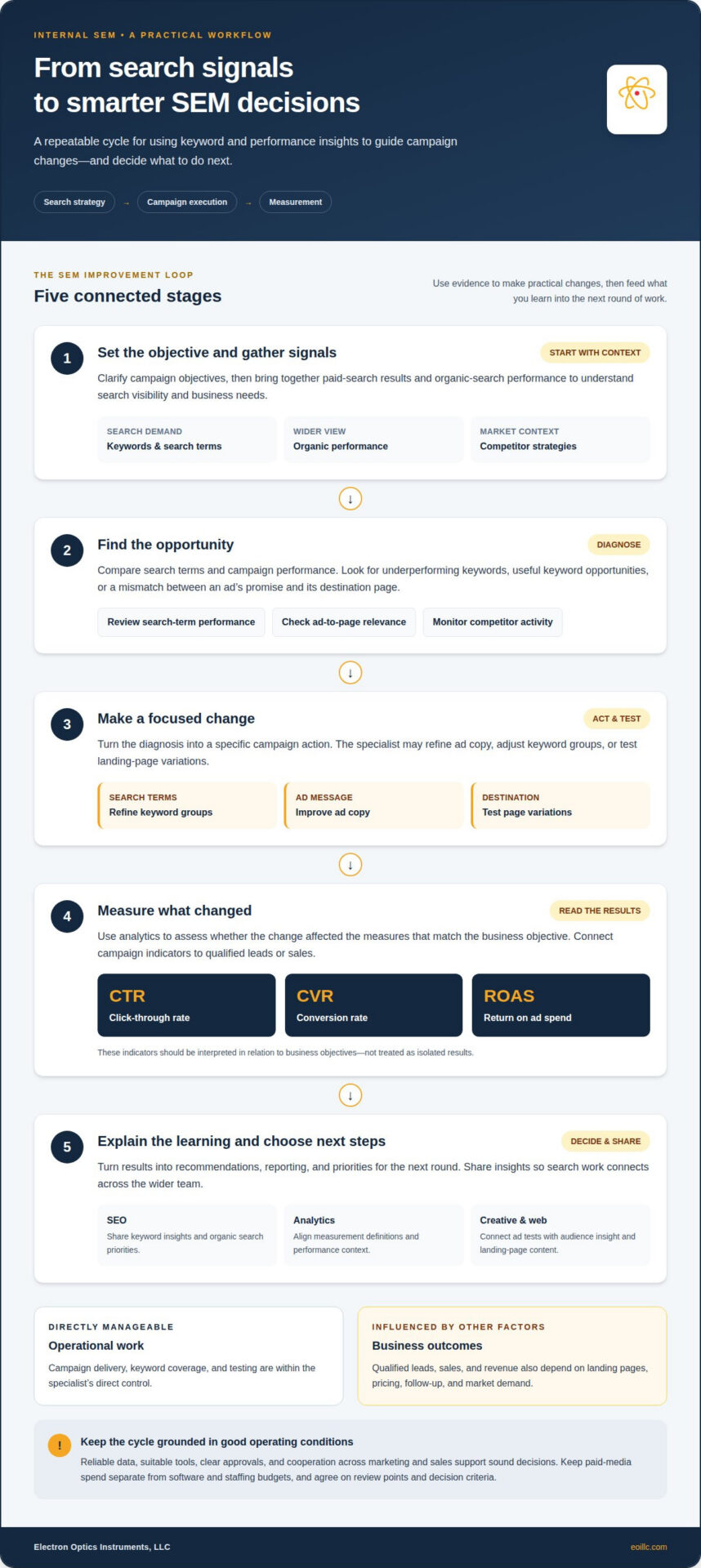
An SEM specialist uses paid-search and organic-search insights to improve search visibility and business outcomes. A generalist may cover broad marketing tasks, while a specialist focuses on search strategy, campaign execution, and measurement. The role can include keyword research, advertising, campaign testing, and analysis of paid-search results.
For example, a specialist might compare search terms, refine ad copy, and test landing-page variations. Analytics can show whether those changes affect click-through rates, conversion rates, or return on ad spend (ROAS). Competitive analysis tools can also help identify keyword and advertising strategies worth monitoring.
What is the cost of hiring an in-house SEM specialist versus an agency? A dedicated SEM generalist in a mid-sized U.S. market typically commands a competitive salary, whereas agency fees depend on scope and account needs, so compare the work covered, reporting, and media management responsibilities.
What tools and budget does an internal SEM team need? Plan for Google Ads or Bing Ads, analytics software, reporting, and competitive analysis tools. Keep paid-media spend separate from software and staffing budgets, then allocate each according to campaign objectives and measurement needs.
How do you hire or develop an internal SEM expert? Set the role’s priorities, assess practical campaign examples, and test how candidates interpret performance data. Support development with supervised campaign work, structured reviews, and continued learning as platforms change.
What KPIs should an internal SEM expert track? Match measures to business objectives. Track click-through rate, conversion rate, and ROAS, and relate them to qualified leads or sales. Organic search performance can provide additional context about search demand and visibility.
What are the risks of relying on a single internal SEM expert? One specialist can become a bottleneck for campaign decisions, reporting, and platform knowledge. Document workflows, share account access appropriately, and make performance context accessible to reduce disruption when priorities shift.
How should an internal SEM expert collaborate with SEO, analytics, and creative teams? Share keyword insights with SEO, align measurement definitions with analytics, and give creative teams relevant audience and performance findings. Shared briefs and regular reviews connect ad tests with landing-page content and organic search priorities.
Education and experience requirements
Employers commonly seek a bachelor’s degree and one to two years of relevant experience for an SEM specialist. Marketing, business, communications, and related disciplines can provide a useful foundation, but a degree title alone doesn’t demonstrate search engine marketing ability. Candidates should explain how they apply keyword research, campaign structure, and performance analysis to real business objectives.
Experience thresholds vary by role. Some job descriptions request 2+ years managing paid search campaigns, while others consider candidates with less experience and strong practical evidence. Look for work with Google Ads or Bing Ads, such as organizing ad groups, refining search terms, or interpreting conversion data. Ask candidates to explain their decisions, not only list platforms used.
A portfolio makes a candidate’s experience easier to assess. It might include campaign plans, anonymized reports, ad examples, or a written account of a testing decision. Ask the candidate to connect each example to its objective, data, action, and learning. For instance, can they explain why a keyword group changed after reviewing search-term performance? Clear reasoning matters more than impressive-looking screenshots.
Technical fluency also supports effective search marketing. A specialist should understand basic HTML and CSS and how page structure can affect the landing-page experience. Ask how they would identify a mismatch between an ad’s promise and its destination page. A strong answer should show how they would work with web and content teams, rather than treating advertising and the website as separate tasks.
During interviews, ask candidates to review your current SEM activity and competitor landscape, then discuss a relevant opportunity. Request a specific example of a campaign challenge and how they used analytics to respond. Certifications can indicate continued learning and familiarity with platform features, but should complement demonstrated experience. Use a focused development plan to address gaps in organic search, reporting, or campaign execution.
Setting realistic expectations
A first in-house SEM hire should manage paid campaigns, interpret organic performance, produce basic reporting, and brief business leaders. Define these responsibilities before setting targets. The specialist’s ability to influence results depends on access to reliable data, suitable tools, clear approvals, and cooperation across marketing and sales.
Separate operational goals from business outcomes. Campaign delivery, keyword coverage, and testing are within the specialist’s direct control. Qualified leads, sales, and revenue also depend on landing pages, pricing, follow-up, and market demand. Measure both activity and impact with indicators such as click-through rate, conversion rate, and return on ad spend.
Search visibility improves through ongoing optimization, not a single campaign adjustment. A specialist can identify underperforming keywords, test ad variations, and recommend landing-page changes. No SEM expert should promise that a website will reach the top of search results. Instead, agree on review points, decision criteria, and the evidence that will guide changes to priorities.
Plan team development as an operating transition. Most businesses take 12 to 24 months to move from their first SEM hire to a functioning department with defined roles, documented processes, and reliable performance data. During that period, record campaign settings, reporting definitions, and approval paths so institutional knowledge does not remain with one person.
Set expectations in stages, then review progress against the same objectives:
- Initial scope: document account access, campaign ownership, and existing measurement practices.
- Operating rhythm: establish recurring performance reviews and a process for prioritizing optimization tests.
- Growth decisions: use accumulated data to identify where additional channel specialists or resources would contribute.
Align visibility targets with the company’s commercial priorities. If the objective is qualified demand, assess whether search traffic produces relevant inquiries, not merely more visits. A written scorecard gives leadership and the specialist a shared basis for decisions, while leaving room to revise tactics as campaign evidence develops.
Questions to ask candidates
Use the interview to test reasoning, not just platform vocabulary. Ask each candidate to describe a search-marketing decision, the evidence behind it, and what they learned. A strong response connects research, campaign choices, and business objectives without promising a particular ranking.
- “How would you assess our paid search account?” Listen for a clear review of campaign structure, search terms, ad relevance, landing pages, and conversion tracking.
- “Tell me about a campaign that underperformed.” Ask what the candidate examined first, which changes followed, and how results informed the next decision.
- “How do you prioritize keywords?” Look for reasoning about search intent, relevance, competition, and the organization’s goals, not just search volume.
- “How would you test an ad or landing page?” A useful answer identifies one change, a measurable outcome, and how the result would guide later optimization.
- “How do paid search and search engine optimization work together?” Strong candidates explain how search-term insights can inform organic content, while keeping paid and organic objectives distinct.
Present a sample report with click-through rate, conversion rate, and return on ad spend. Ask the candidate to identify a concern and recommend a next step. This exercise shows whether they can interpret analytics, distinguish a symptom from a cause, and explain trade-offs to colleagues outside digital marketing.
Ask how candidates communicate with creative and analytics teams. What would they include in a brief for new ad copy, and how would they align conversion definitions? Their response should outline a practical process for sharing campaign evidence and coordinating changes.
Invite candidates to review your current search presence and competitor activity before the interview. Ask them to present an opportunity and an open question. This format reveals preparation and judgment without requiring access to confidential account data.
To connect search strategy with the equipment behind materials analysis, explore SEM systems.
Electron Optics Instruments: Cube II Benchtop SEM
Electron Optics Instruments offers the Cube II Benchtop SEM for organizations developing in-house scanning electron microscopy capabilities. An internal SEM expert needs suitable instrumentation for the organization’s research or industrial analysis workflows, so equipment selection should reflect intended applications and operational requirements.
The Cube II is one option alongside the Genesis Tabletop SEM and Veritas Series SEM. These instruments can help your team evaluate how SEM fits into its work. A specialist can help guide how the organization uses SEM, including its procedures and interpretation of results.
If SEM equipment is part of your internal capability plan, contact Electron Optics Instruments to discuss the Cube II Benchtop SEM or visit eoillc.com.
Build the Next Stage of Your SEM Capability
Developing an internal SEM expert is more than a hiring decision. It means creating the conditions for specialist knowledge to be applied consistently. Connect the role’s remit to your equipment, workflows, and analytical needs. That alignment can help make specialist knowledge more useful across the organization and clarify how SEM supports research or industrial objectives.
Define the work the specialist will support and identify the instrumentation that fits those requirements. Consider how microscopy will integrate with existing processes, who will interpret the data, and how the work connects to wider organizational priorities. A considered equipment decision can support the expert’s contribution from the outset.
For a discussion about SEM equipment as part of your internal capability planning, contact Electron Optics Instruments. Take the next step with a clear view of the work your team needs to accomplish.
Frequently Asked Questions
What is an SEM specialist?
An SEM specialist plans and evaluates how a business reaches audiences through search engines, combining knowledge of organic and paid search. The role involves interpreting search behavior and connecting it to useful actions, such as refining an ad or improving a landing page. When developing an internal SEM expert, look for specialized search judgment, not just familiarity with digital marketing platforms.
How else can someone prepare to become an SEM specialist?
Build practical experience with a portfolio that explains campaign objectives, decisions, and outcomes while protecting confidential account details. Practice interpreting sample performance data and describing a sensible optimization. Candidates can follow platform updates, pursue relevant certifications, and build relationships with digital marketing professionals. A brief analysis of a prospective employer’s search presence can also demonstrate research skills and clear communication.
How long does it take to build a fully functional in-house SEM team?
Most businesses take 12 to 24 months to develop from an initial SEM hire into a functioning department with defined roles, documented processes, and reliable performance data. Progress depends on how quickly the organization establishes measurement, decision rights, and repeatable campaign workflows. A practical sign of maturity is that another team member can understand the reporting and follow documented processes without relying on informal handovers.
What should the first in-house SEM hire be able to do?
The first hire should manage paid-search campaigns, interpret organic performance data, produce basic reporting, and communicate findings to business leaders. That means explaining why a campaign change is proposed and what evidence will inform the next decision. During onboarding, provide access to business objectives and existing measurement definitions so reports can guide decisions, not merely describe activity.
What skills are required for an SEM specialist role?
An SEM specialist needs analytical judgment, keyword research skills, campaign-management capability, and clear communication. Basic HTML and CSS knowledge helps when assessing landing-page structure, while testing skills support disciplined comparisons of campaign changes. Competitive analysis and an understanding of organic search add useful context. A strong candidate can explain how data shaped a recommendation, not just list tools they have used.
What does an internal SEM expert do?
An internal SEM expert turns search data into coordinated marketing decisions. They may identify a search-query trend, assess whether it belongs in paid campaigns or organic content, and share the finding with relevant colleagues. The role also involves organizing workflows and keeping a clear record of changes. This continuity helps the organization apply learning across campaigns instead of treating each adjustment as an isolated task.