
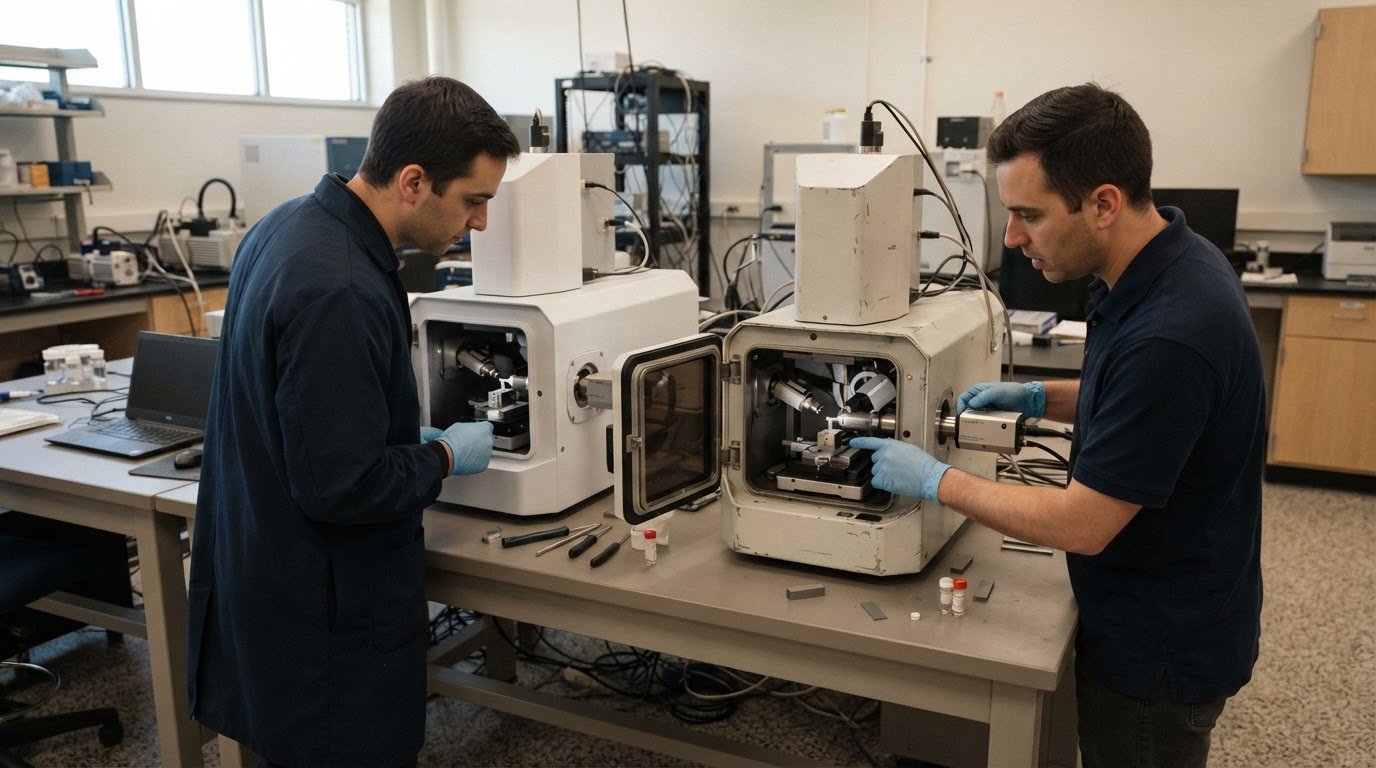
The newest system isn’t automatically the best fit. Choosing between a new and refurbished EDS system depends first on warranty and service coverage, then on budget, application fit, and installation timing. Refurbished equipment may include a warranty, while privately sold used equipment is typically sold as-is; a new system is the clearer choice when having the latest sealed model matters more than budget flexibility.
Reliability and support matter whichever option you choose. Purchase status alone does not determine how well a system will serve your lab: application suitability, maintenance, and access to service all play a part.
This guide explains how to compare warranty and service terms, assess the overall budget, and weigh availability against installation timing. It also provides a practical decision guide to help you identify which option better aligns with your requirements and the role the EDS system will play in your work.
Key Takeaways
- Compare warranty and service coverage, not just whether a system is new or refurbished, to understand the support available after purchase.
- Align the system’s analytical capabilities and maintenance needs with your applications and long-term budget priorities.
- Factor equipment availability and installation timing into the decision, especially when your work depends on a defined operational schedule.
- Assess refurbished options as a route to lower acquisition costs, while weighing the value of a new platform against your requirements.
Business considerations and budget flexibility
When choosing between a new and refurbished EDS system, begin with the work it must support. A university lab conducting scheduled materials studies may prioritize acquisition cost, while a production facility may place greater weight on continuity and serviceability. Refurbished equipment can make established microscopy capability more accessible and leave budget for other operational needs.
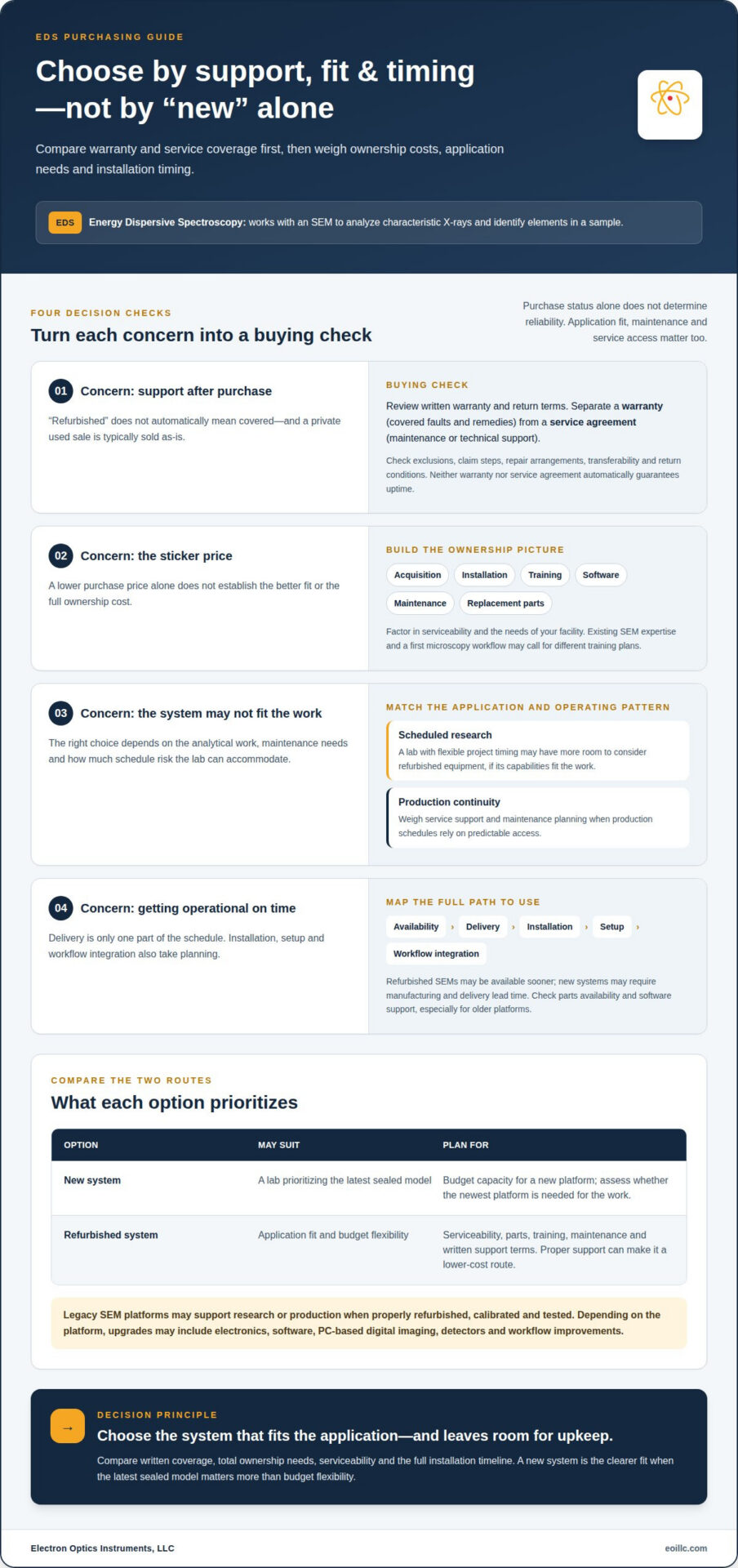
Build your budget around the full ownership picture. Account for acquisition, installation, training, software, maintenance, and replacement parts relevant to your operation. A facility with existing SEM expertise, for example, may have different training needs from a startup establishing its first microscopy workflow. Serviceability and maintenance also affect ownership costs, so a lower purchase price alone does not establish the better fit.
Risk tolerance depends on how the instrument supports daily work. If production schedules rely on predictable access, weigh service support and maintenance planning alongside the purchase. A research group with flexible project timing may have more room to consider refurbished equipment, provided its capabilities fit the imaging and analytical work.
A sound decision also considers the upgrade path. Older SEMs can be upgraded with electronics, software, PC-based digital imaging, detectors, and workflow improvements, depending on the platform. Focus on the upgrades your applications need. A new system is a better fit when you want the latest sealed model and budget is not the deciding factor.
| Option | Budget fit | Priority it supports | Planning consideration |
|---|---|---|---|
| New system | Requires budget capacity for a new platform | Latest sealed model | Assess whether the newest platform is necessary for the work |
| Refurbished system | Can offer a lower total cost of ownership when properly supported | Application fit and budget flexibility | Include serviceability, parts, training, and maintenance in ownership planning |
Choose the option that meets your application requirements while leaving room in the facility budget for maintenance and day-to-day operations.
Does the equipment come with a warranty or service agreement?
Warranty and return terms vary by system and sale. Distinguish professionally refurbished equipment from a private used sale, which is typically sold as-is. Before purchasing, review written coverage, including what it covers and the process for service or repairs.
EDS means Energy Dispersive Spectroscopy. An EDS system works with a scanning electron microscope (SEM) to analyze characteristic X-rays and identify elements in a sample. An X-ray detector and analysis software work together to support elemental imaging and interpretation.
For refurbished models, distinguish a written warranty from a service agreement. A warranty defines covered faults and remedies during its term; a service agreement describes maintenance or technical support. Neither automatically guarantees uptime. Review exclusions, claim procedures, repair arrangements, and whether coverage transfers with ownership.
Return terms matter because an inspection or repair may not resolve every application mismatch. Review the return period, condition requirements, and transport responsibilities. A laboratory relying on routine elemental analysis, for example, may place greater value on access to technical support than a buyer using the system occasionally.
Accidental damage protection is separate from warranty coverage. A warranty may cover specified equipment faults, while damage from impact or mishandling may be excluded. Review the written coverage and service process. A successful initial imaging test does not establish future uptime or protection from every failure.
Financing, tax treatment, and regulatory requirements for U.S. purchases depend on the transaction, buyer, and intended use. Include payment terms in your purchasing plan, and have your organization’s finance and compliance teams assess the circumstances that apply.
Compare options by documenting the warranty term, covered components, service responsibilities, return conditions, and payment schedule. This clarifies the differences between new and refurbished equipment without treating a warranty as a replacement for maintenance planning.
Availability and installation timelines
Refurbished SEMs may be available sooner than new systems, which can require manufacturing and delivery lead time. Performance, reliability, and lifespan depend on application fit, refurbishment, calibration, testing, and ongoing support, not simply on whether a system is new.
Acquisition and Delivery Lead Times
A refurbished system may already be available, shortening the path from purchase to installation. A new system may need to move through production and delivery. This difference matters when a diagnostic project or production schedule has a near-term start. Plan the full sequence, including delivery, installation, setup, and workflow integration, rather than treating shipping as the last step.
Parts Availability and OEM Support
Parts access and manufacturer support affect how readily a system can return to operation after a component issue. For an older platform, replacement-part availability and software support are practical considerations alongside initial availability. A newer model may have a more direct support path, while a refurbished system’s suitability depends on its configuration and serviceability. Include these factors in continuity planning for research or production.
Age alone does not determine imaging performance or useful lifespan. Legacy SEM platforms can serve research and production environments when properly refurbished, calibrated, and tested. For example, a refurbished platform tested for its intended workflow may suit a facility’s diagnostic requirements better than a newer system with capabilities the team does not need.
Before setting an installation date, map the steps from equipment availability through facility readiness and integration. Align the planned workflow, operator training, and supporting parts with the system configuration. Faster availability is valuable only when installation and replacement planning also support the facility’s operational needs.
Cost savings when buying used or refurbished
Refurbished SEMs can provide imaging and analytical capability at a lower acquisition cost than new systems. The difference may leave budget for other operational priorities, but purchase price is only one part of the investment. Compare each option with the work it must support and the resources needed to keep that workflow productive.
Buying new makes sense when access to the latest sealed model is essential and budget is not the deciding factor. For example, a facility whose specifications require a new platform may gain more from that fit than from a lower-cost system that cannot support its workflow. There is no general rule that one option always costs less over time.
For a refurbished system, consider how its refurbishment, testing, and support affect ownership. A properly supported refurbished SEM may offer a lower total cost of ownership, while serviceability, replacement parts, training, and maintenance also influence long-term expenses. Weigh these factors to distinguish a practical investment from a purchase that saves initially but constrains the workflow.
Use a consistent comparison process. First, define the imaging and analytical tasks. Next, identify the platform capabilities they require. Then compare acquisition and ownership needs for both options, including maintenance planning. A research team with established SEM workflows may find a refurbished platform suitable, while a facility that requires the latest sealed model may prioritize new equipment.
Match system capability to actual use rather than paying for features your workflow will not use. Properly refurbished legacy platforms can continue serving research and production when calibrated and tested for their intended applications. Refurbished equipment is worth considering when capability, support, and budget align.
To assess the right investment for your workflow, review EDS system options alongside your application and ownership requirements.
Electron Optics Instruments: Refurbished SEM Units
Electron Optics Instruments offers refurbished SEM units for buyers evaluating a lower-cost route to scanning electron microscopy. This option may suit facilities whose application requirements align with a refurbished system and whose priorities favor budget flexibility over the latest sealed model. The company also offers the Cube II Benchtop SEM, Genesis Tabletop SEM, Veritas Series SEM, and Veritas Plus SEM to consider alongside refurbished equipment.
Use your EDS requirements, intended imaging work, and ownership priorities to frame the decision. The right fit depends on how the SEM supports your analytical workflow, not simply on whether it is new or refurbished. Contact Electron Optics Instruments to discuss your SEM requirements.
Set Your EDS Investment Up for the Next Stage
Your decision should support more than the immediate purchase. Consider how your analytical requirements may develop, how the system will fit into existing workflows, and what capabilities your facility may need next. A clear view of these priorities makes choosing between a new and refurbished EDS system part of a broader equipment strategy, not just a budget decision.
Electron Optics Instruments offers SEM options including the Cube II Benchtop SEM, Genesis Tabletop SEM, and Veritas Series SEM. These products provide a starting point for matching SEM selection to your facility’s imaging and analytical objectives.
Bring your application requirements and purchasing priorities into the next discussion. Contact Electron Optics Instruments for advice about the equipment options that fit your work. A considered equipment decision can help your team build a capable, sustainable microscopy workflow.
Frequently Asked Questions
Is buying used risky?
Buying used carries risk when the system’s condition, testing history, or support pathway is unclear. Professionally refurbished equipment differs from a private used sale: refurbishment involves inspection, testing, and necessary restoration. A lab planning routine elemental analysis, for example, should consider whether the system’s tested configuration suits the workflow, not just its purchase condition.
So which should you buy?
Buy new when your work requires the latest sealed model and your budget supports that priority. Choose refurbished when its tested capabilities fit your applications and budget flexibility matters more. A facility with established SEM workflows may value a suitable refurbished platform, while a lab building around newer capabilities may prioritize a new system. Match the choice to required performance and operating plans.
How much does a new EDS system cost compared with a refurbished one?
Pricing depends on the system and its configuration. Factors include the SEM platform, EDS configuration, installation requirements, and support needs. Refurbished SEMs can provide imaging and analytical capability at a lower acquisition cost than new SEMs, but compare total ownership needs rather than treating purchase price as the complete investment.
What warranty and service coverage do refurbished EDS systems typically include?
Refurbished equipment may be sold with warranty coverage and return options, but the terms vary by system and sale. Coverage can define remedies for specified faults, while service agreements may address maintenance or technical support. For a lab relying on scheduled sample runs, distinguish coverage for equipment failure from planned maintenance, and note any exclusions or return conditions in the purchase documentation.
What should buyers check when evaluating a refurbished EDS system?
Assess whether the system’s configuration supports your samples, analysis workflow, and intended SEM platform. Review refurbishment and functional-testing records, calibration status, included EDS detector and software, and relevant replacement-part availability. A team analyzing a particular class of materials should confirm that the system can perform the required elemental analysis before purchase.
Are refurbished EDS systems eligible for manufacturer support, software updates, or spare parts?
Support access depends on the manufacturer, model, and system configuration, not refurbished status alone. Older SEM platforms may be upgraded with electronics, software, PC controls, detectors, and workflow improvements, depending on the platform. If a system depends on a specific software environment, consider its update and parts pathway when planning the lab’s operating life.