
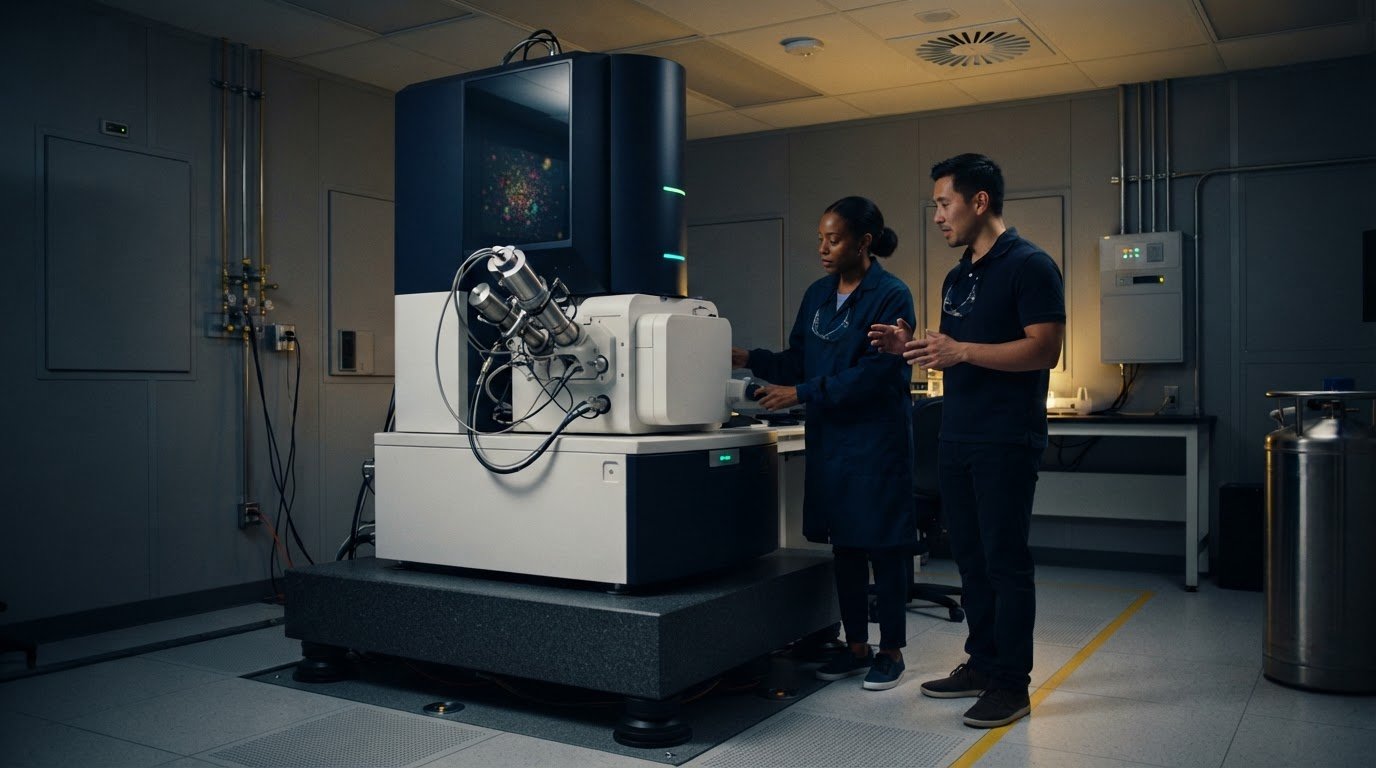
An SEM doesn’t automatically need an ISO-classified cleanroom. The right cleanroom requirements for SEM depend on the instrument, the imaging goals, and the manufacturer’s installation specifications. Assess those factors before investing in a highly controlled space, so facility changes address real requirements rather than assumptions.
Vibration, temperature fluctuations, and electromagnetic interference can affect image quality, but particle cleanliness is only one part of facility readiness. A cleanroom classification alone doesn’t establish that a room meets an SEM’s environmental requirements. Those requirements can also vary between benchtop and larger systems, making documentation for the specific instrument essential.
This guide explains which environmental factors to assess, when a cleanroom may be justified, and how to evaluate a potential SEM location. Use it to compare facility conditions with instrument requirements, plan for installation, and avoid common gaps such as overlooking delivery access or sample handling. The goal is a room suited to the work and the equipment, not a classification chosen by default.
Key Takeaways
- Cleanroom requirements for SEM depend on the instrument and application. An ISO classification isn’t an automatic installation requirement.
- Assess temperature stability, vibration, electromagnetic interference, and airborne contamination against the specific SEM’s documentation.
- Compare a controlled cleanroom with a well-managed standard laboratory before committing to facility changes.
- Review room access, delivery routes, utilities, environmental conditions, and safe operating space before installation.
- Include benchtop and tabletop SEMs in facility planning. Review each system’s installation requirements rather than assuming its format removes them.
Do SEMs Require a Cleanroom? Separate Instrument Needs from Cleanroom Classification
A cleanroom classification isn’t automatically required for every SEM installation. The right room depends on the microscope’s design, its intended application, the samples being examined, and the environmental conditions at the facility. A standard laboratory may be suitable when it meets the instrument’s documented operating requirements and the workflow doesn’t call for classified particle control.
A cleanroom controls environmental conditions, including airborne particle levels, to meet defined criteria. Its classification must be specified and verified. Calling a room “clean” doesn’t establish that it meets a particular class. The Cleanroom overview provides background on cleanroom applications and classification. For formal planning, ISO 14644-1 is a relevant framework for classifying air cleanliness by particle concentration. Confirm the applicable standard and requirements for the project.
SEM environmental control and cleanroom classification are related, but they aren’t interchangeable. Classification addresses airborne particle concentration. It doesn’t demonstrate that a room meets an SEM’s requirements for stability or that samples are protected from every source of contamination.
What does cleanroom classification mean for an SEM laboratory?
A classification describes airborne particle levels under defined conditions. It isn’t a general rating of how suitable a room is for microscopy. SEM performance may also depend on environmental factors that particle classification doesn’t measure. The use of an SEM alone therefore doesn’t establish a required ISO class. Determine whether particle limits apply to the room, sample handling, or both, then identify the criteria and assessment method relevant to that workflow.
When might an SEM workflow need a classified cleanroom?
Stricter particle controls may be appropriate when a process requires samples or components to remain within a specified cleanliness condition. For example, work involving contamination-sensitive materials may require controlled handling and storage, even if the microscope itself doesn’t require a classified room. These are separate considerations: the sample process sets contamination-control needs, while the instrument documentation sets operating-environment requirements. Check industry-specific classification requirements against applicable standards and process documentation.
Separate these requirements before planning the space. A sample may need protection from particles during preparation, transfer, or storage, while the SEM may need particular operating conditions for reliable imaging. A classified room doesn’t automatically resolve every issue that can affect instrument performance. Avoid assigning a class just because electron microscopy will take place there.
For practical planning, record the workflow’s cleanliness objectives and the instrument’s specified environmental conditions as separate items. Compare each with measured facility conditions and applicable documentation. This helps determine whether the laboratory needs a classified cleanroom, targeted controls around sample handling, or a suitable standard room. It also prevents cleanroom classification from being used as a substitute for instrument-specific planning.
SEM Room Environmental Requirements: Stability, Vibration, and Interference
Assess an SEM room for more than cleanliness. Temperature variation, vibration, electromagnetic interference, humidity, and airborne contamination can affect the instrument, sample, or workflow in different ways. Sensitivity depends on the system and imaging task, so start facility planning with the selected SEM’s installation documentation rather than a generic room specification.
Determine acceptable environmental conditions from the selected SEM’s manufacturer documentation, then compare them with measured conditions at the proposed location. Built-in isolation or protection features may help manage certain influences, but they don’t establish that every room is suitable or remove the need to assess the installation site.
How can vibration and electromagnetic interference affect SEM operation?
Vibration can appear as image movement, instability, or reduced detail, particularly when imaging fine features. Potential sources include nearby machinery, elevators, foot traffic, and vibration transmitted through the building structure. Electromagnetic interference from electrical equipment or other systems may also introduce image artifacts or instability, depending on the instrument and operating conditions.
During a site assessment, note when and where these conditions occur. Record nearby equipment and building activity, and note any changes observed during normal operation. These observations provide useful context for comparing the site with the selected SEM’s specifications. They don’t replace instrument-specific measurements or acceptance criteria.
Which temperature, humidity, and cleanliness conditions should be assessed?
Review temperature stability over the periods when the SEM will operate, not just the room’s set point. HVAC cycles, direct sunlight, or nearby heat-generating equipment may cause local or time-dependent variation. Compare humidity with the manufacturer’s stated operating range, since acceptable conditions differ across models. Don’t assume a specification for one SEM applies to another.
Assess routine dust and contamination risks, including how samples are prepared, transferred, and stored. General room housekeeping and sample-process controls serve different purposes. A laboratory can be maintained for routine instrument use while a particular preparation or production workflow requires more stringent contamination control.
- Temperature: Check for fluctuations, drafts, sunlight, or localized heat near the planned instrument position.
- Humidity: Compare expected room conditions with the operating range in the applicable manufacturer documentation.
- Vibration and interference: Document nearby sources and observed changes for technical review.
- Dust and contamination: Identify whether controls are needed for the room, sample handling, or both.
Consider these factors together rather than treating them as independent boxes to check. A benchtop SEM may have instrument-level design features intended to support operation in a laboratory environment, but its installation requirements still need review. Connecting room observations with the chosen system’s documentation during SEM installation planning helps turn environmental concerns into practical readiness decisions.
Cleanroom vs. Standard Laboratory for SEM: Compare the Requirements Before Building
Choosing between a classified cleanroom and a standard laboratory is a facility decision, not a shortcut to better SEM images. A well-managed laboratory may suit an instrument and application when measured conditions meet the manufacturer’s requirements and the workflow doesn’t require classified particle control. A cleanroom may be justified when documented sample, product, or process requirements call for it. Neither room type guarantees image quality or instrument performance.
Decision rule: select the room based on documented instrument and process requirements, then verify that the facility can meet them. Before planning construction or operational changes, compare what each environment is designed to control.
| Consideration | Standard laboratory | Classified cleanroom |
|---|---|---|
| Cleanliness control | Housekeeping and local procedures support routine cleanliness. Airborne particle levels may not be classified. | Particle levels are controlled to a defined classification and require appropriate verification. |
| Environmental monitoring | Monitoring can focus on the SEM’s specified operating conditions and observed room stability. | Monitoring includes particle-control criteria alongside instrument-specific environmental checks. |
| Operational complexity | Procedures generally focus on instrument care, room use, and sample handling. | Entry, conduct, cleaning, and monitoring procedures may be more extensive to maintain controls. |
| Workflow fit | Can suit workflows without a documented need for classified cleanliness. | Can support processes or sample handling that require controlled airborne contamination. |
What can a standard SEM laboratory provide?
A standard laboratory can support SEM work through consistent housekeeping, suitable utilities, controlled access, and monitoring of conditions relevant to the selected instrument. These measures help teams notice changes and maintain orderly sample handling, but they don’t create a cleanroom classification. Suitability depends on actual site conditions, instrument specifications, and the work being performed. Don’t assume the same room is suitable for every SEM or application.
When does a cleanroom add value to SEM work?
A classified space adds value when a documented process, sample, or product requirement calls for defined airborne-particle control. For example, a contamination-sensitive workflow may require controlled handling beyond routine laboratory housekeeping. That cleanliness objective is separate from vibration, electrical, and temperature-control needs, which require their own assessment. Verify any required classification against project documentation and the instrument’s installation requirements.
Use the comparison to distinguish a process requirement from a perceived instrument requirement. If a sample must remain in a controlled cleanliness environment during preparation or handling, determine where that control applies and whether it must continue through microscopy. If the concern is instrument stability, a particle classification alone may not address it. This helps prevent specifying a cleanroom for the wrong reason or overlooking another facility condition.
Translate cleanroom requirements for SEM into separate, verifiable criteria: the microscope’s documented operating conditions, the application’s cleanliness needs, and the room’s measured ability to support both. Benchtop, tabletop, and larger SEM formats all warrant review against their own installation documentation. Decide on the room after aligning those requirements, rather than treating a standard laboratory or classified cleanroom as a universal solution.
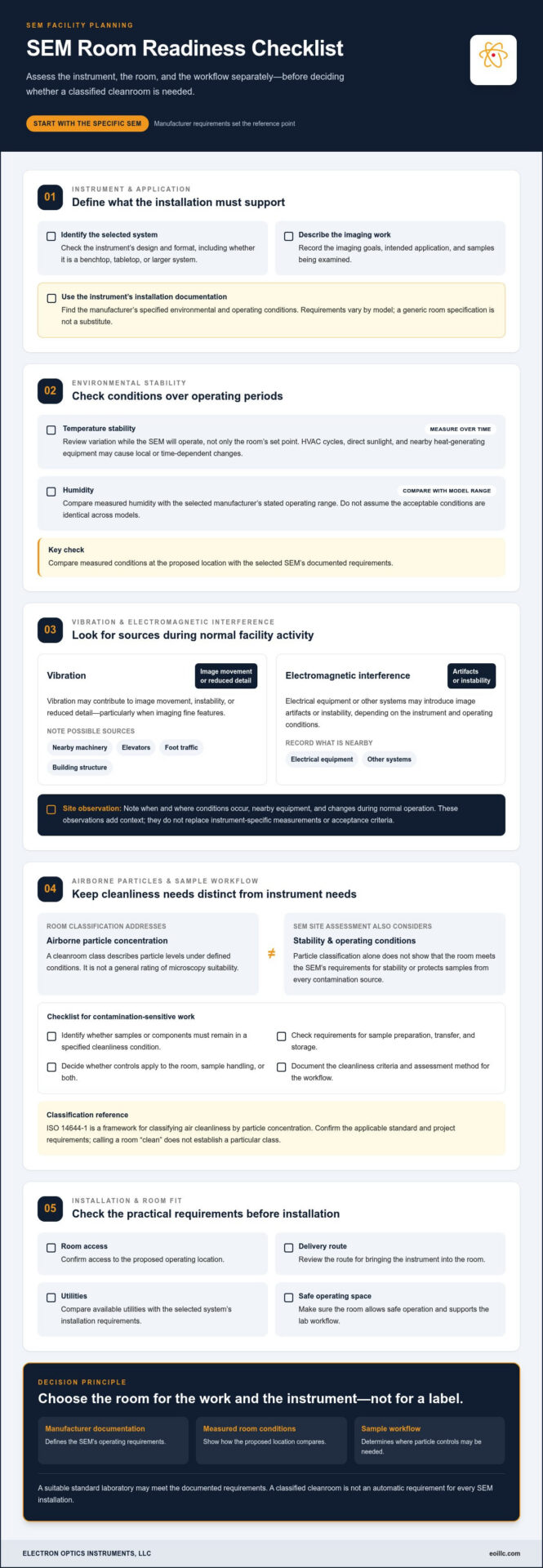
SEM Facility Readiness Checklist: Assess the Room Before Installation
A structured readiness review connects instrument documentation with laboratory conditions before delivery. It can reveal access constraints, utility gaps, or environmental issues while there’s still time to address them. Use this sequence to organize the assessment and align installation, relocation, and operating checks.
What should the laboratory document before SEM installation?
Start with the exact SEM model and its installation documentation. Record the proposed location, room layout, delivery route, available utilities, sample workflow, and any separate cleanliness or contamination-control needs. Compare measured site conditions with the manufacturer’s model-specific requirements. Don’t rely on assumptions based on another instrument or a general cleanroom designation.
- Gather requirements. Collect the selected instrument’s installation documents. Identify the room, utility, access, and operating-environment requirements that need evaluation.
- Map access and delivery. Trace the path from receiving point to final position. Note doorways, corridors, turns, thresholds, elevators, and other potential obstructions. Allow space to maneuver and position the instrument safely.
- Review the proposed location. Document the room layout and confirm there’s adequate space for operation, installation and maintenance access, and safe movement by laboratory staff.
- Record utility availability. Note the electrical and other facility connections at the intended location, then compare them with the instrument documentation. Don’t assume existing connections meet requirements.
- Observe environmental conditions. Record temperature or humidity variation, vibration, nearby electrical equipment, and other potential disturbances. Compare measured conditions with the selected model’s documented limits.
- Map the sample workflow. Follow samples from preparation and storage through transfer and imaging. Identify whether contamination controls apply to the room, a specific handling step, or the sample itself.
- Resolve gaps before delivery. Document conditions that need technical review or facility coordination, and address them before the instrument arrives rather than relying on adjustments after placement.
How should the room be checked after SEM installation?
Installation doesn’t end when the instrument is positioned. Confirm that setup, calibration, and system checks follow the applicable manufacturer procedures, then document baseline operating conditions and observed environmental issues. Include staff orientation and training in the laboratory handover so operators understand routine use, sample handling, and how to report changes that could affect operation.
For a relocation, repeat the readiness review at the destination rather than assuming the previous room’s assessment still applies. A new route, utility arrangement, or surrounding equipment can change the installation context. Coordinate SEM installation and relocation support as part of the facility plan so instrument handling and post-installation checks are considered together.
Plan SEM Cleanroom Requirements Around the Instrument and Your Lab Workflow
A sound facility decision brings together three inputs: the selected SEM’s installation specifications, the application’s requirements, and measured conditions in the proposed room. This sequence helps distinguish a documented need for environmental control from an assumption based on instrument type or laboratory convention. It also gives the team a practical basis for selecting a location and preparing for installation.
Start by translating each input into a planning question:
- Instrument: What room conditions, utilities, access, and operating clearances does the manufacturer specify?
- Application: Do sample preparation, handling, or analysis workflows have defined cleanliness or contamination-control needs?
- Facility: Do observations and measurements show that the proposed location can support those requirements?
How should SEM format influence facility planning?
Compare formats by the questions they raise, not by assuming one is easier to accommodate. Consider footprint, delivery route, utility connections, operating access, and the conditions required by each model. A smaller physical footprint doesn’t establish environmental suitability. Electron Optics Instruments, LLC offers the Cube II Benchtop SEM as one system to evaluate alongside other SEM formats, with its installation documentation guiding the facility review.
Teams considering benchtop systems can also explore desktop SEM evolution as part of their instrument-planning research. Regardless of format, base the room decision on the selected system’s documentation and the laboratory’s actual workflow, not generalized expectations about benchtop or floor-standing equipment.
How can technical support help prepare an SEM laboratory?
Installation and relocation support can help coordinate instrument handling, setup, and post-move system checks within the facility plan. Preventative maintenance supports ongoing equipment care, while on-site training helps staff build familiarity with operation and laboratory procedures. These services complement, but don’t replace, the review of room conditions and model-specific requirements.
Before finalizing a location, bring the instrument specifications, application needs, and site observations into one readiness record. Note open questions, how they’ll be evaluated, and who is responsible for resolving them before delivery. This keeps cleanroom requirements for SEM tied to evidence and workflow rather than treating an ISO classification as a default prerequisite.
Electron Optics Instruments, LLC supports laboratory teams with SEM selection, installation, relocation, preventative maintenance, and on-site training. Explore SEM equipment and support to plan the next steps around your instrument and operating needs.
Move from Facility Assessment to SEM Selection
Turn room observations into a practical instrument and readiness plan. Match the application’s needs with measured facility conditions and the selected SEM’s installation documentation. This gives your team a basis for deciding whether targeted adjustments are sufficient or a classified environment is justified, while keeping cleanroom requirements for SEM tied to evidence rather than assumption.
Electron Optics Instruments, LLC brings more than 30 years of electron microscopy experience to SEM selection and laboratory readiness. Its range includes the Cube II Benchtop SEM and additional systems for research and industrial applications. Installation, relocation, preventative maintenance, and on-site training can support the instrument through setup and ongoing operation.
Build a facility plan that serves the work without adding controls your application doesn’t require. Explore SEM systems and technical support from Electron Optics Instruments, LLC as you plan your laboratory’s next step. Align the instrument, workflow, and room to prepare your team for installation.
Frequently Asked Questions
Does an SEM need to be installed in a cleanroom?
No, an SEM doesn’t automatically need a classified cleanroom. The cleanroom requirements for SEM depend on the specific instrument and whether the sample or process requires controlled particle levels. For example, a workflow may need clean handling during sample preparation even if the microscope’s installation criteria don’t call for a classified room. Keep those needs distinct, then assess the instrument documentation and the requirements of the work.
What temperature and humidity does an SEM laboratory require?
There isn’t one temperature or humidity range that applies to every SEM. Use the operating limits in the documentation for the exact model, and consider whether conditions remain stable during normal laboratory activity. A room’s thermostat setting, for example, may not capture local changes near an exterior wall, window, or heat-producing equipment. Record relevant fluctuations and compare them with the instrument’s stated requirements before installation.
Can vibration affect SEM image quality?
Yes. Vibration can contribute to image movement or instability, with the effect depending on the microscope, imaging conditions, and vibration source. If images appear less stable during nearby equipment operation or building activity, note when the change occurs and whether it is repeatable. Those observations can help distinguish a possible environmental influence from an instrument or sample issue, but they don’t establish a universal vibration threshold.
Does an SEM require a special floor or vibration isolation?
Not every SEM installation requires a special floor or separate vibration isolation. Floor loading, instrument supports, and isolation provisions are model-specific considerations, so use the manufacturer’s installation guidance rather than assuming a reinforced base is necessary. A concrete floor, upper-level room, or shared laboratory can’t be judged on description alone. Evaluate the actual installation location and any measured vibration against the selected instrument’s requirements.
What electrical and utility requirements should an SEM room meet?
Use the instrument documentation to identify the required electrical supply and any other utilities specified for that model. Depending on the system, planning may include outlet location, circuit capacity, grounding, and the placement of connections relative to the instrument. Don’t assume that a nearby outlet or existing laboratory service is suitable. Record what’s available at the proposed position and resolve differences before delivery.
Can a benchtop SEM operate in a standard laboratory?
A benchtop SEM may be suitable for a standard laboratory if the room meets that model’s installation conditions and the application doesn’t require classified cleanliness. Its compact format alone doesn’t determine environmental suitability. A benchtop system still needs an appropriate location, utilities, and operating conditions as defined in its documentation. Evaluate the proposed bench or work area rather than treating the instrument’s size as proof that no facility review is needed.
How do I prepare a laboratory for SEM installation or relocation?
Begin with the exact model’s installation documents, then record the room layout, delivery route, available utilities, and conditions at the intended location. For a relocation, preserve relevant operating records and note changes between the original and destination rooms. Plan instrument handling, setup, and post-move system checks, then include staff orientation in the handover. SEM installation, relocation, preventative maintenance, and on-site training support laboratory readiness and continued operation.