
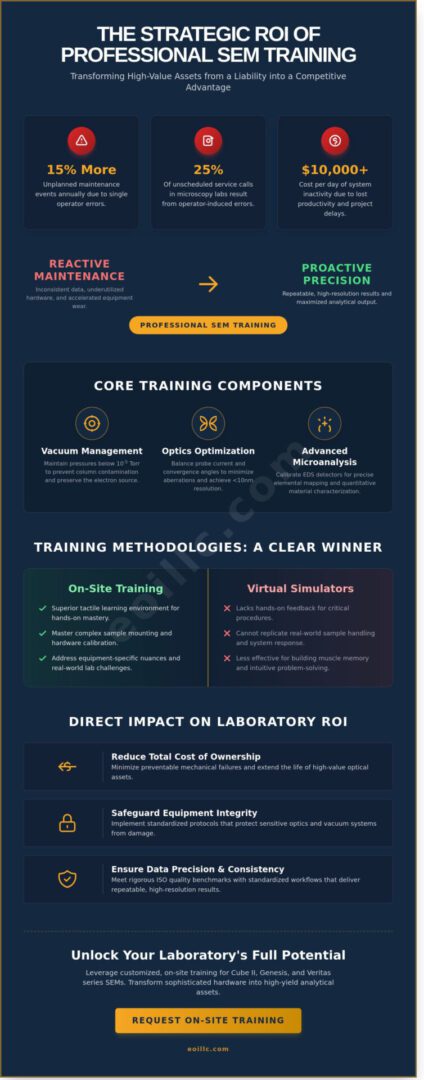
A single operator error can result in an average of 15% more unplanned maintenance events annually, according to 2023 industry benchmarks for high-precision analytical instrumentation. You recognize that maintaining the absolute integrity of your imaging results is paramount for rigorous failure analysis and sophisticated material characterization. However, the gap between basic operation and technical excellence often leads to inconsistent data and underutilized hardware. Professional sem training bridges this technical divide by instilling a standardized methodology that safeguards your hardware while maximizing total analytical output.
By investing in specialized education, you’ll discover how to transform complex instrumentation into a high-yield asset that delivers repeatable, high-resolution results across your entire team. We’ll examine the strategic integration of advanced features like Energy Dispersive X-ray Spectroscopy and the evolutionary shift from reactive maintenance to proactive precision. This overview provides a structured roadmap for establishing robust operating procedures that reduce equipment downtime and ensure your laboratory remains at the forefront of global manufacturing standards.
Key Takeaways
- Understand how specialized operator proficiency directly enhances laboratory ROI by reducing the Total Cost of Ownership through minimized service dependency.
- Master the foundational principles of electron optics and vacuum system management to ensure the long-term integrity and precision of your analytical instrumentation.
- Discover why on-site sem training provides a superior tactile learning environment compared to virtual simulators for mastering complex sample mounting and hardware calibration.
- Acquire advanced methodologies for failure analysis and material characterization to accurately identify contamination sources and fracture patterns in industrial applications.
- Leverage customized training protocols tailored for Cube II, Genesis, and Veritas series to transform sophisticated hardware into high-yield analytical assets.
The Strategic Value of SEM Training for Laboratory ROI
Professional sem training represents the critical intersection of theoretical electron optics and precise hardware mastery. It isn’t merely an orientation on equipment operation; it’s a strategic investment in the longevity of high-value optical assets. When operators possess a deep understanding of the Scanning Electron Microscope and its underlying physical principles, they transition from passive users to expert stewards of technology. This expertise directly influences the Total Cost of Ownership (TCO) by minimizing preventable mechanical failures. Industry data suggests that up to 25% of unscheduled service calls in microscopy labs result from operator-induced errors. By implementing formal education, organizations replace inefficient “tribal knowledge” with standardized protocols that safeguard equipment.
In ISO-certified environments, the precision of data is paramount. Standardized sem training ensures that every image and compositional analysis meets rigorous quality benchmarks. Without this formal structure, labs often suffer from inconsistent workflows and accelerated equipment wear. EOI LLC recognizes that technical excellence is an evolutionary process. Precision in imaging requires more than a manual; it demands a comprehensive grasp of how beam parameters affect sample interaction.
Reducing Risk and Preventing Costly Hardware Damage
Operator proficiency is the first line of defense against catastrophic system failure. Common errors, such as improper venting procedures or the introduction of outgassing samples, can contaminate the sem vacuum system or lead to premature filament burnout. In industrial R&D settings, the financial impact of downtime is severe. A single day of system inactivity can cost a facility upwards of $10,000 in lost productivity and delayed product launches. Establishing rigorous safety protocols for sample handling protects sensitive electron optics from accidental contact. These preventative measures ensure that the evolutionary potential of the laboratory remains unhindered by avoidable technical setbacks.
Maximizing the Utility of Benchtop SEM Investments
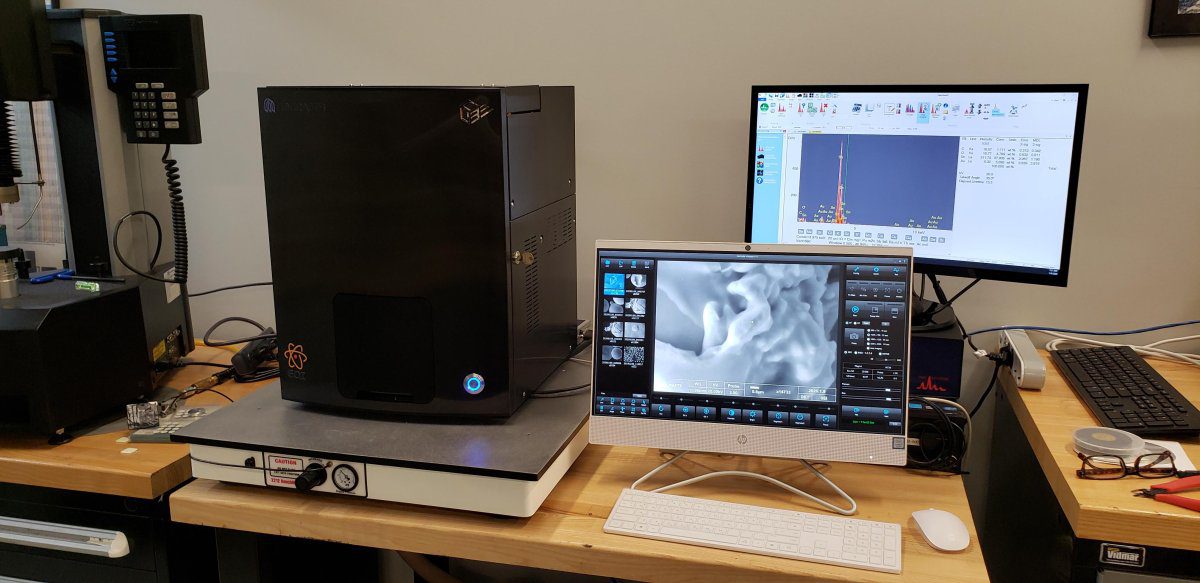
Modern desktop SEM
Core Components of a Comprehensive SEM Training Curriculum
A rigorous sem training curriculum must bridge the gap between theoretical physics and industrial application to ensure maximum ROI on high-capital equipment. Operators begin by mastering foundational electron optics, where they analyze the complex beam-specimen interactions that dictate image resolution. This includes managing vacuum system integrity to prevent column contamination, a critical factor in maintaining the 10-nanometer resolution capabilities of modern field emission systems. Mastering parameters like accelerating voltage, spot size, and working distance allows for the precise control of the interaction volume.
To achieve technical proficiency, many organizations reference the structured SEM training program models established by leading research institutions to standardize their internal certification processes. These programs often integrate Energy Dispersive Spectroscopy (EDS) microanalysis to transition from simple imaging to comprehensive material characterization. Effective training involves:
- Vacuum Management: Maintaining pressures below 10^-5 Torr to preserve the electron source and prevent beam scattering.
- Optics Optimization: Balancing probe current and convergence angles to minimize chromatic and spherical aberrations.
- Microanalysis: Calibrating EDS detectors for precise elemental mapping and quantitative weight percentage calculations.
From Theoretical Physics to Practical Application
The SEM working principle is the synchronized scanning of a focused electron beam across a sample surface to generate measurable signals. Operators must distinguish between secondary electron (SE) detectors, which provide topographic detail from the surface layers, and backscattered electron (BSE) detectors that reveal atomic number contrast. Interpreting signal-to-noise ratios is essential; achieving a ratio above 5:1 is often the baseline for publication-quality imaging in automotive and semiconductor failure analysis. Precise detector alignment ensures that the subtle nuances of material morphology are captured without the interference of charging artifacts. A thorough command of sem imaging techniques is what separates operators who consistently produce publication-quality micrographs from those who struggle with avoidable artifacts.
Software Proficiency and Data Management
By 2026, the evolution of microscopy will require operators to manage massive datasets with sophisticated metadata preservation protocols to ensure traceability in global manufacturing chains. Modern sem training focuses on navigating proprietary interfaces for high-throughput screening, where 95% of repetitive imaging tasks can be automated via macro-driven scripts. This level of evolutionary precision ensures that data management remains as robust as the optical solutions themselves. Workflows prioritize digital file storage systems that integrate directly with Laboratory Information Management Systems (LIMS) to maintain the integrity of results across international teams.
Evaluating SEM Training Methodologies: On-Site vs. Virtual
Virtual simulators provide a cost-effective entry point for theoretical knowledge, yet they often lack the tactile feedback required for mastering sample mounting or delicate aperture alignment. While high-fidelity digital environments in other technical fields have achieved incredible realism—for example, you can visit Apevie Simulators to explore how professional-grade hardware replicates physical feedback—microscopy simulation still requires a physical understanding of the instrument’s specific nuances. Digital modules cannot yet replicate the resistance of a stage motor or the subtle visual cues of a degrading filament, meaning professional sem training remains necessary to bridge the gap between abstract physics and the mechanical realities of the laboratory floor.
The Superiority of On-Site Technical Training
On-site instruction provides an unparalleled advantage by utilizing the facility’s specific hardware and local environment. Every laboratory possesses unique environmental variables that affect imaging. For instance, electromagnetic interference or floor vibrations can degrade image resolution by as much as 12% if the operator isn’t trained to compensate for these local factors. While a standard university SEM training curriculum establishes a robust foundation in radiation safety and basic electron optics, it’s unable to account for the specific sample challenges faced in a specialized industrial setting. Custom sessions ensure that engineers learn to optimize settings for their actual production materials rather than generic test specimens. This direct interaction also fosters a collaborative relationship with field service engineers, which turns the training into a high-level technical consultation.
Integrating Training with Service Contracts
Aligning professional instruction with SEM maintenance schedules transforms a routine service visit into a strategic performance audit. Modern laboratories that implement recurring training for new staff members every 12 months see a measurable increase in equipment longevity. During these sessions, the instructor performs a comprehensive health check of the column alignment and detector sensitivity. This synergy allows staff to execute basic preventative maintenance tasks, such as changing apertures or cleaning the chamber, between official service visits. Data from 2024 industrial surveys indicates that facilities utilizing integrated training and service models reduce unplanned downtime by approximately 22%. This evolutionary approach to staff development ensures that the workforce’s skills progress alongside the technological advancements of the instrumentation itself. It’s a method that prioritizes long-term reliability over short-term cost savings, reflecting a commitment to technical excellence.
- Tailored Methodology: Training focuses on the specific vacuum systems and detector configurations present in your lab.
- Environmental Calibration: Operators learn to mitigate local interference that virtual simulators cannot replicate.
- Operational Continuity: Recurring sessions ensure that institutional knowledge isn’t lost during staff turnover.
Specialized Training for Industrial Applications
Industrial environments demand more than basic instrument operation; they require a sophisticated understanding of how electron beams interact with diverse matter. Specialized sem training empowers technical staff to push benchtop systems to their theoretical limits, achieving high-resolution imaging at the 10-nanometer scale. This level of precision is vital for nanotechnology applications where surface morphology dictates performance. Success in these workflows depends heavily on foundational steps, particularly the rigorous protocols surrounding sem sample preparation. Without precise mounting and coating, even the most advanced imaging techniques won’t yield actionable data.
Failure Analysis and Quality Assurance Protocols
Failure analysis requires a forensic approach to identify fracture patterns and sub-micron contamination sources. Training programs focus on non-destructive imaging of sensitive electronic components, ensuring that the inspection process doesn’t introduce new defects. By utilizing Energy Dispersive X-ray Spectroscopy (EDS), operators can map elemental distribution across failed mechanical parts. This allows for the identification of foreign particulates or oxidation layers that compromise structural integrity. Standardizing these reporting formats ensures that internal engineering teams and external stakeholders receive data that’s both reproducible and technically sound.
Advanced Material Characterization Techniques
Characterizing the properties of polymers, metals, and semiconductors requires a nuanced approach to beam chemistry. Professional sem training provides the expertise needed for low-vacuum imaging; this is essential for non-conductive samples that would otherwise suffer from charging artifacts. Technicians learn to optimize contrast for multi-phase material analysis, distinguishing between discrete alloy compositions or polymer blends. Precision in measuring grain size and porosity is achieved through automated software integration, reducing human error in volumetric assessments. These techniques are fundamental for maintaining quality in global manufacturing chains where a 1% deviation in material density can lead to systemic failure. A deeper understanding of sem operation at the parameter level is essential for technicians who need to adapt beam chemistry settings across these varied material types.
Refine your facility’s analytical capabilities by exploring our industrial imaging and optical excellence solutions designed for high-stakes manufacturing environments.
The EOI LLC Advantage: Evolutionary On-Site Technical Training
EOI LLC leverages over 30 years of specialized expertise in electron optics and industrial service to deliver technical training that transcends standard operational manuals. Our methodology prioritizes the integration of the Cube II, Genesis, and Veritas series into existing industrial workflows with surgical precision. By focusing on the intersection of hardware calibration and operator proficiency, we ensure that every installation functions as a high-performance asset from the first day of operation. This comprehensive support structure encompasses the entire lifecycle of the instrument, providing a stable foundation for global manufacturing excellence.
Our educational programs aren’t merely supplemental; they’re an essential component of a holistic approach to laboratory excellence. We provide rigorous support that covers installation, precise calibration, and deep-level operator education. This ensures that the synergy between sophisticated hardware and human expertise remains constant, driving sustainable innovation in every scan. By drawing on three decades of field experience, our engineers translate complex physics into actionable laboratory protocols.
Customized Professional Fees for Laboratory Staff
Training modules are engineered to maintain laboratory throughput while elevating staff competency. We recognize that downtime represents a significant risk to project timelines, so our engineers conduct on-site troubleshooting tailored to the specific imaging hurdles your research encounters. This targeted sem training transforms standard instruction into a strategic advantage for your facility. Our flexible structures reflect a commitment to minimizing disruption, allowing your staff to master advanced imaging techniques without compromising daily productivity targets.
Ensuring Long-Term Precision and Reliability
Bridging the gap between initial capital expenditure and high-fidelity analytical results requires a rigorous educational framework. A successful sem installation that accounts for environmental variables like electromagnetic interference and structural vibrations is the essential first step before any training program can deliver its full value. When evaluating the electron microscope cost, it’s vital to account for the long-term ROI generated through reduced error rates. Our sem training protocols ensure that your team remains at the forefront of electron optics technology, maintaining the precision required for global industrial standards. Contact Electron Optics Instruments today to schedule your on-site technical training.
Advancing Laboratory Precision Through Strategic Technical Integration
Optimizing the performance of high-resolution instrumentation requires a deliberate shift from basic operational knowledge to advanced technical mastery. Professional sem training serves as the critical link between raw hardware capability and the precise, reproducible data required for rigorous industrial applications. By implementing a curriculum that focuses on both theoretical foundations and hands-on methodology, laboratories can significantly reduce equipment downtime and enhance the accuracy of their analytical outputs. EOI LLC brings 30+ years of electron microscopy expertise to this challenge, serving as the sole US distributor for EmCraft Scanning Electron Microscopes. Our comprehensive service contracts include dedicated on-site instruction, ensuring your staff’s proficiency evolves alongside emerging technological standards. This commitment to excellence transforms your microscopy suite into a cornerstone of sustainable innovation and operational reliability. It’s time to elevate your facility’s diagnostic potential through a partnership built on decades of proven engineering success. Maximize your lab’s potential with EOI LLC’s on-site technical training. We’re ready to help your team achieve new benchmarks in imaging excellence.
Frequently Asked Questions
How long does a typical SEM training session take for a new team?
A standard professional sem training session for a new laboratory team typically spans 3 consecutive days. This timeframe allows for 12 hours of theoretical instruction and 12 hours of hands-on instrument operation. Teams of 4 members benefit from this structured curriculum; it ensures every participant masters sample preparation and vacuum system management. By the 72-hour mark, operators demonstrate proficiency in basic imaging and alignment procedures.
Can SEM training be customized for specific industrial applications like semiconductor failure analysis?
EOI LLC provides specialized training modules tailored for specific industrial applications, including semiconductor failure analysis and metallurgical investigation. We customize 100% of the advanced curriculum to address the unique challenges of your facility’s workflow. For instance, teams working in microelectronics focus on cross-sectional analysis and voltage contrast imaging. This targeted approach ensures that 95% of training time directly impacts your specific production goals.
Is on-site training included with the purchase of a new Cube II or Genesis SEM?
Comprehensive on-site training is included with the purchase of every Cube II or Genesis SEM system. Our field engineers provide 16 hours of dedicated instruction at your facility within 14 days of equipment installation. This service eliminates the need for external travel and ensures your staff learns on the exact hardware configuration they’ll use daily. It’s a standard component of our evolutionary commitment to customer excellence.
What are the prerequisites for staff members attending a professional SEM training course?
Staff members attending sem training should possess a foundational understanding of physics or materials science, typically evidenced by a bachelor’s degree or 2 years of laboratory experience. Participants need basic computer literacy to navigate the Windows-based control software used in the Cube II and Genesis platforms. While previous experience with vacuum systems is beneficial, our introductory modules cover these concepts to ensure technical knowledge across your team.
How often should laboratory teams undergo refresher SEM training?
Laboratory teams should undergo refresher training every 18 months to maintain peak analytical precision. Data from 2023 indicates that teams who participate in biennial updates see a 20% increase in throughput compared to those who don’t. These sessions focus on advanced software features and updated maintenance protocols. Regular intervals prevent the degradation of technical skills and ensure your laboratory utilizes the latest imaging algorithms developed by our engineers.
Does EOI LLC provide training for electron microscopes from other manufacturers?
EOI LLC focuses exclusively on providing training for our proprietary Cube II and Genesis electron microscopes to ensure the highest standards of technical precision. Our expertise is rooted in the specific architecture and software integration of our own evolutionary platforms. By specializing in these systems, we provide a depth of knowledge that generalist trainers can’t match. This focus guarantees that our instructors understand every technical nuance of your hardware.
What is the difference between basic operator training and advanced analytical training?
Basic operator training focuses on the fundamental mechanics of electron beam interaction and primary imaging techniques. In contrast, advanced analytical training covers complex methodologies like Energy Dispersive X-ray Spectroscopy (EDS) and automated particle analysis. While basic sessions ensure safe daily operation, advanced courses empower users to perform quantitative chemical mapping and 3D reconstruction. This distinction allows laboratories to scale their internal expertise based on specific project requirements. Professionals seeking to master the full scope of these advanced workflows can benefit from reviewing the comprehensive sem operation guide covering parameter tuning and EDS data integration for industrial analysis.
How does professional training help in reducing the total cost of ownership for an SEM?
Professional training reduces the total cost of ownership by decreasing the frequency of preventable hardware failures by 30%. Well-trained operators extend the life of tungsten filaments and prevent costly column contamination through proper sample handling. These efficiencies minimize unscheduled downtime, which can cost facilities thousands of dollars per hour. Investing in expert instruction ensures that your equipment operates at peak performance throughout its entire 10-year lifecycle.