
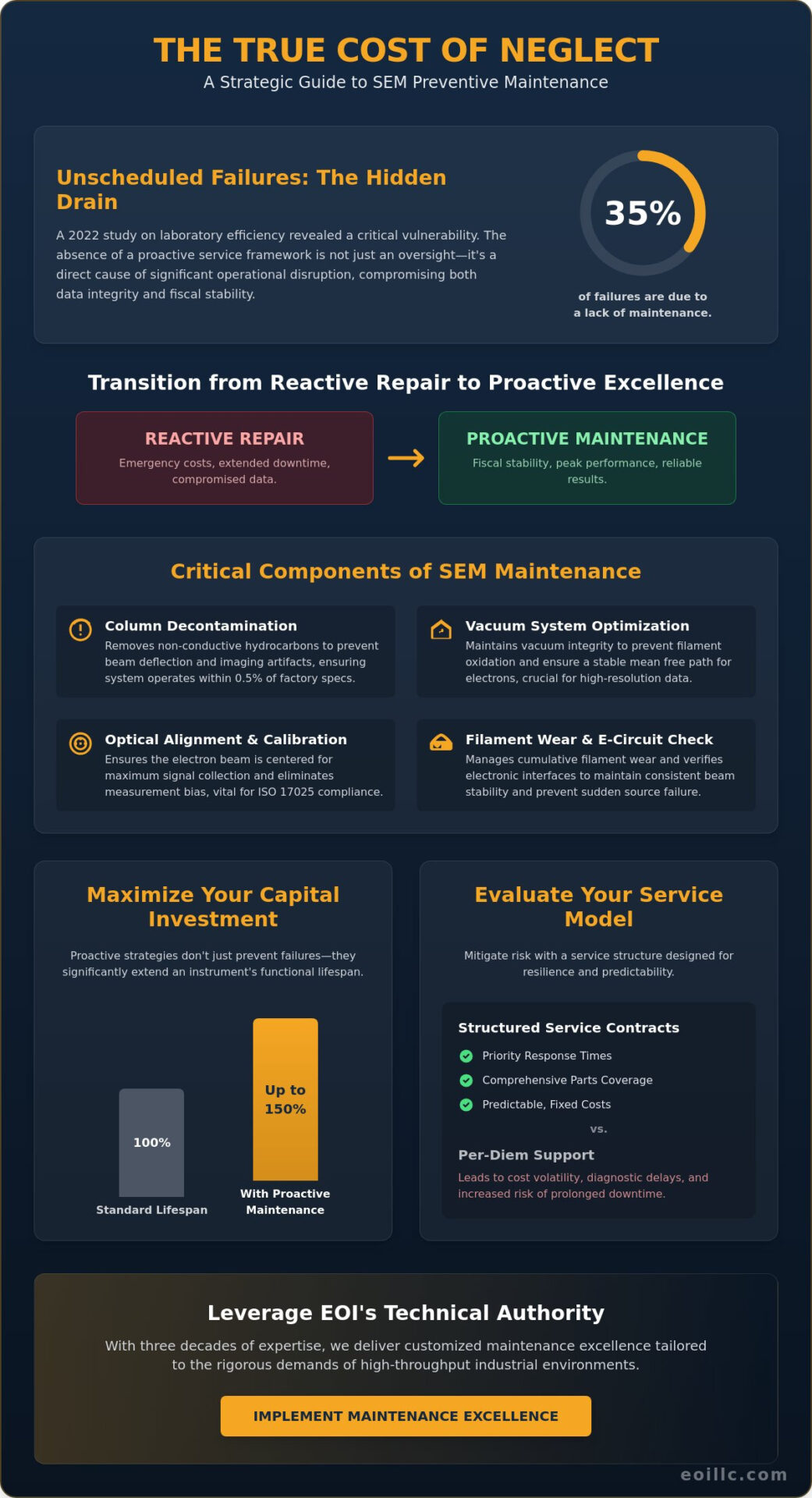
The true cost of a scanning electron microscope isn’t found in its initial procurement, but in the silent erosion of analytical precision that occurs when technical oversight is neglected. A 2022 study on laboratory efficiency revealed that 35% of unscheduled equipment failures are directly attributable to the absence of a proactive service framework. Rigorous sem preventive maintenance acts as more than a mere operational checkbox; it’s a strategic imperative for organizations that prioritize long-term fiscal stability and technical excellence.
You’re likely aware that even the most sophisticated electron optics are susceptible to the cumulative effects of filament wear and column contamination. This article demonstrates how systematic maintenance protocols safeguard your capital investment while ensuring that your laboratory’s data remains beyond reproach. We’ll examine the specific methodologies required to eliminate the volatility of emergency repair costs, maintain the evolutionary trajectory of your research capabilities, and ensure that every micron of data adheres to the highest standards of global manufacturing excellence.
Key Takeaways
- Transition from reactive repair strategies to a systematic engineering protocol designed to preserve the evolutionary performance and analytical precision of modern electron optics.
- Identify the critical technical components of a professional sem preventive maintenance program, ranging from column decontamination to the optimization of vacuum systems for sustained data integrity.
- Evaluate the risk-mitigation benefits of structured service contracts over per-diem support to ensure priority response times and comprehensive parts coverage for critical laboratory infrastructure.
- Discover how to quantify the return on investment by calculating the true cost of laboratory downtime and implementing proactive strategies that can extend an instrument’s functional lifespan by up to 50%.
- Leverage EOI LLC’s three decades of technical authority to implement customized maintenance excellence tailored to the rigorous operational demands of high-throughput industrial environments.
The Strategic Imperative of SEM Preventive Maintenance in 2026
Within the rigorous architecture of modern microscopy, sem preventive maintenance represents a systematic engineering protocol designed to uphold the integrity of electron optics. The industrial paradigm has shifted. Laboratories no longer operate under a reactive repair model where intervention only occurs after a component failure. Instead, the focus has transitioned to evolutionary performance preservation. This approach ensures that every scan meets the exacting standards required for 2026 industrial applications. As benchtop models become increasingly complex, the need for specialized technical oversight grows. High-resolution analytical data relies on the absolute cleanliness of the column and the stability of the vacuum system. Without a structured maintenance schedule, the precision of these instruments degrades, leading to inconsistent results that can compromise multi-million dollar research initiatives.
Beyond the Oil Change: A Professional Perspective
Comparing the maintenance of a scanning electron microscope to a standard vehicle oil change fails to account for the sub-nanometer tolerances involved. In a professional laboratory setting, even microscopic environmental contaminants can severely degrade electron beam stability. These contaminants increase signal-to-noise ratios, which directly compromises the clarity of topographical mapping and elemental analysis. When a system isn’t cleaned to factory specifications, the resulting data loss is often subtle at first, manifesting as a gradual decline in resolution that researchers might attribute to sample quality rather than hardware inefficiency. Maintaining factory standards is a baseline for any organization involved in competitive research or global manufacturing. It’s the only way to ensure that the instrument’s output remains a reliable benchmark for innovation.
Data Integrity and Regulatory Compliance
Rigorous adherence to scheduled sem preventive maintenance is vital for meeting ISO 17025 and other industry-specific auditing requirements. Calibration drift is an inevitable reality of high-usage electron optics; however, if it’s left unaddressed, it leads to catastrophic errors in failure analysis and material characterization. In sectors like semiconductor fabrication or aerospace engineering, a variance of just 2% in measurement accuracy can result in the rejection of entire production batches. Ensuring the sem scanning electron microscope operates within verified tolerances is the only method to guarantee that analytical data remains defensible during regulatory reviews. This commitment to technical excellence protects the laboratory’s reputation and ensures that the synergy between industrial performance and scientific accuracy remains unbroken.
- Systematic Calibration: Eliminates the risk of measurement bias in longitudinal studies.
- Vacuum Integrity: Prevents filament oxidation and maintains the mean free path of electrons.
- Optical Alignment: Ensures the electron beam remains centered for maximum signal collection.
By prioritizing these engineering protocols, organizations secure their investment and maintain a trajectory of sustainable innovation. The complexity of 2026 hardware demands a level of precision that only a dedicated maintenance strategy can provide.
The Technical Anatomy of a Professional PM Protocol
Executing a professional sem preventive maintenance protocol requires a meticulous disassembly and decontamination of the electron source and optical column. This technical intervention isn’t merely a cleaning procedure; it’s a rigorous recalibration of the entire electron-optical system to ensure it remains within a 0.5% tolerance of factory specifications. Engineers focus on the removal of non-conductive hydrocarbons that accumulate on internal surfaces. These contaminants, if left unaddressed, create localized charging zones that deflect the primary electron beam and introduce significant imaging artifacts. The process also involves the verification of electronic circuit interfaces with mechanical stage components, ensuring that the integration of hardware and software remains seamless for complex, multi-axis sample movements.
Systematic replacement of consumables acts as the cornerstone of peak performance. By adhering to a scheduled replacement cycle for apertures and scintillators, laboratories avoid the aperture clogging that frequently disrupts signal-to-noise ratios. This evolutionary approach to maintenance prioritizes the stability of the analytical environment, allowing for the precise measurement of nanostructures without the interference of system-induced noise. For facilities aiming to maintain this level of industrial excellence, partnering with EOI LLC technical consultants ensures that every maintenance cycle leverages global manufacturing standards and engineering expertise.
Column and Aperture Optimization
The precision cleaning process targets critical components including anodes, wehnelt caps, and final apertures to eliminate microscopic debris. Even a 2-micron particle of carbonized material can induce column charging, which manifests as beam drift or uncorrectable astigmatism. Technicians utilize ultrasonic cleaning and specialized polishing compounds to restore the surface integrity of these components. Following decontamination, a professional alignment is mandatory to restore the optimal beam geometry. This alignment ensures the electron crossover point resides perfectly on the optical axis, a necessity for achieving the high-resolution imaging required in semiconductor and materials science applications.
Vacuum System Integrity and Pump Maintenance
Maintaining ultra-high vacuum requirements involves a 24-month cycle for major pump overhauls and the routine replacement of vacuum pump fluids and filters. Technicians perform rigorous testing of leak rates and monitor turbo-molecular pump health metrics. A 10% reduction in rotational frequency or a rise in bearing temperature often signals an impending system crash that could result in weeks of downtime. There’s a critical synergy between vacuum stability and the operational lifespan of sem filaments. If vacuum levels fluctuate by more than 5%, the resulting cathode poisoning can reduce the brightness of the electron source by 25%. Consistent vacuum integrity prevents oxidation, ensuring that the filament performs at maximum efficiency throughout its intended service life.
Evaluating Service Models: Multi-Tiered Contracts vs. Per Diem Support
The decision-making process for laboratory managers often centers on the tension between immediate cost savings and long-term operational resilience. Organizations that rely on on-demand field service rates face a volatile risk profile where a single critical component failure can disrupt workflows for weeks. This reactive posture creates an environment of fiscal unpredictability. It forces procurement teams to scramble for emergency funding during catastrophic events, which often results in prolonged instrument idleness. A strategic approach requires a shift from viewing maintenance as a variable expense to recognizing it as a fixed investment in analytical integrity.
The Limitations of Per Diem Servicing
Per diem models introduce hidden financial burdens that extend beyond the baseline hourly labor rate. Travel fees, which fluctuate based on technician proximity, and emergency labor premiums often increase the total cost of a single repair by 35% or more. Without a structured agreement, parts availability becomes a significant bottleneck. Data from 2023 industry benchmarks suggests that laboratories without service contracts experience 22% longer lead times for specialized vacuum pumps and electron sources. These models fail to address the “soft” signs of hardware degradation. Subtle shifts in beam stability or minor vacuum leaks are frequently overlooked until they trigger a total system shutdown.
Strategic Benefits of Annual Maintenance Agreements
Annual contracts provide a framework for consistent sem preventive maintenance, ensuring that precision instruments remain within specified tolerances. These tiered agreements range from basic annual inspections to comprehensive coverage that includes all parts and labor. By securing priority response times, often guaranteed within 24 to 48 hours, laboratories mitigate the impact of unscheduled downtime. These agreements stabilize budgets by amortizing the cost of high-value components over the fiscal year. This prevents the “sticker shock” associated with major electron column overhauls or detector replacements.
Beyond hardware longevity, these contracts offer essential on-site technical training. This knowledge transfer empowers operators to identify early signs of wear, reducing the frequency of operator-induced errors that account for nearly 15% of service calls. This level of oversight is particularly vital for maintaining the performance of a desktop sem, where compact footprints require specialized calibration to achieve high-resolution results. Selecting a partner with multi-manufacturer expertise further streamlines operations in heterogeneous environments. It provides a single point of accountability for diverse analytical assets across the facility.
Quantifying the ROI: Total Cost of Ownership and Lifespan Extension
The financial justification for rigorous sem preventive maintenance extends far beyond simple repair avoidance. In high-output industrial environments, such as semiconductor fabrication or automotive component failure analysis, the real cost of a single day of SEM downtime often exceeds $25,000 when accounting for stalled production lines and delayed quality assurance milestones. This figure doesn’t even include the secondary costs of missed R&D deadlines or the potential for compromised data integrity. By viewing maintenance as a strategic investment rather than a recurring expense, organizations stabilize their operational budgets and ensure that their most critical analytical assets remain online during peak demand cycles.
The Economics of Precision
Understanding the electron microscope cost is essential for calculating the long-term ROI of a laboratory. While the initial purchase price is substantial, the fractional cost of annual maintenance represents only a small percentage of the total capital expenditure. We define the Maintenance-to-Replacement Ratio as a key lab KPI that tracks the efficiency of upkeep against the total projected cost of system replacement. Effective maintenance prevents the “cascading failure” effect; this occurs when a seemingly minor issue, like a degraded vacuum seal, forces the ion pump to overwork, eventually leading to a catastrophic and expensive failure of the entire column assembly.
- Proactive tuning reduces the frequency of emergency part shipments, which can carry premiums of 20% or more.
- Routine calibration of the electromagnetic lenses ensures that power consumption remains within specified engineering limits.
- Professional service records significantly bolster the resale value of refurbished units, often yielding a 25% higher price point on the secondary market compared to unmaintained systems.
Maximizing Throughput and Efficiency
Optimized systems deliver a level of stability that directly translates into higher laboratory throughput. When an SEM is maintained to factory specifications, it requires less operator intervention and drastically fewer image retakes due to drift or charging artifacts. This reliability is vital for the successful execution of advanced sem techniques, where high-resolution analytical microscopy demands absolute beam stability over extended dwell times. Data from long-term industrial studies indicates that proactive PM protocols extend the functional life of electron microscopes by 30% to 50%, effectively pushing a standard 10-year lifecycle toward a 15-year horizon.
Maintaining consistency across multi-user environments is equally critical. Without standardized sem preventive maintenance, different operators may experience varying levels of precision, leading to data silos and internal friction. A well-maintained system ensures that the first scan of the morning is as accurate as the last scan of the night. It’s about protecting the evolutionary potential of your research facility through sustained technical excellence.
The EOI LLC Approach: Expert-Driven Maintenance Excellence
EOI LLC leverages over 30 years of specialized industry experience to deliver comprehensive maintenance solutions for all major Scanning Electron Microscope manufacturers. We recognize that high-throughput laboratories operate under rigorous schedules where even minor deviations in beam stability result in significant data inaccuracies. Our customized sem preventive maintenance programs are engineered to address the specific duty cycles of these demanding environments. We don’t just perform routine inspections; we integrate on-site training modules that empower laboratory personnel with best practices for daily system management. This holistic strategy creates a powerful synergy between our proprietary hardware sales and a robust national field service network, ensuring every component of the imaging chain remains optimized for peak performance.
- Technical proficiency across legacy and modern SEM platforms including FEI, JEOL, and Hitachi.
- Direct access to factory-certified components and specialized imaging hardware.
- Proactive scheduling that minimizes operational downtime in 24/7 lab environments.
- Staff empowerment through targeted, hands-on instructional sessions on-site.
Comprehensive Support for the Cube II and Veritas Series
Specialized protocols for the Cube II and Veritas series ensure these benchtop and tabletop SEM models consistently meet factory-spec performance metrics. Our engineers focus on the precise calibration of integrated EDS systems, which is critical for maintaining the integrity of elemental analysis results. As the sole US distributor for this specialized imaging hardware, EOI LLC provides a direct link between manufacturing excellence and field reliability. Labs benefit from a streamlined supply chain where replacement parts and technical upgrades are sourced directly from the primary authority. This specialized focus ensures that sem preventive maintenance remains a precise science rather than a generic checklist.
National Service Capability with a Personal Touch
Our national service infrastructure provides consistent engineering excellence across the United States, removing the regional limitations that often hinder laboratory operations. We’ve built a reputation at the intersection of technical innovation and industrial reliability. Every service engagement is a partnership designed to extend the evolutionary lifecycle of your analytical equipment. We understand that precision is non-negotiable in the optical and automotive sectors. It’s time to secure your laboratory’s future with a partner that values technical authority. Contact our technical team today to request a customized service assessment for your specific infrastructure requirements.
Advancing Analytical Integrity Through Proactive System Stewardship
The trajectory of laboratory operations in 2026 necessitates a departure from the high risks of reactive hardware management. Implementing a rigorous sem preventive maintenance protocol isn’t just a technical requirement; it’s a strategic investment that safeguards the precision of your most critical data. By focusing on the technical anatomy of your system and evaluating the ROI of multi-tiered service models, your facility can effectively extend the operational lifespan of its instrumentation while avoiding the catastrophic costs of unscheduled downtime.
EOI LLC brings over 30 years of specialized expertise in electron optics to every engagement, offering comprehensive support for all major SEM brands regardless of the original manufacturer. Our history of minimizing downtime for national research facilities ensures that your equipment remains at the forefront of scientific discovery. You’ll find that our methodical approach to maintenance provides the stability required for long-term industrial performance and sustainable innovation.
Secure your laboratory’s operational future with a customized EOI LLC service contract.
Your commitment to precision today guarantees the breakthrough discoveries of tomorrow.
Frequently Asked Questions
How often should a scanning electron microscope undergo preventive maintenance?
Most scanning electron microscopes require sem preventive maintenance every 6 to 12 months to ensure peak analytical performance. Labs operating at 80% capacity or higher often schedule quarterly inspections to mitigate the risk of unplanned downtime. Adhering to these intervals aligns with ISO 9001 quality management protocols; this ensures that the instrument’s resolution and contrast remain within the manufacturer’s original specifications of 1.0 nm to 3.0 nm.
What is the difference between a service contract and a warranty?
A warranty typically covers manufacturing defects and component failures for a fixed period, often 12 months from the installation date. In contrast, a service contract provides a comprehensive framework for ongoing support, including scheduled sem preventive maintenance and priority emergency response. While a warranty is a reactive guarantee of quality, a service contract represents a strategic investment in the long-term evolution and reliability of the laboratory’s analytical capabilities.
Can our in-house technicians perform SEM column cleaning?
In-house technicians shouldn’t attempt internal column cleaning because the process requires specialized vacuum tools and Class 100 cleanroom environments to prevent contamination. Misalignment of the electromagnetic lenses by even 0.5 millimeters can result in a 40% loss of image resolution. EOI LLC recommends that only certified field engineers execute these procedures to maintain the integrity of the electron optics and ensure the system’s continued precision.
What are the most common signs that an SEM requires immediate maintenance?
Visible image distortion, such as a 15% increase in stigmation errors or persistent beam drift, indicates an immediate need for technical intervention. If the vacuum recovery time exceeds the standard 5-minute threshold after sample loading, it’s a sign of seal degradation or pump inefficiency. These performance bottlenecks often precede catastrophic component failure, making it essential to address them before they compromise the accuracy of critical data sets or research outcomes.
Does EOI LLC provide maintenance for SEM models from other manufacturers?
EOI LLC provides specialized maintenance services for a broad spectrum of scanning electron microscopes, including systems from three of the world’s leading manufacturers. Our engineering team leverages decades of experience in optical solutions to support multi-vendor environments, ensuring that diverse laboratory assets operate with synchronized excellence. This global capability allows partners to consolidate their service requirements under a single, authoritative provider dedicated to technical precision and industrial performance.
How long does a typical preventive maintenance visit take?
A standard preventive maintenance visit typically spans 8 to 16 hours over two consecutive business days. This timeframe allows for a comprehensive 50-point inspection, including column alignment, vacuum system optimization, and final calibration against certified standards. By dedicating this specific window to technical refinement, we ensure that the instrument’s evolutionary trajectory remains consistent with the high-end quality demands of modern semiconductor and material science industries.
What consumables should we keep in stock between scheduled PM visits?
Facilities should maintain a 3-month supply of critical consumables, specifically tungsten or CeB6 filaments, final apertures, and high-vacuum grease. Keeping at least two spare sets of viton O-rings and 1 liter of mechanical pump oil helps prevent extended downtime during minor component replacements. These essential items facilitate immediate restoration of the electron beam if a filament expires during a critical 48-hour testing cycle or a high-priority production run.
Is remote troubleshooting included in modern SEM service agreements?
Modern service agreements from EOI LLC incorporate remote diagnostic capabilities that resolve approximately 65% of common software and alignment issues without an on-site visit. By utilizing secure, encrypted connections, our engineers can analyze system logs and vacuum telemetry in real-time to provide immediate corrective guidance. This integration of digital support and physical expertise ensures that technical hurdles don’t impede the steady flow of innovation within your organization’s global manufacturing framework.