

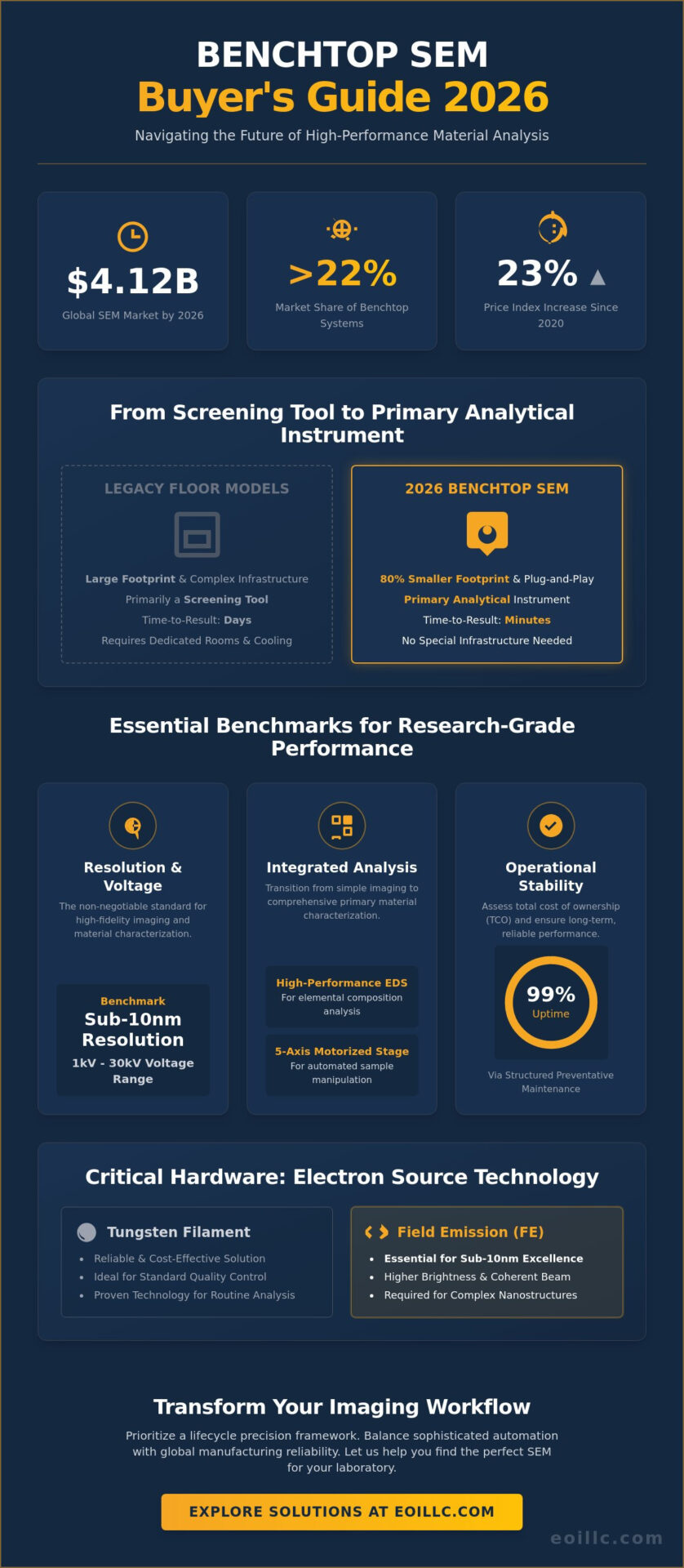
By 2026, the global scanning electron microscopy market has surged to a $4.12 billion valuation, a growth fueled by a paradigm shift where benchtop systems now represent over 22% of all active installations. You likely recognize the mounting pressure to maintain research-grade imaging standards within constrained laboratory environments, yet the fear of investing in a “screening-only” tool that lacks true analytical depth remains a significant hurdle. This benchtop sem buyer’s guide 2026 provides the rigorous technical framework required to identify a high-performance instrument that delivers integrated EDS analysis without the infrastructure burden of a floor-model system.
We examine how to navigate a market where the Producer Price Index for analytical instruments has risen 23% since 2020, focusing on securing a configuration that ensures 99% operational uptime through precision-engineered service protocols. Our analysis details the essential criteria for evaluating modern systems like the Cube II or the Veritas Series, ensuring your laboratory achieves the excellence necessary for the next phase of industrial evolution. By prioritizing a lifecycle precision framework, you can transform your imaging workflow into a strategic asset that balances sophisticated automation with global manufacturing reliability.
Key Takeaways
- Establish sub-10nm resolution and a flexible 1kV to 30kV accelerating voltage range as the essential benchmarks for research-grade benchtop instrumentation.
- Transition from preliminary screening to primary material characterization by integrating high-performance EDS systems and 5-axis motorized stage automation.
- Assess the total cost of ownership through a strategic lens, prioritizing structured preventative maintenance visits to ensure 99% operational uptime and long-term stability.
- Utilize this benchtop sem buyer’s guide 2026 to differentiate between specialized platforms like the Cube II and Veritas Series based on specific resolution and throughput requirements.
The Evolutionary State of Benchtop SEM Technology in 2026
The year 2026 marks a definitive era where the technological gap between compact systems and traditional floor-standing units has effectively closed. This benchtop sem buyer’s guide 2026 identifies a new standard of excellence where high-vacuum capabilities and sub-10nm resolution are no longer aspirational features but fundamental requirements for modern laboratories. The modern benchtop SEM is a research-grade tool with 80% less footprint than traditional models. This evolutionary progress allows for the deployment of advanced imaging solutions in environments previously deemed unsuitable due to spatial or structural constraints, reflecting the 22% increase in benchtop installations observed across global research hubs. As you navigate this benchtop sem buyer’s guide 2026, it’s clear that the transition to compact systems is driven by a need for immediate, high-fidelity data without the historical overhead of large-scale instrumentation.
From Screening Tool to Primary Analytical Instrument
Historically, tabletop systems served primarily as preliminary screening tools for larger instruments. Today, advancements in electron column design and emitter stability have elevated these instruments to the status of primary analytical workstations. By utilizing a Scanning Electron Microscope (SEM) with high-resolution field emission or optimized tungsten sources, laboratories now achieve characterization results that were once exclusive to multi-million dollar facilities. This shift facilitates the decentralization of microscopy, enabling departments to maintain localized control over their failure analysis and quality assurance workflows. The result is a significant reduction in time-to-result for industrial failure analysis, often moving from days to mere minutes, which is critical for maintaining 99% operational uptime in high-output manufacturing sectors. It’s a strategic move that prioritizes precision and global capability over sheer instrument size.
Footprint Optimization vs. Infrastructure Requirements
The logistical burden of traditional microscopy typically includes dedicated cooling systems, high-voltage power lines, and specialized vibration-dampened rooms. In 2026, the benchtop SEM eliminates these infrastructure requirements through integrated internal dampening and standard electrical compatibility. This “plug-and-play” architecture allows for strategic placement directly on manufacturing floors or within cleanroom environments. Such mobility ensures that precision analysis occurs at the point of need, optimizing the synergy between industrial performance and high-end quality control. Laboratories no longer need to invest in extensive facility renovations; they can instead focus resources on the analytical depth and technical support that drive sustainable innovation. This approach suggests a preference for depth and expertise, ensuring that internal processes are as rigorous as the external communications they support.
Critical Technical Specifications for High-Resolution Characterization
Selecting a high-performance instrument requires a rigorous evaluation of its core optical and mechanical architectures. While some manufacturers prioritize cost reduction, this benchtop sem buyer’s guide 2026 emphasizes that research-grade performance is defined by sub-10nm resolution and robust source stability. A critical differentiator between entry-level screening tools and primary analytical instruments lies in the electron source technology. Tungsten filaments provide a reliable, cost-effective solution for standard quality control, but advanced Field Emission (FE) options are necessary for sub-10nm excellence. These FE sources deliver higher brightness and a more coherent beam, which is essential for the characterization of complex nanostructures.
Vacuum architecture serves as the foundation for this precision. Modern systems utilize multi-stage pumping sequences to achieve high-vacuum environments quickly, which directly impacts imaging stability and sample throughput. High-quality vacuum systems prevent beam scattering and sample contamination, ensuring that the data collected is both accurate and reproducible. If you’re evaluating systems for high-throughput environments, consider exploring the Veritas Series SEM for its superior integration of vacuum and optical controls. The synergy between these components ensures that the instrument remains a reliable partner in global manufacturing excellence.
Resolution and Electron Optical Precision
Manufacturers often cite “best case” resolution figures achieved under ideal conditions. In practice, real-world industrial imaging demands clarity at magnifications exceeding 150,000x, where environmental factors and mechanical vibrations can degrade image quality. Resolution without stability is functionally useless in nanotechnology. Achieving excellence requires a synergy between the electron column design and the internal dampening systems that protect the beam path. Recent advancements in SEM technology highlighted by NIST focus on reducing these measurement uncertainties to improve the utility of the data across diverse research applications.
Accelerating Voltage and Sample Penetration
A versatile instrument must offer a broad accelerating voltage range, typically from 1kV to 30kV. High-voltage settings (20-30kV) are essential for deep sample penetration and the excitation of heavy metal X-rays during EDS analysis. Conversely, low-kV imaging (1-5kV) is vital for non-conductive polymers or beam-sensitive biological samples that would otherwise suffer from charging or surface damage. Modern 2026 systems often feature automatic column alignment, which maintains precision when switching between these disparate voltage settings, ensuring a seamless workflow for diverse material types. This benchtop sem buyer’s guide 2026 identifies this flexibility as a non-negotiable requirement for laboratories that value depth and expertise.
Evaluating Analytical Capabilities: EDS, Stages, and Software
The transition from a secondary screening tool to a primary material characterization workstation depends heavily on the integration of analytical modules. This benchtop sem buyer’s guide 2026 underscores that the most effective systems are those where Energy Dispersive Spectroscopy (EDS) is not a mere additive component but a core part of the digital workflow. In the current industrial climate, where rapid decision-making is paramount, the ability to perform simultaneous imaging and elemental analysis defines the boundary between standard documentation and visionary failure analysis. By leveraging advanced EDS (Energy Dispersive Spectroscopy) Systems, laboratories achieve a level of technical authority that mirrors the precision of much larger installations. Precision defines every result.
Energy Dispersive Spectroscopy (EDS) Integration
In 2026, the standard for elemental analysis has shifted toward Silicon Drift Detectors (SDD) that offer high count rates and exceptional analytical precision. These systems provide real-time elemental mapping and line scans that are critical for identifying contaminants or verifying alloy compositions during high-end manufacturing. The true excellence of a 2026 benchtop SEM lies in its integrated software, which streamlines the reporting process for B2B stakeholders by consolidating high-resolution imagery with quantitative chemical data. This unified approach ensures that every analytical session contributes directly to the sustainable innovation goals of the organization and doesn’t require manual data post-processing. Efficiency remains a priority.
Motorized Stage Versatility and Sample Handling
Precision selection requires a focus on stage control and automation, specifically the shift toward 5-axis motorized precision (X-Y-Z-T-R). This level of control is essential for analyzing complex geometries and ensuring that samples are oriented correctly for both imaging and EDS collection. Features such as the “nav-cam” facilitate rapid sample orientation and region-of-interest identification, allowing users to move from sample loading to high-magnification analysis with minimal delay. High-performance models like the Veritas Pro SEM often incorporate vacuum load-lock systems that reduce sample exchange time to under 3 minutes, a 60% improvement over manual chamber venting methods used in older generations. Speed drives laboratory ROI.
Ultimately, the software user experience dictates the long-term ROI of the instrument. When the interface is intuitive and automated, it reduces the training burden and increases the overall lab throughput. Accommodating large or multiple samples within a single chamber cycle further enhances this efficiency, allowing for high-volume characterization that meets the rigorous demands of global manufacturing. This benchtop sem buyer’s guide 2026 identifies these integrated analytical capabilities as the primary drivers of operational excellence in the modern laboratory.
Assessing Total Cost of Ownership (TCO) and Operational Stability
The acquisition of high-performance imaging instrumentation represents a significant capital commitment that extends far beyond the initial procurement phase. This benchtop sem buyer’s guide 2026 advocates for a lifecycle precision framework that accounts for the total cost of ownership (TCO) to ensure long-term fiscal rigor. While the initial purchase price is a primary consideration, laboratories must evaluate the recurring expenditures associated with consumables and specialized technical support. In a market where the Producer Price Index for analytical instruments has risen 23% since 2020, selecting an instrument based on its operational stability becomes a visionary strategy for mitigating systemic risk and maintaining 99% operational uptime. A reliable partner doesn’t just sell hardware; they provide the infrastructure for sustained excellence.
Beyond the Initial Capital Expenditure
A comprehensive financial evaluation must identify recurring costs such as SEM Filaments and Consumables, apertures, and vacuum pump oil. These components are essential for maintaining the sub-10nm resolution standards previously discussed. Unlike floor-model units that require dedicated chilled water lines and high-voltage electrical configurations, benchtop systems offer hidden savings through reduced energy consumption and the elimination of facility cooling requirements. These infrastructure-related savings often offset the costs of high-count rate analytical modules over the instrument’s first 5 years of service. For a detailed breakdown of current market rates and investment tiers, consult our comprehensive 2026 price guide.
The Critical Role of Professional Service Contracts
Operational stability is maintained through the strategic implementation of service contract tiers that prioritize rapid response and preventative care. By 2026, a 24-hour response time has become the industrial standard for organizations that cannot afford lengthy disruptions in their failure analysis or quality control workflows. Preventative Maintenance Visits (PMVs) act as a proactive safeguard against mechanical degradation, ensuring that vacuum seals and electron optics remain within factory specifications. Furthermore, on-site technical training for laboratory staff reduces the risk of operator-induced downtime, which accounts for approximately 15% of all service calls in high-throughput environments. You can explore the specific protocols required for long-term instrument health in our definitive guide to SEM maintenance.
Ultimately, the value of a benchtop SEM is realized through its consistent performance and the expertise of the support network behind it. Laboratories that invest in robust service agreements often see a higher ROI through extended equipment longevity and superior data reproducibility. Secure your laboratory’s operational future by scheduling a consultation for our Preventative Maintenance Visits today to ensure your systems continue to push the boundaries of what’s possible in material science.
Implementing the Cube II and Veritas Series for Industrial Excellence
The final phase of procurement involves selecting a strategic partner capable of sustaining long-term industrial excellence through rigorous technical support and logistical reliability. Electron Optics Instruments, LLC serves as the definitive choice in this transition, leveraging three decades of specialized expertise in US-wide distribution and service to support your analytical infrastructure. This benchtop sem buyer’s guide 2026 emphasizes that hardware performance must be verified under real-world conditions; therefore, we facilitate preliminary sample analysis as a standard component of our technical evaluation. This process allows stakeholders to confirm resolution and EDS accuracy on their specific material types before final capital allocation is confirmed.
By prioritizing a synergy between advanced electron optics and practical manufacturing requirements, Electron Optics Instruments, LLC ensures that every installation contributes to a laboratory’s broader goals of sustainable innovation. Our internal validation processes are designed to mirror the high standards of the automotive and electronics sectors, providing a sense of stability and thoroughness for our B2B partners. Selecting a system through this benchtop sem buyer’s guide 2026 framework ensures that your facility is equipped with a tool capable of maintaining peak performance in a competitive global landscape.
Cube II: Uncompromising Benchtop Performance
The Cube II Benchtop SEM represents the pinnacle of compact high-resolution microscopy, engineered specifically for professionals who demand research-grade depth without the traditional infrastructure burden. While its 1-30kV range and sub-10nm resolution provide the necessary optical power, the platform’s true strength lies in its seamless integration with Bruker EDS systems for world-class elemental analysis. This unified digital workflow allows for rapid characterization of complex nanostructures, ensuring that failure analysis results are delivered with absolute technical authority. Detailed specifications regarding this platform’s capabilities can be found in our technical overview of the evolutionary shift in benchtop microscopy.
Veritas and Genesis: Scalable Microscopy Solutions
For laboratories requiring more specialized or scalable configurations, the Genesis and Veritas Series provide a structured path toward operational excellence. The Genesis Tabletop SEM functions as a robust workhorse optimized for high-volume quality control and educational environments, where ease of use and rapid throughput are the primary ROI drivers. Conversely, the Veritas FE utilizes field-emission technology to achieve detail levels that effectively bridge the gap between benchtop footprints and traditional floor-model performance. To determine which configuration best aligns with your specific research budget and characterization needs, we invite you to schedule a technical consultation with a specialist at Electron Optics Instruments, LLC today.
Advancing Laboratory Excellence Through Precision Procurement
Selecting an instrument requires a visionary outlook that balances immediate imaging needs with long-term operational reliability. This benchtop sem buyer’s guide 2026 has outlined the technical benchmarks necessary to transition from basic screening to advanced material characterization. By focusing on sub-10nm resolution and integrated analytical modules, laboratories can achieve the precision required for high-end industrial applications while maintaining a compact footprint. It’s about establishing a foundation for excellence that evolves alongside your research demands.
As the sole US distributor for EmCraft SEMs, Electron Optics Instruments, LLC brings over 30 years of electron microscopy expertise to every partnership. We ensure that your investment is protected through comprehensive on-site training and structured service contracts that prioritize uptime and data reproducibility. This expert-driven approach guarantees that your internal processes remain as rigorous as the technology you deploy. You’re invited to View the Cube II and Veritas Series Specifications to identify the configuration that will drive your next phase of sustainable innovation. We’re ready to secure your laboratory’s future today.
Frequently Asked Questions
What is the typical resolution of a benchtop SEM in 2026?
In 2026, the typical resolution for a high-performance benchtop SEM is sub-10nm. This benchmark ensures that the instrument provides the precision required for advanced material characterization and failure analysis. While entry-level systems may hover around 15nm, research-grade models like the Cube II consistently deliver the clarity necessary for modern nanotechnology applications. This standard reflects the evolutionary progress of electron optics within a compact footprint.
Can a benchtop SEM perform the same analysis as a floor-model unit?
Modern benchtop systems can perform approximately 85% of the analytical tasks traditionally reserved for floor-model units. While floor models still excel in specialized applications like ultra-high resolution below 1nm or extremely large sample chambers, this benchtop sem buyer’s guide 2026 highlights that compact units now handle primary characterization with comparable accuracy. The transition is supported by integrated EDS and automated 5-axis stages that mirror the capabilities of larger infrastructure.
How much space is required for a benchtop SEM installation?
A benchtop SEM requires a standard laboratory bench space of approximately 60cm by 60cm. Unlike traditional units, these systems don’t necessitate specialized vibration-dampened rooms or dedicated cooling water lines. This footprint optimization allows for the strategic placement of analytical tools directly on the manufacturing floor. You’ll only need a standard electrical outlet and a stable surface to achieve research-grade results in any industrial setting.
What is the difference between Tungsten and Field Emission (FE) sources in benchtop models?
The primary difference lies in the brightness and coherence of the electron beam produced by each source. Tungsten filaments utilize thermionic emission and are valued for their reliability and lower initial cost in quality control environments. Field Emission (FE) sources, found in systems like the Veritas FE, provide significantly higher brightness and a smaller probe size. This allows for the sub-10nm resolution that defines the upper tier of this benchtop sem buyer’s guide 2026.
Is EDS analysis standard on all benchtop SEM models?
Integrated Energy Dispersive Spectroscopy (EDS) is typically an optional module rather than a standard feature on every base model. By 2026, over 75% of industrial buyers choose to include silicon drift detectors (SDD) for real-time elemental mapping. The modular nature of systems like the Veritas Series allows laboratories to tailor their analytical capabilities to specific research budgets while maintaining the option for future upgrades to their characterization workflow.
How often does a benchtop SEM require preventative maintenance?
Research-grade benchtop SEMs generally require preventative maintenance visits at 6-month or 12-month intervals to ensure 99% operational uptime. These scheduled visits focus on vacuum system integrity, electron column alignment, and aperture cleaning. Proactive maintenance is a cornerstone of sustainable innovation, as it prevents the mechanical degradation that can lead to costly unscheduled downtime in high-throughput global manufacturing environments. Stability is maintained through rigorous service protocols.
What is the expected lifespan of a benchtop SEM filament?
A standard tungsten filament typically offers a lifespan of approximately 100 to 150 hours of active beam time. In contrast, advanced sources such as Hexaboride (CeB6) filaments can last up to 1,500 hours, significantly reducing the frequency of maintenance interruptions. Choosing the appropriate source is a critical factor in calculating the total cost of ownership, as it impacts both consumable expenses and the long-term continuity of laboratory workflows.
Do I need a dedicated technician to operate a modern benchtop SEM?
You don’t need a dedicated, full-time technician to operate a modern benchtop SEM due to advancements in automated software and intuitive user interfaces. Features like auto-focus and auto-stigmation allow research staff to achieve high-quality results with approximately 4 to 8 hours of initial technical training. This democratization of technology ensures that precision imaging is accessible to a wider range of laboratory personnel without compromising the technical authority of the results.