
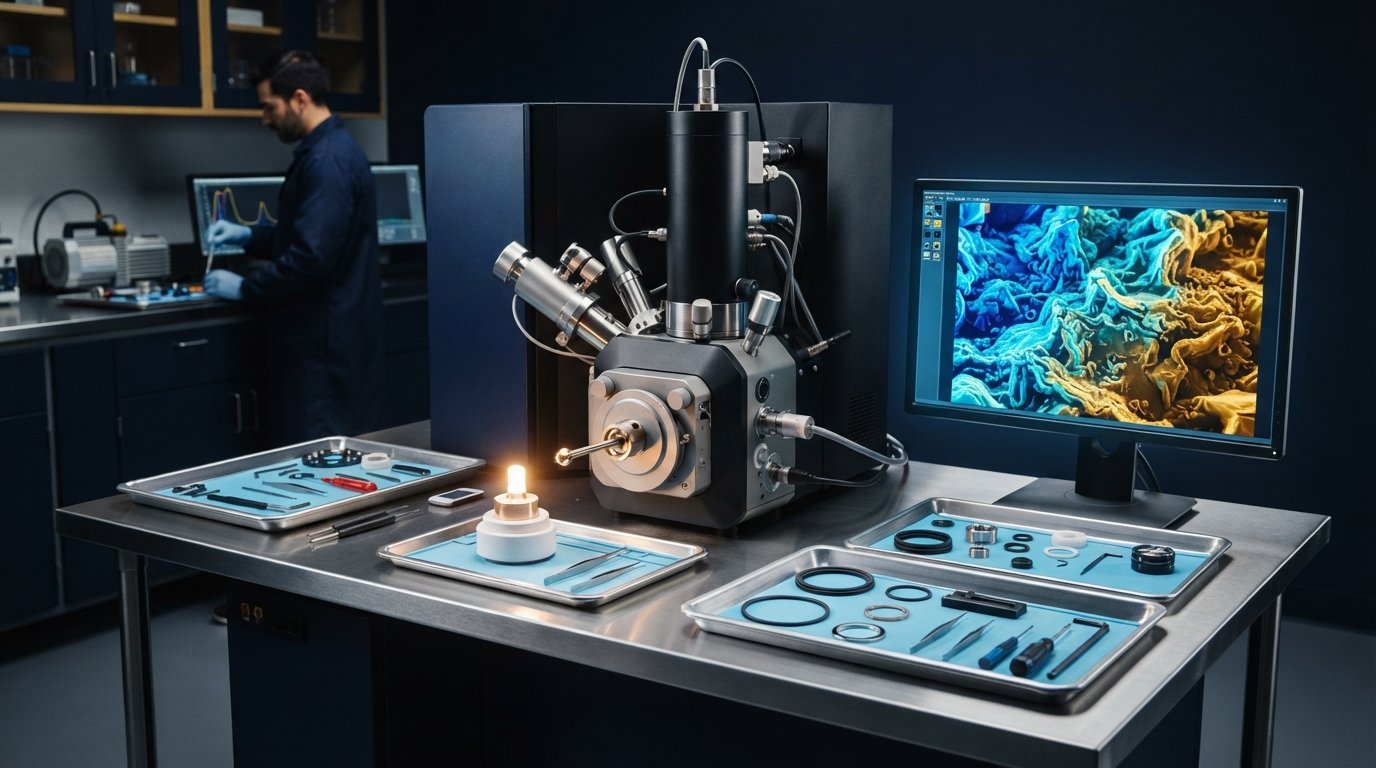
What if the modest savings on a third-party aperture actually costs your laboratory thousands in unscheduled downtime and contaminated column optics? For research facilities and semiconductor manufacturers, the margin for error in electron microscopy is measured in nanometers, yet many procurement cycles still prioritize upfront cost over vacuum integrity. You recognize that a single failed filament or an outgassing O-ring doesn’t just halt a project; it compromises the meticulous precision of your Veritas or Cube II system. Finding reliable sem parts suppliers is no longer just a logistical task, it’s a fundamental requirement for maintaining imaging excellence and protecting your capital investment.
This 2026 guide establishes a rigorous framework for identifying high-authority vendors capable of supporting both cutting-edge and discontinued SEM models. We’ll examine the technical benchmarks for sourcing high-brightness LaB6 cathodes and tungsten hairpins that meet ISO 9001:2015 standards. By the end of this analysis, you’ll possess the expert guidance needed to build a resilient supply chain. This ensures consistent access to verified consumables while reducing the operational risks associated with substandard components that threaten your sensitive electron optics and laboratory uptime.
Key Takeaways
- Implement a rigorous technical vetting process to distinguish between mere parts distributors and high-authority providers who understand the intricate physics of electron optics.
- Protect your instrument’s vacuum integrity by sourcing only ISO-compliant consumables that prevent outgassing and minimize the risk of costly column contamination.
- Utilize our strategic framework for finding reliable sem parts suppliers, focusing on verified manufacturer distribution rights and a minimum of 30 years of industry expertise.
- Enhance long-term equipment performance by aligning your parts procurement strategy with expert-led preventative maintenance schedules for Veritas and Cube II series microscopes.
- Distinguish between routine consumables and mission-critical components to prioritize high-resolution imaging needs and maintain consistent laboratory uptime.
The Critical Role of Component Integrity in Scanning Electron Microscopy
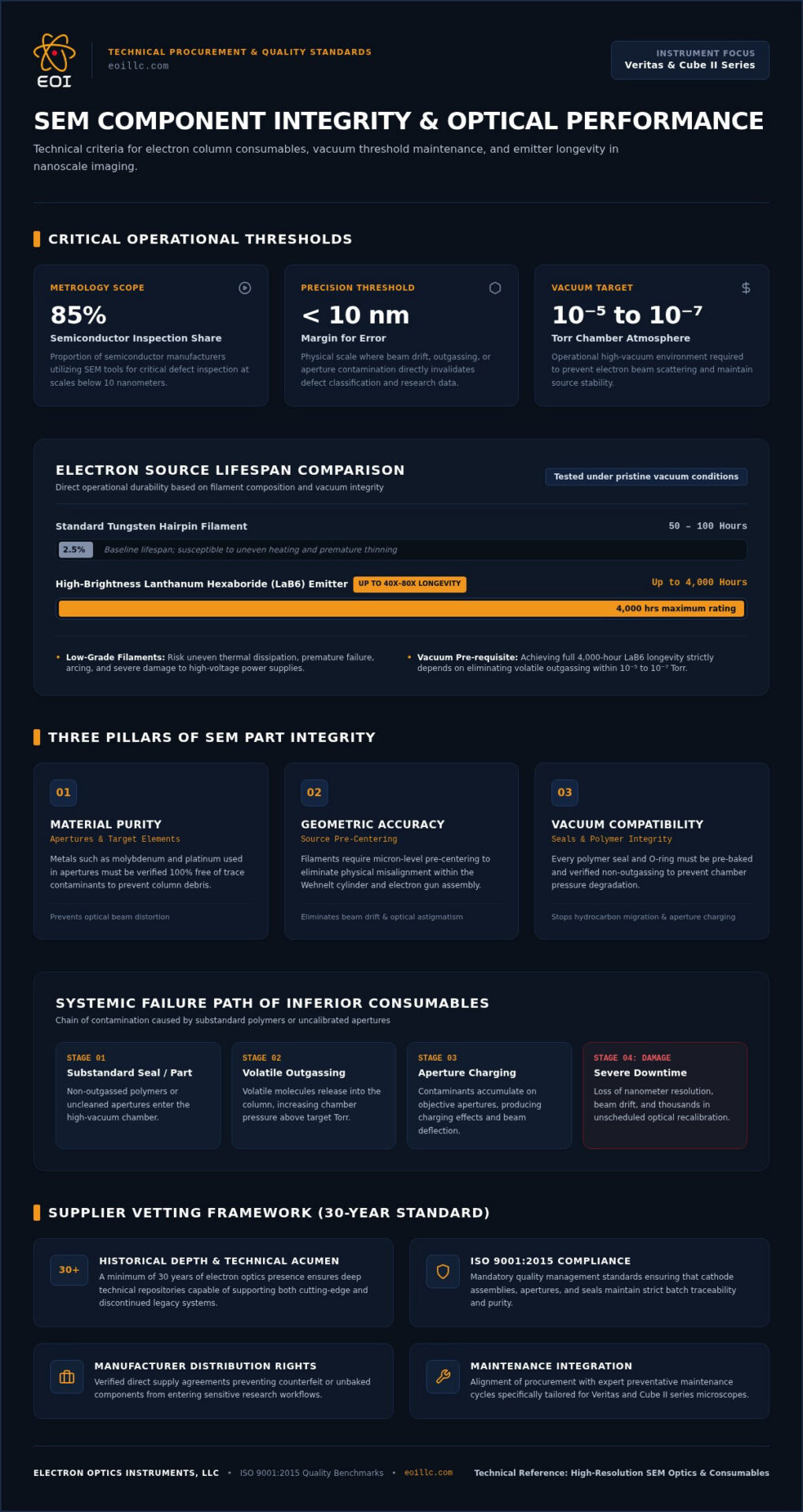
Scanning electron microscopy operates at the intersection of high-vacuum physics and precision electron optics, where the integrity of every individual component dictates the validity of the resulting data. For industrial facilities and research institutions, the stakes of instrument uptime are exceptionally high. In semiconductor manufacturing, for instance, nearly 85% of manufacturers utilize SEM tools for critical defect inspection at scales below 10 nanometers. A single failure in a secondary electron detector or a contaminated aperture doesn’t merely pause a workflow. It risks the loss of irreplaceable samples and consumes hundreds of labor hours in recalibration. Consequently, finding reliable sem parts suppliers is a strategic imperative for maintaining the imaging precision required in advanced materials science.
Utilizing substandard third-party components introduces variables that can degrade the entire electron column. Reliability in this context is defined by rigorous material purity and exact geometric precision. Even minor deviations in aperture diameter or the use of non-outgassed polymers in vacuum seals can lead to beam drift and resolution loss. The hidden costs of these failures extend beyond the price of the part, encompassing the systemic delays that ripple through a project’s timeline. Laboratories must account for several critical factors when evaluating part integrity:
- Material Purity: Ensuring that metals like molybdenum or platinum used in apertures are free from trace contaminants.
- Geometric Accuracy: Verifying that filaments are pre-centered to prevent misalignment within the Wehnelt assembly.
- Vacuum Compatibility: Confirming that all consumables are processed to prevent outgassing under high-vacuum conditions.
The Interdependence of Vacuum Systems and Part Quality
The maintenance of a stable high-vacuum environment, typically ranging from 10-5 to 10-7 Torr depending on the source type, is essential for preventing electron scattering. Inferior seals or unbaked components often release volatile molecules into the chamber, a process known as outgassing. This contamination migrates to the objective aperture, causing charging effects that distort the electron beam. Maintaining the delicate balance of these environments requires parts that adhere to strict ISO 9001:2015 quality management standards. High-purity components are necessary to ensure the cleanliness required for sub-nanometer resolution in systems like the Veritas or Cube II series.
Source Stability: Why Filament Quality Dictates Imaging Excellence
The electron source is the heart of the microscope, and its stability directly determines imaging excellence. Whether utilizing standard tungsten hairpin filaments or high-brightness Lanthanum Hexaboride (LaB6) emitters, material consistency is paramount. Low-grade filaments often suffer from uneven heating, leading to premature thinning and unpredictable lifespans. While tungsten filaments typically offer 50 to 100 hours of operation, specialized LaB6 cathodes can provide up to 4,000 hours if the vacuum environment remains pristine. Poorly manufactured sources cause beam drift and arcing, which can eventually damage high-voltage power supplies and compromise the entire optical path.
Key Indicators of a High-Authority SEM Parts Provider
Identifying high-authority providers requires more than a cursory review of digital catalogs. It’s about the intersection of technical prowess and industrial reliability. When finding reliable sem parts suppliers, laboratories must prioritize organizations that demonstrate a profound understanding of electron optics rather than those that simply manage inventory SKUs. A seasoned provider brings decades of field experience, often exceeding 30 years of industry presence, which ensures they can navigate the complexities of both legacy systems and modern Veritas or Cube II configurations. This historical depth acts as a repository of technical knowledge, allowing for the precise identification of compatible components even for discontinued models.
The depth of a supplier’s manufacturer support serves as a primary indicator of their technical standing. High-authority partners provide comprehensive solutions for major brands, including JEOL and FEI, while maintaining specialized roles, such as acting as the sole US distributor for EmCraft systems. This breadth of capability suggests a rigorous internal knowledge base and a commitment to international quality standards. To ensure the highest levels of accuracy, verify that your supplier adheres to ISO 9001:2015 certifications and utilizes cleanroom packaging protocols for sensitive optics, apertures, and emitters.
Technical Support and Expert Consultation
A “Service-First” philosophy distinguishes elite suppliers from transactional vendors. These partners provide expert troubleshooting alongside component sales, helping users diagnose whether a resolution issue stems from a failed filament or a deeper column misalignment. For those seeking to optimize their instrument life, professional preventative maintenance serves as a critical safeguard against unscheduled downtime. High-authority providers often offer on-site technical training, ensuring that your internal staff can perform part installations without risking damage to sensitive electron emitters or delicate detector assemblies.
Inventory Management and Logistical Excellence
Logistical reliability is critical in an era of tightening export controls, such as the U.S. ECCN 3B903 regulations that impact advanced microscopy equipment. Domestic inventory is essential to bypass the delays inherent in international shipping and complex customs clearance. Quality-controlled suppliers utilize batch-controlled traceability and specialized packaging to protect sensitive optics from environmental contamination or physical shock during transit. This meticulousness ensures that every aperture or scintillator arrives in a state of pristine readiness, preserving the imaging precision your research demands while stabilizing your operational budget.
Essential Consumables and Components: Prioritizing Quality in Procurement
Procurement of SEM consumables is a meticulous balancing act between operational budgets and technical performance. Daily laboratory functions rely on a steady supply of high-purity materials to maintain the integrity of the vacuum and the electron beam path. When finding reliable sem parts suppliers, it’s vital to categorize components based on their impact on imaging precision and vacuum stability. Routine items such as sample stubs and conductive adhesives are essential; however, the focus must remain on mission-critical hardware that directly influences the signal-to-noise ratio and resolution limits of the instrument.
Vacuum system maintenance requires specialized consumables, including hydrocarbon-free polyfluorinated (PFPE) greases and high-purity oils for mechanical backing pumps. Using generic O-rings or non-outgassed seals can introduce volatile molecules that migrate to the objective lens, leading to persistent charging effects and beam drift. Similarly, imaging hardware like Everhart-Thornley phosphor scintillators has a finite operational lifespan. As the phosphor coating degrades over time, the detector’s sensitivity diminishes, necessitating replacement to maintain the high-resolution standards expected of systems like the Cube II or Genesis series.
High-Resolution Consumables: Filaments and Emitters
The choice between tungsten hairpin filaments and specialized emitters depends on the required resolution and brightness. Standard tungsten filaments are valued for their robustness in high-vacuum environments and typically offer 50 to 100 hours of service. However, achieving nanometer-scale resolution often requires single-crystal Lanthanum Hexaboride (LaB6) cathodes, which provide ten times the brightness and up to 4,000 hours of life. For ultra-high-resolution applications, Schottky thermal field emission modules are the gold standard, offering 8,000 to 15,000 hours of operation. Identifying premature failure in these sources often reveals manufacturing defects or poor material centering, emphasizing the need for verified supplier provenance.
Analytical System Components: EDS and Integrated Hardware
Maintaining analytical precision requires seamless integration between the SEM column and Energy Dispersive Spectroscopy (EDS) systems. Finding reliable sem parts suppliers who understand the geometric constraints of detector positioning is essential for preventing mechanical interference during stage movements. The Veritas series, for instance, utilizes integrated hardware that demands specific maintenance parts to preserve X-ray collection efficiency. Whether you’re upgrading refurbished units with modern detector components or sourcing consumables for an active research fleet, prioritizing batch-controlled parts ensures that your analytical data remains consistent across multiple imaging sessions.
A Strategic Framework for Vetting Industrial and Research Suppliers
Establishing a rigorous procurement framework is essential for laboratories prioritizing imaging precision and long-term instrument health. Finding reliable sem parts suppliers involves a multi-stage validation process that transcends basic cost-benefit analysis. This strategic framework ensures that every component, from routine sample stubs to complex electron emitters, meets the exacting standards required for high-vacuum environments. By following a structured vetting process, procurement officers can minimize the risks associated with substandard hardware and ensure consistent laboratory uptime.
- Step 1: Verify Technical Credentials: Confirm that the supplier possesses deep industry experience, ideally exceeding 30 years, and holds legitimate manufacturer distribution rights, such as being the sole US distributor for EmCraft systems.
- Step 2: Audit Quality Assurance: Evaluate the supplier’s adherence to ISO 9001:2015 standards and their use of cleanroom protocols for packaging sensitive optics and apertures.
- Step 3: Evaluate Support Responsiveness: Test the technical team’s ability to provide troubleshooting guidance rather than just part numbers.
- Step 4: Review Contractual Terms: Analyze service contracts for explicit parts coverage and priority response times to stabilize operational budgets.
- Step 5: Incremental Testing: Begin the partnership by sourcing low-risk consumables before committing to high-value hardware like Schottky field emission modules.
Critical Questions for Procurement Officers
Procurement officers should inquire about the batch-testing procedures for tungsten filaments to ensure material uniformity across different production runs. It’s also necessary to confirm the supplier’s direct experience with specific architectures, such as the Genesis or Cube II series. High-authority vendors provide comprehensive technical documentation and installation guides, which are vital for maintaining internal maintenance protocols. Always ask for a verification of the origin of specialized emitters to ensure they haven’t been subjected to improper storage or handling.
Identifying Red Flags in the SEM Parts Market
The emergence of “gray market” components presents a significant risk to vacuum integrity and imaging resolution. Avoid unbranded apertures or non-vacuum-rated materials that lack verifiable provenance and batch-controlled traceability. A suspiciously low price often signals a compromise in material purity or a lack of proper outgassing procedures, which can lead to catastrophic column contamination. To mitigate these risks and ensure the longevity of your Veritas or Genesis system, source your high-purity filaments and consumables from a verified industry innovator with a proven track record in technical excellence.
Optimizing Laboratory Efficiency with Professional Service and Parts Integration
The procurement of high-precision components represents only the initial phase of maintaining an advanced electron microscopy suite. True operational excellence emerges from the synergy between quality hardware and professional preventative maintenance visits. When finding reliable sem parts suppliers, laboratories should seek partners who offer integrated support frameworks that extend beyond the point of sale. This holistic approach ensures that new filaments, apertures, and detectors are not only installed correctly but are also calibrated to the specific optical requirements of the instrument, thereby maximizing imaging precision and preventing arcing or vacuum failures. Expert-led repairs provide the technical depth necessary to diagnose underlying issues that a simple part replacement might overlook.
Annual service contracts provide a strategic mechanism for stabilizing laboratory budgets while ensuring peak equipment performance. By transitioning from a reactive repair model to a proactive maintenance schedule, research facilities can mitigate the high costs associated with emergency downtime. These agreements often include priority response times and comprehensive parts coverage, allowing for the seamless integration of new components into systems like the Veritas series or the Cube II benchtop SEM. This structured predictability is essential for sustaining long-term research initiatives and meeting the rigorous demands of industrial quality assurance. Finding reliable sem parts suppliers who also offer these service tiers ensures that your facility remains at the forefront of technological advancement.
The Comprehensive Service Model for Benchtop and Tabletop SEMs
Integrating parts supply with specialized support is particularly critical for compact systems such as the Cube II and Genesis series. Professional installation and calibration following a part replacement are vital for maintaining the high-resolution capabilities of these instruments. On-site technical training sessions further empower laboratory staff to understand the nuances of their equipment, ensuring they can perform routine maintenance that extends the longevity of sensitive electron emitters. This level of technical integration transforms a simple transaction into a strategic partnership, where the supplier’s 30 years of industry experience becomes a direct asset to your laboratory’s productivity.
Future-Proofing Your Research Infrastructure
Maintaining the viability of research infrastructure often requires the support of legacy or refurbished SEM units. Expert repairs and the availability of high-performance consumables, including those for EDS systems, allow older columns to achieve resolution standards that remain competitive in modern materials science. As the global scanning electron microscope market continues its expansion toward 2030, the reliance on verified supplier partnerships will only increase. Ensuring your facility is equipped with the latest detector components and high-purity emitters is fundamental to future-proofing your analytical capabilities against evolving industry standards.
Partner with Electron Optics Instruments, LLC for reliable SEM solutions and secure the technical authority your laboratory requires for continued innovation and imaging precision.
Securing the Future of High-Precision Imaging
The transition toward more complex nanostructures in materials science necessitates a procurement strategy that prioritizes technical authority over mere availability. Maintaining the integrity of your Veritas or Cube II system requires a rigorous vetting process that addresses the intersection of vacuum physics and electron optics. It’s clear that standardizing on ISO-compliant consumables and high-purity emitters allows laboratories to effectively mitigate the risks of column contamination. Finding reliable sem parts suppliers isn’t just about logistics; it’s the cornerstone of a resilient research infrastructure that ensures your analytical capabilities remain uncompromised by substandard hardware.
Electron Optics Instruments, LLC serves as a seasoned innovator with over 30 years of technical expertise in electron optics. As the sole US distributor for EmCraft Scanning Electron Microscopes, we provide national field service and preventative maintenance that bridges the gap between component supply and operational excellence. Our commitment to meticulousness ensures that every scintillator, aperture, and filament we provide supports the highest standards of imaging precision. This technical synergy allows your facility to push the boundaries of what is possible in advanced hardware systems.
Explore our comprehensive SEM service contracts and parts inventory to stabilize your laboratory’s performance and drive your research forward with confidence.
Frequently Asked Questions
What are the most common parts that need replacement in a Scanning Electron Microscope?
The most frequently replaced components include electron sources such as tungsten or LaB6 filaments, objective apertures, and detector scintillators. Routine consumables like vacuum grease, O-rings, and conductive carbon tapes also require regular replenishment. Maintaining a consistent inventory of these items is essential for preventing unscheduled downtime in industrial and research settings. Finding reliable sem parts suppliers ensures that these high-turnover components meet the exact geometric tolerances required for stable imaging.
How do I know if a third-party SEM filament is reliable?
Reliability in a third-party filament is determined by its material purity and precise centering on the ceramic base. You should verify that the supplier utilizes batch-controlled manufacturing and provides filaments that are pre-aligned to prevent beam drift. Inferior filaments often exhibit uneven heating or premature thinning, which can lead to unpredictable lifespans. High-authority vendors typically adhere to ISO 9001:2015 standards, ensuring that every electron source provides the brightness and stability your research demands.
Why is vacuum integrity so important when choosing SEM parts suppliers?
Vacuum integrity is the primary safeguard against column contamination and resolution loss. Suppliers must provide components, such as seals and apertures, that are processed in cleanroom environments to prevent outgassing. If a part releases volatile molecules under high-vacuum conditions, it can cause persistent charging effects or damage sensitive turbomolecular pumps. Choosing a provider with 30 years of experience ensures they understand the rigorous cleaning and packaging protocols necessary to maintain a pristine vacuum environment.
Can I use the same filaments for different SEM manufacturers?
No, filaments are not universal; they are engineered with specific pin configurations and base geometries for different manufacturers like JEOL, Hitachi, or Zeiss. Using a filament with an incorrect configuration can damage the Wehnelt assembly or cause high-voltage arcing. It’s vital to source components that are explicitly rated for your specific model. Finding reliable sem parts suppliers who offer a broad range of manufacturer-specific consumables is the most effective way to ensure hardware compatibility across your laboratory fleet.
What is included in a professional SEM service contract regarding parts?
Professional service contracts typically include priority field support, scheduled preventative maintenance visits, and coverage for critical wear-and-tear components. These agreements often bundle routine consumables like filaments and apertures to stabilize annual operational budgets. By integrating parts supply with expert-led inspections, laboratories can ensure that every replacement component is calibrated for peak performance. This comprehensive model reduces the logistical burden on procurement officers while maximizing the longevity of systems like the Veritas or Genesis series.
How often should SEM apertures and filaments be replaced for optimal resolution?
Replacement intervals depend on the source type and the intensity of your imaging sessions. Standard tungsten filaments generally require replacement every 50 to 100 hours of beam time, while high-brightness LaB6 emitters can last up to 4,000 hours. Apertures should be inspected monthly and replaced if they show signs of contamination or physical degradation. Regular replacement of these components is necessary to prevent beam aberrations and maintain the sub-nanometer resolution required for advanced materials analysis.
What are the risks of using low-cost aftermarket SEM consumables?
Utilizing low-cost aftermarket consumables introduces significant risks to the sensitive electron optics and high-voltage power supplies. Substandard materials often outgas, leading to carbon buildup on apertures and detectors, which permanently degrades image quality. Poorly centered filaments can cause arcing that destroys the gun assembly, resulting in repairs that far exceed the initial savings. High-authority providers prioritize material purity and vacuum compatibility to protect your capital investment from the systemic failures associated with generic parts.
Does Electron Optics Instruments provide parts for all major SEM brands?
Yes, Electron Optics Instruments, LLC provides comprehensive parts support and field service for all major SEM manufacturers. While we are the sole US distributor for EmCraft systems, our 30 years of technical expertise allows us to source high-quality consumables for JEOL, Hitachi, and FEI instruments. We maintain a robust inventory of filaments, apertures, and detector components to support a wide range of legacy and modern microscopes, including our proprietary Veritas and Cube II series.