
What if an older SEM’s recurring fault points to a failing electronic controller rather than a worn-out electron column? A blank image, unstable beam, or prolonged pump-down can have several possible causes. That is why the common failure points in older SEM models should be assessed by symptom and system, not age alone. Unplanned downtime can disrupt imaging and laboratory schedules, but replacing an instrument before the fault is understood may be premature.
Older systems can remain functional for decades, while electronics, vacuum components, electron sources, and control computers may need closer attention. The challenge is to distinguish an observable symptom from its possible causes, then gather enough information to choose a sensible next step.
This checklist covers warning signs, the system areas they may involve, and the observations to record before service. It also explains how to weigh repair, preventative maintenance, and replacement without assuming that an instrument’s age determines its remaining value.
Key Takeaways
- Treat vacuum, electron-source, beam, imaging, and stage symptoms as clues to investigate, not definitive diagnoses.
- Use symptom trends, repeatability, service history, and application needs to distinguish wear, maintenance conditions, and capability limitations.
- The common failure points in older SEM models involve different subsystems. Record operating conditions and review system logs before drawing conclusions.
- Follow manufacturer documentation and approved procedures. Leave internal repairs to qualified personnel.
- Compare repair, preventative maintenance, and replacement against the verified fault and the work the instrument needs to perform.
Common failure points in older SEM models: symptoms are clues, not diagnoses
A failure point is a component or subsystem whose condition may contribute to a change in instrument performance. In an older SEM, that change might show up as a longer pump-down, unstable signal, inconsistent images, or difficulty starting a session. These observations can narrow the investigation, but they do not identify a failed part by themselves. The common failure points in older SEM models are diagnostic categories, not a prediction that a particular component has failed.
Age-related wear is one possibility, but not the only one. Contamination, operating conditions, maintenance history, sample properties, or an external interruption may also affect performance. A change that follows maintenance or a shift in instrument use deserves attention alongside gradual deterioration. An SEM symptom identifies an investigation path, not a confirmed failed part.
How to read an older SEM’s changing performance
First, establish whether the symptom is repeatable. A single unusual image may reflect a sample-related effect or an isolated imaging artifact rather than a persistent instrument fault. Note when the change began, what happened beforehand, and whether it occurs again under comparable conditions.
Where practical, compare results across different samples, sessions, or operators. Record whether the symptom appears consistently and whether it changes with the setup. For example, document gradual focus drift as an observation rather than labeling it a specific component failure without supporting evidence. A concise timeline and repeatable observations give a technician a stronger basis for troubleshooting.
Which SEM systems can produce overlapping symptoms?
SEM performance depends on several interacting systems. Vacuum, electron source, beam control, detector, stage, and control system can all be relevant to startup or image-quality concerns. The Scanning electron microscope overview describes the instrument’s components and operation, offering context for why symptoms may overlap.
An inconsistent image, for instance, may have several plausible causes, while a startup problem can involve different system areas. Treat these as possibilities for qualified assessment, not instructions to open or adjust the instrument. A broader SEM maintenance guide can help frame routine care; model-specific troubleshooting should follow manufacturer documentation and approved procedures.
- Record: the symptom, when it began, and whether it repeats.
- Compare: performance across samples and sessions, using similar conditions where possible.
- Contextualize: recent maintenance, operating conditions, and interruptions.
These notes help distinguish a persistent instrument change from a one-off result and support a focused service discussion. They also reduce the risk of treating the SEM’s age as the diagnosis before the fault has been assessed.
Older SEM vacuum, electron-source, and imaging symptoms to check
Changes in pump-down behavior, emission, image quality, or stage movement can help focus an investigation, but none points to a single cause on its own. The common failure points in older SEM models span interconnected systems. Similar symptoms may come from the instrument, sample, operating conditions, or a combination of factors. Record what you observe before interpreting it.
Vacuum and electron-source warning signs
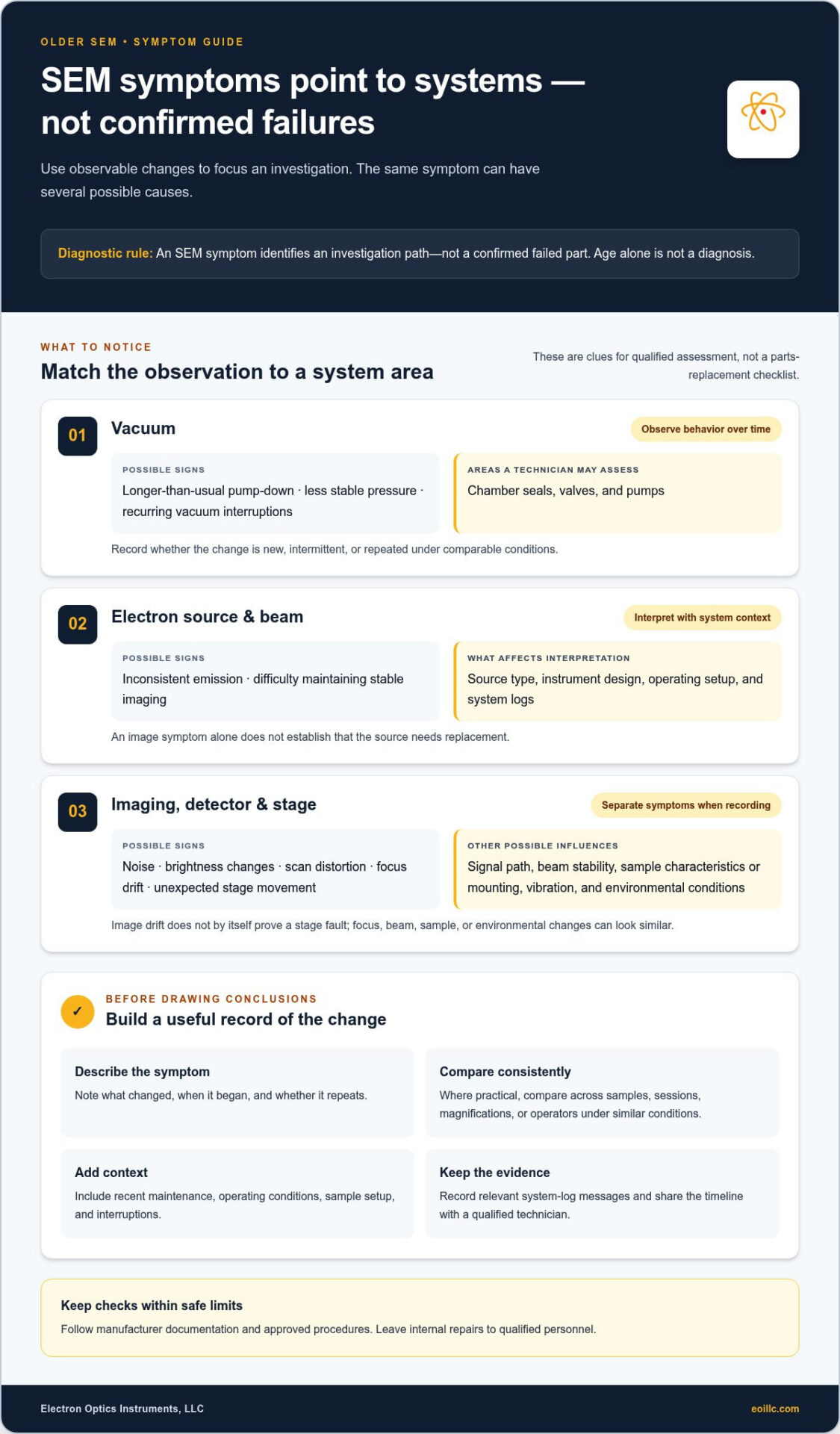
A pump-down that takes longer than usual, pressure that appears less stable, or recurring vacuum interruptions are reasons to review system history and operating conditions. Chamber seals, valves, and pumps are among the areas a qualified technician may assess, but the observation alone does not establish which, if any, is responsible. Note whether the behavior is new, intermittent, or repeated under comparable conditions.
Inconsistent emission or difficulty maintaining stable imaging may also warrant attention to the electron source. Interpretation depends on the source type, instrument design, operating setup, and system logs. Do not infer that a source needs replacement from an image symptom alone. Use the manufacturer’s documentation and approved procedures to guide checks, and leave internal work to qualified personnel.
Image, detector, and stage irregularities
Noise, changing brightness, scan distortion, focus drift, or unexpected stage movement can each have multiple explanations. Detector or signal-path behavior may be relevant to noise or brightness changes, while beam stability, sample characteristics, vibration, or other environmental variables can also affect the image. Image instability is a reason to investigate, not proof of an electron-source fault.
Observe stage behavior separately. Note whether movement is unexpected or inconsistent, and whether it is associated with a particular session or setup. Do not assume that image drift means the stage is at fault: changes in focus, beam conditions, sample mounting, or environmental conditions can produce similar observations.
- Vacuum: Note pump-down behavior, pressure stability, and any recorded interruptions.
- Source and beam: Describe emission or image stability without assigning a component failure.
- Imaging and stage: Record noise, brightness changes, distortion, drift, or unusual movement.
For each symptom, document whether it persists across magnifications, sessions, and prepared samples. Include relevant conditions and system-log messages, comparing like with like where possible. A problem limited to one sample or setup may lead the investigation in a different direction from a repeatable change across sessions. Check procedures against the documentation for the specific instrument, since designs and diagnostic methods vary.
When patterns remain unclear, structured troubleshooting can help clarify the fault before repair or maintenance decisions are made. Electron Optics Instruments, LLC services electron microscopes from major manufacturers. Its SEM service and repair support can help assess recurring symptoms and determine the next step.
How to distinguish SEM wear, maintenance issues, and system obsolescence
A recurring SEM problem can reflect gradual component wear, a correctable maintenance condition, or a limitation in what the instrument can do. These categories call for different decisions. A fault may be repairable even if the system’s capabilities no longer meet current application needs. Conversely, an older instrument may still perform required work despite its age. Assess the common failure points in older SEM models against observed trends, service history, and operational requirements rather than age alone.
Gradual wear
Look for a persistent change that develops over time, recurs under comparable conditions, or appears in the service history. These patterns can justify technical assessment, but do not identify the affected part or establish that replacement is necessary.
Maintenance or operating conditions
Consider changes in usage, sample preparation, contamination, or maintenance intervals. Symptoms that appear after a change in routine or near a service event are useful context, not proof of cause.
Capability limitation
Assess whether the instrument can meet current image, analytical, throughput, and workflow requirements. A stable SEM may still fall short of a new application without having a repairable fault.
Use the same comparison dimensions for each category:
- Observed trend: Is performance gradually changing, intermittent, or consistently below a current requirement?
- Repeatability: Does the issue return under similar conditions, or was it isolated?
- Service history: Did maintenance, repairs, or operating changes occur near the time the symptom began?
- Impact on required work: Does the condition prevent a necessary task, or is the concern about future capability?
When symptoms may point to maintenance or operating conditions
Contamination, altered usage patterns, sample preparation, and gaps or changes in scheduled care can all provide relevant diagnostic context. Record when a symptom occurs, which samples and settings were involved, and whether it followed a maintenance visit or change in routine. These details help frame a technical assessment, but do not establish a cause on their own. A dedicated SEM preventative maintenance guide can provide broader context for scheduled care.
Compare the instrument’s current condition with its documented maintenance history. If a symptom recurs, note its pattern rather than assuming that a particular maintenance task will resolve it. Use the manufacturer’s instructions and approved procedures when evaluating routine care.
When an older SEM may no longer meet the application
Define the work the instrument must support, then compare those requirements with demonstrated performance. Consider the image quality and analytical results needed, expected throughput, and whether existing software and workflows support the process. An SEM techniques guide can help clarify what different applications demand from an instrument.
This is a capability decision, not automatically a repair diagnosis. Repair may address a verified fault, while preventative maintenance supports ongoing instrument condition; neither necessarily changes an instrument’s inherent capabilities. Replacement is a separate option to evaluate when documented performance no longer aligns with required work. Avoid fixed age or cost thresholds. The decision depends on verified fault scope, service history, and application priorities.
A practical checklist for documenting older SEM problems
Clear records make troubleshooting more efficient by showing what changed, when it happened, and whether it can be reproduced. For the common failure points in older SEM models, disciplined observation is a useful first step. Do not open the instrument or attempt an internal repair. Follow manufacturer documentation and approved procedures throughout.
What to record before requesting troubleshooting
Build a concise record in a consistent order. Include enough detail for a service team to understand the circumstances without guessing:
- Identify the instrument: Record the manufacturer, model, and other identifying information available in the instrument documentation.
- Describe the behavior: State what changed, when it began, how often it occurs, and what the instrument was doing at the time. Write “image brightness fluctuates during scanning,” rather than concluding that the detector has failed.
- Capture session conditions: Note relevant settings, sample type or preparation, and whether the symptom appears at particular magnifications or during a specific part of operation.
- Save displayed information: Transcribe error messages accurately, including when they appear. Preserve logs or representative images only when the manufacturer’s procedures permit it.
- Document recent changes: Include maintenance, consumable changes, relocation, or changes in operating routine that may provide useful context.
Keep the record factual and chronological. A service event shortly before a symptom is worth noting, but timing alone does not prove a causal connection. Include relevant changes and the absence of obvious changes, then note what you have already compared or repeated.
How to prioritize the next diagnostic step
First, distinguish an isolated event from a recurring pattern. If a problem appears once and cannot be reproduced, record it and watch for recurrence according to approved operating procedures. If it returns across sessions, affects routine work, or coincides with repeated interruptions, arrange a more formal assessment.
Compare conditions that are reasonably similar, such as the same type of prepared sample or a comparable imaging setup. This can help clarify whether the behavior is tied to one sample or session, but it will not confirm which subsystem is responsible. Share the comparison and supporting records with the service team.
Respect warnings and stop instructions. Do not continue operating the SEM if its displayed fault or manufacturer-approved procedure directs you to stop, and do not remove covers or attempt internal adjustments unless you are qualified and explicitly authorized to do so. Repeated restarts may obscure useful information or conflict with the instrument’s procedures.
When recurring interruptions or unstable operation affect scheduled work, a qualified service assessment can help establish the fault scope and inform next steps. Organized notes support that process. For SEM service and maintenance support, gather the instrument details, symptom timeline, messages, and relevant service history.
Repair, maintain, or replace an older SEM: plan the next step
Choosing what to do with an older SEM starts with a clear picture of the fault and the work the instrument must support. Consider the verified problem, application requirements, service history, and operational impact together. Age alone cannot establish that a system is beyond repair, just as restoring operation will not necessarily resolve a gap between current capabilities and laboratory needs.
Repair, preventative maintenance, and replacement serve different purposes. Repair addresses a diagnosed fault; maintenance supports assessment and ongoing instrument condition; replacement is an option to evaluate when the system no longer aligns with required work or operational priorities. None is an automatic outcome of a symptom or service visit. The common failure points in older SEM models provide a starting point for investigation, not a substitute for establishing the fault’s scope.
What a service assessment can clarify
Documented symptoms, operating conditions, system messages, and service history give a technician a more focused basis for troubleshooting. An assessment can help identify which system area requires attention and distinguish a verified fault from other contributing factors. It can also inform whether repair or preventative maintenance is the more relevant next step, without presuming a particular result.
Electron Optics Instruments, LLC provides service, repair, and preventative maintenance for electron microscopes from major manufacturers. Its technicians bring more than 30 years of industry experience to evaluating older instruments. That experience supports an assessment across different systems without assuming similar symptoms have identical causes or outcomes. Any decision should account for the actual findings and the instrument’s role in your workflow.
When replacement deserves a separate evaluation
Replacement merits consideration when an SEM repeatedly interrupts work, no longer meets application requirements, or presents supportability concerns that affect operational planning. Assess whether its demonstrated imaging and analytical capabilities meet current needs, how recurring downtime affects schedules, and whether the system can support the required workflow. These are separate questions from whether an individual fault can be repaired.
Capital planning should compare options in context, including the consequences of maintaining the current system and the requirements of a suitable alternative. Avoid deciding from an assumed repair threshold or the instrument’s age alone. An electron microscope cost guide can provide broader planning context, while actual choices should reflect the instrument and application under consideration.
Before deciding, bring together the documented fault, service history, required capabilities, and operational priorities. That evidence helps clarify whether repair, preventative maintenance, or replacement best supports the laboratory’s work. To discuss the next step, discuss SEM service and equipment options with Electron Optics Instruments, LLC.
Turn diagnostic findings into a clearer plan
Use troubleshooting findings to establish a practical baseline for the instrument: what work it supports reliably, which changes need attention, and what conditions should prompt another assessment. This gives your team a stronger foundation for maintenance planning and future equipment decisions, rather than treating each interruption as an isolated event. The common failure points in older SEM models can guide that process, but the right next step depends on evidence from your system and its role in the lab.
If the fault remains uncertain or recurring interruptions affect planned work, professional assessment can help clarify the options. Electron Optics Instruments, LLC supports electron microscopes from major manufacturers through service, repair, preventative maintenance, and training. Its technicians bring more than 30 years of industry experience to this work.
Discuss SEM service and equipment options with Electron Optics Instruments, LLC to plan the next step for your laboratory.
Frequently Asked Questions
Is it normal for an older SEM to produce noisier images?
Image noise can occur on an older SEM, but it is not a reliable age indicator. If reference images are available, compare them with new images captured using similar sample types, scan conditions, and detector configurations. Note whether the noise is uniform, localized, or changes during a scan. Avoid changing several settings at once, since that makes comparisons harder. If noise persists, preserve your observations for qualified review.
What are the most common failure points in older SEM models?
Potential trouble areas include vacuum components, electron-source assemblies, beam-control systems, detectors, stages, and control electronics. These common failure points in older SEM models are not a ranked list. No single subsystem can be identified without considering the instrument’s design and available evidence. For example, a startup message may help distinguish a control-system concern from an imaging issue. Model-specific logs and service records can help a technician narrow the investigation.
Can an older SEM be repaired if its vacuum system is unstable?
Possibly, but unstable vacuum alone does not show whether repair is required or which component is involved. Record any pressure or status indications the instrument provides, along with when interruptions occur and whether they follow a consistent pattern. Follow the model’s operating instructions, and do not bypass warnings or continue if approved procedures direct you to stop. If instability persists or prevents normal operation, arrange a qualified assessment.
How do I know whether my SEM needs maintenance or repair?
Maintenance typically concerns planned inspection and care; repair focuses on investigating a fault or degraded function, though the work can overlap. One useful distinction is whether the concern is a scheduled service task or a specific change from established performance. For example, a new recurring startup warning warrants investigation rather than being treated as routine upkeep. Review the instrument’s maintenance schedule and service history before deciding what kind of assessment is appropriate.
What should I record before calling for SEM service?
Record the instrument model, symptom, timing, repeatability, displayed messages, and recent service or operating changes. If readily available, include the control-software version and identify the workflow affected, such as routine imaging or a particular analytical task. Keep the exact wording of messages instead of paraphrasing, and distinguish what you observed from what you suspect. Collect images or logs only when the instrument’s procedures permit it.
Should I repair or replace an older SEM?
Make the decision after assessing the fault and the instrument’s fit for its application. A focused problem affecting a system that still meets laboratory requirements presents a different decision from recurring downtime or a capability gap that prevents required analysis. Review work interruptions, service history, supportability, and the performance needed for upcoming projects. Age by itself does not establish that replacement is the better choice.
Can poor sample preparation look like an SEM failure?
Yes. Sample charging, contamination, or inconsistent preparation can affect image appearance and may be mistaken for an instrument problem. For example, if an artifact appears on one specimen but not on other appropriately prepared samples, sample-related factors may warrant closer consideration. Compare results using established preparation and operating procedures, and avoid changing multiple variables at once. If the issue also appears across samples or accompanies instrument warnings, document the pattern for qualified troubleshooting.