
What if the most defensible annual cost to run a tabletop SEM isn’t a single industry average, but a model built around your lab’s actual workload? An equipment quote establishes the initial investment, but it may not include recurring consumables, maintenance, utilities, software, or operator time. Support scope and expected uptime also affect how confidently you can plan.
That uncertainty is understandable. Expenses may be quoted separately, and a low-use teaching instrument won’t have the same operating profile as a system supporting frequent analysis. Start by separating recurring costs from purchase expenses, then connect each budget category to how the instrument will be used.
This guide outlines the annual budget categories to consider, explains how usage and configuration affect estimates, and provides a consistent framework for comparing support approaches. It also shows which assumptions to verify against model documentation and supplier quotes, so your forecast reflects your lab rather than an unsupported average. Whether you’re assessing Cube II or Genesis requirements, the goal is a transparent operating model for practical planning and informed comparison.
Key Takeaways
- Build the annual cost to run a tabletop SEM from recurring expenses and lab-specific workload, not the equipment quote alone.
- Check which utilities, consumables, scheduled service, repairs, and training needs apply to your selected model.
- Compare light, typical, and intensive use with consistent assumptions for operating hours and sample volume.
- Use a worksheet to set the budget period, gather documented inputs, annualize costs, and record assumptions for review.
- Confirm service scope and model-specific requirements in current documentation and quotes; consider Cube II or Genesis only if they fit your lab’s needs.
What Does the Annual Cost to Run a Tabletop SEM Include?
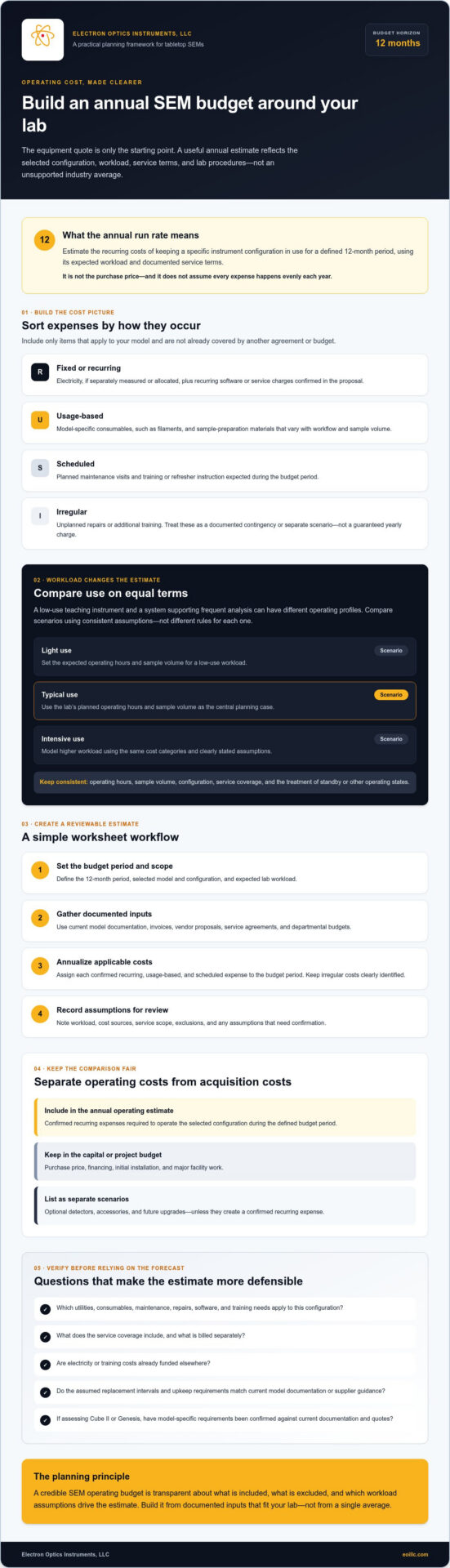
The annual cost to run a tabletop SEM is the set of recurring and usage-dependent expenses required to operate a selected instrument during a defined 12-month budget period. It is an annual run rate, not the instrument’s purchase price or a prediction that every expense will occur evenly each year.
Definition: “An annual SEM operating budget estimates the recurring costs of keeping a specific configuration in use for 12 months, based on its workload, service terms, and lab procedures.”
This boundary makes estimates easier to compare. Total cost of ownership takes a wider view across the instrument’s service life. The annual run rate answers a narrower planning question: what expenses should the lab assign to this year of operation? For background on the instrument and its components, see this overview of the Scanning electron microscope (SEM).
Which SEM expenses belong in the annual budget?
Include an expense only if it applies to the selected model and isn’t already covered by another budget or agreement. Classify each item by how it arises:
- Fixed or recurring: Electricity, if separately measured or allocated, and recurring software or service charges confirmed in the proposal.
- Usage-based: Model-specific consumables, such as filaments, and sample-preparation materials that vary with workflow and sample volume.
- Scheduled: Planned maintenance visits and training or refresher instruction expected during the budget period.
- Irregular: Unplanned repairs or additional training prompted by staffing or application changes. Treat these as a documented contingency or a separate scenario, not a guaranteed yearly charge.
Review vendor proposals, service agreements, and departmental budgets line by line. Confirm what service coverage includes, which consumables are required, and whether electricity or training is funded elsewhere. Requirements vary by configuration and use, so verify assumptions against current model documentation and quotes.
What should stay outside the annual operating estimate?
Keep acquisition costs separate from recurring operation. Record purchase price, financing, initial installation, and major facility work in the capital or project budget, rather than blending them into the first year’s run rate. List optional detectors, accessories, and future upgrades as separate scenarios. Include them in the annual estimate only if they create a confirmed recurring expense.
This separation prevents a one-time investment from distorting year-to-year comparisons. It also makes clear whether a change in the annual estimate reflects workload, service scope, or a different configuration. For wider acquisition and ownership context, consult the electron microscope cost guide alongside this operating-budget framework.
Which Recurring Tabletop SEM Expenses Change from Year to Year?
Not every SEM generates the same annual expenses, and some costs may not apply to a particular model or lab. To estimate the annual cost to run a tabletop SEM, classify each expense as fixed or recurring, usage-based, scheduled, or irregular. Then confirm it against the instrument’s documentation, invoices, and written vendor quotes.
- Utilities: Electricity costs depend on documented power consumption, actual operating hours, and the lab’s utility rate. Ask how the estimate treats standby or other operating states instead of assuming the instrument runs continuously.
- Consumables: Source components and other required consumables depend on the selected configuration, workload, and sample workflow. Find replacement intervals and vacuum-related upkeep requirements in the manufacturer’s maintenance documentation or confirm them with the service provider.
- Scheduled service: Preventive maintenance and service-contract charges are easier to plan when scope and timing are specified. Check what is covered and what is billed separately.
- Repairs: Unplanned repair expenses are irregular, not an automatic annual charge. Review the lab’s service history, and distinguish past repair spending from contractual commitments.
- Training: Budget for training when it is expected during the period, such as onboarding staff or refreshing operator skills. Confirm whether it is included in a proposal, funded by a department, or arranged separately.
How do utilities and consumables affect annual SEM costs?
Use model-specific figures rather than generic assumptions. For electricity, multiply documented power consumption by estimated operating hours, then apply the lab’s utility rate and accounting method. For consumables, list the items required by the selected instrument’s maintenance documentation, including applicable source components and replacement intervals. Sample type and preparation practices may also affect material use. Confirm any vacuum-related upkeep and its timing with the manufacturer or service provider before including it in the annual estimate.
How should service, repairs, and training be budgeted?
Compare preventive maintenance visits and service agreements by scope, scheduled work, response terms, parts coverage, and exclusions. Plan contract charges as recurring expenses; keep repairs outside that scope in a separate variable category. Use invoices and service records to understand the lab’s history, but don’t treat a past repair as a guaranteed yearly cost. Record training separately and note whether it is planned or conditional.
Electron Optics Instruments, LLC provides preventative maintenance visits, service contracts, repairs, training, and SEM consumables. To clarify which support items fit your configuration and workload, you can discuss your SEM support requirements.
Why Does Annual Tabletop SEM Cost Vary by Lab and Service Plan?
Estimates vary with instrument use and the assumptions behind the quote. A lab processing a limited number of samples won’t necessarily use materials, electricity, or operator time at the same rate as one doing frequent, high-throughput work. Configuration and service-plan scope also affect comparisons. Transparent inputs make estimates easier to compare and revise.
Define light, typical, and intensive use from your lab’s actual or forecast operating hours and sample volume. These profiles are comparison tools, not universal utilization standards. Populate each one with documented figures, then keep the instrument configuration constant to isolate the effect of workload.
| Lab-defined use profile | Workload basis | Consumables and utilities | Scheduled service and coverage | Training needs |
|---|---|---|---|---|
| Light | Enter lower planned operating hours and sample volume. | Estimate from expected use, applicable consumables, and documented power consumption. | Record required maintenance and compare quoted coverage with likely support needs. | Include planned onboarding or refresher training. |
| Typical | Enter the lab’s expected routine hours and sample throughput. | Use expected material consumption and operating hours to build the estimate. | List scheduled visits, contract scope, exclusions, and any uncovered repair exposure. | Reflect the staff and workflow expected during normal operation. |
| Intensive | Enter higher forecast hours and sample volume based on a credible demand plan. | Recalculate consumption and utility assumptions for the greater workload. | Check that maintenance timing and service terms align with planned use and downtime tolerance. | Account for added operator onboarding or application-specific instruction if needed. |
How do operating hours and sample volume affect the estimate?
Use actual instrument logs where available. For a new system, document the forecast and its basis instead of assuming continuous operation or applying a universal utilization rate. Sample throughput matters too: more samples may require additional operator time, consumables, or instrument scheduling. Keep workload-driven changes distinct from costs caused by choosing a different configuration or support plan. Verify operating and replacement assumptions against current model documentation.
How should service-contract and ad hoc repair options be compared?
Review written proposals side by side, including coverage, exclusions, response arrangements, scheduled visits, and parts terms. A contract can make some expenses more predictable, while ad hoc repair costs depend on events. Neither approach is automatically less expensive. Consider budget predictability and the operational impact of downtime, then consult an SEM maintenance guide for broader planning context. Tabletop systems may reduce facility demands in some settings, but confirm installation and utility requirements for the specific instrument and lab.
How Can You Calculate an Annual Tabletop SEM Operating Budget?
A defensible estimate comes from a repeatable method, not a market-wide average. Use this five-step worksheet to calculate the annual cost to run a tabletop SEM for a defined period, workload, and configuration:
- Set the period: Enter the 12-month budget start and end dates.
- Define workload: Record expected operating hours, sample volume, and relevant workflow assumptions.
- Collect inputs: Gather current utility rates, model-specific consumable requirements, maintenance schedules, service terms, and available repair history.
- Annualize expenses: Convert applicable recurring charges and expected usage-based expenses to the same 12-month period.
- Review assumptions: Document unresolved items, quote dates, inclusions, exclusions, and confidence in each input before procurement review.
Annual operating estimate = applicable recurring costs + usage-based costs. For example, calculate electricity as documented power consumption × estimated operating hours × the lab’s applicable utility rate. For consumables, use the documented replacement interval and expected workload. Don’t substitute an industry average when model-specific information is available.
What information should a tabletop SEM cost worksheet collect?
Keep a record for each proposal or scenario, including model and configuration, expected operating hours, sample volume, and applicable consumables. Add utility-rate assumptions, service-plan terms, scheduled maintenance, and historical repair information. Note the source and confidence level for every input. Mark unknown requirements as “confirm with vendor” instead of filling gaps with estimates that aren’t tied to your instrument or lab.
- Input: Record the value, unit, source, and date obtained.
- Coverage: Note whether the expense is included, excluded, or funded by another department.
- Confidence: Identify whether the figure is documented, forecast, or awaiting confirmation.
How can teams compare vendor quotes on equal terms?
Request itemized recurring charges and written details on parts coverage, exclusions, planned visits, and response conditions. Normalize each proposal to the same 12-month period, workload, and configuration before comparing totals. Otherwise, differences may reflect mismatched assumptions rather than meaningful cost distinctions. Keep purchase-related quote evaluation separate from operating expenses, and consult the SEM price-factors guide for acquisition context.
For help clarifying model-specific requirements and support inputs for your worksheet, discuss your SEM budget assumptions with Electron Optics Instruments, LLC.
How Can EOI Help You Plan Tabletop SEM Ownership Costs?
A lab-specific estimate depends on more than model selection. Configuration, expected workload, applicable consumables, maintenance schedules, service scope, and training all affect the annual operating picture. Electron Optics Instruments, LLC (EOI) can help clarify equipment and support options so your comparison reflects the instrument and use case under consideration, rather than a generic cost assumption.
EOI distributes benchtop and tabletop SEMs nationally in the United States, including the Cube II and Genesis. These models may be worth discussing if they align with your imaging requirements and operating plans. EOI also offers preventative maintenance visits, service contracts, repairs, training, and SEM consumables. Confirm which requirements apply to your selected configuration and which items are included or quoted separately.
What should you ask before selecting a tabletop SEM?
Ask for model- and configuration-specific operating assumptions, including applicable consumables and maintenance requirements. Clarify which support tasks, parts, and training are covered by a proposal or service agreement, and which would be separate expenses. Then request a written estimate based on your expected operating hours, sample volume, and defined budget period. Recording these details makes procurement comparisons more consistent and easier to review.
How can lifecycle support improve budget planning?
Scheduled maintenance and clearly defined service terms help teams identify planned commitments and distinguish them from uncertain repair needs. EOI brings more than 30 years of industry experience to equipment and lifecycle-support discussions. Its distribution serves customers nationally in the United States; confirm the specific service arrangements and coverage applicable to your lab. For operational considerations beyond budgeting, consult an SEM operation guide.
With your workload assumptions and open questions in hand, discuss a tabletop SEM and support plan with EOI.
Turn Your SEM Budget Into a Practical Plan
A defensible annual cost to run a tabletop SEM estimate starts with your lab’s actual or forecast workload and includes the recurring expenses that apply to the selected configuration. Keep one-time acquisition and installation costs separate, and compare service options using consistent assumptions about coverage, maintenance, and potential repair needs.
Document the source and confidence level for each input. Confirm model-specific requirements, consumable use, and support terms in current documentation and written quotes rather than filling gaps with a universal average. This gives procurement and lab teams a clearer basis for reviewing operating needs as workloads or plans change.
Electron Optics Instruments, LLC brings more than 30 years of electron microscopy industry experience, distributing equipment and offering maintenance, repair, and training support nationally across the United States. If you’re evaluating tabletop SEM requirements, support scope, or annual budget assumptions, discuss your tabletop SEM requirements with EOI. With verified inputs and a model aligned to your work, your lab can move forward with greater confidence in its operating plan.
Frequently Asked Questions
How much does it cost to run a tabletop SEM per year?
There isn’t one dependable annual figure for every lab. The annual cost to run a tabletop SEM depends on the selected model and configuration, operating hours, sample workflow, consumables, utility rates, maintenance, service terms, and training needs. Build an estimate for a defined 12-month period using current model documentation, lab records, and written quotes. Keep one-time acquisition and installation expenses separate from recurring and usage-based operating costs.
What expenses should an annual tabletop SEM operating budget include?
Include expenses that apply to your configuration and budget period: electricity, model-specific consumables, planned maintenance, service coverage, repairs, and training. Classify them as recurring, usage-based, scheduled, or irregular so a past repair isn’t mistaken for a guaranteed annual expense. Check vendor proposals and service agreements for inclusions and exclusions, and verify whether any costs are already covered by another departmental budget.
How much electricity does a tabletop SEM use?
Electricity use depends on the instrument’s documented power consumption and how long it operates, including any relevant operating states identified by the manufacturer. Estimate annual energy by multiplying the applicable power figure by expected operating hours, then apply your lab’s utility rate and accounting method. Confirm the correct operating assumptions for the selected model rather than assuming continuous use or relying on a generic figure.
Does a tabletop SEM need an annual service contract?
Not every lab requires the same service arrangement. Start with the manufacturer’s maintenance recommendations, then assess the instrument’s workload, the lab’s repair history, downtime tolerance, and available technical support. Compare a contract’s scheduled visits, coverage, parts terms, exclusions, and response arrangements with an ad hoc repair approach. Request written terms so you can assess budget predictability without assuming that either option is always less expensive.
How often do tabletop SEM consumables need to be replaced?
Replacement timing varies by instrument model, consumable type, operating hours, and sample workflow. Check the selected SEM’s maintenance documentation for applicable components, recommended intervals, and usage conditions, then compare those assumptions with lab records. Ask the supplier or service provider to confirm any unclear requirements in writing. Don’t use a general replacement schedule as a substitute for model-specific guidance, since configurations and usage patterns can differ.
Is a tabletop SEM less expensive to operate than a full-size SEM?
It may have lower facility demands in some settings, but operating expenses depend on the instruments being compared, their configurations, workloads, and service arrangements. Compare electricity, consumables, maintenance, repairs, and training over the same period, using equivalent workload assumptions. Also confirm installation and facility requirements for each specific system. A tabletop format alone doesn’t establish which instrument will have the lower annual operating cost for your lab.
How do you calculate the cost per sample for SEM analysis?
Divide the operating expenses you intend to allocate by the number of samples processed during the same period: cost per sample = allocated operating costs ÷ samples analyzed. Define what the numerator includes, such as consumables, utilities, service, and operator time, and use a consistent sample-counting method. If some expenses are fixed while others vary with use, show both components so changes in throughput don’t obscure the underlying budget assumptions.