

The most substantial financial burden in high-resolution imaging is rarely the initial procurement price, but rather the silent accumulation of specialized infrastructure modifications and recurring logistical overhead. You likely recognize that while traditional floor-model systems provide exceptional resolution, the hidden costs of vibration isolation, dedicated cooling, and extensive facility preparation often destabilize long-term budgets. For many research institutions and industrial facilities, analyzing the long term cost of ownership tabletop sem systems reveals a compelling pathway toward fiscal stability and operational independence. This guide serves as a comprehensive 2026 framework to help you justify capital investments by mapping the total lifecycle of these advanced instruments.
We’ll provide a detailed ten-year cost projection that accounts for everything from “zero-infrastructure” advantages to the strategic value of multi-tiered service contracts. You’ll discover how the transition to in-house tabletop microscopy eliminates the high cost-per-sample associated with external core facilities while significantly reducing total laboratory overhead. By examining the synergy between technical integration and sustainable performance, this analysis empowers your team to make an expert-driven procurement decision that prioritizes both precision and profitability.
Key Takeaways
- Understand how the long term cost of ownership tabletop sem systems is optimized through the elimination of intensive facility modifications and specialized electromagnetic shielding.
- Evaluate the strategic trade-offs between tungsten filaments and high-brightness electron sources to align recurring operational expenses with your laboratory’s specific throughput requirements.
- Learn to mitigate financial volatility by utilizing multi-tiered service contracts that stabilize maintenance budgets and protect critical electron optics from unforeseen technical failures.
- Quantify the significant “Zero-Infrastructure” advantage, allowing instruments like the Cube II to function in standard environments without the capital investment required for floor-model vibration isolation.
- Develop a procurement strategy that balances resolution demands with fiscal responsibility, selecting from the Veritas series for high-end applications or the Genesis series for versatile industrial analysis.
Defining Total Cost of Ownership (TCO) for Tabletop SEMs
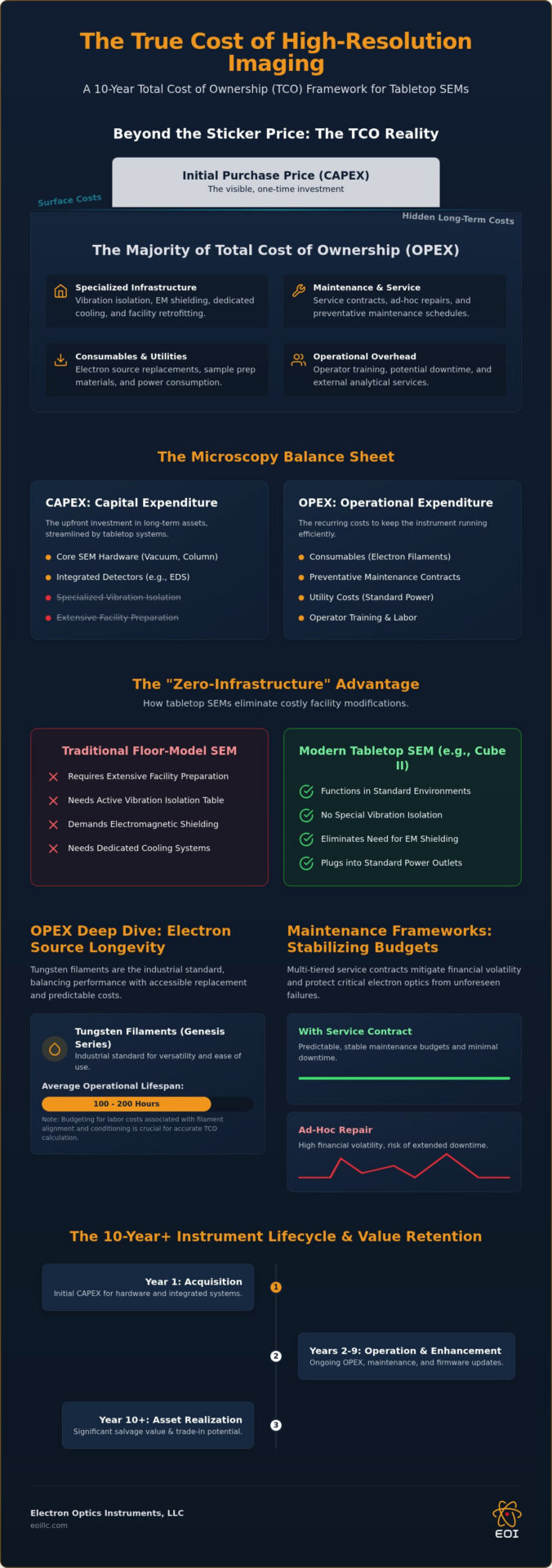
Quantifying the financial impact of a Scanning electron microscope (SEM) requires a move beyond simple sticker price analysis. Total Cost of Ownership (TCO) represents the aggregate of initial capital expenditure (CAPEX) and the cumulative operational expenditure (OPEX) sustained over the instrument’s functional life. While high-end floor-standing models often demand extensive facility preparation, the 2026 market increasingly favors decentralized industrial quality control using tabletop units. This shift is driven by the need for agility in manufacturing environments where technical integration and rapid data acquisition are paramount. Understanding the long term cost of ownership tabletop sem systems involves distinguishing between hard costs, such as the core hardware, and soft costs, including operator training, facility preparation, and potential downtime. Selecting a tabletop unit often eliminates the peripheral CAPEX associated with specialized vibration isolation tables.
CAPEX vs. OPEX: The Microscopy Balance Sheet
Acquiring research-grade units like the Cube II Benchtop SEM involves a primary CAPEX outlay that covers the vacuum system, electron column, and detectors. In corporate R&D environments, these assets follow rigorous amortization schedules that reflect their role in large-scale production cycles. Strategic budgeting must also account for integrated systems like EDS (Energy Dispersive Spectroscopy) at the point of purchase. Integrating EDS into the initial CAPEX often proves more cost-effective than retrofitting, as it streamlines the technical workflow and reduces the need for external analytical services. OPEX, conversely, remains a fluid variable influenced by consumable consumption and preventative maintenance schedules. High-throughput laboratories must calculate these recurring costs to ensure the long term cost of ownership tabletop sem remains within projected budgetary limits.
The 10-Year Lifecycle Projection
Modern tabletop scanning electron microscope models are engineered for an operational lifespan exceeding ten years when supported by professional maintenance. During this decade, the TCO framework must account for technological obsolescence and the evolving standards of industrial performance. Reliable partners mitigate this risk through consistent firmware updates that enhance system resolution and automation capabilities without requiring hardware replacement. At the end of the primary lifecycle, these instruments often retain significant salvage value or trade-in potential. Refurbished SEM units continue to hold a strong position in the secondary market, providing a recovery mechanism for the initial capital investment while supporting sustainable development goals within the scientific community. This circular economy approach ensures that the instrument remains a viable asset well beyond its initial deployment.
Operational Expenditures: Consumables and Utilities
Managing the recurring costs of high-resolution imaging is as critical as the initial capital investment. The long term cost of ownership tabletop sem is largely defined by the consumption rate of electron sources and the materials required for sample preparation. Most tabletop units are engineered for maximum efficiency, utilizing standard laboratory outlets that eliminate the need for expensive electrical retrofitting or specialized cooling systems. This “plug-and-play” capability ensures that the instrument’s utility requirements remain negligible compared to the substantial power demands of traditional floor-standing models.
Electron Source Longevity and Replacement
The selection of an electron source significantly impacts the maintenance rhythm and overall throughput of the laboratory. Tungsten filaments remain the industrial standard for versatility and ease of use in diverse applications. In a Genesis Tabletop SEM, a standard tungsten filament typically provides an average operational lifespan of 100 to 200 hours. While these components are relatively accessible, the labor costs associated with filament alignment and source conditioning must be factored into the annual budget. For laboratories with high-capacity requirements, higher-brightness sources can extend service intervals to over 1,000 hours, though they require a greater initial outlay during the procurement phase.
The Hidden Cost of Vacuum Integrity
Vacuum systems are the technical foundation of stable imaging, and their maintenance is vital for protecting sensitive electron optics. Routine maintenance for rotary and turbo-molecular pumps includes monitoring oil levels, replacing filters, and verifying seal integrity to prevent catastrophic failure. Sample outgassing-where volatile compounds are released under vacuum-can degrade pump oil and stress seals, leading to shorter service intervals. Utilizing high-quality SEM filaments and consumables minimizes the risk of chamber contamination, ensuring that the Veritas Series SEM or Genesis units maintain peak performance over their decade-long lifecycle.
Beyond the column itself, daily operations require a steady supply of aluminum stubs, conductive carbon tape, and sputter coater targets such as gold or palladium. These “soft costs” are often overlooked during the initial procurement phase, yet they aggregate into a significant portion of the operational budget. A structured evaluation of these factors, similar to the requirements found in the Technology Costs Considerations Statute, helps laboratories avoid the financial strain of unexpected repairs. This rigorous approach to cost analysis ensures that equipment uptime is tied directly to institutional productivity. To ensure your system remains within its projected budget, it’s wise to source verified SEM filaments and consumables that are compatible with your specific model.
Maintenance Frameworks: Service Contracts vs. Ad Hoc Repair
The strategic management of maintenance represents a significant pivot point in the long term cost of ownership tabletop sem analysis. Laboratory managers often face a choice between the perceived flexibility of “pay-as-you-go” ad hoc repairs and the structured security of multi-tiered service contracts. While reactive maintenance might appear cost-effective during periods of peak instrument performance, it introduces substantial financial volatility. A single catastrophic failure in sensitive electron optics can result in repair expenses that far exceed the annual cost of a comprehensive service agreement. Proactive maintenance strategies, conversely, emphasize the extension of the mean time between failures (MTBF), ensuring that the instrument remains a reliable asset for industrial quality control and research-grade imaging.
Electron Optics Instruments, LLC leverages over 30 years of specialized expertise to provide national service coverage across all major manufacturers. This wide-ranging capability allows organizations to consolidate their maintenance requirements under a single, expert-driven provider. By utilizing multi-tiered contracts that include priority support and parts coverage, laboratories can stabilize their operational budgets and eliminate the administrative burden of negotiating individual repair quotes during technical emergencies.
Preventative Maintenance (PM) and Its ROI
A standard Preventative Maintenance visit for a Veritas series SEM involves a meticulous series of technical checks designed to preserve system integrity. These visits typically include:
- Comprehensive cleaning of the electron column and final apertures to prevent beam instability.
- Verification of vacuum system performance, including pump efficiency and seal integrity.
- Professional calibration of the stage and detectors to ensure data accuracy and repeatability.
The ROI of these visits is realized through the mitigation of downtime. Calculating the hourly loss of laboratory productivity during an unplanned outage often reveals that the cost of inactivity is the most expensive component of an equipment failure. Professional calibration also protects data integrity, reducing the need for expensive re-testing or the rejection of production batches due to imaging artifacts.
Hourly Field Service and Repair Rates in 2026
Engaging in ad hoc repairs in the 2026 market requires an understanding of the complex variables that influence billable labor. On-site troubleshooting involves not only the technician’s hourly rate but also significant travel expenses and the potential for delayed parts procurement. Organizations without a service contract often find themselves at the bottom of the priority list during peak service periods, extending the duration of laboratory interruptions. The advantage of partnering with a national distributor like Electron Optics Instruments, LLC lies in faster response times and a deeper inventory of critical components. When comparing annual service contract fees against the potential for a major hardware failure, the contract acts as a vital insurance policy that secures the long term cost of ownership tabletop sem and protects the laboratory’s primary capital investment.
The ‘Zero-Infrastructure’ Advantage of Tabletop SEMs
The economic justification for a scanning electron microscope often overlooks the substantial peripheral expenditures required to stabilize the operating environment. Floor-standing systems frequently necessitate over $50,000 in hidden costs for specialized vibration isolation platforms and electromagnetic interference (EMI) shielding to ensure image stability. These environmental modifications are essential for large-scale units but represent a significant inflation of the long term cost of ownership tabletop sem alternatives successfully avoid. By contrast, instruments like the Cube II operate efficiently on standard laboratory benches without the need for dedicated chilled water loops or high-capacity HVAC upgrades. This “zero-infrastructure” model significantly lowers the cost per square foot of laboratory real estate, allowing for higher equipment density and more efficient technical workflows. Portability remains a critical factor in 2026 industrial environments; benchtop models can be relocated with minimal installation fees, whereas floor-standing units require specialized rigging, heavy-duty logistics, and extensive recalibration by factory technicians.
Facility Preparation and Environmental Controls
Traditional microscopy requires a highly controlled ecosystem that is often incompatible with standard industrial floors. The Genesis series, however, is engineered with a robust vibration tolerance that permits high-resolution imaging in environments where floor-standing models would fail without extensive structural reinforcement. You should see our guide on how much an electron microscope costs for a broader facility comparison that details these environmental requirements. Eliminating the demand for specialized cooling and vibration management allows for rapid deployment, ensuring that the laboratory remains agile and responsive to shifting production priorities while reducing the overall carbon footprint of the facility.
Operational Efficiency and Training ROI
The technical sophistication of modern tabletop units is balanced by an intuitive interface that reduces the steep learning curve traditionally associated with electron optics. This ease-of-use directly impacts the ROI by lowering staff training turnover costs and minimizing user-error-induced repairs. It’s a strategic advantage that investing in on-site technical training further secures the long term cost of ownership tabletop sem by empowering operators to maintain peak performance without constant external intervention. Rapid sample loading and automated alignment protocols in units like the Veritas series significantly decrease the “time to image,” which increases daily throughput and enhances laboratory profitability through higher analytical volumes.
To optimize your laboratory’s spatial and financial resources, consider a consultation on benchtop SEM integration to determine the best fit for your facility.
Conclusion: Strategizing Your SEM Procurement
The strategic transition from external core facilities to in-house imaging represents a fundamental shift in laboratory economics. By prioritizing the long term cost of ownership tabletop sem systems, procurement teams can secure a predictable fiscal trajectory that avoids the volatility of per-sample outsourcing fees. The cumulative advantages of lower entry pricing, minimal infrastructure requirements, and professional maintenance frameworks ensure that these instruments function as high-yield assets rather than traditional cost centers. Selecting the appropriate model is essential for long-term success. The Cube II Benchtop SEM offers unmatched versatility for general industrial research, while the Veritas series provides the sophisticated high-resolution capabilities necessary for advanced materials science and life sciences. For organizations seeking to further reduce the initial capital expenditure hurdle without compromising on meticulousness, Refurbished SEM Units present a viable, cost-effective alternative that maintains rigorous technical standards.
Why Partner with Electron Optics Instruments, LLC?
With over 30 years of specialized expertise in electron optics, our team customizes low-TCO solutions that align precisely with your specific industrial applications and large-scale production goals. As the sole US distributor for EmCraft, Electron Optics Instruments, LLC provides direct access to critical components, proprietary firmware updates, and specialized technical training that ensure long-term system stability and accuracy. You can explore the Cube II Benchtop SEM features to understand how this evolutionary shift in hardware fits your operational budget while pushing the boundaries of what is possible in benchtop microscopy. This partnership guarantees that your equipment is supported by a national service network capable of maintaining peak performance across its entire ten-year lifecycle, providing a steady flow of high-quality data.
Next Steps for Procurement Teams
A successful acquisition begins with a data-driven evaluation of your laboratory’s projected throughput and analytical requirements. We recommend requesting a customized analysis of the long term cost of ownership tabletop sem based on your specific sample volume and detector requirements, such as integrated EDS systems. Scheduling a technical demonstration allows your team to evaluate the “Time to Image” efficiency and the impact of automated alignment protocols on daily productivity. This meticulous approach ensures that your capital investment is justified by measurable gains in analytical speed, data integrity, and reduced overhead. To begin your evaluation of these visionary technical systems, contact Electron Optics Instruments, LLC for a 2026 SEM price quote and discover how our technical authority can transform your imaging capabilities.
Advancing Industrial Precision through Optimized Lifecycle Management
The evolution of benchtop microscopy in 2026 demands a meticulous approach to capital expenditure that prioritizes both resolution and fiscal stability. By neutralizing the extensive facility preparation costs typically associated with traditional floor-model systems, organizations can achieve a significantly more favorable long term cost of ownership tabletop sem profile while maintaining research-grade imaging standards. The synergy between zero-infrastructure hardware and multi-tiered service contracts ensures that your laboratory remains agile and resilient against technical failures. It’s a strategic shift that allows for the decentralization of quality control, bringing high-resolution analysis directly to the production floor.
As the sole US distributor for EmCraft with over 30 years of industry expertise, Electron Optics Instruments, LLC provides the technical authority required to integrate these visionary systems into your specific workflow. Our national on-site service and specialized training programs further protect your investment by maximizing equipment uptime and data accuracy. Transitioning to in-house microscopy represents a decisive step toward sustainable industrial performance and logistical excellence. We invite you to Request a Comprehensive SEM Cost Analysis and Quote to begin your journey toward a more efficient and predictable analytical future.
Frequently Asked Questions
What is the average annual maintenance cost for a tabletop SEM?
Annual maintenance expenditures are primarily dictated by the complexity of your detector configuration and the selected service level agreement. While research indicates that industry-standard contracts for advanced analytical systems can range from $5,000 to $20,000 annually, your actual outlay depends on whether you prioritize comprehensive parts coverage or basic preventative visits. These predictable costs are essential for maintaining a stable long term cost of ownership tabletop sem projection.
How often do filaments need to be replaced in a benchtop SEM like the Cube II?
Electron source replacement intervals depend on the specific emission material and your laboratory’s daily duty cycles. Standard tungsten filaments used in the Cube II Benchtop SEM typically provide between 100 and 200 hours of active imaging time. High-brightness sources, such as Cerium Hexaboride, offer significantly longer lifespans that often exceed 1,000 hours, though they require a higher initial investment during the procurement phase.
Does a tabletop SEM require a specialized room or cooling system?
Tabletop SEMs are engineered for “zero-infrastructure” deployment, meaning they don’t require specialized vibration isolation rooms or dedicated chilled water loops. These systems operate efficiently in standard laboratory environments using conventional electrical outlets. This architectural flexibility eliminates the substantial facility preparation costs often associated with floor-standing models, which frequently require expensive electromagnetic shielding and environmental stabilization to maintain image integrity.
Is it more cost-effective to buy a new tabletop SEM or a refurbished floor model?
A new tabletop SEM is generally more cost-effective when evaluating the total lifecycle due to lower infrastructure demands and predictable service requirements. While a refurbished floor model might offer a lower initial price point, the ongoing costs of specialized maintenance and facility upkeep often exceed the investment of a modern benchtop system. New units also provide immediate access to the latest automation features and firmware updates.
What are the most common consumables I need to budget for in SEM operation?
Daily operational budgets must account for a consistent supply of electron sources, aluminum specimen stubs, and conductive carbon tape or adhesives. Additionally, laboratories utilizing sputter coaters for non-conductive samples must factor in the cost of gold or palladium targets. Routine vacuum system maintenance also requires the periodic replacement of pump oil and filters to ensure long-term chamber integrity and prevent technical degradation of the optics.
How much does professional SEM training cost for laboratory staff?
Professional training costs vary based on the depth of technical instruction and the number of operators involved in the session. Investing in on-site technical training is a strategic move that reduces user-error-induced repairs and maximizes equipment utility. These sessions typically cover advanced alignment, sample preparation, and basic troubleshooting, which significantly lowers the long term cost of ownership tabletop sem by decreasing reliance on external service providers.
Can I upgrade my tabletop SEM with an EDS system later to manage costs?
Most research-grade systems, including the Veritas series, are designed with modularity in mind, allowing for the subsequent integration of EDS (Energy Dispersive Spectroscopy) systems. While adding these analytical capabilities later helps manage initial capital expenditure, it’s often more efficient to integrate them at the time of purchase. This ensures seamless hardware calibration and avoids the additional labor costs associated with a secondary on-site technical installation.
What happens to the TCO if I don’t purchase a service contract?
Operating without a service contract introduces significant financial volatility, as a single major failure in the electron optics or vacuum system can result in unpredictable repair fees. While ad hoc repairs might seem cheaper initially, the lack of priority support and preventative maintenance often leads to extended downtime. This inactivity results in a higher cost-per-sample and destabilizes the long-term laboratory budget through lost productivity.