
While the global electron microscope market is projected to reach USD 6.13 billion by 2033, the operational integrity of these sophisticated systems often rests upon a single, microscopic point of failure: the cathode. It’s a reality that even the most advanced Veritas HR or Cube II benchtop units cannot compensate for the degradation of image resolution caused by premature filament burnout or inconsistent beam stability. The technical burden of troubleshooting sem filament issues often leads to significant downtime, particularly in high-throughput environments where vacuum failures and frequent replacements compromise both research timelines and budgetary efficiency.
This professional guide serves as a definitive resource for mastering the technical nuances of SEM filaments to optimize beam brightness and extend hardware longevity. By aligning metallurgical selection with specific application requirements, you’ll ensure peak analytical performance and superior image resolution across your entire infrastructure. We’ll examine the critical distinctions between Tungsten and LaB6 emitters, provide rigorous maintenance protocols to mitigate vacuum-related failures, and outline strategies for maintaining a reliable supply chain of high-end consumables in an evolving global market.
Key Takeaways
- Identify the optimal metallurgical choice for your specific application by evaluating the distinct performance profiles of Tungsten hairpins and Lanthanum Hexaboride (LaB6) cathodes.
- Implement advanced saturation techniques and rigorous vacuum monitoring to mitigate oxidation, which significantly extends the operational lifespan of your SEM hardware.
- Develop a systematic approach to troubleshooting sem filament issues that addresses the root causes of beam instability and premature burnout in high-throughput laboratory settings.
- Enhance the analytical precision of high-end systems, such as the Veritas Series or Cube II, through the integration of superior consumables and professional calibration protocols.
- Secure a reliable supply chain for critical consumables to ensure consistent uptime and maintain the high resolution required for complex failure analysis and biological imaging.
The Critical Role of Filaments in Scanning Electron Microscopy
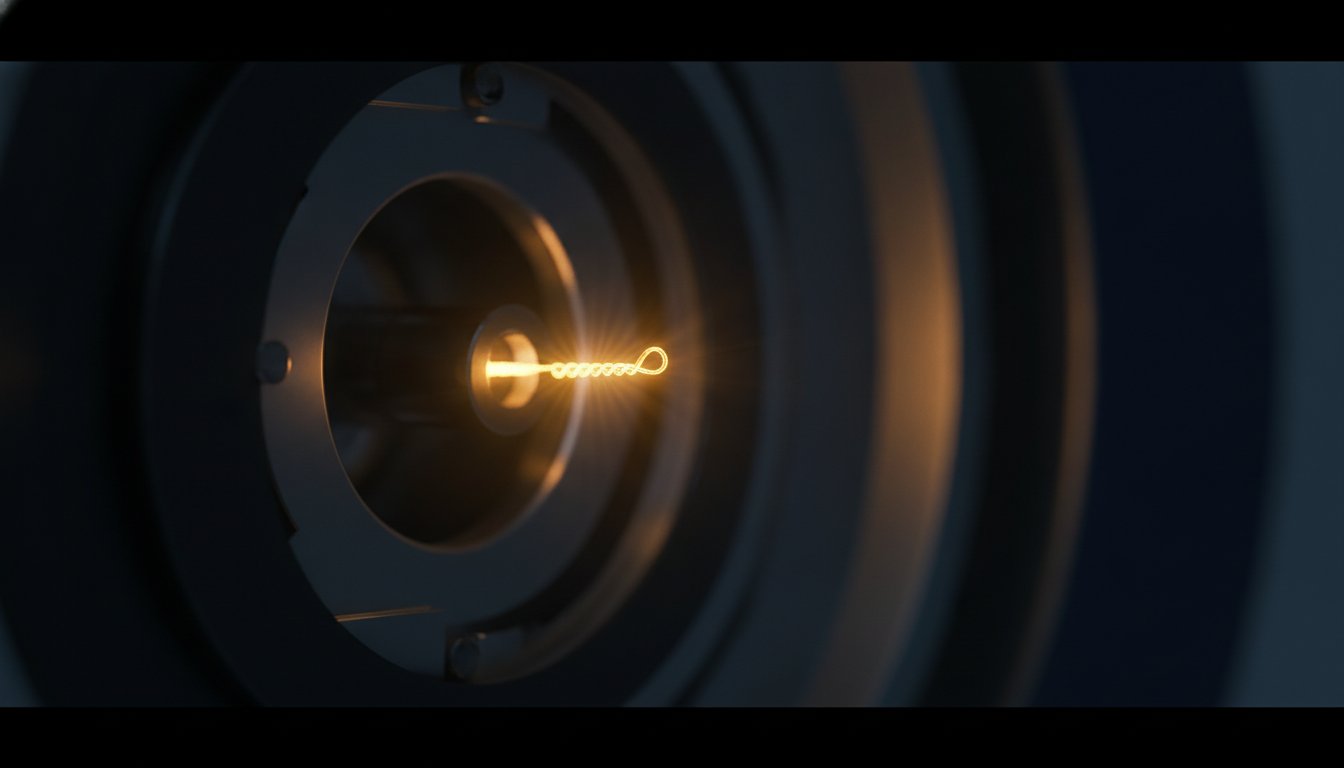
In the architecture of a Scanning electron microscope (SEM), the filament functions as the heart of the electron gun assembly. It’s the catalyst for the entire imaging process, providing the primary source of electrons required to probe a specimen’s surface. High-resolution results depend entirely on the source’s ability to generate a coherent, high-brightness beam. When laboratory personnel engage in troubleshooting sem filament issues, they’re often addressing fundamental disruptions in this electron generation cycle. The filament’s physical geometry is not merely a design choice; it directly influences the crossover point, which dictates the initial beam diameter and subsequent brightness. A well-maintained source ensures that the relationship between source size and focal depth remains optimized, leading to the final image clarity that industry professionals demand.
Principles of Thermionic Emission
Thermionic emission is the thermal release of electrons from a conductive material. This phenomenon occurs when the thermal energy provided to the cathode exceeds the material’s work function, which is the energy barrier preventing electrons from escaping into the vacuum. In systems like the Veritas HR or Genesis, the choice of cathode material determines the emission density. As the temperature rises, the number of electrons emitted increases exponentially, yet this also heightens the risk of metallurgical fatigue. Meticulous temperature management is vital. Technicians must balance the need for high beam current against the physical evaporation of the filament, as excessive heat leads to thinning and eventual failure.
Impact on Beam Stability and Image Quality
Image quality is inextricably linked to the stability of the electron source. During the initial stabilization period, the filament undergoes thermal expansion, which can manifest as beam drift on the display. This drift isn’t just a nuisance; it’s a sign that the system hasn’t reached equilibrium. Proper alignment between the filament tip and the Wehnelt cylinder is critical for maintaining a high signal-to-noise ratio. The Wehnelt cylinder acts as a control electrode, using a negative bias to focus the emitted electrons into a tight crossover point. The bias voltage applied to this cylinder effectively acts as a gatekeeper for the electron flow. If this alignment is compromised, the beam becomes erratic, making troubleshooting sem filament issues a priority to restore analytical precision. A misaligned source leads to aberrations that no amount of digital post-processing can fully correct.
Comparing SEM Filament Materials: Tungsten vs. LaB6 vs. Field Emission
Selecting a cathode material requires a calculated assessment of resolution requirements, budget constraints, and the existing vacuum infrastructure. While Tungsten remains the ubiquitous baseline for many industrial applications, advanced materials like Lanthanum Hexaboride (LaB6) and Field Emission (FE) sources offer significant upgrades in beam brightness and spatial resolution. Each material dictates a specific operational environment, meaning that the nature of troubleshooting sem filament issues shifts fundamentally depending on the chosen source. Understanding these metallurgical and physical differences is the first step toward optimizing laboratory throughput.
Tungsten Hairpin Filaments: Reliability and Accessibility
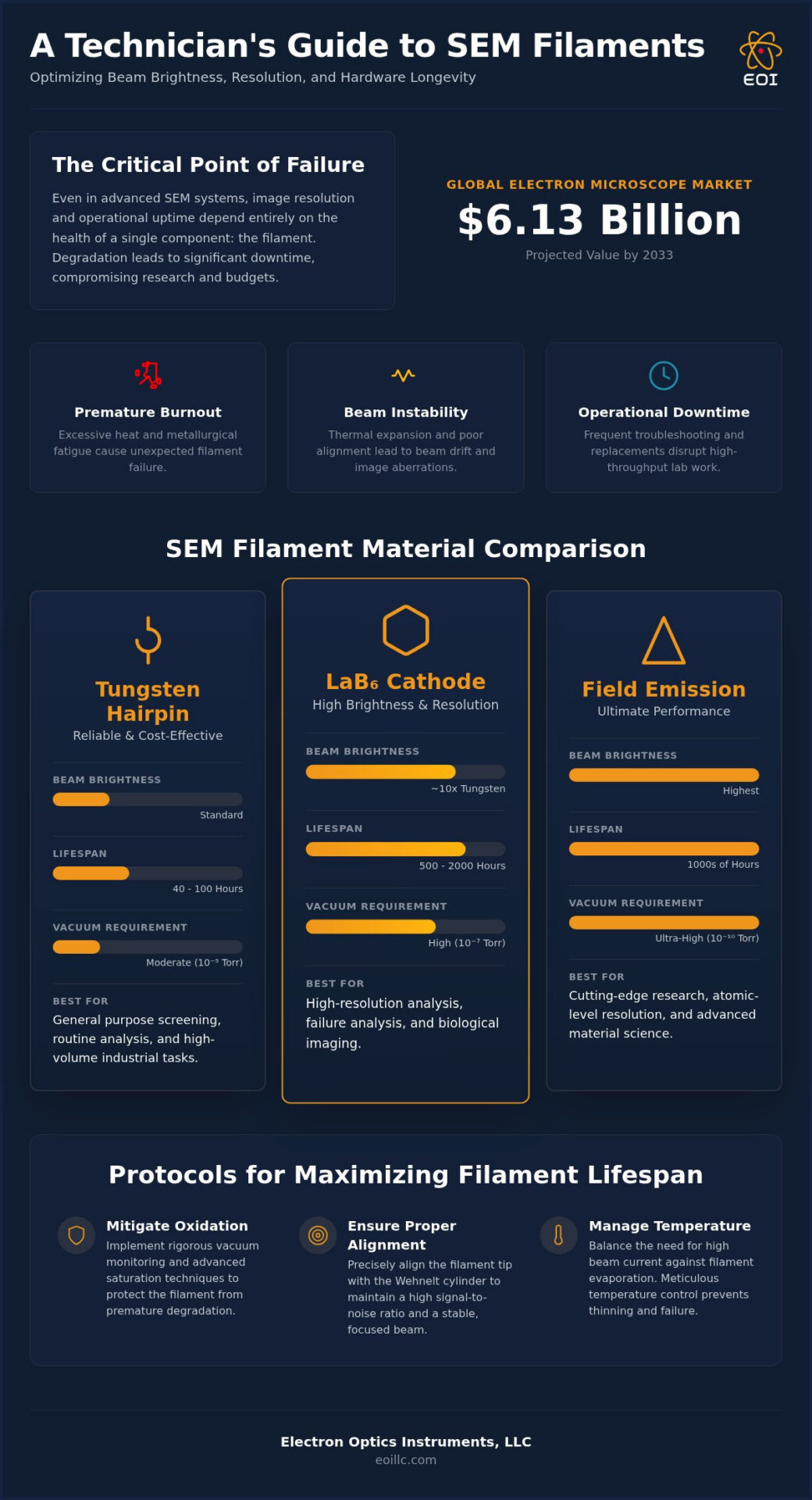
Tungsten hairpin filaments represent the industry standard for versatility and cost-efficiency. These thermionic emitters are favored in general-purpose laboratories due to their ease of replacement and straightforward alignment protocols. Operating under moderate vacuum conditions, typically around 10^-5 Torr, they provide a reliable electron source for routine screening and material characterization. A cost-per-hour analysis often reveals Tungsten as the most economical choice for high-volume industrial tasks, even though they possess a shorter lifespan than crystal-based alternatives. Technicians don’t need specialized training for installation, which makes them highly accessible for facilities requiring rapid turnaround on standard imaging tasks.
Lanthanum Hexaboride (LaB6) Cathodes: High Brightness Solutions
Lanthanum Hexaboride cathodes offer a 10x increase in brightness compared to standard Tungsten sources, making them essential for high-resolution applications. This superior performance comes with more stringent environmental demands. Specifically, LaB6 requires a significantly higher vacuum, ideally 10^-7 Torr, to prevent chemical poisoning and oxidation of the crystal tip. While the initial investment is higher, the extended lifespan, often exceeding 1,000 hours under optimal conditions, provides long-term value for research-grade instrumentation. When troubleshooting sem filament issues in LaB6 systems, the technical focus shifts heavily toward maintaining vacuum integrity and precise heating protocols to avoid crystal cracking or premature degradation.
Advanced Field Emission Sources
Field Emission sources represent the pinnacle of resolution for nanotechnology and advanced materials science. Systems like the Veritas FE SEM utilize these emitters to achieve nanometer-scale imaging that thermionic sources simply cannot match. Schottky emitters, which utilize a combination of thermal energy and high electric fields, offer excellent beam stability for long-term mapping and EDS analysis. Conversely, Cold FE sources provide the smallest electron energy spread, which is necessary for the highest possible resolution at low accelerating voltages. The trade-offs involve extreme system complexity and the requirement for ultra-high vacuum environments. For laboratories seeking to maximize their analytical potential, investing in high-quality SEM filaments and consumables ensures that these advanced hardware systems operate at their theoretical limits without frequent interruptions.
Maximizing Filament Lifespan and Preventing Premature Failure
Operational efficiency in high-resolution microscopy is contingent upon the meticulous preservation of the electron source. While high-end systems like the Veritas Series are engineered for resilience, the filament remains a consumable subject to the laws of thermodynamics and chemical interaction. Effective troubleshooting sem filament issues requires a proactive approach that prioritizes vacuum integrity and thermal management over reactive replacement. Beyond the internal vacuum environment, external factors such as ambient temperature swings and structural vibrations can introduce subtle instabilities that compromise the beam’s focal precision. Laboratories that monitor real-world performance degradation rather than relying strictly on hour-meters often achieve significantly higher ROI on their consumable investments.
Vacuum Management and Contamination Control
Vacuum integrity is the primary determinant of cathode health. Even microscopic leaks introduce oxygen into the chamber, which catalyzes rapid oxidation and aggressive thinning of the filament wire. For Lanthanum Hexaboride (LaB6) sources, maintaining an ultra-high vacuum via dedicated ion pumps is non-negotiable to prevent chemical poisoning of the crystal tip. Contamination from poorly degassed samples or degraded O-rings can also lead to carbon deposition, which alters the work function of the cathode. For a deeper analysis of these systemic interactions, consult The Definitive Guide to SEM Maintenance: Maximizing Precision and Longevity in 2026.
Optimal Saturation and Operating Protocols
Troubleshooting sem filament issues often reveals that improper saturation is a leading cause of premature burnout. Technicians should adhere to a methodical saturation procedure to reach the “knee” of the emission curve without over-stressing the hardware. This involves:
- Gradually ramping the filament current in small increments to avoid thermal shock.
- Monitoring the beam current until the brightness plateaus, indicating the saturation point.
- Fixing the current at the lowest possible level that provides a stable, coherent beam.
Operating below this point results in beam instability and flickering, while exceeding it causes the filament to evaporate at an exponential rate without improving image quality.
Signs of Filament Exhaustion
Predictive maintenance necessitates the recognition of subtle hardware cues before a catastrophic break occurs. Visual inspection of a Tungsten filament during preventative maintenance visits may reveal “notching” effects or localized thinning near the tip. Performance-based indicators include a noticeable decrease in signal intensity and a persistent increase in image noise that cannot be corrected by standard alignment. By scheduling replacements when these performance cues first manifest, laboratories can avoid the unexpected downtime associated with sudden filament failure during critical analytical runs.
Strategic Selection: Matching Filaments to Analytical Requirements
The decision-making process for cathode selection must be rooted in the specific analytical goals of the facility. For instance, failure analysis in semiconductor manufacturing requires high beam stability and consistent current for Energy Dispersive Spectroscopy (EDS) accuracy, whereas biological imaging often prioritizes low accelerating voltages to minimize sample damage. The filament’s brightness directly impacts the X-ray count rate. A brighter source like LaB6 provides faster data acquisition and better peak-to-background ratios in EDS systems, which is essential for quantitative elemental mapping. If a lab frequently faces troubleshooting sem filament issues, it may indicate a fundamental mismatch between the chosen cathode material and the system’s vacuum capacity or the intended duty cycle. High-end platforms like the Veritas Series demand precision-matched emitters to maintain their theoretical resolution limits during complex analytical runs.
Resolution vs. Cost-of-Ownership Trade-offs
In industrial quality control environments, Tungsten hairpins often provide sufficient resolution for micrometer-scale inspections while maintaining a low cost-of-ownership. These emitters are ideal for laboratories where the primary focus is on high-volume screening rather than nanometer-scale characterization. However, as research demands push toward higher magnifications, the investment in LaB6 becomes justifiable due to its superior brightness and longer operational life. This choice significantly influences the total cost of ownership (TCO) over the instrument’s lifecycle, as the reduced frequency of replacement offsets the higher initial price of the crystal. For a detailed breakdown of these financial considerations, refer to our guide on How Much Does an Electron Microscope Cost? A Comprehensive 2026 Price Guide.
Optimizing Benchtop and Tabletop Systems
The rise of compact instrumentation, such as the Genesis Tabletop SEM and the Cube II Benchtop SEM, has shifted the paradigm of consumable management. These systems are often deployed in satellite labs or production floors where throughput is the primary metric. Standardizing high-quality consumables across a fleet of these units ensures consistent imaging results and simplifies the inventory process. When troubleshooting sem filament issues in these compact environments, the focus often remains on rapid turnaround and maintaining vacuum seals during high-frequency sample exchanges. Selecting the correct filament grade is essential to maximize the uptime of these high-efficiency tools. To ensure your laboratory maintains these standards, you should source your SEM filaments and consumables from a partner with proven technical expertise.
Comprehensive SEM Support and Consumable Management
Integrating high-quality filaments into a holistic maintenance strategy is essential for laboratories seeking to maintain peak analytical performance. While selecting the correct cathode material is a critical first step, the long-term operational stability of a system relies on the synergy between superior hardware and rigorous technical support. Effective troubleshooting sem filament issues often requires more than a simple component swap; it necessitates a comprehensive evaluation of the electron gun assembly and vacuum integrity. By viewing filaments as integral components of a larger service ecosystem, facilities can transform their maintenance routines from reactive repairs into a proactive model of reliability and accuracy.
Expert Field Service and Calibration
Professional alignment after a filament replacement ensures the electron beam remains perfectly centered within the optical column, maximizing both focus and signal intensity. This calibration process is vital for high-performance units like the Veritas HR or Veritas FE, where even a slight misalignment can introduce aberrations that compromise nanometer-scale imaging. Preventative Maintenance Visits provide an opportunity to assess the health of the entire vacuum system, identifying potential micro-leaks or pump inefficiencies before they cause premature cathode failure. Priority service contracts further reduce downtime by ensuring that expert technicians and critical parts are available when they’re needed most, protecting the lab’s throughput and analytical consistency.
The Advantage of 30 Years of Technical Expertise
Electron Optics Instruments, LLC leverages three decades of specialized industrial knowledge to support a wide array of electron microscopy platforms. As the sole US distributor for EmCraft and a provider of expert field services for all major manufacturers, the company offers a level of meticulousness that is rare in the consumables market. This deep expertise allows for the development of customized solutions for complex imaging challenges, ensuring that every Veritas Series or Cube II Benchtop SEM operates at its theoretical limit. Beyond technical repair, on-site training for laboratory staff on proper filament handling and installation techniques empowers teams to manage their hardware with greater confidence and precision.
Maintaining a reliable supply of SEM filaments and consumables nationwide is a cornerstone of this support model. Whether a facility utilizes the Genesis Tabletop SEM for rapid screening or a Veritas Ultra for advanced research, consistent access to high-grade emitters is non-negotiable. Partnering with a seasoned global innovator ensures that troubleshooting sem filament issues doesn’t become a recurring bottleneck. Instead, it becomes a managed aspect of a sophisticated production and research environment, allowing scientists and engineers to focus on their primary mission of discovery and failure analysis without the distraction of hardware instability.
Advancing Laboratory Precision through Strategic Cathode Management
Achieving superior image resolution and hardware reliability requires a meticulous approach to both component selection and operational protocols. By understanding the distinct thermionic properties of Tungsten and LaB6 emitters, technicians can align their consumable strategy with the specific demands of high-throughput industrial screening or nanometer-scale research. A commitment to proactive vacuum monitoring and precise saturation techniques remains the most effective method for troubleshooting sem filament issues before they result in catastrophic downtime.
As a seasoned global innovator with over 30 years of field service expertise, Electron Optics Instruments, LLC provides the technical depth necessary to support all major SEM brands. As the sole US distributor for EmCraft, we offer the specialized knowledge required to optimize your Veritas or Cube II systems. We invite you to Request a Quote for SEM Filaments and Expert Maintenance Services to ensure your laboratory maintains its competitive edge in analytical performance. Master your hardware today to secure the discoveries of tomorrow.
Frequently Asked Questions
How long does a typical Tungsten SEM filament last?
A typical Tungsten SEM filament lasts between 40 and 100 hours of operational time, depending heavily on the vacuum quality and saturation level. While some operators report lifespans at the higher end of this range, aggressive heating protocols or frequent vacuum cycles can reduce this significantly. Monitoring the specific hour-meter on your Veritas or Cube II system provides a baseline, but observing the physical thinning of the wire is a more accurate indicator of remaining life.
Can I upgrade my Tungsten SEM to use LaB6 filaments?
Upgrading a Tungsten SEM to use LaB6 filaments is possible but requires a dedicated upgrade kit to enhance the system’s vacuum capacity and bias electronics. Standard Tungsten systems operate at 10^-5 Torr, whereas LaB6 requires a vacuum of at least 10^-7 Torr to prevent crystal degradation. This transition involves installing an additional ion pump and recalibrating the electron gun assembly to accommodate the higher brightness and different emission characteristics of the hexaboride crystal.
What causes a filament to ‘pop’ or burn out prematurely?
Premature filament burnout is frequently caused by poor vacuum integrity, which introduces oxygen that catalyzes rapid metallurgical evaporation. When troubleshooting sem filament issues, technicians often find that micro-leaks in the specimen chamber or degraded O-rings lead to localized oxidation. Additionally, excessive current during the saturation process creates hot spots that cause the wire to snap. Maintaining a stable environment and following gradual ramping protocols are essential for preventing these catastrophic failures.
How do I know if my SEM filament is properly saturated?
Proper saturation is confirmed when the beam current plateaus despite further increases in the filament heating current. This point, known as the knee of the emission curve, represents the optimal balance between electron brightness and cathode longevity. Operating beyond this point causes exponential evaporation without improving image quality. Technicians should monitor the image display and beam current meter simultaneously to identify the exact moment when the brightness stops increasing during the ramping procedure.
Is it better to replace filaments myself or hire a professional?
Replacing filaments is a routine task for trained operators, but hiring a professional ensures that the critical alignment and calibration steps are performed with industrial precision. Expert technicians from Electron Optics Instruments, LLC can identify underlying vacuum issues that might lead to future failures. Professional installation is particularly recommended for high-end units like the Veritas HR series, where perfect centering of the cathode is necessary to achieve the system’s specified nanometer-scale resolution.
What are the vacuum requirements for Lanthanum Hexaboride (LaB6) cathodes?
Lanthanum Hexaboride (LaB6) cathodes require an ultra-high vacuum environment, typically maintained at 10^-7 Torr or better, to ensure operational stability. Operating at lower vacuum levels causes chemical poisoning of the crystal tip, which leads to erratic beam behavior and a drastic reduction in lifespan. Most systems utilize a dedicated ion pump for the gun chamber to maintain these stringent conditions, even when the specimen chamber is cycled for sample exchanges.
Does the filament type affect EDS (Energy Dispersive Spectroscopy) results?
Yes, the filament type directly affects EDS results by influencing the X-ray count rate and the overall signal-to-noise ratio. High-brightness sources like LaB6 or Field Emission emitters provide a higher electron flux, which generates more characteristic X-rays from the sample surface. This increased intensity allows for faster elemental mapping and improved detection limits for trace elements. Troubleshooting sem filament issues is often the first step in resolving inconsistent or noisy EDS data in complex failure analysis.
How often should I perform preventative maintenance on my SEM vacuum system?
Preventative maintenance on the SEM vacuum system should be performed at least every six to twelve months to ensure peak performance. These visits include checking pump oil levels, cleaning the gun assembly, and inspecting all vacuum seals for signs of wear or contamination. High-throughput laboratories running units like the Genesis Tabletop SEM may require more frequent intervals to mitigate the impact of constant sample cycling on the system’s internal pressure and overall cleanliness.