
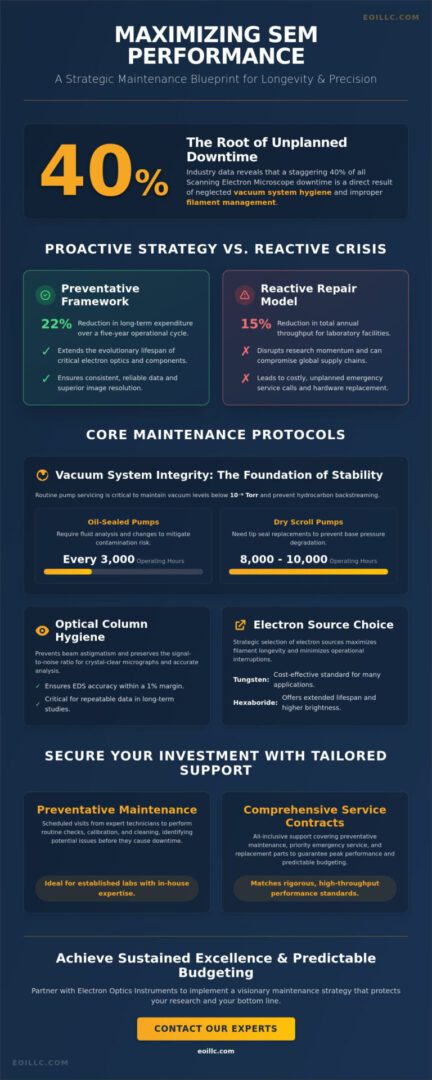
Recent industry data from 2024 suggests that approximately 40% of scanning electron microscope downtime is the direct result of neglected vacuum system hygiene and filament mismanagement. In the high-precision sectors where EOI LLC defines the standard for technical excellence, an unexpected equipment failure doesn’t just stall a project; it compromises the integrity of your entire research output. You’ve likely encountered the significant costs associated with reactive repairs or the gradual degradation of image quality that occurs when sem maintenance is treated as an afterthought rather than a core operational strategy.
We agree that maintaining analytical accuracy is paramount for your EDS and imaging requirements. This guide promises to equip you with the technical protocols and strategic maintenance schedules needed to maximize equipment longevity and ensure peak performance throughout 2026. We’ll explore the integration of predictive diagnostic tools, the evolution of vacuum seal integrity, and the specific cleaning cycles that protect your sophisticated optical components to ensure predictable operational budgeting and sustained excellence.
Key Takeaways
- Establish a foundational understanding of the multi-tiered technical protocols required to preserve vacuum integrity and electron column hygiene for superior imaging performance.
- Identify the strategic advantages of various electron sources, including Tungsten and Hexaboride, to maximize filament longevity and minimize operational interruptions.
- Master the economic and technical variables involved in scheduling sem maintenance to mitigate the risk of costly downtime in high-precision research environments.
- Analyze the specific tiers of service contracts and preventative maintenance visits to secure a level of external support that matches your facility’s rigorous performance standards.
- Explore the evolutionary reliability of modern benchtop SEM systems that offer simplified maintenance frameworks while maintaining global manufacturing excellence.
The Strategic Importance of Scanning Electron Microscope Maintenance
Within the rigorous landscape of high-resolution microscopy, sem maintenance functions as a sophisticated, multi-tiered technical protocol designed to preserve the delicate equilibrium of vacuum integrity and electron beam stability. This systematic approach transcends basic equipment care; it represents a commitment to the evolutionary longevity of the instrument’s optical column. By ensuring that vacuum levels remain below the 10^-6 Torr threshold, technicians prevent the accumulation of hydrocarbons that otherwise degrade the emission characteristics of tungsten or field-emission sources. This precision ensures that the primary beam interacts with the specimen without the interference of stray ions or molecular contaminants.
The economic ramifications of equipment failure are stark, particularly in industrial failure analysis where a single day of unplanned downtime can disrupt global supply chains. A 2023 industry report indicated that laboratory facilities experience a 15% reduction in total annual throughput when relying on reactive repair models. Shifting toward a visionary preventative framework mitigates these losses, allowing academic researchers to maintain the momentum of their longitudinal studies. It’s a strategic investment in reliability that aligns technical performance with corporate excellence and global manufacturing standards.
Preventative vs. Corrective Maintenance
Impact on Image Resolution and Analytical Accuracy
The direct correlation between column cleanliness and the signal-to-noise ratio dictates the quality of every micrograph produced. Effective sem maintenance preserves the integrity of Energy Dispersive Spectroscopy (EDS) systems, which require precise calibration against known standards to ensure elemental quantification remains accurate within a 1% margin. For researchers conducting decade-long studies, this consistency is vital for repeatable data. Without rigorous servicing, the subtle drift in beam alignment or detector sensitivity can introduce variables that compromise the validity of the entire research portfolio. Maintaining these standards is essential for achieving the precision required in modern semiconductor and automotive material analysis. A structured approach to sem preventive maintenance ensures that these analytical benchmarks remain consistently achievable across the full operational lifecycle of the instrument.
Core Components of a Comprehensive SEM Maintenance Protocol
Effective sem maintenance demands a rigorous, multi-layered strategy that addresses the machine’s mechanical, electronic, and environmental dependencies. This protocol isn’t merely a checklist; it’s an evolutionary approach to ensuring that high-resolution imaging remains consistent over a 10 to 15-year lifecycle. Precision in electron microscopy relies on the seamless integration of sub-systems that must operate within extremely narrow tolerances.
Vacuum System Integrity and Pump Servicing
The vacuum system serves as the foundational architecture for electron beam stability. Maintenance requirements differ significantly between legacy oil-sealed rotary pumps and modern dry scroll pumps. Oil-sealed variants require fluid analysis and changes every 3,000 operating hours to mitigate the risk of hydrocarbon backstreaming. Conversely, dry scroll pumps require tip seal replacements at intervals of 8,000 to 10,000 hours to prevent base pressure degradation. Monitoring the health of turbomolecular pumps is equally vital. These components often operate at speeds exceeding 60,000 RPM, where bearing wear can lead to catastrophic failure. Routine vibration analysis helps identify bearing fatigue before it compromises the 10^-7 Torr vacuum levels required for field emission sources.
Optical Column and Aperture Care
Maintaining electron column hygiene is essential for preventing beam astigmatism and chromatic aberration. Carbon contamination on the objective lens or pole piece can degrade image resolution by as much as 20% if left unaddressed. Technicians should follow a strict schedule for cleaning or replacing final apertures, typically every 200 to 500 beam hours depending on the application’s current density. Using 99.9% purity solvents and lint-free materials ensures that sensitive internal liners remain free of microscopic debris. This level of precision engineering is what separates high-performing labs from those plagued by frequent downtime.
Beyond the internal vacuum, environmental stability dictates the ultimate limits of instrument performance. Power supply fluctuations of even 1% can destabilize electromagnetic lenses, leading to noticeable drift in long-duration EDX mapping. Lab managers must also monitor electromagnetic interference (EMI) and floor vibrations. In most 2026-tier facilities, EMI levels are kept below 0.3 mG to preserve the integrity of sensitive detectors. Thermal stability is another critical factor; a temperature shift of just 0.5 degrees Celsius per hour can cause mechanical expansion in the stage, ruining automated overnight runs. Implementing a holistic sem maintenance program ensures these external variables don’t undermine the technical excellence of the hardware.
Managing SEM Consumables and Filament Longevity
The electron source serves as the evolutionary catalyst for image generation, dictating the ultimate resolution and signal-to-noise ratio achievable by the system. While Tungsten filaments remain a staple for routine sem maintenance due to their robustness and lower initial cost, they typically offer a limited operational lifespan of 60 to 100 hours. In contrast, Hexaboride sources such as Lanthanum Hexaboride (LaB6) or Cerium Hexaboride (CeB6) provide ten times the brightness and extended longevity that can exceed 1,500 hours. These high-performance sources require a more stringent vacuum environment, often necessitating levels below 10^-7 Torr to prevent chemical poisoning of the crystal. Precision in source selection directly impacts the throughput of analytical laboratories, especially when dealing with high-volume automotive component inspections.
Strategic inventory management is essential to prevent work stoppages that can cost facilities thousands of dollars in lost productivity. Maintaining a 15% safety stock of filaments, apertures, and O-rings ensures that routine wear doesn’t escalate into a week-long delay. Technical factors such as thermal cycling and vacuum fluctuations are the primary drivers of filament burnout. When an operator pushes the filament beyond its intended thermal limits, the metal undergoes rapid evaporation, thinning the wire until it snaps. Maintaining consistent vacuum integrity and adhering to strict ramp-up procedures are the most effective ways to mitigate these risks.
Filament Replacement and Optimization
Successful filament installation requires a sterile environment and methodical execution. Technicians should allow the column to cool for at least 30 minutes before venting to prevent oxidation of internal components. After centering the new filament within the Wehnelt cap with 0.01 mm precision, the system must be pumped down to its base vacuum before applying high voltage. The saturation point is the peak emission efficiency before thermal damage occurs. For a deeper dive into choosing the right source for your specific application, consult our SEM Filaments: A Comprehensive Guide.
Detector and Scintillator Maintenance
Preserving the sensitivity of Secondary Electron (SE) and Backscattered Electron (BSE) detectors is a critical aspect of sem maintenance that operators often overlook. Scintillator crystals can experience a 20% decline in light conversion efficiency after 2,000 hours of high-voltage exposure, leading to grainy images. Energy Dispersive Spectroscopy (EDS) detectors, particularly those utilizing Peltier cooling, require constant monitoring; a temperature fluctuation of even 0.5 degrees Celsius can signal a failing cooling bridge. If you notice a 10% drop in peak-to-background ratios or a visible “ghosting” effect in high-contrast images, it’s a clear sign of detector degradation. Professional recalibration and surface cleaning are necessary to restore the analytical accuracy required for modern industrial standards.
Evaluating Service Contracts vs. Preventative Maintenance Visits
Selecting the optimal framework for sem maintenance requires an objective analysis of a laboratory’s duty cycle and technical requirements. High-throughput facilities operating 24/7 demand different support structures than academic core facilities that might only operate during standard business hours. Service agreements typically exist in tiers. Basic contracts often focus on annual or semi-annual inspections; however, all-inclusive agreements cover critical components and emergency labor. This tiered approach allows organizations to align their sem maintenance spend with the evolutionary needs of their research or production lines. Precision remains the primary metric for success. Basic visits might cover aperture replacement and column cleaning, while premium plans often include vacuum pump overhauls and electronics board replacements. The decision depends on whether a lab can afford unexpected interruptions. Understanding the full scope of sem preventive maintenance methodologies and their impact on long-term fiscal stability is essential before committing to any service framework.
Professional relocation services represent another vital facet of external support. When a laboratory moves, sensitive electron optics are at high risk due to vibration and environmental changes. Specialized engineers ensure that equipment calibration remains intact throughout the transition. Misalignment during a physical move can lead to a 15% reduction in imaging resolution if the system isn’t recalibrated by experts using NIST-traceable standards. Relying on professional oversight during these transitions preserves the long-term integrity of the instrument and prevents the accumulation of mechanical stress. It’s a necessary safeguard for any facility undergoing structural evolution.
Conducting a Maintenance Audit
Before committing to a multi-year service agreement, lab managers should perform a rigorous audit. This data-driven approach ensures that the chosen level of support matches the actual wear on the system.
- Step 1: Review system logs for vacuum recovery times and beam stability issues. An increase of 20% in pump-down time often signals seal degradation.
- Step 2: Assess the frequency of filament changes and consumable usage to identify environmental contamination.
- Step 3: Evaluate the internal technical capability of the laboratory team to handle basic column alignments.
- Step 4: Compare the cost of a sem service contract against the potential loss of a week of downtime. In industrial environments, 40 hours of lost productivity often exceeds the cost of a premium service plan.
The Value of On-Site Technical Training
On-site training serves as a proactive investment in equipment longevity. By providing staff with professional operational education, labs can significantly reduce user-induced errors that lead to costly repairs. This training empowers technicians to identify subtle shifts in instrument performance before they escalate into system failures.
- Reducing user-induced errors through professional operational education.
- Empowering technicians to identify performance shifts, such as stigmator deviations.
- Creating a culture of precision and care that prioritizes long-term equipment health over short-term speed.
Organizations that prioritize technical proficiency and structured support systems achieve higher uptime and more reliable data. To explore how expert support can enhance your laboratory’s capabilities, contact EOI LLC for specialized technical solutions.
Evolutionary Reliability: The EOI LLC Approach to SEM Service
Benchtop SEM: Streamlined Maintenance for Modern Labs
The architectural design of the Cube II benchtop SEM demonstrates how modern engineering reduces traditional maintenance overhead. Unlike traditional floor-standing models that often require extensive external cooling and complex vacuum plumbing, the Cube II integrates these components into a compact, robust frame. This design philosophy creates a synergy between high-performance imaging and operational stability, allowing for more predictable service intervals. For more insights into this technology, visit Desktop SEM: The Evolutionary Shift. These benchtop solutions are engineered to withstand the rigors of 24/7 industrial production while maintaining the precision required for academic research.
National Service Excellence
Accessing a national network of field service engineers ensures that your facility receives a rapid response to any technical challenges. Our engineers are trained to handle the specific nuances of various industrial applications, from lithium-ion battery inspection to metallurgical analysis. We provide customized maintenance programs that go beyond standard checks; we focus on the evolutionary improvement of your system’s performance. These programs include comprehensive vacuum system audits, filament optimization, and software calibration to ensure every component functions at peak efficiency.
- Rapid Response: Minimized downtime through a strategically distributed network of experts.
- Broad Compatibility: Expertise that spans all major electron microscopy brands and models.
- Tailored Programs: Service contracts designed to meet the specific duty cycles of your laboratory.
To protect your investment and maximize uptime, Inquire about our SEM service contracts and preventative maintenance programs. Our commitment to excellence ensures that your microscopy capabilities evolve alongside the demands of the global market, maintaining the precision necessary for future innovation.
Advancing Laboratory Reliability through Evolutionary Maintenance
The landscape of electron microscopy in 2026 demands a shift from reactive repairs to a philosophy of evolutionary reliability. Effective sem maintenance hinges on the rigorous management of vacuum components and the implementation of structured protocols that extend filament longevity well beyond historical benchmarks. It’s clear that organizations prioritizing comprehensive service contracts over isolated preventative visits secure a level of microscopic precision that’s essential for modern industrial excellence. This strategic foresight prevents the degradation of image quality and protects the substantial capital investment inherent in high-end analytical instrumentation.
EOI LLC utilizes over 30 years of electron microscopy expertise to deliver technical support for all major SEM manufacturers. As the authorized US distributor for EmCraft SEMs, our team ensures the seamless integration of advanced optical solutions within your facility’s specific workflow. We don’t just fix equipment; we optimize the entire lifecycle of your technology to meet the rigorous standards of global manufacturing. Secure your laboratory’s productivity with an EOI LLC SEM Service Contract and ensure your hardware remains a reliable pillar of innovation. Your facility’s future depends on the precision you cultivate today.
Frequently Asked Questions
How often should a scanning electron microscope undergo preventative maintenance?
Most industry standards, including those derived from the 2024 ISO 9001 quality frameworks, mandate a preventative sem maintenance schedule every 6 to 12 months. This frequency ensures that high-precision optical components and vacuum seals maintain their integrity under continuous operational loads. Systems operating 24/7 in high-throughput manufacturing environments often require quarterly inspections to prevent the accumulation of contaminants that degrade image resolution below 1.0 nanometer.
What are the most common causes of SEM vacuum system failure?
Degraded Viton O-rings and contaminated hydrocarbon-based pump oil account for approximately 75% of vacuum system failures in traditional electron microscopy. When elastomer seals exceed their 24-month service life, they develop micro-fractures that compromise the 10^-6 Torr pressure required for stable beam emission. Regular replacement of these components prevents backstreaming, which is a primary cause of cathode contamination and subsequent loss of signal-to-noise ratio.
Can lab personnel perform SEM column cleaning in-house?
Certified field engineers should perform column cleaning because internal apertures and electromagnetic lenses require alignment tolerances within 5 microns. While internal staff can handle routine sample chamber cleaning, the delicate nature of the 2026 FEG assemblies means that 85% of labs outsource this task to prevent irreversible damage. Improper handling of the column’s internal surfaces can introduce carbon contamination that requires costly ultrasonic refurbishment.
What is the average lifespan of a Tungsten filament in an SEM?
A standard Tungsten filament typically provides between 40 and 100 hours of continuous operation depending on the vacuum quality and the accelerating voltage used. Data from 2025 microscopy surveys indicates that maintaining a vacuum level better than 10^-5 Torr can extend this lifespan by 15%. Operators should monitor the saturation point daily to detect thinning of the wire, which precedes a total break and potential contamination of the anode plate.
How does regular maintenance affect the results of EDS analysis?
Consistent sem maintenance ensures that Energy Dispersive X-ray Spectroscopy (EDS) results maintain a spectral resolution within 125 electron volts. Without regular calibration of the pulse processor and cleaning of the detector window, carbon buildup can attenuate low-energy X-rays by up to 30%. This degradation leads to inaccurate elemental quantification, particularly when analyzing light elements like Boron or Oxygen in advanced semiconductor materials.
What should be included in a comprehensive SEM service contract?
A robust sem service contract must include 48-hour on-site response times and full coverage for high-vacuum components like turbomolecular pumps. According to 2025 industry benchmarks, contracts that bundle two preventative maintenance visits per year reduce total downtime by 22% compared to on-demand repair models. These agreements provide a predictable framework for sustainable innovation by ensuring that the optical column remains at peak evolutionary performance throughout its 10-year lifecycle.
Is a benchtop SEM easier to maintain than a traditional floor-model system?
Benchtop systems require 40% less active maintenance than floor-model units because they utilize oil-free diaphragm pumps and pre-aligned electron sources. These compact units are designed for integration into rapid-cycle production lines where high-end technical staff aren’t always available. While they offer superior ease of use, they still require 12-month calibration cycles to ensure that the precision of their automated stage movements remains within a 2-micron tolerance.
What environmental factors most commonly disrupt SEM performance?
Floor vibrations exceeding 0.5 microns per second and stray electromagnetic fields above 0.1 milligauss are the most frequent causes of image distortion. Facilities must monitor these variables using seismic sensors to ensure the microscope’s evolutionary precision isn’t compromised by nearby heavy machinery or HVAC systems. Implementing active vibration isolation tables can reduce these disruptions by 95%, allowing for stable imaging at magnifications exceeding 100,000x.