
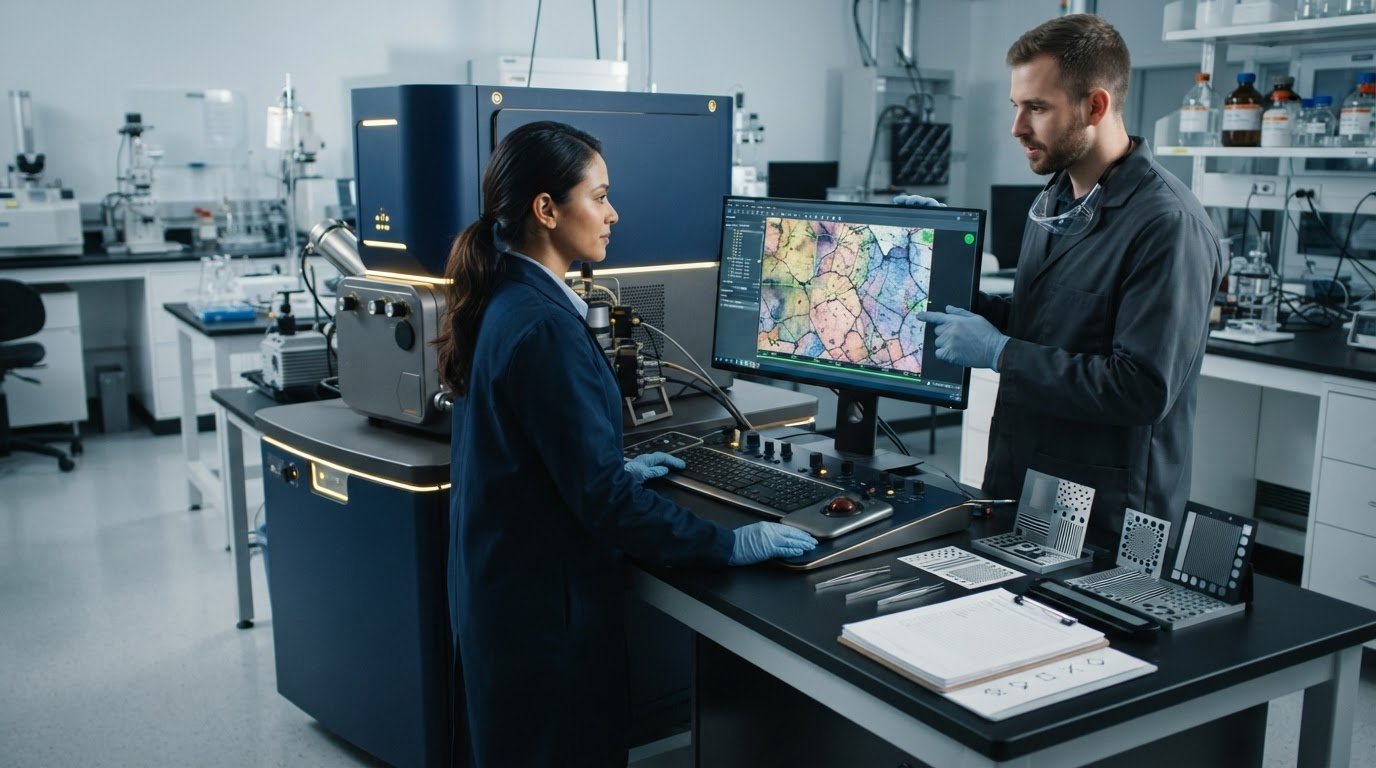
A sharp SEM image can look convincing while still failing to show that the instrument performs reliably under routine analytical conditions. SEM performance qualification (PQ) should go beyond a one-time image check: it should provide repeatable evidence that the system meets requirements tied to its intended use.
It can be difficult to decide which characteristics to test, what to record, and where PQ ends and installation or operational qualification begins. A generic template may miss the imaging conditions, measurement tasks, and workflows that matter in your laboratory. A risk-based protocol makes those decisions explicit by focusing tests on performance that affects result quality and data integrity.
This practical checklist explains how to define acceptance criteria, choose relevant tests, run them under representative conditions, and document results for review. It also clarifies how PQ differs from IQ and OQ, how to assess deviations, and when investigation or reassessment may be warranted. The goal is a qualification record that uses traceable evidence to show whether your SEM performs consistently as intended.
Key Takeaways
- Define the SEM’s intended use first, then select performance checks that reflect the laboratory’s actual imaging, analytical, and workflow requirements.
- Use sem performance qualification (pq) to document consistent performance under routine conditions, distinct from installation and operational qualification.
- Set measurable, justified acceptance criteria before testing so results can be assessed against clear expectations.
- Record test conditions, observations, evidence, and review decisions in a controlled protocol to make results traceable and repeatable.
- Treat qualification as a performance snapshot, and support ongoing reliability with consistent procedures, training, and preventive maintenance.
What SEM Performance Qualification (PQ) Demonstrates in a Laboratory
Performance qualification is a documented demonstration that an instrument can perform acceptably for its intended use under representative conditions. For an SEM, that means testing whether the system produces reliable results for the laboratory’s actual imaging or measurement tasks, not simply checking whether an image looks clear. A visually sharp micrograph alone cannot establish that magnification, stability, analytical output, or other workflow-critical characteristics meet defined requirements.
SEM PQ definition: SEM performance qualification (PQ) is the documented evaluation of an electron microscope’s ability to meet predefined, intended-use requirements during representative laboratory work, supported by recorded evidence. The scope depends on how the instrument is used, the risks associated with its outputs, and the laboratory’s quality-system procedures.
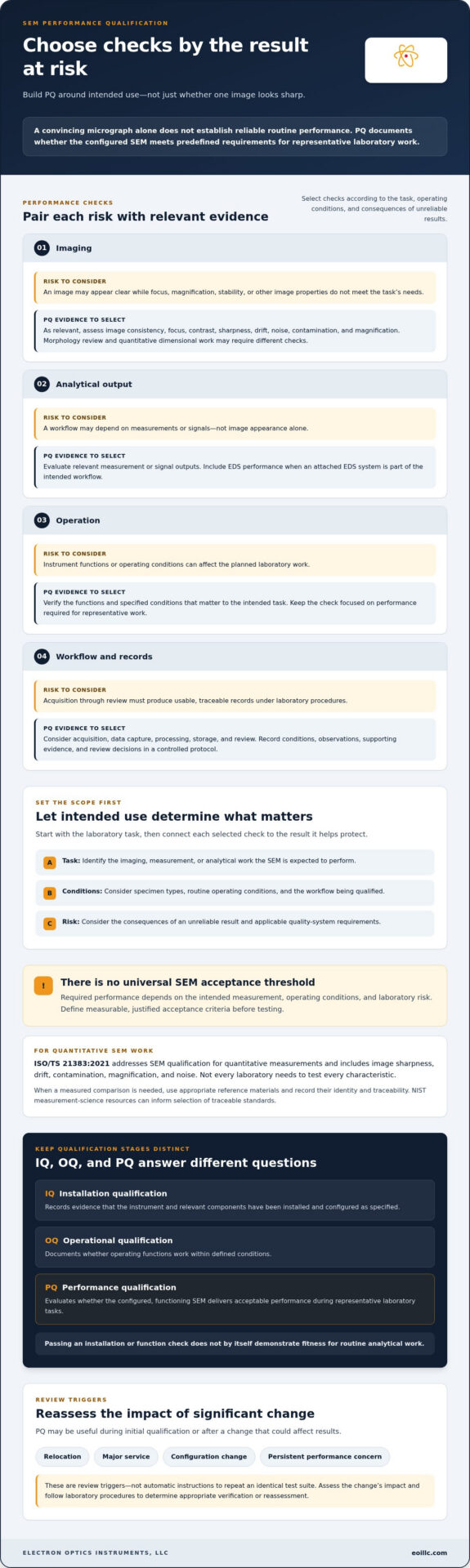
This distinction matters because an SEM image results from interactions between the electron beam and a specimen, then must be interpreted in relation to the task. A foundational overview of the Scanning Electron Microscope (SEM) can help explain why applications place different demands on the instrument. Laboratories performing quantitative measurements may also consult ISO/TS 21383:2021, which addresses SEM qualification for quantitative measurements and includes characteristics such as image sharpness, drift, contamination, magnification, and noise. Not every laboratory needs to test every characteristic. Let intended use determine which ones matter.
How SEM PQ differs from IQ and OQ
Qualification stages answer different questions. Installation qualification (IQ), where applicable, records evidence that the instrument and relevant components have been installed and configured as specified. Operational qualification (OQ) documents whether operating functions work within defined conditions. Performance qualification (PQ) evaluates whether the configured, functioning SEM delivers acceptable performance during representative laboratory tasks. The stages are related, but passing an installation or function check does not by itself demonstrate that the instrument is fit for routine analytical work.
When an SEM performance qualification is useful
Consider PQ during initial qualification and after a significant change that could affect results, such as relocation, major service, a configuration change, or a persistent performance concern. These are review triggers, not automatic instructions to repeat an identical test suite. Assess the change’s impact and follow laboratory procedures to determine the appropriate verification or reassessment.
Start with intended use. A laboratory using an SEM for surface imaging may need different evidence from one relying on dimensional measurements or an attached EDS system for elemental analysis. Document the task, relevant operating conditions, potential consequences of unreliable results, and applicable quality-system requirements. Understanding the fundamental principles of scanning electron microscopy helps connect instrument behavior to the evidence a workflow needs. This application-led approach keeps qualification focused and makes its conclusions useful to analysts and reviewers.
Which SEM Performance Characteristics Should a PQ Protocol Evaluate?
A useful protocol tests performance that could affect the laboratory’s results, rather than treating every available instrument characteristic as equally important. The scope depends on specimen types, analytical questions, routine operating conditions, and the consequences of an unreliable result. No single set of SEM acceptance thresholds is appropriate for every application because required performance depends on the intended measurement, operating conditions, and laboratory risk.
Organize the protocol into categories so each result answers a clear question and reviewers can connect evidence to its purpose:
- Imaging: Assess characteristics such as image consistency, focus, contrast, sharpness, drift, noise, contamination, and magnification when relevant to the application.
- Analytical: Evaluate measurement or signal outputs, including EDS performance when EDS is part of the intended workflow.
- Operational: Verify instrument functions and specified operating conditions that affect the planned work.
- Workflow: Confirm that acquisition, data capture, processing, storage, and review produce usable, traceable records under laboratory procedures.
Imaging performance checks for representative SEM work
Choose documented methods that match the task. For routine morphology review, consistent focus, contrast, and image appearance may be central. Quantitative dimensional work may also require evaluation of magnification or field of view. ISO/TS 21383:2021 identifies parameters including image sharpness, drift, contamination, magnification, and noise for quantitative SEM qualification. Use appropriate reference materials when a measured comparison is needed, and record their identity and traceability. Measurement-science resources from the National Institute of Standards and Technology (NIST) can inform the selection of traceable standards.
Control and record test conditions. Identify the specimen or reference, operating settings relevant to the test, method, and evidence captured. If focus is judged visually, define who assesses it and how consistency is determined. For a numerical measurement, state the instrument or analysis method and the calculation used. The aim is not to impose a universal resolution value, but to make the method reproducible and the result interpretable.
Analytical and workflow checks, including EDS
Include EDS checks when the system and intended laboratory workflow use EDS. Define what the check must demonstrate, such as repeatable acquisition or reviewable analytical output, and align the method with established procedures. Advanced applications may introduce additional considerations. Information on advanced SEM techniques can help put the range of workflows a protocol may need to cover into context.
Before testing, assign each check a test condition, measurement method, acceptance criterion, and record owner. Criteria should be justified and measurable, not chosen after results are visible. A well-designed sem performance qualification (pq) protocol states what will be tested, how evidence will be judged, and who is responsible for the record. SEM technical support and on-site training can also help laboratories reinforce consistent operating practices. SEM service and training support can help laboratories establish those practices.
How to Build an SEM PQ Checklist with Meaningful Acceptance Criteria
A useful checklist turns laboratory requirements into tests that can be run consistently and reviewed without guesswork. Build it before testing begins. Each item should connect an intended task to a method, a predefined acceptance rule, and the evidence needed to support a decision. Record observed results during execution, not as part of the criteria used to judge them.
Define intended use, scope, and test conditions
Describe the work the SEM supports. Identify sample types, imaging modes, routine analytical tasks, relevant operators, and attached systems used in the workflow. Record the instrument configuration and settings that could affect the test, such as detector selection, software version, or operating conditions. Select representative conditions, but avoid tests unrelated to the laboratory’s intended use or risk profile.
Set criteria and prepare evidence before testing
For every check, state the method, expected result, acceptance rule, required record, and responsible role. Criteria must be justified and measurable, whether they use a numerical tolerance, a defined comparison method, or a documented review procedure. Establish criteria in advance. Do not derive a passing limit from the result after testing.
- Define the intended use. Describe the decisions supported by SEM results, such as assessing surface features or measuring dimensions, and identify the consequences of unsuitable data.
- Set the protocol scope. Select performance checks that address those tasks, including relevant imaging, analytical, operational, and workflow elements. State what is excluded and why when that clarifies the rationale.
- Specify test conditions. Record the configuration, sample or reference material, operating conditions, software or detector settings, and preparation needed to reproduce the test.
- Write the acceptance rule. Define an acceptable outcome and how it will be assessed. Keep the predefined criterion separate from the measured or observed result, including any uncertainty or interpretation needed for review.
- Prepare evidence and responsibilities. Identify reference materials, supporting equipment, controlled procedures, data records, and the person responsible for performing and documenting each check.
- Review and approve before execution. Route the protocol through the laboratory’s quality system so designated technical and quality reviewers can assess the rationale, methods, and criteria before results are generated.
Standards can inform a method without automatically establishing an appropriate acceptance limit. For example, ISO 16700:2016 provides guidance on SEM image-magnification calibration, while ASTM E766-14(2019) addresses magnification calibration for specified operating conditions. Verify the current edition, scope, and applicability to the instrument and task before citing a standard. Assess any regulatory obligations that apply to the laboratory as well. The U.S. Food and Drug Administration (FDA) publishes regulations and guidance relevant to regulated work, but applicability depends on context. A well-constructed sem performance qualification (pq) checklist records the rationale rather than implying that one threshold fits every SEM.
How to Run, Review, and Document SEM PQ Results
A qualification protocol becomes useful evidence only when the team follows the approved method and records what happened as the work proceeds. Before testing, confirm that the current protocol is authorized, required reference materials and procedures are available, and assigned personnel understand their responsibilities. If conditions differ from the approved plan, record the difference instead of silently changing the method.
Use a controlled sequence:
- Authorize the protocol. Verify approvals, revision status, test scope, and readiness of the instrument and supporting materials.
- Execute under defined conditions. Follow the approved method and record actual settings, including any permitted adjustments.
- Document results as observed. Enter measurements, observations, calculations, and exceptions when the test is performed, not from memory later.
- Review against criteria. Compare each result with its predefined acceptance rule, assess supporting evidence, and document the review decision.
- Approve the conclusion. Route the complete record through laboratory quality procedures, including any deviation or follow-up documentation.
Capture results that another reviewer can evaluate
Identify the SEM and its configuration, test conditions, operator, date, method, and protocol revision. Retain relevant images, analytical outputs, calculations, and supporting records so a reviewer can trace the conclusion to the evidence. For electronic data, preserve enough context to interpret each file, including relevant acquisition settings and sample or reference identification.
Compact test-and-evidence record
- Check and criterion: State the test and the predefined acceptance rule.
- Observed result and status: Record the measured or observed outcome, then mark pass, fail, or another defined status.
- Supporting evidence and review: Identify the image, data file, calculation, or attachment, and record reviewer comments or approval.
Keep the criterion distinct from the result. For example, a magnification check should show both the required comparison rule and the observed measurement, rather than presenting a measurement alone as proof of acceptability. Consistent SEM operation best practices support repeatable execution and make differences in results easier to interpret.
Manage failures, changes, and reassessment decisions
A failed or unexpected result calls for a documented deviation, not an undocumented retest until a passing result appears. Record what occurred, assess the potential effect on intended analytical work, and investigate plausible causes under laboratory procedures. Follow-up may include corrective action, repeat testing after an identified issue is addressed, or reassessment of affected workflows. Document the evidence behind the decision.
Consider reassessment after significant instrument changes, relocation, repair, or sustained performance concerns. Determine which functions or applications may have been affected and whether targeted testing is sufficient. This keeps qualification focused on actual risk while preserving a defensible record of decisions. For instrument service or operational support that helps establish consistent SEM practices, SEM service support is available from Electron Optics Instruments, LLC.
A complete sem performance qualification (pq) record connects approved criteria, actual observations, supporting files, deviations, and review decisions. That traceable chain lets another qualified reviewer understand both whether the SEM met requirements and how the laboratory reached its conclusion.
Maintaining SEM Performance After Qualification
A completed qualification record describes performance at a defined point in time and under documented conditions. It does not replace routine controls or establish that the SEM will remain suitable indefinitely. Instrument condition, operating practices, software or configuration changes, and sample preparation can all influence later results. Continued confidence depends on reviewing these factors alongside the original qualification evidence.
Use a risk-based review rather than treating every maintenance event as an automatic reason to repeat the full protocol. Examine performance trends, service records, instrument or workflow changes, and recurring deviations. If results drift or a change could affect an intended application, follow laboratory procedures to decide whether targeted checks, investigation, corrective action, or broader reassessment is appropriate.
Use maintenance and operating records as performance context
Maintenance history helps explain the instrument’s condition when results were generated. Review it alongside qualification data, routine checks, and records of repairs or recurring issues. Consistent operating procedures also reduce avoidable variation between users by defining sample handling, instrument setup, acquisition practices, and data review. A structured SEM maintenance guide can help plan instrument care and connect maintenance activities with performance oversight.
Look for patterns, not just isolated entries. For example, repeated adjustments to achieve acceptable focus or recurring interruptions during acquisition may warrant review in relation to the tasks the SEM supports. Document the observation, assess potential impact, and determine whether existing controls remain adequate. This links routine instrument stewardship with the quality of analytical outputs.
Plan support around the laboratory’s instrument and workflow
Build support into the laboratory plan according to instrument use, operating procedures, and the expertise available to maintain consistent practice. Preventive maintenance, repair, and technical training address different aspects of instrument stewardship. Training helps operators follow established methods, while service records provide context for decisions about performance changes and reassessment.
Electron Optics Instruments provides support for SEMs from major manufacturers, including preventative maintenance, repairs, and on-site technical training. The support plan should complement the laboratory’s procedures and qualification records, not replace them. Use service and training records to inform ongoing performance review and keep them connected to the instrument’s specific workflow.
- Review trends: Compare routine checks and qualification evidence over time, especially where recurring issues may affect results.
- Control changes: Document repairs, relocation, configuration changes, and workflow updates, then assess their potential impact.
- Reassess proportionately: Use investigation findings and laboratory procedures to determine the scope of any follow-up testing.
Maintaining sem performance qualification (pq) confidence is an ongoing discipline: preserve consistent operating practices, connect service and training records with performance evidence, and respond to meaningful changes through documented review. To discuss SEM service and instrument support for your laboratory, connect with Electron Optics Instruments.
Carry Qualification Forward into Daily Practice
Treat the approved protocol as a foundation for ongoing instrument stewardship. Connect each qualification measure with the routine checks and change reviews that help your laboratory recognize when performance may need attention. This gives the team a practical reference between formal assessments and keeps instrument oversight aligned with the work the SEM supports.
Clarify who reviews ongoing performance information, where it is recorded, and what findings should prompt escalation. These responsibilities matter when applications, operating practices, or personnel change. The goal is not to repeat qualification without cause, but to make timely, evidence-based decisions about continued suitability.
Electron Optics Instruments supports SEM laboratories with service, maintenance, repairs, and technical training. Explore SEM support for your laboratory to identify a practical next step for your instrument and workflow. A clear plan for sustaining performance helps your team continue building reliable results and confidence in analytical decisions.
Frequently Asked Questions
What is performance qualification for an SEM?
Performance qualification for an SEM is documented evidence that the instrument is suitable for the laboratory tasks it is expected to perform. A lab measuring feature dimensions needs evidence relevant to those measurements, while one using the instrument for comparative surface imaging may emphasize consistency between images. The protocol should connect each test to an analytical decision rather than treating image quality alone as proof of fitness.
How is SEM performance qualification different from operational qualification?
Operational qualification evaluates whether instrument functions operate within defined conditions. Performance qualification asks whether the system supports the laboratory’s intended work. For example, confirming that a detector responds to controls does not establish that measurements from a routine specimen meet laboratory requirements. This distinction helps teams avoid treating function checks as a substitute for evidence tied to their actual application and decisions.
Is there a standard SEM PQ protocol or acceptance limit?
There is no universal SEM PQ protocol or acceptance limit suitable for every instrument and use. ISO/TS 21383:2021 addresses qualification for quantitative SEM measurements, while ISO 16700:2016 provides guidance for calibrating image magnification. These references do not remove the need to assess relevance. Determine whether a standard’s scope and method apply to the instrument, operating conditions, and intended measurements before adopting it.
What tests should an SEM performance qualification include?
Choose tests based on the results the laboratory relies on. A dimensional analysis workflow may need magnification calibration using an appropriate reference material; a morphology workflow may prioritize image sharpness or stability. If charging or contamination could affect specimens, those conditions may warrant evaluation too. Explain why each test matters and avoid checks that have no meaningful connection to the intended analytical task.
Can EDS performance be included in SEM PQ?
Yes. Include EDS evaluation when the instrument’s intended use includes energy-dispersive X-ray spectroscopy. Define the analytical task first, such as identifying elements in a specimen, then specify suitable reference material, acquisition conditions, and a documented method for assessing the output. Keep EDS evidence identifiable as a separate test so reviewers can distinguish analytical-system findings from electron imaging performance.
How often should an SEM be performance-qualified?
Set the review interval through the laboratory’s quality procedures and risk assessment. There is no single interval that fits every SEM workflow. Consider how consequential the results are, how stable past performance has been, and whether routine monitoring can reveal changes between formal assessments. A repair, relocation, configuration change, or recurring problem may also prompt a review of qualification status before the scheduled interval.
What should an SEM PQ report document?
An SEM PQ report should let a reviewer reconstruct the evaluation and understand its outcome. Include the approved protocol and revision, instrument identity, configuration, test conditions, operator, dates, methods, criteria, observed results, and links to supporting files. Record deviations and their disposition, reviewer approval, and the final conclusion. For electronic records, follow applicable laboratory controls for access, retention, and traceability.