
Does the pursuit of higher resolution in your laboratory often result in a 15% increase in operational costs due to premature cathode degradation? Industry data from 2023 indicates that cathode failure and the subsequent vacuum recovery cycles account for nearly 40% of unplanned electron microscopy downtime. You’ve likely experienced the frustration when inconsistent beam stability compromises critical data integrity during high-stakes research. Managing a fleet of sem filaments shouldn’t be a gamble on performance or a drain on your laboratory’s resources.
You’re already aware that precision is the bedrock of microscopic analysis; the reliability of your electron source is non-negotiable for sustained innovation. This guide enables you to master the technical nuances of cathode selection to extend filament life cycles by an estimated 20% while achieving superior image resolution across diverse applications. We’ll examine the evolutionary shift from standard tungsten to high-performance LaB6 and provide a methodical maintenance framework to ensure your laboratory maintains its competitive edge through technical excellence.
Key Takeaways
- Evaluate the technical performance parameters of Tungsten hairpins versus Lanthanum Hexaboride emitters to determine the optimal electron source for your specific high-resolution imaging objectives.
- Gain clarity on cross-manufacturer compatibility frameworks to ensure that sem filaments are precisely matched to the exacting requirements of various leading electron microscope systems.
- Master the precision “Saturation Point” calibration technique to harmonize bias settings, thereby maximizing cathode longevity and ensuring consistent beam stability.
- Develop a proactive diagnostic framework to identify early-stage failure modes, including thermal evaporation and contamination, before they compromise laboratory productivity.
- Explore the strategic advantages of integrating high-grade consumables into a comprehensive preventative maintenance program to achieve institutional excellence in electron microscopy.
Table of Contents
- The Role of Filaments in Thermionic Emission SEM Systems
- Material Science: Tungsten vs. LaB6 and CeB6 Filaments
- Compatibility Framework for Major SEM Manufacturers
- Optimizing Filament Lifespan and Troubleshooting Failure
- Strategic Sourcing and Professional Service Integration
The Role of Filaments in Thermionic Emission SEM Systems
The cathode serves as the primary engine within the electron optics column, acting as the critical interface where electrical energy transforms into a directed probe. In a thermionic emission system, this component must withstand extreme thermal stress to generate a stable stream of electrons. By heating the source material, typically a tungsten wire, to temperatures approaching 2700 K, the system provides enough thermal energy for electrons to overcome the material’s work function. This process is fundamental to the operation of the Scanning Electron Microscope (SEM), where the quality of the initial emission dictates the resolution of the final micrograph.
The structural integrity of sem filaments directly influences the beam’s crossover point and overall brightness. Precision in filament geometry is mandatory; a deviation of even 10 micrometers in the centering of the tip can lead to significant astigmatism and beam instability. While the industry relied almost exclusively on tungsten hairpin structures since the first commercial instruments debuted in 1965, the evolutionary trajectory of microscopy has introduced advanced hexaboride crystals. Lanthanum hexaboride (LaB6) cathodes, for instance, provide a brightness level roughly 10 times greater than traditional tungsten, though they require a more stringent vacuum environment of 10^-7 Torr to prevent oxidation.
The Physics of the Electron Gun Assembly
The electron gun operates as a triode assembly consisting of the filament, the Wehnelt cylinder, and the anode. This configuration utilizes a bias voltage to create an electrostatic field that pinches the electron cloud into a tight crossover. It’s a delicate balance of forces. The distance between the filament tip and the Wehnelt aperture, often set between 0.1 mm and 0.5 mm, determines the convergence of the beam. If the alignment deviates from the electron optical axis, the resulting beam tilt introduces aberrations that no electromagnetic lens can fully correct. Achieving excellence in imaging requires the perfect integration of these three components.
Primary Performance Metrics for SEM Cathodes
Evaluating the efficacy of sem filaments involves analyzing three specific technical benchmarks:
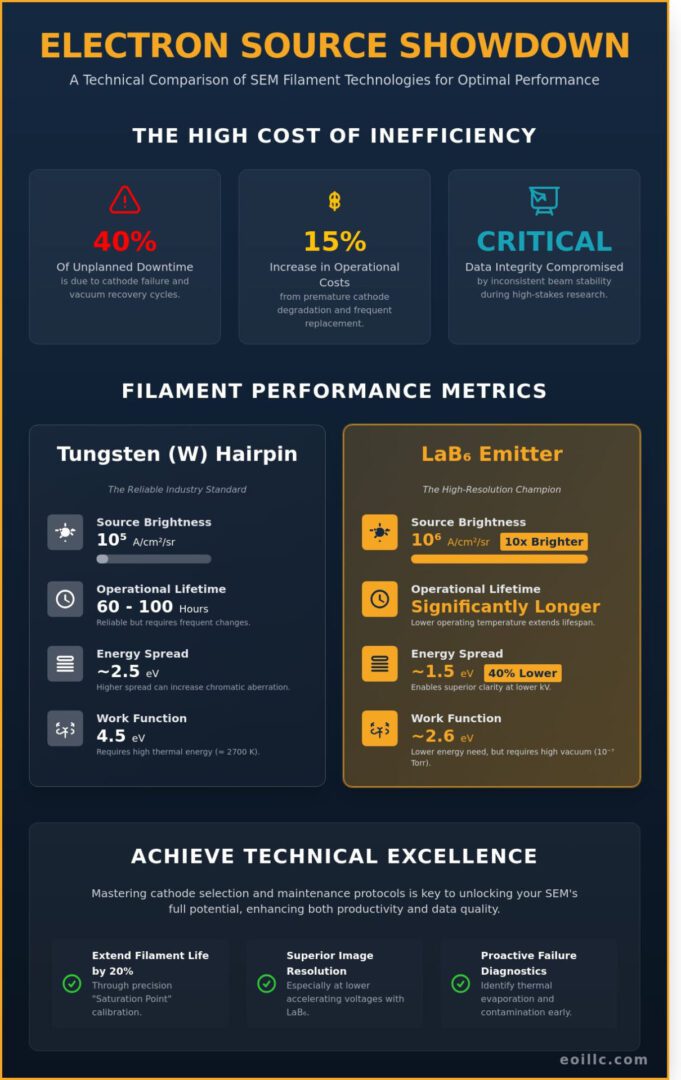
- Source Brightness: Measured in Amps per square centimeter per steradian (A/cm²/sr), this defines the electron density. Tungsten typically offers 10^5 A/cm²/sr, while LaB6 reaches 10^6 A/cm²/sr.
- Energy Spread: This metric influences chromatic aberration. A standard tungsten source has an energy spread of approximately 2.5 eV, whereas hexaboride sources reduce this to 1.5 eV, enhancing clarity at lower accelerating voltages.
- Operational Lifetime: Most tungsten filaments provide between 60 and 100 hours of continuous use. This duration is a direct result of the evaporation rate of the metal at 2700 K.
Maximizing the lifecycle of these consumables requires a disciplined approach to saturation. Pushing the filament beyond its optimal temperature doesn’t yield a linear increase in brightness; instead, it accelerates the thinning of the wire, leading to premature failure. Precision control over the heating current ensures that the system maintains a stable emission current without sacrificing the structural longevity of the cathode.
Material Science: Tungsten vs. LaB6 and CeB6 Filaments
The selection of an appropriate electron source represents a critical juncture in the evolution of any microscopy workflow. Tungsten hairpins remain the foundational standard for many laboratories, operating through thermionic emission at temperatures exceeding 2,700 degrees Celsius. These sem filaments provide a reliable, cost-effective solution for diverse analytical needs, yet the pursuit of higher resolution leads many facilities toward hexaboride materials. Lanthanum Hexaboride (LaB6) and Cerium Hexaboride (CeB6) provide significant advantages in brightness and longevity that tungsten cannot match.
Performance disparities between these materials are rooted in their work functions. Tungsten requires high thermal energy to overcome its 4.5 eV work function, while hexaborides operate at lower temperatures due to their 2.5 eV to 2.7 eV work functions. This difference allows LaB6 to achieve 10 times the brightness of tungsten, facilitating superior resolution at low accelerating voltages. CeB6 offers a similar brightness profile but features higher resistance to carbon contamination, making it the preferred choice for high-vacuum environments where sample outgassing is a concern.
The transition to hexaboride cathodes necessitates a rigorous approach to vacuum management. While tungsten operates effectively at pressures around 10⁻³ Pa, LaB6 and CeB6 require ultra-high vacuum environments, typically reaching 10⁻⁷ Pa, to prevent cathode poisoning. This relationship between vacuum integrity and SEM performance and maintenance ensures that the emitter remains free from oxidation and ion bombardment, preserving the precision of the electron beam over extended periods.
When to Choose Tungsten Filaments
Tungsten filaments are the optimal choice for routine industrial inspections where magnification rarely exceeds 30,000x. In multi-user facilities where the chamber is vented 10 or more times daily, the robust nature of tungsten minimizes the financial risk associated with vacuum failures. These emitters are compatible with over 85 percent of legacy SEM models still in operation, offering a versatile solution for labs that prioritize ease of use over extreme resolution. It’s a pragmatic choice for environments with high user turnover.
The Case for Hexaboride (LaB6/CeB6) Upgrades
For nanotechnology and semiconductor failure analysis, hexaboride upgrades provide the stability required for long-duration EDS mapping and automated particle analysis. CeB6 emitters offer an evolutionary step in efficiency, providing a typical lifespan of 1,500 hours compared to the 60 to 100 hours expected from tungsten. This increased longevity reduces the total cost of ownership by decreasing downtime and labor costs associated with frequent source replacements. Professionals seeking to optimize their laboratory efficiency can explore high-performance optical and electron source solutions to ensure long-term stability and excellence in imaging results.
Compatibility Framework for Major SEM Manufacturers
Achieving optimal beam stability requires a rigorous understanding of the interface between electron sources and the specific column geometries of major manufacturers. Systems from JEOL, Hitachi, and Thermo Fisher (formerly FEI) utilize distinct mounting architectures that dictate the selection of sem filaments. These configurations generally fall into four primary categories: AEI bases, K-Type discs, S-Type assemblies, and cartridge-mounted configurations. Each architecture demands specific tolerances to ensure the emitter sits precisely at the optical center of the electron gun.
Using non-calibrated or low-grade third-party consumables introduces variables that compromise the evolutionary trajectory of laboratory throughput. Substandard filaments often lack the rigorous pre-stressing required to prevent sagging during the first 50 hours of use. If the filament isn’t centered within a tolerance of 0.001 inches, the resulting astigmatism can’t be fully corrected by the electromagnetic lenses. This leads to a measurable loss in resolution, often exceeding 15% at high magnifications, which undermines the precision required for advanced materials analysis.
- JEOL Systems: Typically require S-Type filaments that demand exact height positioning to match the Wehnelt aperture.
- Hitachi Systems: Often utilize K-Type ceramic bases designed for high thermal stability during rapid voltage fluctuations.
- Thermo Fisher/FEI: Frequently employ specialized cartridge mounts that facilitate rapid exchange in high-vacuum environments.
Benchtop and Tabletop SEM Consumables
The evolution of compact electron microscopy, exemplified by the Cube II and Genesis series, has shifted the paradigm of filament maintenance. These systems utilize precision-aligned sem filaments designed to operate within the constraints of smaller vacuum chambers. Because these compact systems often reach operating pressure in under 3 minutes, the thermal expansion coefficients of the filament assembly must be perfectly matched to the gun housing. The Veritas series emphasizes a plug-and-play methodology; it’s a design choice that eliminates the 20-minute manual alignment process required by traditional floor-standing units. This integration ensures that even in portable configurations, the beam excellence remains consistent with laboratory standards.
Ensuring OEM-Grade Precision
Maintaining the integrity of the electron beam starts with the microscopic specifications of the filament wire. High-grade emitters typically utilize 0.125mm tungsten wire, where a deviation of even 5 microns in loop centering can cause significant beam drift. The quality of the ceramic disc is equally critical; low-grade components often use porous ceramics that outgas, degrading the vacuum level by as much as 10% during peak operation. Technicians don’t just install these parts; they must verify the structural integrity of the V-shape tip under 40x magnification before installation to ensure the absence of micro-fractures. This commitment to verification ensures that the synergy between green technology and industrial performance is never compromised by avoidable hardware failure.
Optimizing Filament Lifespan and Troubleshooting Failure
Achieving operational excellence with sem filaments requires a disciplined approach to the saturation point. Users must increase the filament current until the emission peaks and then levels off. Operating beyond this specific threshold doesn’t increase brightness; instead, it accelerates tungsten evaporation by as much as 50 percent for every 100 Kelvin increase in temperature. This thermal mismanagement leads to premature thinning and eventual structural failure. Precision in setting the bias ensures that the electron source operates at its peak evolutionary efficiency without unnecessary degradation.
Most failures result from three distinct vectors: evaporation, chemical contamination, or mechanical shock. While evaporation is an inevitable consequence of thermionic emission, contamination often stems from poor vacuum integrity. Maintaining a vacuum level of at least 1.33 x 10^-5 Pa is vital to prevent oxidation. If oxygen levels rise, the tungsten reacts to form volatile oxides that strip the cathode surface rapidly. Proper handling is equally critical. Technicians should use lint-free gloves and vacuum-sealed storage to prevent skin oils from carbonizing on the wire surface during high-voltage operation. These contaminants can cause localized hotspots that lead to a premature snap. A structured approach to SEM maintenance protocols and vacuum system hygiene is essential to mitigating these contamination risks and extending cathode service life.
Extending Filament Life Through Proper Operation
Precision control starts with gradual ramping. Technicians should increase the heating current in increments of 0.1 Amperes every 30 seconds to minimize thermal shock. It’s essential to manage the vacuum to vent cycle carefully. Exposing a hot filament to atmospheric pressure causes immediate catastrophic oxidation. Monitoring the emission current provides a 20 percent early warning window before a filament snaps. This proactive data tracking allows for scheduled maintenance rather than unexpected downtime during critical imaging sessions. Consistent monitoring ensures the excellence of the electron beam remains stable over the component’s 100-hour lifecycle.
Troubleshooting Beam Artifacts
Distinguishing between a failed filament and a dirty aperture is a core competency in electron microscopy. If the beam disappears entirely, it’s likely a burnout, but ghost images or flickering often indicate carbon buildup on the final aperture. Centering the gun can resolve 90 percent of alignment flickers. However, if the emission remains unstable after centering, a full gun cleaning is required to remove accumulated metal vapors from the ceramic insulators. Professionals should evaluate the sem filaments for thinning before committing to a complete system teardown, as a simple replacement often restores optical clarity.
To ensure your laboratory maintains the highest standards of imaging precision and component longevity, explore our range of high-performance SEM solutions today.
Strategic Sourcing and Professional Service Integration
Achieving peak resolution in electron microscopy requires a shift from transactional purchasing to strategic sourcing. Sourcing sem filaments from service-oriented experts like Electron Optics Instruments, LLC ensures that every component meets rigorous technical tolerances. This approach prioritizes long-term instrument health over short-term cost savings. Lab managers often face the challenge of maintaining beam stability while managing operational costs. Integrating high-grade consumables into a structured preventative maintenance strategy addresses this tension directly. It’s a method that maximizes the lifecycle of the vacuum system and the cathode itself.
Precision in imaging relies on the alignment of the entire optical column. A high-quality cathode only functions as well as the system that supports it. By aligning procurement with technical service, facilities ensure that their internal teams possess the necessary skills for complex maintenance tasks. This synergy reduces the risk of vacuum leaks or contamination during filament changes, which can lead to costly downtime. The integration of consumables into a preventative maintenance framework transforms the laboratory from a reactive environment to a proactive one. When a facility adopts a rigorous schedule for cathode evaluation, they typically see a measurable decrease in unscheduled service calls. Electron Optics Instruments, LLC specializes in aligning these maintenance cycles with the specific duty cycles of your equipment. This ensures that sem filaments are replaced before failure occurs, protecting the sensitive electronics within the gun chamber from sudden arcs or pressure spikes.
The EOI LLC Advantage: Beyond the Part Number
Electron Optics Instruments, LLC leverages over 30 years of specialized expertise in electron optics to support every consumable it provides. Our service contracts go beyond simple repairs; they simplify inventory management for modern laboratories. We provide customized training programs that focus on the intricacies of filament replacement and precise column alignment. This hands-on education empowers technicians to maintain optimal imaging conditions without waiting for external support. Our focus on technical authority ensures that your facility maintains its competitive edge in research and manufacturing. It’s a standard of excellence that reflects our global leadership in high-precision technology. We don’t just ship parts; we deliver the technical foundation required for evolutionary progress in microscopy.
Procurement and Consultation
Evaluating your current imaging performance is the first step toward a successful cathode upgrade. We offer technical audits designed to identify bottlenecks in your SEM workflows. For facilities operating 3 or more instruments, our bulk sourcing programs streamline the supply chain and ensure consistency across all platforms. This methodical approach to procurement ensures that your research remains uninterrupted. Optimize your SEM performance with Electron Optics Instruments, LLC filaments to secure the reliability your sophisticated imaging projects demand. Our consultation process focuses on the evolutionary trajectory of your laboratory’s capabilities, ensuring that your hardware keeps pace with your innovative goals. By partnering with a seasoned global innovator, you ensure that your procurement strategy is as rigorous as your scientific methodology.
Advancing Analytical Precision Through Strategic Source Integration
Achieving peak resolution in thermionic emission systems relies on the precise alignment of material science and operational maintenance. Selecting between Tungsten, LaB6, or CeB6 emitters determines the long-term stability and brightness of your sem filaments. EOI LLC brings over 30 years of specialized experience in electron optics service and repair to ensure your laboratory maintains a competitive edge. We’re the sole US distributor for EmCraft Scanning Electron Microscopes; our technical expertise also extends to comprehensive support for all major manufacturers including JEOL, Hitachi, and FEI. This depth of knowledge allows us to transform routine maintenance into an evolutionary step for your research capabilities. It’s essential to integrate high-performance consumables with rigorous service protocols to secure the reliability your high-stakes imaging demands. We’re ready to help you optimize your system’s performance and longevity. Please consult with our technical experts on SEM consumables and service to elevate your facility’s output. Your commitment to excellence deserves a partner that values precision as much as you do.
Frequently Asked Questions
How long should a standard tungsten SEM filament last under normal conditions?
A standard tungsten SEM filament typically yields between 60 and 100 hours of operational life under optimal laboratory conditions. This duration depends heavily on maintaining a vacuum pressure of at least 10^-5 Torr and adhering to precise saturation protocols. If operators exceed the saturation point by even 5 percent, the evaporation rate of the tungsten increases, and it’s likely to reduce the service life by approximately 25 percent.
Can I upgrade my SEM from a tungsten filament to an LaB6 cathode?
Upgrading from a tungsten source to a Lanthanum Hexaboride (LaB6) cathode’s possible provided the microscope’s vacuum system can sustain pressures below 10^-7 Torr. While tungsten emitters function in lower vacuum environments, LaB6 requires a dedicated ion pump to prevent oxidation of the crystal tip. This transition improves brightness by a factor of 10 and increases source longevity to 1,000 hours, representing a clear evolution in imaging resolution.
What are the signs that my SEM filament is about to fail?
Visible indicators of imminent failure include beam current instability and a notable increase in image noise during high-magnification procedures. When the sem filaments approach the end of their lifecycle, the emission becomes erratic as the wire thins to less than 10 percent of its original diameter. Operators often observe a characteristic flicker in the secondary electron signal, signaling that the loop’s structural integrity is compromised and breakage is likely within 4 hours.
How does vacuum pressure affect the lifespan of a hexaboride filament?
Vacuum pressure is the primary determinant of LaB6 longevity; any oxygen levels above 10^-7 Torr cause rapid chemical erosion of the hexaboride crystal. Operating at a degraded vacuum of 10^-6 Torr can reduce the expected 1,500-hour lifespan by 50 percent due to accelerated oxidation at the emitting surface. Maintaining a stable, high-vacuum environment ensures the crystal maintains its sharp geometry, which is essential for consistent electron brightness and long-term analytical precision.
Is it necessary to realign the electron gun every time I change the filament?
Realigning the electron gun is a mandatory procedure following every filament replacement to account for microscopic variations in mechanical positioning. Even a shift of 50 microns in the filament tip’s placement relative to the Wehnelt aperture can degrade beam symmetry and resolution. Technicians must perform both mechanical centering and electronic tilt adjustments to ensure the primary beam aligns perfectly with the optical axis, maximizing the performance of the new sem filaments.
What is the difference between a pre-centered and a standard SEM filament?
Pre-centered filaments are factory-aligned within a tolerance of 0.01 millimeters relative to the ceramic base, whereas standard filaments require manual alignment by the user. This precision manufacturing reduces the time spent on gun calibration during the installation phase. By utilizing pre-centered components, laboratories achieve higher reproducibility in beam current, as the emitter sits at the exact geometric center of the electron optics assembly upon insertion.
Why is my new filament burning out prematurely?
Premature burnout’s frequently caused by vacuum leaks that introduce oxygen or by operating the filament at an over-saturated temperature setting. If the vacuum level rises above 5×10^-5 Torr during operation, the tungsten wire oxidizes and thins rapidly, leading to failure in less than 10 hours. Additionally, oil contamination from backstreaming diffusion pumps can coat the filament, causing localized hotspots that weaken the metal structure and trigger early breakage.
Does EOI LLC provide filaments for older or discontinued SEM models?
EOI LLC’s inventory includes high-precision emitters compatible with legacy SEM platforms manufactured as far back as 1995. Our global supply chain ensures that discontinued models from major manufacturers receive the same level of technical excellence and component reliability as modern systems. We focus on providing sustainable solutions that extend the operational life of existing laboratory infrastructure through the integration of superior optical consumables and expert-driven support.