
By 2026, the global market for high-resolution imaging is projected to exceed $6.5 billion, yet 35% of procurement officers report that initial quotes for advanced instrumentation fail to account for the total cost of ownership over a five-year lifecycle. You’ve likely recognized that securing such a sophisticated optical solution is a significant milestone for any laboratory, but the persistent opacity in manufacturer pricing makes it difficult to justify the ROI to your board. This article delivers a rigorous analysis of the current electron microscope cost landscape, focusing on the technical drivers and the capital investment required for modern microscopy. We’ll evaluate the technical distinctions between benchtop and floor-standing models while providing full transparency regarding service contracts and operational overhead. Through this structured framework, your organization can achieve the synergy between sustainable innovation and industrial performance that defines global leadership in engineering. This guide ensures your next evolutionary step in precision imaging is grounded in fiscal accuracy and technical excellence.
Key Takeaways
- Evaluate the 2026 market landscape to determine how the evolutionary shift toward high-performance benchtop solutions is redefining capital investment benchmarks for modern laboratories.
- Analyze the technical drivers behind electron microscope cost, specifically the financial premiums associated with advanced field emission sources and integrated Energy Dispersive Spectroscopy (EDS) systems.
- Conduct a precise cost-benefit analysis between compact benchtop units and traditional floor-standing models, accounting for both initial expenditure and the long-term fiscal impact of laboratory footprint requirements.
- Identify the critical components of Total Cost of Ownership (TCO), including multi-tiered service contracts and recurring operational expenses essential for maintaining long-term technical excellence.
- Navigate the strategic acquisition process by weighing the risk-to-reward ratio of manufacturer-backed refurbished units against the precision-engineered advantages of new instrumentation.
The Economics of Electron Microscopy: Understanding the 2026 Market
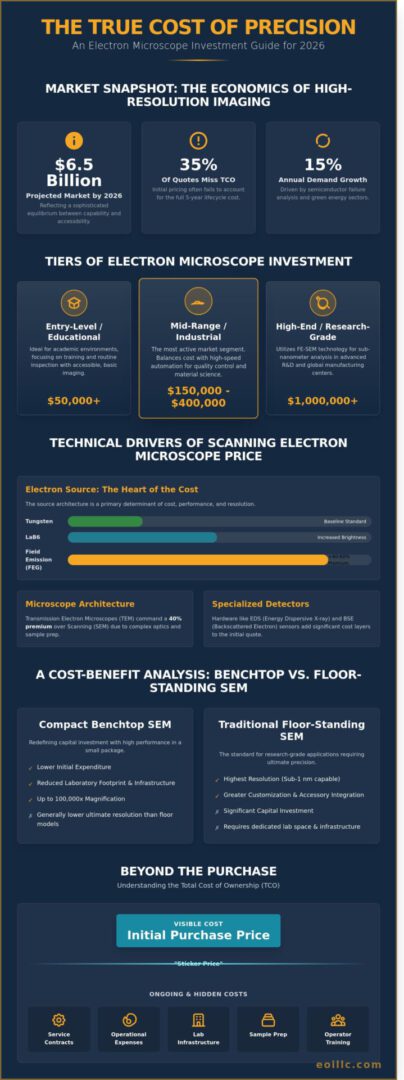
The 2026 landscape for high-resolution imaging reflects a sophisticated equilibrium between extreme technical capability and commercial accessibility. Current market valuations for a scanning electron microscope typically span from $50,000 for entry-level systems to well over $1,000,000 for research-grade installations. This pricing architecture is no longer dominated solely by massive, floor-standing units. Instead, an evolutionary shift toward high-performance benchtop solutions has disrupted traditional procurement models. These compact systems provide 100,000x magnification without the infrastructure requirements of their predecessors. Demand is currently driven by a 15% annual increase in semiconductor failure analysis and the rigorous demands of material characterization in green energy sectors. A simple sticker price isn’t a reliable metric for 2026 buyers. It’s essential to evaluate the total electron microscope cost against specific throughput requirements and environmental constraints of the laboratory.
The Price of Precision: Why Costs Vary Significantly
Resolution limits serve as the primary catalyst for price escalation in any procurement strategy. A system capable of 15 nm resolution represents a significantly lower investment than an aberration-corrected unit pushing sub-1 nm boundaries. The fundamental architecture also dictates the electron microscope cost. Transmission Electron Microscopes (TEM) often command a 40% premium over Scanning Electron Microscopes (SEM) due to their complex sample preparation and transmission optics. Specialized imaging hardware, such as Energy Dispersive X-ray Spectroscopy (EDS) detectors or backscattered electron (BSE) sensors, adds further layers to the initial quote. Precision is expensive. Integrating these tools into a unified workflow requires a deep understanding of the synergy between hardware and analytical software.
Defining the Tiers of Electron Microscope Investment
- Entry-level/Educational units: These systems focus on accessibility and basic imaging. They’re ideal for academic environments where training and routine inspection are the primary goals.
- Mid-range/Industrial workhorses: This is the territory of the Genesis and Cube II series. These systems balance cost with high-speed automation for quality control and material science. They represent the most active market segment in 2026.
- High-end/Research-grade systems: These units utilize Field-emission (FE-SEM) technology and ultra-high resolution models. They’re necessary for sub-nanometer analysis in global manufacturing centers and advanced metallurgy labs.
Selecting the correct tier isn’t just about budget; it’s about matching the tool to the industrial reality. A mid-range system often provides a higher return on investment for high-volume manufacturing than a research-grade system that’s too complex for rapid throughput. The objective is to achieve a balance between technical excellence and operational efficiency.
Technical Drivers of Scanning Electron Microscope Price
The procurement of advanced imaging technology requires a rigorous evaluation of how specific hardware configurations align with long-term research objectives. The primary determinant of the real-world examples of electron microscope costs often begins with the electron source architecture. Tungsten filaments represent the baseline standard, offering reliability for routine imaging at a lower capital expense. In contrast, Lanthanum Hexaboride (LaB6) sources provide increased brightness and longevity, though they necessitate more sophisticated vacuum environments. Field Emission Guns (FEG) represent the pinnacle of current evolutionary trends in microscopy, delivering the spatial resolution required for advanced nanotechnology applications. These FEG systems typically command a 40% to 60% price premium over tungsten counterparts due to the extreme engineering precision required to maintain stable, high-brightness beams. For a comprehensive breakdown of how these technical specifications translate into procurement budgets, the scanning electron microscope price strategic guide for 2026 provides an in-depth framework for evaluating total cost of ownership across all system tiers.
Vacuum architecture directly dictates both the operational stability and the lifecycle value of the instrument. High-end systems utilize multi-stage pumping configurations, including ion getter pumps, to achieve pressures below 10^-7 Pa. This level of sophistication ensures that the electron beam remains coherent and that sensitive internal components remain free from carbon contamination. While these robust vacuum systems increase the initial electron microscope cost, they reduce maintenance frequency by approximately 25% over a ten-year operational period. Modern pricing structures also reflect the integration of AI-driven automated image analysis. Software that automates particle counting or defect detection can increase laboratory efficiency by 40%, justifying the higher procurement costs for global manufacturing facilities.
Resolution and Magnification Thresholds
Achieving sub-5 nm resolution necessitates a substantial escalation in hardware investment because it requires electromagnetic lens systems with near-zero spherical aberration. Engineering excellence in vibration isolation and thermal stability is mandatory to maintain image clarity at magnifications exceeding 500,000x. Electron optics precision serves as the fundamental metric that dictates the final price point of the instrument.
Integrated Analytical Capabilities
Adding elemental analysis through Energy Dispersive Spectroscopy (EDS) typically increases the total system cost by $30,000 to $100,000 depending on detector surface area and sensitivity. Integration of specialized detectors, such as Backscattered Electron (BSE) and Secondary Electron (SE) sensors, enhances the versatility of the instrument for complex material characterization. Multi-detector configurations allow for simultaneous topographical and compositional mapping, which is essential for high-throughput industrial environments. For organizations seeking to optimize their laboratory workflows through sustainable innovation, exploring advanced optical solutions can provide the necessary technical edge for future-proof operations. Mastering advanced SEM techniques for high-resolution analytical microscopy becomes crucial when integrating these sophisticated analytical capabilities into a unified workflow.
- Tungsten Sources: Cost-effective, suitable for samples larger than 100 nm.
- Field Emission: High-resolution capability for sub-10 nm characterization.
- EDS Integration: Essential for chemical mapping and elemental identification.
- Automation Software: Reduces manual labor costs by streamlining data acquisition.
Benchtop vs. Floor-Standing SEM: A Cost-Benefit Analysis
The financial evaluation of an electron microscope cost necessitates a rigorous analysis of both immediate capital expenditure and long-term operational overhead. Benchtop models, exemplified by the Cube II, represent a strategic pivot for industrial laboratories seeking high-resolution imaging without the prohibitive price tag of traditional infrastructure. While a floor-standing unit offers unmatched versatility, the benchtop alternative provides a streamlined performance-to-price ratio that is increasingly attractive for routine industrial failure analysis.
Beyond the initial purchase, the “footprint factor” introduces substantial indirect costs. A traditional floor-standing unit typically requires a dedicated 150-square-foot environment with reinforced flooring and electromagnetic shielding. Conversely, benchtop systems operate on standard laboratory tables. This eliminates the need for specialized vibration isolation or dedicated water-cooling circuits; these infrastructure requirements can save a facility upwards of $20,000 in site preparation costs alone. Maintenance requirements also diverge significantly. Compact systems utilize dry vacuum pumps and pre-aligned electron columns, reducing the need for the specialized on-site technicians required by large-scale installations.
The Rise of High-Performance Desktop SEMs
The Desktop SEM: The Evolutionary Shift to High-Performance Benchtop Microscopy in 2026 illustrates how miniaturization has reached a point of technical parity for most industrial applications. These systems facilitate rapid throughput in quality control environments by reducing vacuum pump-down times to less than 180 seconds. Because they lack the complex pneumatic requirements of larger architectures, routine maintenance cycles are less frequent. This shift allows companies to decentralize their microscopy capabilities, placing high-resolution tools directly on the production floor.
When is a Floor Model Worth the Investment?
Certain specialized research objectives justify the $500,000+ investment required for a Veritas FE-SEM or similar high-end platforms. These floor models provide expansive sample chambers capable of housing 200mm wafers or heavy metallurgical mounts that exceed the weight limits of desktop stages. If a protocol demands a 70-degree tilting stage for Electron Backscatter Diffraction (EBSD) or sub-nanometer resolution at ultra-low kilovolts, the floor-standing architecture remains indispensable. These platforms offer superior longevity through modular upgradeability. Labs can integrate new detectors as technology evolves over a 10-year lifecycle, protecting the initial electron microscope cost through extended relevance.
- Benchtop Systems: Ideal for rapid screening, 5nm to 10nm resolution, and limited lab space.
- Floor-Standing Systems: Necessary for sub-nanometer imaging, large-scale sample manipulation, and multi-detector integration.
- Operational Savings: Benchtops reduce energy consumption by approximately 40% compared to floor-standing counterparts.
Beyond the Purchase: Total Cost of Ownership (TCO) in 2026
The initial electron microscope cost represents roughly 65% of the total financial commitment over a five-year operational lifecycle. Facilities shouldn’t overlook the recurring operational expenditures (OPEX) that ensure the precision of high-resolution imaging remains uncompromised. These expenses include specialized consumables like tungsten filaments or hexaboride (LaB6) cathodes. These components require replacement every 100 to 1,000 hours of beam time. Additionally, high-purity apertures and vacuum pump oil contribute to a steady stream of maintenance costs that accrue regardless of throughput levels. Professional on-site technical training for laboratory staff also requires a dedicated budget, often ranging from $2,500 to $5,000 per session, to ensure the equipment’s evolutionary capabilities are fully utilized.
Maintenance and Service Contract Fees
Service agreements are categorized into multi-tiered structures. They range from basic preventative maintenance to comprehensive “all-inclusive” plans that cover both parts and labor. Preventative visits typically occur twice annually to calibrate electron optics and verify vacuum integrity. Without these, emergency repair rates in 2026 can exceed $375 per hour plus travel expenses for specialized engineers. For organizations evaluating smaller footprints, the Benchtop SEM Price: A Comprehensive Analysis of Capital Investment and Total Cost of Ownership in 2026 provides a detailed breakdown of how integrated systems reduce these overheads. Annual service contracts are essential for mitigating the risk of costly downtime that’s capable of stalling critical R&D pipelines for weeks.
Relocation, Installation, and Infrastructure
Installing a high-performance system requires an environment free from electromagnetic interference (EMI) and mechanical vibration. Professional decommissioning and transport for sensitive electron optics often cost between $6,000 and $18,000. This depends on the distance and the complexity of the column. Labs must often invest in dedicated clean power lines and active vibration isolation tables to maintain sub-nanometer resolution. Post-installation, rigorous calibration and testing protocols ensure the system meets factory performance standards. Staff proficiency is equally vital. It’s an evolutionary step for any lab to transition from basic imaging to high-throughput automated analysis. Ensuring the electron microscope cost translates into actionable data requires a synergy between high-end hardware and expert operation.
Consult with EOI LLC for precision optical solutions and infrastructure planning.
Strategic Acquisition: Navigating New vs. Refurbished Options
Procurement officers in 2026 face a complex decision matrix where fiscal constraints must meet high-precision requirements. The electron microscope cost for a new, field-emission system often exceeds the reach of mid-sized laboratories or specialized industrial startups. This reality makes the second-hand market a strategic necessity rather than a compromise. When you evaluate the risk-to-reward ratio, the primary concern isn’t just the purchase price; it’s the long-term reliability of the vacuum system and the integrity of the electron optics. A refurbished unit from a reputable source provides a visionary path toward high-end research without the prohibitive capital expenditure of a factory-fresh model. Understanding the full spectrum of scanning electron microscope price variables across new and refurbished configurations is essential for making a fiscally sound procurement decision.
Trust in the second-hand market depends entirely on manufacturer-backed warranties and the depth of technical support. Without a verified service history, a used SEM becomes a liability. EOI LLC utilizes its 30-year legacy to bridge this gap, ensuring that every system undergoes a rigorous restoration process. This technical authority allows laboratories to secure precision instruments that perform at original specifications, backed by the expertise of seasoned engineers who understand the evolution of optical technology.
The Value of Refurbished Scientific Instrumentation
Refurbished units allow institutions to access high-end capabilities, such as energy-dispersive X-ray spectroscopy (EDS), at a mid-range price point. It’s not enough to simply clean the exterior; a true restoration requires the replacement of critical wear items. This includes vacuum pumps, apertures, and filaments. Rigorous testing of the electromagnetic lenses is mandatory to ensure resolution standards are met. Choosing a trusted distributor ensures that these technical milestones are documented, transforming a used machine into a reliable asset for sustainable innovation.
Finalizing Your Investment Strategy
Your final investment strategy should balance three core pillars: resolution requirements, sample throughput, and the total electron microscope cost over a five-year period. It’s vital to take a long-term view that prioritizes serviceability. A system that’s cheaper upfront but lacks available replacement parts will eventually stall your research. Expert-driven guidance is the best way to ensure your hardware remains functional as imaging standards advance. Use the following checklist to finalize your procurement:
- Component Certification: Verify the age and condition of the turbo-molecular or ion getter pumps.
- Software Lifecycle: Ensure the operating system is compatible with modern network security protocols and data analysis suites.
- Warranty Scope: Confirm that the warranty covers both the electron column and the electronics rack.
- Service Access: Validate that the vendor has a localized support team for rapid on-site maintenance.
Precision and reliability are the cornerstones of successful microscopy. Consult with the experts at Electron Optics Instruments for a tailored SEM quote.
Securing Precision Through Strategic Microscopy Investment
Navigating the 2026 microscopy landscape requires a calculated approach to capital investment and specific technical requirements. Determining the total electron microscope cost involves more than the initial purchase price; it necessitates a comprehensive analysis of maintenance cycles, specialized service contracts, and the resolution capabilities required for your research. It’s essential to balance the spatial efficiency of benchtop systems against the expanded analytical power of floor-standing units to ensure long-term operational excellence. EOI LLC leverages over 30 years of industry experience in electron optics to guide organizations through these complex procurement cycles with precision. As the sole US distributor for EmCraft Scanning Electron Microscopes, we provide access to precision engineering that aligns with modern industrial standards. Our expertise extends beyond hardware distribution, offering comprehensive service contracts that cover all major SEM brands to ensure your instrumentation maintains peak performance. We’re ready to help you secure the ideal balance of evolutionary innovation and reliability for your facility.
Request a Specialized Quote for Your Laboratory’s Microscopy Needs
We look forward to advancing your laboratory’s capabilities with precision and reliability.
Frequently Asked Questions
How much does a basic benchtop scanning electron microscope cost?
A basic benchtop scanning electron microscope typically requires a capital investment ranging from $70,000 to $150,000 depending on the specific optical resolution and vacuum capabilities. These entry-level systems provide essential imaging for quality control in manufacturing environments. While more affordable than full-sized floor models, the total electron microscope cost scales as users integrate advanced automated features or higher-voltage electron guns for deeper material penetration.
What are the main factors that drive up the price of an electron microscope?
Resolution requirements and the choice of electron source represent the primary drivers of system pricing. Upgrading from a standard tungsten filament to a field emission gun (FEG) can increase the base price by 40 percent because of the superior brightness and smaller probe size achieved. Additional factors include the integration of high-precision stages and specialized software for automated particle analysis, which cater to the evolutionary needs of modern industrial laboratories.
Is it better to buy a new or a refurbished electron microscope?
Purchasing a refurbished system often yields savings of 30 to 50 percent compared to the price of a factory-new unit. This approach allows laboratories to acquire high-end capabilities that might otherwise exceed their budgetary constraints. However, new systems provide the latest advancements in green technology and energy efficiency, backed by comprehensive manufacturer warranties that ensure long-term reliability and technical support for complex optical solutions.
What is the typical annual maintenance cost for an SEM?
Annual maintenance for a scanning electron microscope typically costs between 10 and 15 percent of the original purchase price. This expenditure covers routine vacuum system servicing, filament replacements, and necessary software updates to maintain precision. For a system valued at $200,000, organizations should allocate $20,000 to $30,000 annually to ensure consistent performance and prevent unexpected downtime in critical production workflows.
Do I need special facility modifications for a benchtop SEM?
Benchtop SEMs don’t require the extensive facility modifications associated with floor-standing models, such as reinforced flooring or specialized electromagnetic shielding. Most units operate on standard 110V or 220V power outlets and require only a stable, vibration-dampened table. It’s essential to verify that the laboratory’s acoustic noise levels remain below 60 decibels to prevent interference with the system’s high-resolution imaging capabilities.
How much does an EDS system add to the total cost of an electron microscope?
Integrating an Energy Dispersive X-ray Spectroscopy (EDS) system adds approximately $30,000 to $80,000 to the total electron microscope cost. This investment enables precise elemental analysis and chemical mapping, transforming a purely topographical imaging tool into a comprehensive analytical platform. The final price depends on the detector size and the speed of the processing electronics required for high-throughput material characterization.
Are there financing or leasing options for electron microscopes?
Most major manufacturers and third-party financial institutions offer leasing programs with terms spanning 36 to 60 months. These arrangements allow companies to preserve capital while accessing the latest evolutionary advancements in microscopy technology. Leasing often includes options for technology refreshes at the end of the term, ensuring that the laboratory maintains a competitive edge through continuous integration of modern optical solutions.
How long does a typical electron microscope last before needing replacement?
A well-maintained electron microscope typically remains operational for 10 to 15 years before the hardware becomes technologically obsolete. While the core vacuum and optical components are durable, the rapid evolution of computer hardware and imaging software often necessitates a system upgrade after a decade. Consistent adherence to manufacturer-specified maintenance protocols can extend the functional life of the instrument, maximizing the return on investment for the organization.