
The most expensive component of an electron microscopy suite isn’t the initial capital outlay; it’s the operational stagnation caused by a mismatch between technical capability and industrial throughput. While the global microscopy market is projected to expand through 2026, data from recent industrial audits suggests that up to 35% of research facilities struggle to realize the full ROI of their equipment due to unforeseen integration hurdles. You’ve likely found that the scanning electron microscope price remains frustratingly opaque, often hidden behind layers of proprietary configurations that make direct comparisons between a high-resolution FE-SEM and a versatile benchtop model nearly impossible.
This strategic guide clarifies the financial landscape by providing a rigorous framework for evaluating total cost of ownership and technical synergy. We’ll examine the specific engineering drivers that dictate price tiers and expose the hidden variables of maintenance and installation that often compromise long-term budgets. By the end of this analysis, you’ll possess the technical authority to select a system that mirrors the evolutionary growth of your organization’s precision requirements.
Key Takeaways
- Analyze the 2026 market landscape to distinguish between entry-level, mid-range, and high-end research tiers for precise budgetary alignment.
- Identify how electron source technology and nanometer resolution limits serve as the primary technical determinants of the scanning electron microscope price.
- Compare the evolutionary advantages of high-performance benchtop systems against traditional floor models to mitigate hidden infrastructure and utility expenses.
- Quantify the Total Cost of Ownership by integrating recurring service contracts and consumable management into your long-term financial framework.
- Develop a strategic procurement methodology that balances critical resolution requirements with the risk-to-reward ratio of new versus refurbished instrumentation.
Understanding the Scanning Electron Microscope Price Landscape in 2026
The global market for high-precision instrumentation has entered a phase of significant transformation. By 2026, the scanning electron microscope industry reflects both the pressures of global supply chain recalibration and the benefits of evolutionary manufacturing breakthroughs. Precision engineering requirements continue to dictate the baseline scanning electron microscope price, yet the integration of automated workflows has shifted the value proposition for many industrial laboratories. Manufacturers have increasingly prioritized modularity, which allows organizations to scale their imaging capabilities without the immediate need for a total system replacement. It’s a strategy that balances the high costs of optical precision with the practicalities of corporate budgeting.
The Three Tiers of SEM Investment
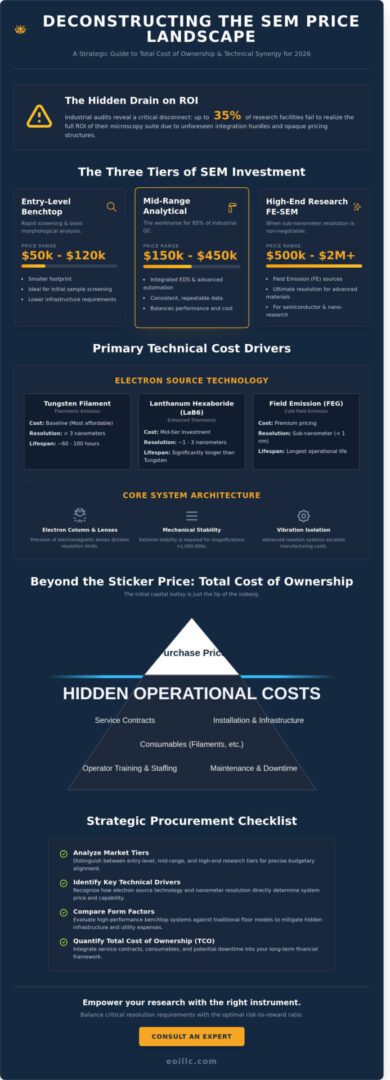
Capital expenditure for these systems generally falls into three distinct categories based on electron source technology and vacuum requirements. Understanding these tiers is essential for aligning technical needs with fiscal reality.
- Entry-level Benchtop systems ($50,000 – $120,000): These units provide rapid screening and basic morphological analysis. While they offer a smaller footprint, they often sacrifice large sample chambers and the highest levels of magnification.
- Mid-range Analytical SEMs ($150,000 – $450,000): This tier integrates Energy Dispersive X-ray Spectroscopy (EDS) and advanced automation. These systems serve as the workhorse for 85% of industrial quality control departments that require consistent, repeatable data.
- High-end Research and FE-SEMs ($500,000 – $2,000,000+): These platforms utilize Field Emission (FE) sources to achieve sub-nanometer resolution. This level of investment is necessary when extreme resolution is non-negotiable for semiconductor or advanced nanomaterial research.
Market Drivers and Economic Factors
Supply chain excellence now dictates lead times and final costs more than ever. The shift toward regional manufacturing hubs in 2025 has helped stabilize the scanning electron microscope price against the 4.2% inflation rates seen in specialized electronic components. 2026 represents a pivotal year because benchtop models have achieved a price-to-performance ratio previously reserved for floor-standing units. This evolution allows smaller firms to bypass traditional barriers to entry. The 2026 market doesn’t just reflect historical trends; it represents a fundamental shift in how precision is priced. Evolutionary advancements in electron optics have allowed manufacturers to condense high-resolution capabilities into smaller, more cost-effective frames. For a deeper analysis of these financial commitments, consult our guide on How Much Does an Electron Microscope Cost? to align your budget with specific technical requirements.
Primary Technical Determinants of SEM Capital Expenditure
The procurement of a high-performance imaging system involves a sophisticated evaluation of core hardware components that directly influence the total scanning electron microscope price. At the foundational level, the architecture of the electron column and the precision of the electromagnetic lenses dictate the system’s inherent resolution limits. Achieving sub-nanometer resolution requires extreme mechanical stability and advanced vibration isolation, factors that escalate manufacturing costs. These technical specifications aren’t merely arbitrary benchmarks; they represent the engineering rigor required to maintain beam stability at magnifications exceeding 1,000,000x.
Electron Source: Tungsten vs. LaB6 vs. Field Emission
The electron source is the primary driver of both image quality and system cost. Tungsten filaments represent the baseline for thermionic emission, offering a cost-effective entry point for laboratories focusing on standard topographical imaging where resolution requirements stay above 3 nanometers. While reliable, tungsten sources have a limited lifespan, often requiring replacement after 60 to 100 hours of operation. Lanthanum Hexaboride (LaB6) cathodes offer an evolutionary step in brightness and longevity, providing up to 1,000 hours of service, though they necessitate higher vacuum levels that increase the initial system investment.
Field Emission (FEG) technology sits at the high end of the market. It utilizes a sharp monocrystalline tip to produce a coherent, high-brightness beam. This enables sub-nanometer resolution and superior performance at low accelerating voltages. The complexity of maintaining the ultra-high vacuum environment required for FEG sources accounts for a substantial portion of the premium scanning electron microscope price. It’s a necessary investment for researchers analyzing sensitive polymers or advanced semiconductor nodes where beam damage must be minimized.
Analytical Capabilities and Software Integration
A microscope’s value is often defined by its detector suite and the software that interprets the resulting data. Standard secondary electron (SE) detectors provide surface morphology, but comprehensive material characterization requires additional sensors. Energy Dispersive Spectroscopy (EDS) integration allows for precise elemental mapping, while Electron Backscatter Diffraction (EBSD) provides critical data on crystallographic orientation. Each added sensor requires dedicated signal processing hardware and specialized vacuum ports, which can increase the capital outlay by 25% or more depending on the detector’s sensitivity.
Software integration serves as the vital link between raw signal acquisition and actionable industrial intelligence. Automated particle analysis routines have become essential for high-throughput quality control, providing a quantifiable return on investment in automotive and aerospace manufacturing. To contextualize these hardware costs within a broader operational framework, the SEM service and fee schedule offers a transparent look at how technical complexity influences hourly usage rates and specialized labor fees. Organizations looking to lead their industry through precision optical solutions must balance these immediate capital costs against the long-term gains of proprietary software efficiency and automated data synthesis.
Vacuum system complexity further differentiates entry-level units from high-end research platforms. Low-vacuum (LV) or environmental SEM (ESEM) configurations allow for the study of non-conductive or hydrated samples without the need for gold or carbon coating. This flexibility adds mechanical complexity to the pressure-limiting apertures and vacuum pumping sequences. In contrast, ultra-high vacuum (UHV) systems designed for surface science require specialized ion pumps and stainless steel chambers, reflecting a commitment to technical excellence that defines the upper tier of the microscopy market.
Benchtop vs. Floor Model SEM: Analyzing Cost-to-Performance Ratios
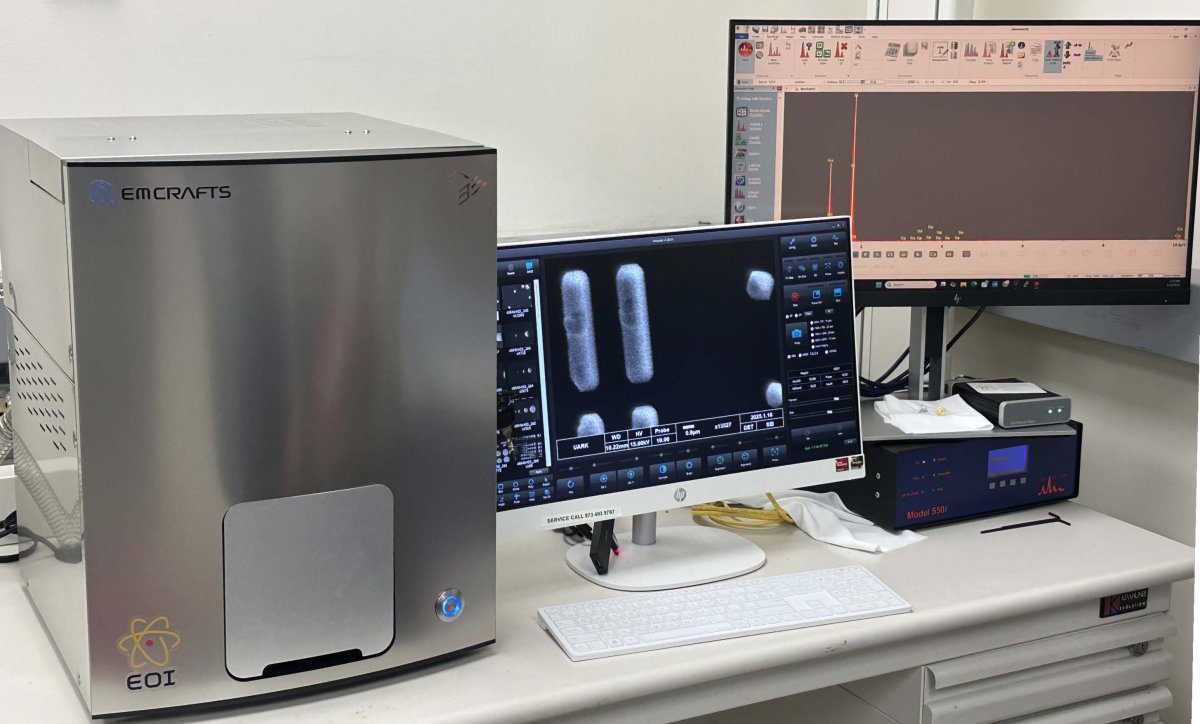
The transition from traditional, room-sized floor models to sophisticated benchtop units represents a critical evolutionary milestone in microscopy. High-performance instruments like the Cube II have redefined the capital investment landscape. While the initial scanning electron microscope price for a floor model often reflects its massive physical scale, the actual cost of ownership extends far beyond the purchase order; floor models frequently necessitate specialized laboratory infrastructure. This includes active vibration isolation tables and dedicated cooling systems that can add 15% to 20% to the total setup cost. In contrast, benchtop units integrate these requirements into a compact footprint, allowing for immediate deployment in standard manufacturing environments.
When evaluating the total scanning electron microscope price, organizations must weigh these infrastructure demands against the operational flexibility of modern desktop solutions. High-volume failure analysis requires rapid turnaround, and benchtop models facilitate higher throughput by reducing vacuum cycle times. These cycles often drop from several minutes in floor models to under 60 seconds in units like the Cube II. Maintenance accessibility also favors the benchtop form factor. Service engineers can access internal components more readily, and the modular design of modern desktop systems often results in a 30% reduction in annual service contract fees compared to their floor-standing counterparts.
The Rise of the Benchtop SEM in Industrial Settings
Analyzing the benchtop SEM price requires a focus on decentralized microscopy. The Genesis and Cube II series challenge traditional dominance by placing high-resolution imaging directly on the production floor. It’s a strategic shift that eliminates the logistical bottlenecks of centralized labs, providing real-time quality control that accelerates production cycles by up to 25% in semiconductor and automotive sectors. This proximity to the manufacturing line ensures that precision isn’t sacrificed for speed.
When the Floor Model Premium is Justified
The floor model premium remains a necessity for specific high-end applications despite the efficiency of smaller units. Large sample chambers are essential for analyzing intact turbine blades or automotive components that exceed the 80mm stage travel limits of most desktop units. For nanotechnology research requiring sub-nanometer resolution or complex multi-axis stage precision, the floor model’s stability is unmatched. This distinction is vital when tracking the Desktop SEM Evolution, as it highlights the boundary between industrial throughput and specialized academic research where large-scale sample manipulation is mandatory.
Calculating Total Cost of Ownership (TCO): Beyond the Sticker Price
Acquiring high-resolution imaging technology involves a financial commitment that extends far beyond the initial procurement phase. While the baseline scanning electron microscope price serves as a primary capital expenditure, the lifecycle costs often represent a significant portion of the total investment. Operational excellence requires a disciplined approach to budgeting for recurring expenses, starting with consumables management. Laboratory managers must account for the periodic replacement of filaments, apertures, and specimen stubs. For instance, tungsten filaments typically provide 60 to 100 hours of stable beam time before requiring replacement, whereas hexaboride (LaB6) cathodes offer extended longevity at a higher unit cost. Effective inventory control ensures that research doesn’t stall due to preventable hardware depletion.
Technical training fees are another critical component of the TCO equation. Investing in comprehensive instruction for laboratory staff minimizes the risk of user-induced column contamination or vacuum system failures. High-end systems require specialized knowledge to maximize their analytical capabilities; without this expertise, the instrument’s utility remains under-leveraged. Furthermore, facility preparation demands rigorous engineering standards. Achieving sub-nanometer resolution often necessitates vibration isolation platforms and electromagnetic shielding to neutralize environmental interference. Specialized cooling systems, designed to maintain thermal stability within 0.2 degrees Celsius, are frequently required to protect sensitive optical components from drift during long-duration mapping sessions. For a comprehensive breakdown of how these variables compound across pricing tiers, our SEM microscope cost strategic guide provides a rigorous framework for quantifying the full financial evolution from entry-level to field emission systems.
Service Contracts and Maintenance Agreements
Professional service contracts act as a vital risk-mitigation strategy for any high-tech facility. These agreements typically offer tiered support levels, ranging from standard preventative maintenance to priority emergency response. The cost of downtime in a 24-hour manufacturing or research environment can quickly exceed the price of a premium service tier. EOI LLC’s approach to multi-manufacturer repair emphasizes service excellence and technical precision, ensuring that complex optical systems maintain peak performance throughout their operational life. By securing a robust maintenance agreement, organizations protect their scanning electron microscope price investment against the volatility of unexpected hardware failures.
Infrastructure and Installation Logistics
Successful integration requires meticulous attention to installation logistics and infrastructure calibration. Professional decommissioning and relocation fees for sensitive optics are essential when upgrading or moving facilities, as improper handling can lead to permanent misalignment. Modern installations must also address the financial implications of specialized vacuum requirements and dedicated power conditioning units to prevent voltage spikes from damaging sensitive electronics. Ensuring sustainable innovation through proper facility calibration allows for a seamless transition from installation to active research, grounding the visionary potential of the technology in a stable, high-performance environment.
Strategic Procurement: Selecting the Optimal SEM Configuration
Procuring high-precision imaging technology requires a methodical evaluation of the “Critical Resolution” necessary for specific analytical workflows. Organizations frequently over-specify their technical needs, which leads to inflated capital expenditure without a proportional increase in data quality. Industrial data suggests that approximately 72 percent of research facilities utilize less than 60 percent of their instrument’s maximum resolution capabilities. By defining the exact spatial resolution and depth of field required for your primary applications, you can optimize the scanning electron microscope price and allocate resources toward essential accessories like Energy Dispersive X-ray Spectroscopy (EDS) detectors.
The decision between new and refurbished systems involves a complex risk-to-reward calculation. While new EmCraft systems offer the latest advancements in automated stage control and AI-driven image processing, refurbished units provide a strategic entry point for budget-constrained laboratories. In 2026, the scientific instrumentation market has shifted toward flexible financing and performance-linked leasing. These financial structures allow institutions to upgrade their hardware every 36 to 48 months, ensuring their researchers always have access to the most precise electron optics available.
- CapEx Preservation: Leasing options reduce the initial financial burden, allowing for immediate deployment of advanced imaging solutions.
- Technical Alignment: Matching vacuum requirements (high vacuum vs. variable pressure) to sample types prevents over-spending on unnecessary pump configurations.
- Scalability: Modular systems allow for future integration of specialized detectors as laboratory needs evolve.
The Value Proposition of Refurbished SEM Units
Rigorous re-certification processes ensure that pre-owned systems meet original factory tolerances and performance benchmarks. It’s common for a refurbished Veritas series model to outperform a brand-new entry-level unit in terms of beam stability and signal-to-noise ratio. These systems include comprehensive warranty coverage, providing technical reliability that rivals new equipment. Choosing a certified pre-owned system allows labs to balance capital preservation with the high-end technical specifications required for sophisticated material science research.
Partnering with EOI LLC for Long-Term Success
EOI LLC leverages 30 years of expertise in electron optics and industrial imaging to facilitate the procurement of high-performance EmCraft systems. Our approach focuses on the synergy between sustainable innovation and industrial performance. We provide customized on-site training modules that reduce the learning curve for new operators by an average of 45 percent within the first 90 days of installation. This ensures your team achieves maximum image quality and throughput immediately. To begin a technical consultation, contact our engineering team for a comprehensive scanning electron microscope price quote tailored to your specific operational requirements.
Future-Proofing Laboratory Excellence through Strategic Micro-Analysis
Navigating the complexities of laboratory procurement requires a rigorous synthesis of technical requirements and strategic fiscal foresight. As the 2026 fiscal landscape approaches, the primary scanning electron microscope price shouldn’t be viewed as a static expenditure but as a foundational investment in long-term analytical precision. Organizations that prioritize a comprehensive Total Cost of Ownership (TCO) model over initial sticker price ensure their research capabilities remain resilient against evolving industry standards. Selecting between a streamlined benchtop configuration and a high-performance floor model necessitates a precise evaluation of specific resolution demands and throughput quotas.
With 30+ years of industry expertise, EOI LLC serves as the sole US distributor for EmCraft SEMs, providing a unique bridge between advanced engineering and American industrial requirements. Our commitment extends beyond the initial sale; we provide comprehensive service protocols for all major SEM brands to ensure sustained operational uptime. It’s time to elevate your analytical infrastructure with solutions that balance visionary innovation with practical reliability. Request a Specialized Quote for Cube II or Veritas Series SEM to align your 2026 capital strategy with the highest standards of optical excellence. We look forward to facilitating your next evolutionary leap in microscopy.
Frequently Asked Questions
What is the average price for a benchtop scanning electron microscope in 2026?
Industry projections from market analysts suggest that benchtop SEM units will likely range between $70,000 and $150,000 by 2026. This pricing structure reflects the integration of automated AI diagnostic tools and high-resolution detectors that have become standard in compact optical solutions. Evolutionary advancements in manufacturing efficiency help stabilize these costs despite the inclusion of field emission sources in premium models. It’s a strategic investment for labs prioritizing space and precision.
How much does a field emission SEM (FE-SEM) cost compared to a tungsten model?
A Field Emission SEM typically costs 2 to 3 times more than a standard tungsten filament model due to the sophisticated vacuum requirements and superior resolution capabilities. While a tungsten SEM offers a reliable entry point for routine inspections, the FE-SEM provides the precision required for advanced semiconductor and nanomaterial analysis. This investment ensures long-term technical authority in high-resolution imaging environments. It’s the preferred choice for facilities demanding sub-nanometer excellence.
Are refurbished scanning electron microscopes reliable for industrial failure analysis?
Refurbished scanning electron microscopes are highly reliable for industrial failure analysis when sourced from certified manufacturers who provide a 12-month warranty and documented calibration records. Statistics from industry refurbishers indicate that 85% of industrial labs utilize pre-owned equipment to maintain global manufacturing standards while managing capital expenditure. These systems undergo rigorous testing to ensure they meet original factory specifications for precision and accuracy. They don’t compromise on the quality of diagnostic data.
What hidden costs should I include in my SEM budget beyond the purchase price?
Hidden costs beyond the base scanning electron microscope price include specialized vibration isolation tables, chilled water systems, and high-purity gas supplies which can add 15% to the total project cost. You must also account for laboratory infrastructure modifications, such as electromagnetic interference shielding and dedicated electrical circuits. These environmental requirements are essential for maintaining the evolutionary performance and precision of high-end optical instruments. Ignoring these factors often leads to significant operational delays.
Does the price of an SEM include installation and staff training?
Most Tier 1 manufacturers include basic installation and an initial 3-day staff training program within the purchase agreement to ensure immediate operational excellence. Advanced integration of the SEM into existing global manufacturing workflows may require additional specialized training modules that are billed separately. It’s critical to verify that the contract covers the calibration of all integrated detectors and software suites during the initial setup phase. This ensures your team achieves technical proficiency quickly.
How much should I budget for annual SEM maintenance and service contracts?
You should budget approximately 8% to 12% of the initial purchase price annually for comprehensive service contracts and preventative maintenance. These agreements typically cover the cost of replacement filaments, vacuum pump oil, and emergency onsite repairs. Maintaining a consistent service schedule is vital for the sustainable innovation of your laboratory and prevents the high costs associated with unexpected system downtime. Reliable maintenance schedules preserve the instrument’s long-term precision and value.
What is the price difference between an SEM and a Transmission Electron Microscope (TEM)?
When evaluating the scanning electron microscope price against a Transmission Electron Microscope (TEM), the cost disparity is substantial, as TEM systems often cost 3 to 5 times more. While an SEM provides detailed surface topography, the TEM requires significantly more complex sample preparation and higher voltage electronics to achieve atomic-scale resolution. For a detailed breakdown of these investment tiers, our guide on transmission electron microscope cost covers the full spectrum from $400,000 entry-level units to cryo-TEM systems exceeding $3 million. This cost difference reflects the evolutionary leap in engineering required for sub-nanometer imaging in advanced research facilities. It’s a choice between surface detail and internal structure.
Can I lease an electron microscope to preserve capital for other lab operations?
Leasing an electron microscope is a common strategy that allows 40% of private research firms to preserve capital for other critical lab operations and sustainable innovation projects. Equipment leasing programs often include structured payment plans that align with corporate fiscal cycles and provide pathways for technology upgrades every 3 to 5 years. This approach ensures your facility maintains technical authority without the immediate burden of a large capital outlay. It’s an effective method for managing global manufacturing resources.