
Does a $150,000 capital expenditure truly represent the baseline for modern analytical precision, or is your laboratory overlooking the 23% inflationary surge in instrument pricing documented since 2020? For many technical directors, evaluating the sem microscope cost is a task fraught with hidden variables, where the initial purchase price is merely the starting point of a complex financial evolution. You likely recognize that while a desktop unit might start at $30,000, the integration of advanced detectors like EDS or EBSD can quickly push those figures toward the $275,000 threshold. It’s a challenging landscape where the distinction between a $60,000 entry-level model and a $650,000 field emission system dictates your facility’s long-term competitive capability.
This guide offers a strategic framework to master these financial complexities, ensuring your investment aligns with both current resolution needs and future operational stability. We’ll provide a rigorous breakdown of pricing tiers, from refurbished systems offering 30% savings to high-end floor models exceeding $1,000,000. By the end of this analysis, you’ll possess a comprehensive total cost of ownership model that accounts for everything from monthly $1,500 leasing options to the 35% variance in consumable filament expenses. We’re here to transform your procurement process into a visionary roadmap for technical excellence.
Key Takeaways
- Identify the distinct price tiers within the 2026 market to accurately benchmark your projected sem microscope cost against entry-level, mid-range, and high-end field emission systems.
- Analyze how specific technical variables, such as electron source selection and resolution limits, dictate the primary capital expenditure for your facility.
- Master a sophisticated evaluation framework that accounts for total cost of ownership, including the often-overlooked expenses of service contracts and infrastructure integration.
- Execute a strategic two-step audit of your analytical requirements and facility capacity to prevent the common pitfall of over-specification.
- Explore the strategic advantages of the Cube II Benchtop SEM as a high-performance solution that balances evolutionary precision with fiscal responsibility.
The Landscape of SEM Microscope Cost in 2026
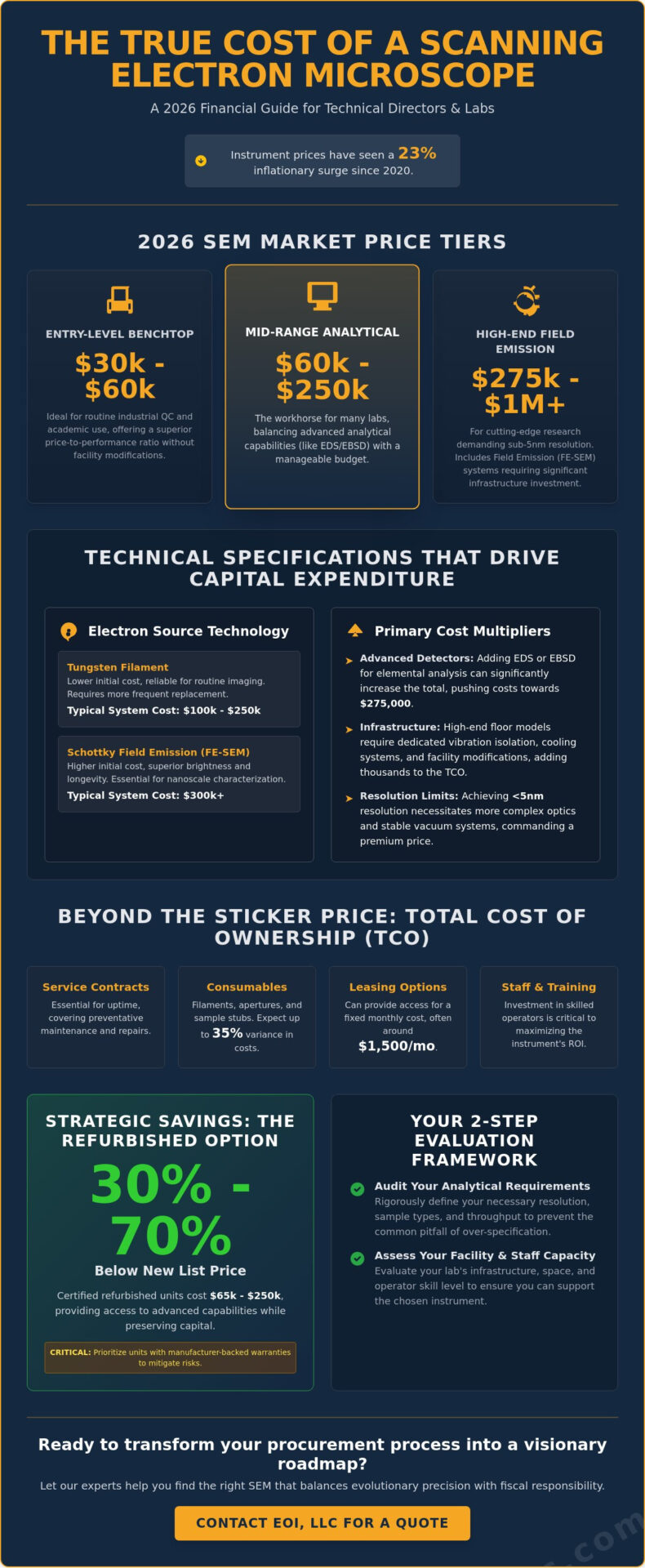
The current fiscal environment for analytical instrumentation reflects a period of significant recalibration. Since January 2020, the Producer Price Index for laboratory analytical instruments has climbed by approximately 23%, a shift that has fundamentally altered the sem microscope cost for global manufacturing and research facilities. In 2026, the market is stratified into three distinct tiers: entry-level benchtop systems ranging from $30,000 to $60,000; mid-range analytical units priced between $60,000 and $250,000; and high-end field emission systems that often exceed $1,000,000. This pricing structure necessitates a strategic approach to acquisition, particularly as the “desktop evolution” continues to bridge the gap between compact accessibility and high-resolution performance. For a granular analysis of these figures, professionals should consult our detailed guide on how much an electron microscope costs.
Benchtop vs. Floor Model Price Tiers
The transition from traditional floor-mounted systems to sophisticated benchtop units represents a critical shift in capital expenditure strategy. While a high-end scanning electron microscope in a floor-standing configuration offers unparalleled resolution, it demands extensive infrastructure, including dedicated vibration isolation and specialized cooling systems. Conversely, benchtop models like the Hitachi TM4000 or the JEOL JCM-7000 provide a superior price-to-performance ratio for routine industrial quality control. These compact units eliminate the need for facility modifications, effectively reducing the total investment by thousands of dollars beyond the initial sticker price. This evolution allows labs to achieve 5nm to 10nm resolution without the million-dollar price tag associated with infrastructure-heavy FE-SEM systems.
The Role of Refurbished SEMs in Budget Optimization
Strategic budget optimization often leads B2B partners toward the refurbished market, where certified units typically retail for 30% to 70% below new list prices. A refurbished SEM from a reputable provider can cost between $65,000 and $250,000, offering a viable path for educational institutions or secondary research labs to access advanced imaging capabilities. It’s essential to prioritize manufacturer-backed warranties during this process to mitigate the risks associated with aging electronics or vacuum systems. By selecting a refurbished model with modern software upgrades, facilities can maintain high precision while lowering the initial sem microscope cost to preserve capital for other critical analytical tools.
Technical Specifications That Drive Capital Expenditure
The underlying architecture of an electron microscope dictates its primary capital requirements. While the previous section outlined broad market tiers, the specific technical configuration of the electron source and optical column serves as the primary engine of the sem microscope cost. For instance, tungsten filaments remain the most accessible entry point, typically integrated into systems ranging from $100,000 to $250,000. These sources offer reliable performance for routine imaging; however, they lack the brightness and longevity required for advanced nanoscale characterization. The engineering complexity required to achieve resolution limits below 5nm necessitates a fundamental shift in the optics and vacuum stability of the instrument. Facilities requiring sub-nanometer transmission imaging should also evaluate the transmission electron microscope cost, where 2026 market tiers range from $400,000 entry-level units to cryo-TEM systems exceeding $3 million.
Electron Source Technology and Performance
The selection of an electron source is a pivotal decision that impacts both resolution and long-term operational efficiency. Tungsten sources involve a lower initial capital outlay but require frequent filament changes, whereas Schottky Field Emission (FE-SEM) systems demand a higher upfront investment, often starting at $300,000. Despite this cost, FE-SEM technology provides a lower per-image cost for nanotechnology applications by enabling faster acquisition and superior resolution at lower accelerating voltages. The industry is currently witnessing an evolutionary shift toward integrating Field Emission Gun (FEG) sources into benchtop models, allowing facilities to achieve extreme precision without the footprint of traditional floor units. Understanding these nuances is critical when calculating total cost of ownership for high-throughput laboratories.
Analytical Add-ons: EDS, EBSD, and WDS
Integrating specialized detectors significantly alters the final procurement quote. Adding Energy Dispersive Spectroscopy (EDS) for elemental analysis typically increases the base system price by 40% to 65%. For example, a base configuration for a mid-range desktop SEM might start at $75,000, but the inclusion of a high-resolution EDS detector can elevate that figure to $125,000. Electron Backscatter Diffraction (EBSD) for crystallographic mapping represents an even more specialized investment, with full analytical suites reaching $175,000 to $205,000. These scanning electron microscope price factors must be weighed against the specific analytical throughput requirements of your facility.
The sophistication of the vacuum system also plays a decisive role in the final investment. Standard high-vacuum systems are optimized for conductive samples, whereas Environmental SEM (ESEM) or low-vacuum configurations allow for the imaging of non-conductive or hydrated specimens without extensive sample preparation. This added versatility involves complex pressure-limiting apertures and specialized secondary electron detectors, which naturally increases the engineering complexity and the total sem microscope cost. By prioritizing automation and integrated software, organizations can maximize their ROI through reduced operator training times and streamlined data processing. Discover how our precision optical solutions can optimize your laboratory’s analytical capabilities and technical evolution.
Beyond the Sticker Price: Calculating Total Cost of Ownership
The acquisition of an electron microscope represents a strategic commitment that extends far beyond the initial capital outlay. Professional procurement requires a shift toward a Total Cost of Ownership (TCO) model, which integrates the primary sem microscope cost with long-term operational and maintenance expenditures. A common institutional oversight involves the belief that securing the hardware alone suffices for long-term capability; however, neglecting the operational budget can lead to catastrophic vacuum failures or degraded resolution within the first 24 months of operation. A visionary approach accounts for recurring costs such as replacement filaments, final apertures, and high-vacuum pump oil to ensure the system’s evolutionary performance remains consistent.
Service Contracts and Maintenance ROI
Selecting a tiered service agreement is a critical step in preserving the precision of the electron optics over a projected 10-year lifespan. Basic preventative maintenance (PM) contracts typically cover annual inspections and vacuum system health checks, while “all-inclusive” packages provide comprehensive parts and labor coverage for high-value components like the electron gun or turbo pumps. Investing in these agreements provides a measurable return by preventing unplanned downtime, which can cost thousands of dollars in lost analytical throughput. For more detailed strategies on protecting your investment, consult our definitive guide to SEM maintenance.
Infrastructure and Installation Requirements
The physical environment where the instrument resides is just as vital as the hardware itself. Site preparation involves significant engineering considerations, including electromagnetic interference (EMI) shielding and acoustic dampening to mitigate environmental noise that disrupts high-magnification imaging. These infrastructure upgrades, combined with billable hours for professional calibration and on-site technical training, can add 10% to 15% to the total sem microscope cost. Additionally, a complete analytical workflow often necessitates specialized sample preparation equipment, such as sputter coaters for non-conductive specimens or ion polishers for cross-sectional analysis.
Data from April 2026 indicates that certain models, like the SNE-Alpha, achieve a 20% to 35% lower total cost of ownership over a five-year period compared to high-end desktop alternatives, primarily due to the affordability of replacement filaments and simplified maintenance protocols. By evaluating these downstream variables during the initial procurement phase, organizations build a foundation for technical excellence that remains fiscally sustainable throughout the instrument’s entire lifecycle. A comprehensive TCO model isn’t just a financial exercise; it’s a prerequisite for technical reliability.
How to Evaluate and Select the Right SEM for Your Budget
Selecting an electron microscope requires a methodical evaluation of technical requirements against fiscal constraints. To optimize the sem microscope cost, organizations must move beyond surface-level specifications and adopt a structured procurement process. This evolutionary approach ensures that the chosen system provides the necessary precision without the burden of over-specification, which often leads to underutilized capital. By following a rigorous five-step framework, technical directors can align their acquisition strategy with both immediate analytical needs and long-term corporate objectives.
- Step 1: Define primary analytical requirements. Determine if your workflow prioritizes sub-nanometer resolution or high-throughput elemental analysis via EDS.
- Step 2: Audit facility infrastructure. Evaluate existing electrical capacity and floor stability to identify potential hidden costs in site preparation.
- Step 3: Conduct a throughput analysis. Determine if the rapid sample loading of a benchtop model or the large chamber capacity of a floor system offers higher operational efficiency.
- Step 4: Request itemized quotes. Ensure every bid explicitly details installation fees, operator training, and an initial kit of consumables to avoid downstream budget shocks.
- Step 5: Perform a 5-year TCO projection. Compare competing bids by calculating the cumulative expense of service contracts and power consumption over the instrument’s first half-decade.
Determining Necessary Resolution vs. Budget
One of the most effective ways to manage the sem microscope cost is to identify the precise resolution threshold required for your specific industry. While high-end research applications may demand sub-1 nm resolution, many industrial quality control and failure analysis tasks are performed effectively within the 5 nm to 10 nm range. Choosing a high-performance desktop sem for these routine tasks can save a facility hundreds of thousands of dollars in initial capital expenditure. For the majority of industrial quality control environments, the resolution-to-cost sweet spot is found in modern benchtop units that offer field emission performance at a fraction of the traditional floor model price.
Building the Internal Business Case
Justifying a major capital investment to finance departments requires a narrative built on measurable ROI and operational excellence. Shift the conversation from the sticker price to “cost-per-sample” metrics, demonstrating how bringing capabilities in-house reduces the reliance on expensive external contract research organizations (CROs). In competitive manufacturing sectors, the “time-to-result” advantage of an on-site SEM can accelerate product development cycles by weeks, providing a visionary edge that far outweighs the initial procurement expense. By presenting a data-driven case for technical independence, you position the microscope as a catalyst for sustainable innovation rather than a mere line-item expense. Contact our technical experts to receive a tailored performance analysis for your facility.
Strategic Acquisition: Maximizing ROI with EOI LLC Solutions
EOI LLC understands that achieving technical excellence requires a synergy between capital efficiency and analytical precision. As an established leader in the optical and automotive technology sectors, we provide a structured pathway for organizations to integrate advanced imaging without the fiscal volatility often associated with high-end instrumentation. Our role as a global distributor and a dedicated service partner ensures that your sem microscope cost remains a predictable, value-generating asset rather than an escalating operational burden. By aligning our visionary technical roadmap with the grounded realities of your manufacturing requirements, we facilitate a seamless transition to in-house nanoscale characterization.
The Cube II and Genesis Advantage
The Cube II Benchtop SEM represents a pinnacle of engineering, specifically designed to address the rigorous demands of failure analysis while maintaining the fiscal benefits of a compact footprint. For facilities prioritizing rapid characterization, the benchtop SEM price of the Cube II offers an optimized entry point that doesn’t compromise on the resolution or vacuum stability required for industrial excellence. The Veritas and Genesis series provide additional scalable solutions for laboratories whose analytical requirements are in a state of constant evolution. These platforms offer the technical depth needed for high-resolution imaging while maintaining the reliability required for 24/7 industrial operations. Each system features integrated EDS options, providing a turnkey analytical solution that removes the technical complexity and cost of managing third-party detector integrations.
Comprehensive Support and Training
Realizing the full potential of an investment in electron microscopy necessitates more than hardware; it requires a workforce trained in the nuances of electron optics and sample preparation. EOI LLC provides structured on-site technical training, where our specialists ensure your team masters the equipment’s utility from the first day of installation. These training fees are a strategic component of the sem microscope cost that directly contributes to sample throughput and data accuracy. Along with these educational benefits, our flexible annual service contracts are tailored to your specific laboratory throughput. This approach provides the stability of a partner who understands the rigorous processes of global manufacturing and supply chain excellence.
We invite you to consult with EOI LLC specialists to develop a customized capital equipment quote that aligns with your facility’s unique evolutionary goals. Our team is prepared to conduct a thorough performance analysis, ensuring your chosen configuration meets your resolution needs while respecting your budgetary boundaries. By balancing precision with industrial performance, we help you secure a future of technical authority and sustainable innovation. Contact us today to begin your facility’s analytical transformation.
Securing Your Laboratory’s Analytical Future
Navigating the financial requirements of advanced microscopy in 2026 demands a shift from reactive purchasing to a strategy centered on long-term operational excellence. You’ve seen how the 23% increase in laboratory instrument pricing since 2020 necessitates a rigorous evaluation of the sem microscope cost, specifically by balancing technical precision with a five-year total cost of ownership model. By aligning your resolution requirements with the appropriate electron source and accounting for infrastructure variables, you ensure your facility remains at the forefront of industrial performance. Technical independence is no longer a luxury; it’s a prerequisite for sustainable innovation.
EOI LLC brings over 30 years of specialized electron optics expertise to your procurement process, acting as the sole US distributor for EmCraft Scanning Electron Microscopes while providing comprehensive service support for all major SEM brands. We’re committed to your technical evolution, offering the stability and precision required for global manufacturing excellence. We invite you to Request a Specialized Quote for Your SEM Requirements to begin your journey toward visionary analytical capability. Your path to precision and technical authority starts with a partner who understands the intersection of reliability and progress.
Frequently Asked Questions
How much does a basic scanning electron microscope cost in 2026?
Entry-level scanning electron microscopes in 2026 typically range from $30,000 to $60,000 for basic tabletop configurations. These systems are optimized for routine imaging and provide an accessible entry point for laboratories focusing on micro-scale characterization. For more advanced mid-range desktop units, the investment increases to between $60,000 and $120,000, depending on the integrated analytical capabilities and detector sensitivity.
What is the difference in price between a benchtop SEM and a floor model?
The price differential between a benchtop SEM and a floor-standing model is substantial, often exceeding $200,000. While sophisticated benchtop units cap at approximately $120,000, high-end floor models start at $250,000 and can reach figures beyond $1,000,000 for field emission systems. This disparity reflects the increased engineering complexity of floor models, which offer superior resolution and larger specimen chambers for complex industrial samples.
Are refurbished SEM units reliable for high-precision research?
Refurbished units are exceptionally reliable for high-precision research when sourced through certified programs with manufacturer-backed warranties. These instruments provide a cost-effective alternative, typically offering savings of 30% to 70% compared to new systems. Many refurbished models undergo extensive electronics and software upgrades to meet modern analytical standards, making them a strategic choice for budget-conscious secondary laboratories.
How much should we budget for SEM maintenance and service contracts annually?
Annual maintenance and service contracts typically require a budget allocation of 10% to 15% of the initial sem microscope cost. These tiered agreements protect against catastrophic vacuum or electronics failure, ensuring the instrument’s precision remains consistent over its operational lifecycle. Investing in a comprehensive contract mitigates the risk of unplanned downtime, which can disrupt critical manufacturing timelines and increase long-term operational expenses.
Do SEM prices include the cost of EDS or other detectors?
Base SEM prices generally don’t include the cost of Energy Dispersive Spectroscopy (EDS) or other specialized detectors. Integrating an EDS system for elemental analysis typically adds $50,000 to $125,000 to the total quote, depending on the sensor resolution and processing speed. It’s essential to request an itemized proposal that specifies whether the sem microscope cost includes the necessary hardware and software for these analytical add-ons.
What infrastructure costs are typically associated with SEM installation?
Infrastructure costs for a professional SEM installation often involve site preparation for electromagnetic interference (EMI) shielding and vibration isolation. These requirements can add 10% to 15% to the total investment, particularly for floor-standing units that demand specialized flooring and acoustic dampening. Benchtop models significantly reduce these expenses as they typically operate on standard laboratory power without the need for dedicated facility modifications.
Can leasing an SEM be more cost-effective than a direct purchase?
Leasing an SEM is a strategic alternative to direct purchase for organizations that prioritize cash flow preservation and rapid technology upgrades. In the 2026 market, certain desktop models are available to lease from approximately $1,500 per month. This approach allows laboratories to access high-end imaging capabilities with lower upfront capital expenditure while maintaining the flexibility to evolve their analytical tools as research needs change.
How long does a scanning electron microscope typically last with proper maintenance?
A scanning electron microscope typically maintains peak performance for 10 to 15 years when supported by a rigorous preventative maintenance program. Some systems exceed a 20-year lifespan through strategic electronics and software upgrades that keep the hardware compatible with modern data processing standards. The longevity of the instrument is directly correlated to the stability of the vacuum environment and the consistency of technical support.