
Vibration isolation is not a peripheral accessory but a fundamental component of the electron optical path, requiring a rigorous, diagnostic-first approach rather than a simple hardware acquisition. Many researchers discover that even the most sophisticated systems, such as the Veritas HR SEM or the Veritas FE SEM, cannot circumvent the physical limitations imposed by sub-micrometer floor oscillations. These environmental disturbances frequently manifest as debilitating image blurring at high magnifications or inconsistent data quality that varies significantly according to the time of day. Implementing robust sem vibration isolation solutions is therefore a critical prerequisite for maintaining the structural integrity of high-resolution imaging and ensuring the reliability of nanometer-scale observations.
It’s a common challenge for laboratory directors to find that environmental noise undermines significant capital investments in advanced microscopy. This technical guide provides a comprehensive framework for identifying, diagnosing, and mitigating environmental vibration to protect your research outcomes. You’ll explore the technical nuances between active piezoelectric cancellation and passive damping methods, clarifying the specific cost-performance trade-offs inherent in each technology. We will detail the methodical site survey processes and mitigation strategies required to ensure your facility meets the exacting specifications of modern industrial and research applications.
Key Takeaways
- Analyze the critical relationship between mechanical stability and the integrity of the electron optical path to eliminate resolution degradation caused by environmental interference.
- Evaluate the technical distinctions between passive pneumatic damping and active piezoelectric feedback loops to determine the optimal isolation mechanism for your high-resolution requirements.
- Utilize frequency domain analysis and comprehensive site assessments to deploy targeted sem vibration isolation solutions that address the unique vibration profile of your laboratory.
- Adapt isolation strategies to specific equipment footprints, ensuring seamless integration for both compact units like the Cube II Benchtop SEM and large-scale floor-standing systems.
- Leverage professional preventative maintenance visits to maintain the delicate balance between vacuum system performance and environmental stability for consistent imaging excellence.
The Impact of Environmental Vibration on SEM Imaging Integrity
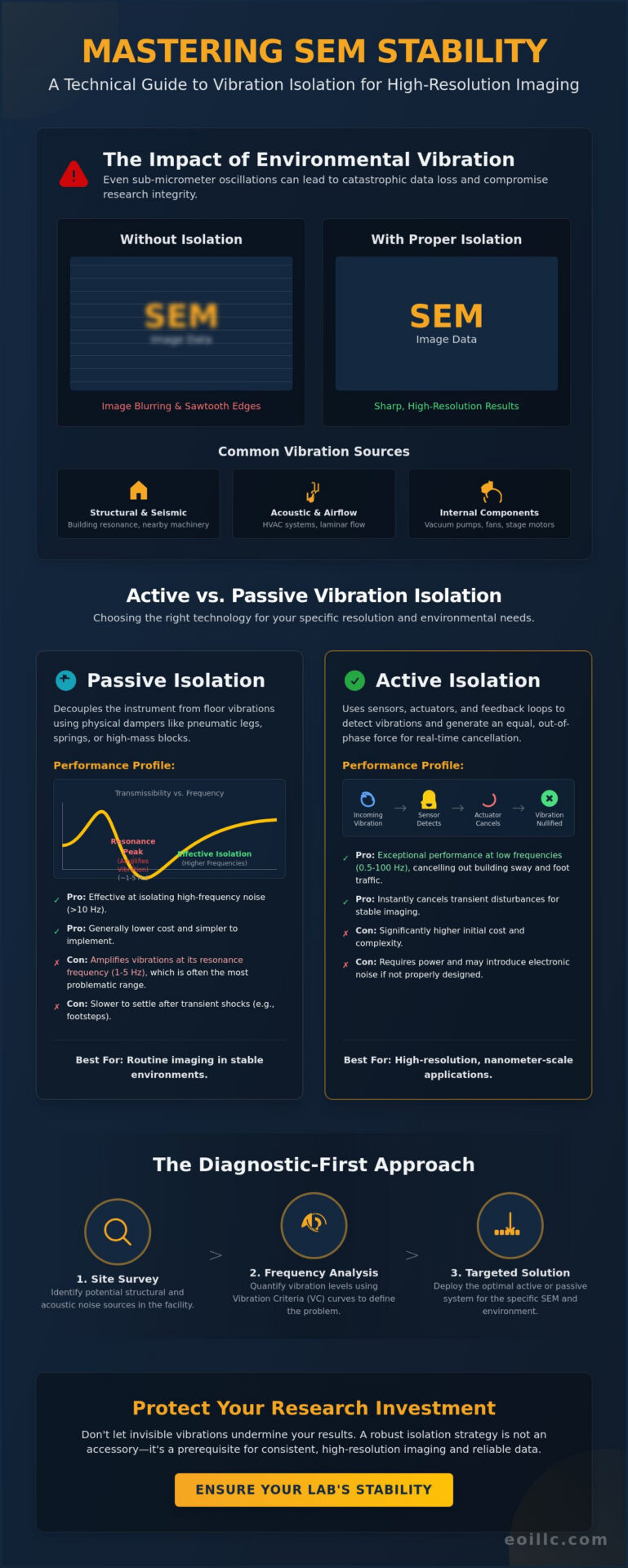
The integrity of Scanning Electron Microscopy is fundamentally contingent upon the mechanical stability of the laboratory environment. In high-resolution imaging, the electron optical path functions as a highly sensitive probe where even sub-nanometer deviations can lead to catastrophic data loss. Achieving peak performance requires a sophisticated understanding of vibration isolation principles, as the interaction between the electron beam and the specimen surface is susceptible to both external and internal disturbances. These oscillations manifest as distinct image artifacts, such as sawtooth edges resulting from periodic interference or generalized blurring that obscures fine topological features. Internal components, including rotary vacuum pumps, cooling fans, and stage motors, often generate high-frequency micro-vibrations that necessitate localized damping, while external forces require more comprehensive sem vibration isolation solutions to preserve imaging structural integrity.
Structural vs. Acoustic Noise: Identifying the Culprit
Distinguishing between floor-borne structural vibrations and airborne acoustic noise is vital for an accurate diagnostic profile. Structural interference often originates from building resonance, heavy machinery in adjacent rooms, or seismic activity, which travel through the floor and directly into the microscope column. Engineers utilize Vibration Criteria (VC) curves to quantify these levels, ensuring the facility meets the stringent requirements of instruments like the Veritas HR SEM. Acoustic pressure, conversely, is frequently driven by HVAC systems or cleanroom laminar airflow. This pressure exerts force on the microscope’s enclosure, inducing micro-movements that can be just as detrimental as floor-borne shocks during high-resolution acquisitions.
Magnification Limits and the Vibration Threshold
The correlation between resolution specifications and environmental stability becomes increasingly critical as magnification levels escalate. While the Cube II Benchtop SEM offers remarkable portability, its ability to resolve nanoscale features remains strictly limited by the mechanical stability of its mounting surface. When environmental noise exceeds the instrument’s tolerance threshold, the resulting image degradation forces operators to repeat scans, leading to reduced throughput and increased operator fatigue. Implementing effective sem vibration isolation solutions isn’t merely a technical preference; it’s a strategic necessity to maximize the return on investment for advanced hardware systems. Without proper mitigation, the “invisible” costs of vibration manifest as inconsistent data quality and an inability to reach the instrument’s theoretical resolution limits, undermining the progress of complex industrial and research projects.
Active vs. Passive Vibration Isolation: A Technical Comparison
Selecting between active and passive sem vibration isolation solutions requires a meticulous evaluation of the laboratory’s ambient frequency profile and the specific resolution requirements of the instrument. Passive isolation relies on the physical properties of pneumatic mounts, mechanical springs, or high-inertia mass, such as granite blocks, to decouple the instrument from floor-borne energy. While these systems are effective at higher frequencies, their performance is governed by a transmissibility curve that exhibits a significant resonance peak. At this specific frequency, typically between 1 Hz and 5 Hz, a passive system doesn’t isolate but rather amplifies incoming vibrations, which can be catastrophic for sub-nanometer imaging. Active vibration control bypasses these mechanical constraints through a sophisticated architecture of sensors, actuators, and digital feedback loops that provide real-time cancellation of transient disturbances.
Passive Isolation: Pneumatic Tables and Damping Benches
Pneumatic workstations are a standard choice for routine imaging applications where high-frequency floor noise is the primary concern. These systems utilize pressurized air to float the microscope, effectively filtering out vibrations above 10 Hz. However, they demand consistent maintenance, including a reliable air supply and periodic leveling to ensure the system doesn’t bottom out. For floor-standing models, heavy-mass granite benches offer superior thermal stability and damping, though lightweight honeycomb tables are often preferred for benchtop installations where weight limits are a factor. While these methods provide a foundational layer of protection, they lack the agility to respond to the low-frequency, non-periodic shocks common in modern industrial environments.
Active Isolation: Piezoelectric and Electromagnetic Systems
Advanced instruments, particularly the Veritas FE SEM, require a more aggressive approach to stability. Active systems utilize high-precision sensors to detect incoming disturbances across six degrees of freedom (6 DOF), spanning X, Y, and Z axes along with pitch, roll, and yaw. These sensors feed data to piezoelectric or electromagnetic actuators that generate an equal and opposite force, neutralizing the vibration before it reaches the column. This technology is essential for achieving sub-Hertz isolation, which is critical for field-emission systems that operate at extreme magnifications. For laboratories aiming to upgrade their existing infrastructure, exploring advanced SEM integration services can provide the necessary technical roadmap to retrofitting modular active platforms into current workflows without extensive downtime. These modular units offer a visionary path toward future-proofing research capabilities against the increasing logistical noise of urbanized laboratory settings.
Diagnostic Criteria: Conducting an SEM Site Assessment
The implementation of sem vibration isolation solutions begins long before the instrument arrives at the facility. A pre-installation environmental survey is a non-negotiable prerequisite for ensuring that the chosen laboratory space can support the resolution specifications of advanced electron optics. This diagnostic phase utilizes high-sensitivity accelerometers to capture the laboratory’s unique vibration signature, providing a data-driven foundation for isolation selection. Rather than relying on anecdotal evidence of floor stability, technical teams employ frequency domain analysis to identify specific resonance frequencies that could interfere with the electron beam’s stability. By mapping these environmental variables, lab managers can determine whether a standard passive solution is sufficient or if the site requires the active cancellation capabilities found in more robust sem vibration isolation solutions.
A critical component of this assessment involves the identification of “Transient Events,” which are non-periodic disturbances that can compromise long-term data consistency. These events often originate from external sources such as nearby heavy traffic, elevators operating in the same building, or large-scale industrial machinery. To visualize these disruptions, analysts interpret Power Spectral Density (PSD) plots, which illustrate how vibration energy is distributed across the frequency spectrum. Comparing these plots against the manufacturer’s allowable vibration limits allows for a precise determination of microscope compatibility, ensuring that the structural integrity of the imaging process remains uncompromised by the surrounding infrastructure.
Mapping the Labs Frequency Profile
Differentiating between steady-state background noise and intermittent spikes is essential for selecting the correct isolation architecture. While continuous background noise from HVAC systems is predictable, intermittent spikes from foot traffic or construction require a more resilient damping strategy. Analysts must also be careful to distinguish between mechanical vibrations and 50/60 Hz electrical interference, as these require entirely different mitigation tactics. The final report typically references Vibration Criteria (VC) curves, providing a standardized benchmark for SEM and TEM compliance that helps laboratory directors make informed procurement decisions based on documented environmental realities.
Predictive Modeling for SEM Placement
Structural dynamics generally dictate that ground floor or basement locations offer the most stable foundations for high-resolution electron optics due to their proximity to the earth’s mass. However, evaluating upper-floor feasibility for more compact units, such as the Genesis Tabletop SEM, requires a specialized analysis of floor stiffness and building sway. In these scenarios, predictive modeling must also account for electromagnetic interference (EMI), which often emanates from the same structural sources as mechanical vibration, such as elevator motors or electrical sub-panels. A holistic site assessment ensures that both mechanical and electromagnetic variables are synchronized with the instrument’s operational requirements, fostering an environment of uncompromising precision.
Implementing Isolation Strategies for Benchtop and Floor Models
Executing effective sem vibration isolation solutions requires a nuanced understanding of the instrument’s mass and its specific sensitivity to environmental disturbances. While floor-standing units benefit from their own significant inertia, benchtop models present a different set of challenges due to their compact footprints and lighter weight. Integrating high-performance isolation into a laboratory setting isn’t a universal process; it’s a tailored engineering task that must align with the microscope’s resolution capabilities and the facility’s structural dynamics. For many organizations, the decision to invest in advanced sem vibration isolation solutions is driven by the need to protect the precision of sub-10nm imaging across diverse operational environments.
Benchtop SEM Stability: Cube II and Genesis Solutions
The Cube II Benchtop SEM and Genesis Tabletop SEM represent a shift toward decentralized microscopy, yet their portability doesn’t exempt them from the laws of physics. Achieving 1-10nm resolution on a standard laboratory bench is often impossible without dedicated damping, as typical furniture resonance frequencies often overlap with the instrument’s sensitive range. Laboratory managers must optimize the benchtop surface by selecting between desktop active platforms and high-performance, vibration-damped workstations. Modern tabletop electron microscopes often feature some level of integrated damping, but this is frequently insufficient in high-traffic areas or upper-floor installations. In scenarios where cleanroom airflow or ambient noise is high, acoustic enclosures become a necessary secondary layer of protection, shielding the column from air-pressure fluctuations that mechanical isolation alone cannot mitigate.
Floor-Standing Systems: Veritas Series Requirements
Large-scale systems, such as the Veritas Series SEM, including the Veritas HR SEM and Veritas FE SEM, demand a more robust infrastructure to maintain their industry-leading resolution specifications. These high-performance models require sophisticated isolation strategies that can manage significant mass while providing sub-Hertz cancellation of floor-borne energy. Active isolation pedestals are often the preferred choice for these installations, as they provide real-time response to transient shocks that would otherwise compromise long-term imaging stability. Professional installation and meticulous calibration of this hardware are essential to ensure the system’s actuators are tuned to the specific vibration profile of the facility. To ensure your facility is prepared for these technical requirements, you can contact our technical specialists for a comprehensive consultation on hardware integration and performance optimization. This methodical approach to installation ensures that the synergy between the instrument and its environment remains uncompromised, allowing for consistent, high-fidelity data acquisition across all shifts.
Professional SEM Support: Beyond Vibration Isolation
The efficacy of sem vibration isolation solutions is intrinsically linked to the broader operational health of the microscope. While high-performance platforms mitigate external disturbances, the long-term structural integrity of imaging depends on a holistic support strategy that encompasses vacuum system health and meticulous mechanical calibration. Professional preventative maintenance visits provide a critical opportunity to conduct environmental checks that verify the ongoing performance of isolation hardware. These assessments ensure that as building dynamics shift over time due to nearby construction or facility upgrades, the microscope remains shielded from detrimental oscillations that could compromise research outcomes.
Integrating these technical checks into a standard service schedule allows field engineers to identify subtle performance drifts before they manifest as failed acquisitions. Vacuum system health plays a significant role in imaging stability; for instance, a vibrating pre-pump or a degraded roughing line can introduce internal noise that bypasses even the most advanced external sem vibration isolation solutions. Educating operators on identifying vibration-induced artifacts, such as periodic line noise or specific frequency-dependent blurring, empowers the laboratory staff to distinguish between specimen charging and environmental interference. By addressing these internal and external factors simultaneously, laboratories can achieve a superior standard of data reliability while reducing the total cost of ownership through the prevention of long-term mechanical wear.
Integrated Maintenance and Service Contracts
Comprehensive service agreements are essential for maintaining the delicate equilibrium required for high-resolution microscopy. A structured approach to SEM maintenance ensures that isolation systems remain calibrated and responsive to the specific frequency profile of the laboratory. This is particularly vital for refurbished SEM units, where site optimization can bridge the gap between legacy hardware and modern resolution requirements. Field service engineers provide the technical depth necessary to troubleshoot persistent noise issues, utilizing frequency analysis to isolate the root cause of image artifacts whether they originate from structural resonance or internal mechanical components.
Expert Consultation and Relocation Services
Relocating a high-precision instrument represents a significant risk to its future performance standards and requires a visionary approach to logistical planning. Professional decommissioning and re-installation services prioritize the preservation of the electron optical path, ensuring that new site conditions are thoroughly vetted and stabilized before the system is commissioned. Expert consultation allows for the customization of isolation solutions for unique research and industrial applications, where standard configurations might fall short of the required precision. To ensure your facility maintains its technical edge and operational stability, consult with our experts for a comprehensive SEM site assessment and secure the long-term reliability of your nanometer-scale research infrastructure.
Advancing Microscopy Through Structural Excellence
The pursuit of nanometer-scale precision demands a rigorous commitment to environmental stability that extends far beyond the microscope column. As established throughout this technical guide, the successful integration of high-resolution microscopy depends on a methodical approach to identifying and neutralizing mechanical disturbances through a diagnostic-first framework. By prioritizing comprehensive site assessments and selecting the appropriate active or passive architecture, laboratories can ensure the structural integrity of their imaging data remains uncompromised. Implementing sophisticated sem vibration isolation solutions is a strategic investment in the long-term reliability and accuracy of your research outcomes.
With over 30 years of specialized industry experience, Electron Optics Instruments, LLC serves as a seasoned partner for organizations seeking superior standards in technical integration. As the sole US distributor for EmCraft Scanning Electron Microscopes and a provider of comprehensive service contracts for all major SEM brands, we possess the meticulous expertise required to optimize your facility’s performance. Our commitment to visionary innovation and practical reliability ensures that your laboratory infrastructure evolves alongside the demands of modern industrial science. Explore high-performance SEM solutions and expert service at Electron Optics Instruments, LLC to secure the future of your microscopic investigations and maintain an environment of uncompromising precision.
Frequently Asked Questions
Does a benchtop SEM really need vibration isolation if it’s placed on a sturdy desk?
Yes, a sturdy desk is often insufficient for high-resolution imaging because typical laboratory furniture possesses resonance frequencies that can amplify ambient floor vibrations. While a desk may feel stable to a human operator, the sub-nanometer requirements of instruments like the Genesis Tabletop SEM necessitate dedicated damping to prevent image blurring at high magnifications. Without supplemental isolation, the mechanical energy from the building’s infrastructure can easily compromise the stability of the electron optical path.
What is the difference between active and passive vibration isolation for SEM?
Passive systems utilize mechanical components like pneumatic mounts or springs to decouple the instrument from high-frequency noise, whereas active systems employ a complex architecture of sensors and actuators to cancel low-frequency disturbances in real time. Active sem vibration isolation solutions are particularly critical for field-emission systems that operate in environments where sub-Hertz oscillations are prevalent. These active systems provide a visionary approach to stability by neutralizing vibrations before they reach the microscope column.
How can I tell if my SEM image blur is caused by vibration or a vacuum leak?
Vibration-induced artifacts typically manifest as periodic distortions or directional blurring, such as sawtooth edges on straight features, while vacuum leaks generally result in generalized signal instability or poor signal-to-noise ratios. Technicians often utilize frequency analysis to confirm mechanical interference, distinguishing it from the erratic beam behavior associated with vacuum contamination or pressure fluctuations. If the blur follows a specific rhythmic pattern, it’s a strong indicator of mechanical interference rather than a vacuum integrity issue.
Are acoustic enclosures necessary if I already have a vibration isolation table?
Acoustic enclosures are necessary when airborne noise from HVAC systems or laboratory activity creates pressure fluctuations that physically disturb the microscope column. While a vibration table isolates the base from floor-borne energy, it cannot protect the instrument’s upper architecture from the acoustic energy that propagates through the air. In high-precision environments, the synergy between mechanical isolation and acoustic shielding is required to maintain the structural integrity of the imaging process.
Can I retrofit an older SEM with a modern active vibration isolation system?
Retrofitting older SEM units with modern active isolation is a highly effective method for extending the operational life and resolution capabilities of legacy hardware. Modular active platforms can be integrated beneath the existing frame or column, providing an upgrade path that circumvents the need for a complete system replacement. This approach allows older instruments to meet the stringent stability requirements of modern research applications without extensive infrastructure overhauls.
What are VC curves and why are they important for electron microscope labs?
VC curves, or Vibration Criteria curves, are standardized benchmarks used to quantify the maximum allowable vibration levels for sensitive scientific instruments. These curves, ranging from VC-A to VC-G, allow facility managers to evaluate whether a laboratory’s floor stability meets the stringent requirements of high-resolution electron microscopy. Adhering to these benchmarks is essential for ensuring that the facility can support the precision specifications of advanced hardware like the Veritas series.
Does the Cube II Benchtop SEM include internal vibration damping?
The Cube II Benchtop SEM features sophisticated internal damping mechanisms designed to mitigate standard laboratory noise, though external sem vibration isolation solutions are frequently recommended for environments with high foot traffic or structural resonance. Utilizing an external platform ensures the instrument can consistently reach its theoretical resolution limits without environmental interference. This dual-layer approach provides the meticulous stability required for industrial-grade nanoscale observations.
How often should I have my vibration isolation system inspected or recalibrated?
Vibration isolation systems should be inspected and recalibrated at least once per year, ideally during scheduled preventative maintenance visits. Regular checks ensure that pneumatic levels remain optimal and that active sensors are correctly tuned to the laboratory’s evolving vibration profile, maintaining the long-term integrity of the electron optical path. This methodical upkeep is a critical component of a comprehensive support strategy designed to minimize the total cost of ownership and prevent data degradation.