
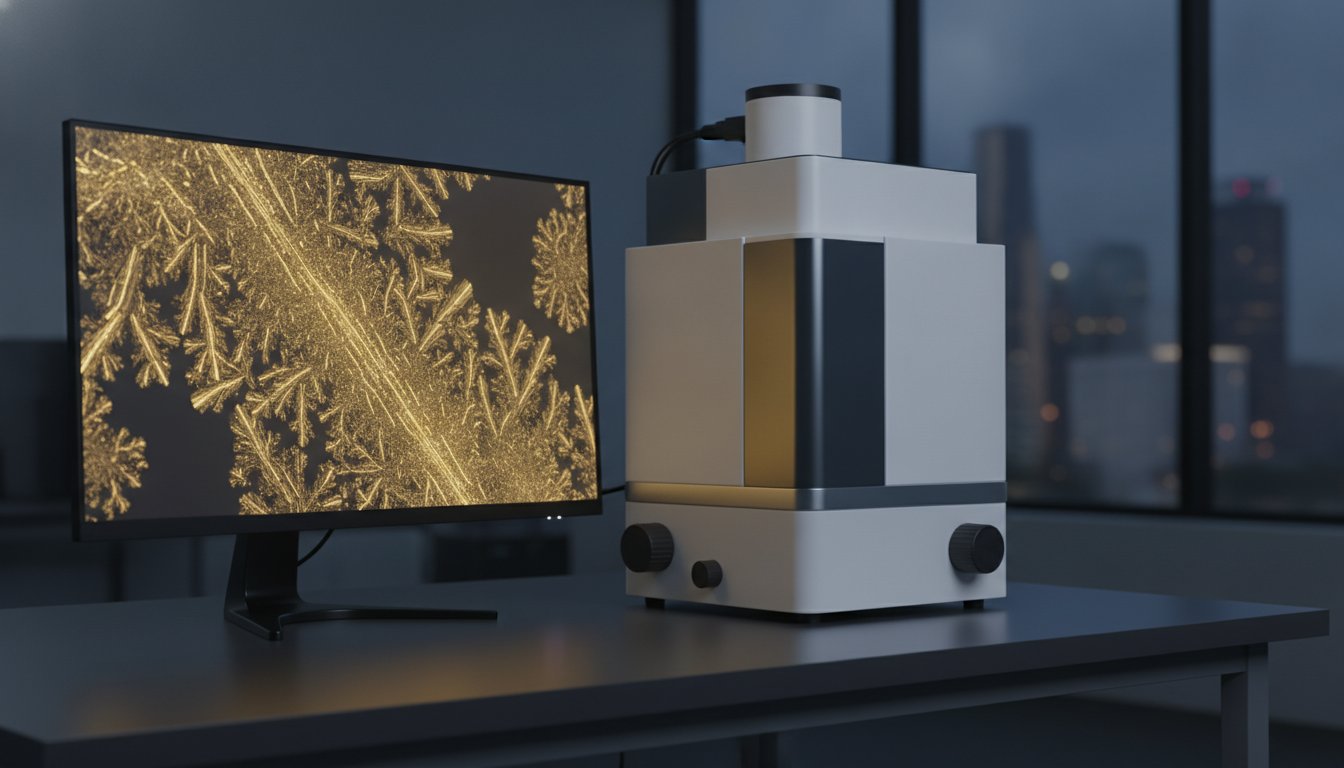
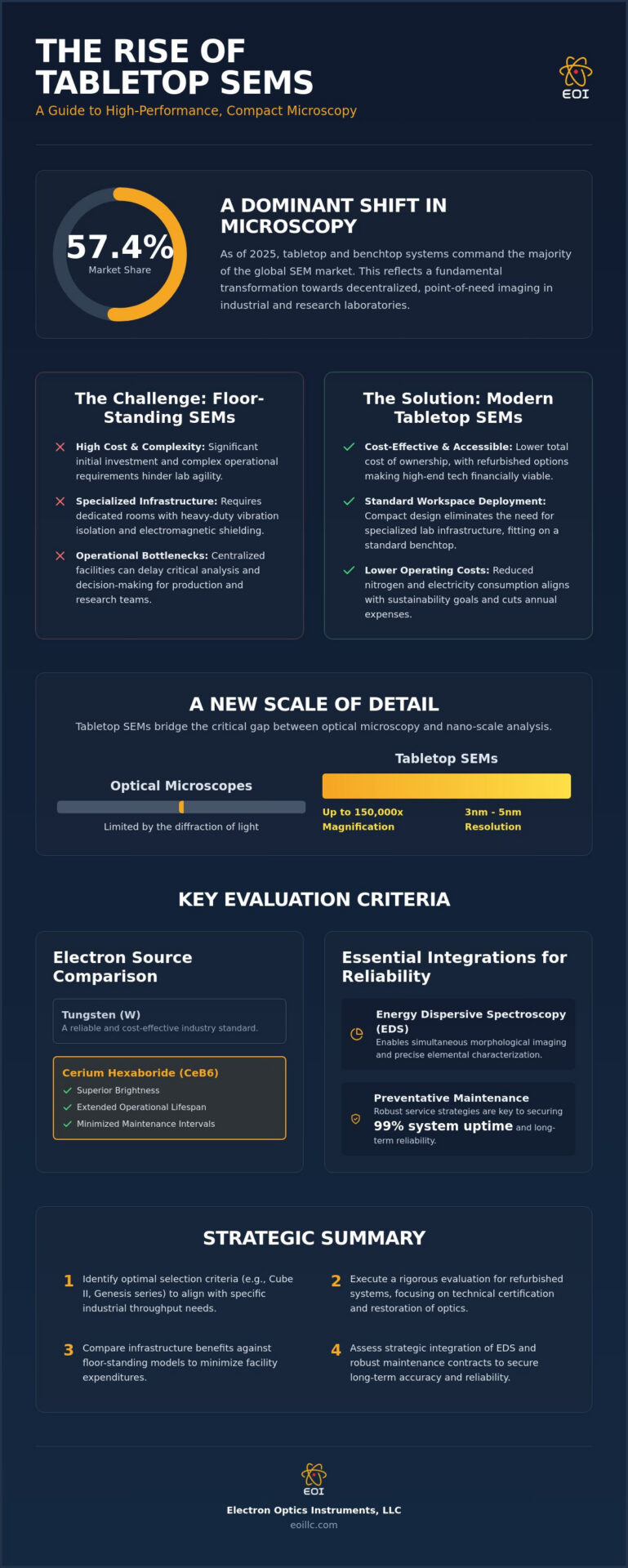
While floor-standing units once defined the pinnacle of microscopy, tabletop and benchtop systems now command a dominant 57.4% share of the global SEM market according to 2025 industry data. This shift reflects a fundamental transformation in how industrial laboratories approach high-resolution imaging and elemental analysis. You likely recognize that the high cost of traditional floor-standing infrastructure and the technical complexity of legacy optics often hinder your laboratory’s developmental pace. Securing a high-performance refurbished tabletop sem for sale represents a strategic move to decentralize your imaging capabilities without compromising on the meticulous accuracy required for advanced materials science.
This guide provides a comprehensive framework for evaluating modern tabletop SEM systems, focusing on the synergy between advanced electron optics and the practicalities of long-term operational stability. We’ll examine the technical specifications of the Cube II and Genesis series, the seamless integration of Energy Dispersive Spectroscopy for precise material characterization, and the robust service strategies required to maintain 99% system uptime. By prioritizing total cost of ownership and technical integration, your organization can acquire a benchtop system that rivals the performance of much larger installations while ensuring a sustainable analytical lifecycle.
Key Takeaways
- Identify the optimal selection criteria for the Cube II and Genesis series to establish a high-throughput imaging workflow that aligns with specific industrial throughput requirements.
- Execute a rigorous evaluation framework for acquiring a refurbished tabletop sem for sale, focusing on technical certification and the restoration of legacy electron optics to original specifications.
- Compare the infrastructure benefits of the Veritas Series SEM against floor-standing models to minimize expenditures on specialized vibration isolation and electromagnetic shielding.
- Assess the strategic integration of Energy Dispersive Spectroscopy (EDS) and robust preventative maintenance contracts to secure long-term analytical accuracy and operational reliability.
The Strategic Value of Tabletop Scanning Electron Microscopes in 2026
Industrial leaders increasingly recognize that centralized core facilities often act as operational bottlenecks that delay critical decision-making. The 2026 analytical landscape favors point-of-need microscopy, where high-performance electron optics are integrated directly into production lines or localized research environments. A tabletop Scanning Electron Microscope (SEM) represents the convergence of sophisticated imaging and spatial efficiency. These compact systems utilize advanced turbo-molecular vacuum pumps and improved electron source longevity to deliver consistent results without the massive infrastructure requirements of legacy hardware. This shift allows technical teams to maintain a steady, expert-driven narrative of progress by providing immediate feedback on material properties and structural integrity.
The economic justification for these systems extends beyond the initial purchase price. By eliminating the need for specialized vibration isolation tables and heavy-duty electromagnetic shielding, laboratories can deploy these instruments in standard workspaces. Additionally, modern benchtop units significantly reduce nitrogen and electricity consumption, aligning with corporate sustainability objectives while lowering annual operating costs. For many budget-conscious facilities, the availability of a refurbished tabletop sem for sale offers an entry point into high-end characterization that was previously financially inaccessible. This acquisition strategy allows for the optimization of laboratory imaging infrastructure while adhering to strict fiscal boundaries.
Bridging the Gap Between Optical and Electron Microscopy
Optical microscopes encounter physical barriers when characterizing features at the sub-micron scale because they’re fundamentally limited by the diffraction limit of light. Tabletop SEMs bridge this gap by providing up to 150,000x magnification, allowing researchers to observe surface topographies that remain invisible to traditional lenses. This capability facilitates the seamless integration of electron optics into routine laboratory workflows, transforming any standard benchtop into a powerful site for detailed morphological assessment. It’s a technical evolution that ensures reliability in specialized industrial sectors where accuracy is paramount.
Industrial Applications and Failure Analysis
The utility of compact SEMs is most evident in semiconductor manufacturing and metallurgical assessment, where real-time quality control is vital for maintaining production standards. Benchtop systems allow engineers to perform rapid failure analysis and defect detection without the logistical burden of transporting samples across a facility. Modern tabletop models in 2026 consistently achieve resolutions as fine as 3nm to 5nm, providing the analytical depth necessary for rigorous industrial characterization. This level of precision supports large-scale production by identifying microscopic irregularities before they escalate into costly systemic failures.
Technical Benchmarks: Evaluating the Cube II and Genesis Series
Selecting an appropriate microscopy platform requires a meticulous analysis of the electron source and detector configuration. Most modern benchtop systems utilize either Tungsten or Cerium Hexaboride (CeB6) cathodes to generate the primary electron beam. While Tungsten remains a reliable and cost-effective standard, CeB6 sources are increasingly prioritized in 2026 for their superior brightness and extended operational lifespan, which significantly minimizes maintenance intervals during intensive analytical campaigns. Integrating these sources with Energy Dispersive Spectroscopy (EDS) allows for simultaneous morphological imaging and precise elemental mapping. This synergy is a fundamental requirement for laboratories transitioning to high-performance benchtop microscopy.
When procurement teams evaluate a refurbished tabletop sem for sale, they must verify that the technical specifications align with their specific throughput and resolution targets. Refurbished units from the EmCraft line undergo rigorous certification processes to ensure that their vacuum integrity and electron optics perform at original factory standards. This approach provides a visionary path for laboratories to expand their infrastructure while maintaining a serious commitment to fiscal responsibility and technical excellence.
Cube II: Performance Metrics and User Interface
The Cube II Benchtop SEM functions as a high-throughput workhorse designed for demanding industrial environments. Its vacuum system is engineered for rapid sample exchange, which reduces the temporal gap between sample loading and data acquisition. The integrated software environment facilitates automated image stitching and sophisticated particle analysis, making it an ideal choice for high-volume screening and quality assurance. With its 5-axis stage and a verified resolution of 5.0nm at 30kV, the Cube II provides the stability and precision necessary for detailed structural characterization in large-scale production settings.
Genesis Series: Versatility in Research and Development
While the Cube II focuses on throughput, the Genesis Tabletop SEM balances intuitive operation with significant analytical depth. This series is exceptionally versatile, accommodating diverse sample types ranging from non-conductive polymers to complex metallurgical specimens. The inclusion of both Secondary Electron (SE) and Backscattered Electron (BSE) detectors allows for a comprehensive assessment of surface topography and compositional contrast. Achieving resolutions as fine as 3nm, the Genesis series provides the meticulous accuracy required for advanced research and development. If your facility requires this level of specialized characterization, you might consult our technical team to determine the optimal configuration for your application.
Tabletop vs. Floor-Standing SEMs: A Performance and Cost Analysis
Historically, the transition to electron microscopy demanded significant structural investment, as traditional large-chamber systems require dedicated facilities equipped with specialized vibration isolation and rigorous electromagnetic shielding. The Veritas Series SEM disrupts this paradigm by offering a compact architecture that maintains the analytical integrity of floor-standing models without the associated logistical burden. Choosing a refurbished tabletop sem for sale allows organizations to bypass these extensive facility modifications, facilitating a more rapid integration into existing laboratory environments. This strategic acquisition optimizes the return on laboratory square footage, as the compact footprint liberates high-value space for additional analytical instrumentation or developmental workflows.
The Total Cost of Ownership (TCO) over a 10-year lifecycle reveals a stark contrast between benchtop and floor-standing platforms. Beyond the initial capital expenditure, floor-standing units incur substantial secondary costs through high nitrogen consumption, increased electrical requirements, and the need for frequent expert-level maintenance. Benchtop systems, by comparison, operate with significantly higher efficiency. Their smaller vacuum volumes and optimized electron optics reduce the frequency of preventative maintenance visits while maintaining the stability required for consistent industrial characterization. This visionary approach to procurement ensures that technical prowess remains balanced with fiscal sustainability.
Resolution and Magnification Thresholds
While modern benchtop units handle the vast majority of industrial screening, certain research requirements mandate the sub-nanometer resolution found in a floor-standing Veritas Ultra or Veritas HR SEM. These systems utilize advanced field-emission (FE) sources to achieve the highest possible magnification for characterizing the most delicate nanostructures. However, the evolution of FE sources in compact form factors has narrowed this performance gap significantly. For a detailed breakdown of the financial implications of these different tiers, you should consult our cost guide to align your technical needs with your budget.
Maintenance and Operational Stability
Operational stability is often a function of vacuum management and filament longevity. Benchtop models benefit from smaller vacuum chambers, which lead to faster pump-down times and higher sample throughput compared to large-chamber systems. This efficiency is critical for high-volume quality control where temporal delays translate directly into production bottlenecks. Additionally, many tabletop systems feature user-serviceable components and simplified filament replacement procedures. These design choices ensure that 99% uptime is an attainable standard, allowing laboratory personnel to focus on data interpretation rather than technical troubleshooting.
Key Considerations for Acquiring a Tabletop SEM for Sale
Procuring advanced imaging hardware in 2026 requires a structured framework that transcends simple price comparisons. Decision-makers must evaluate the synergy between hardware performance and the long-term reliability provided by a vendor’s technical infrastructure. Partnering with an organization that possesses 30 years of industry experience ensures that your laboratory doesn’t just receive a piece of equipment, but a fully integrated analytical solution. This expertise is critical when assessing whether a new system or a certified refurbished tabletop sem for sale best aligns with your facility’s developmental trajectory and fiscal boundaries.
The acquisition process should prioritize the protection of capital equipment investments through robust preventative maintenance visits. These scheduled technical assessments are vital for maintaining the meticulous accuracy of electron optics and ensuring the longevity of vacuum components. By establishing a rigorous service schedule from the outset, laboratories can maintain 99% uptime, which is essential for high-throughput industrial environments where any deviation from operational standards results in significant logistical delays.
Refurbished SEM Units: A Strategic Entry Point
Acquiring a certified refurbished tabletop sem for sale represents a visionary approach to infrastructure expansion. Unlike “as-is” units found on generic secondary markets that lack technical support or calibration, our refurbished hardware undergoes a rigorous process of decommissioning, cleaning, and re-installation. Each system is restored to its original factory specifications, often including updated software and certified vacuum integrity. This methodology allows laboratories to access higher-tier optics, such as those found in the Veritas series, while maintaining a lower initial capital expenditure. It’s a strategic move that maximizes analytical depth without compromising on the reliability expected from premium instrumentation.
Integrated EDS Systems and Analytical Software
Elemental characterization is no longer an optional luxury but a fundamental requirement for modern material science. When evaluating a tabletop system, it’s essential to assess the sensitivity and dead-time of the integrated Energy Dispersive Spectroscopy (EDS) detector. High-performance EDS systems allow for rapid, quantitative elemental analysis and mapping, which are critical for identifying contaminants or verifying alloy compositions. Understanding the fundamental principles of scanning electron microscopy helps technical teams appreciate how seamless software integration can transform raw signal into actionable data. If you’re ready to enhance your laboratory’s analytical capabilities, you can contact our specialists for a technical consultation to explore our current inventory and service options.
Electron Optics Instruments: Your National Partner for SEM Integration
Electron Optics Instruments, LLC serves as the exclusive US distributor for EmCraft Scanning Electron Microscopes, providing a sophisticated bridge between South Korean engineering excellence and domestic industrial requirements. This partnership ensures that laboratories utilizing the Cube II, Genesis, or Veritas series receive direct access to factory-authorized parts and specialized technical expertise. Identifying a high-performance refurbished tabletop sem for sale is merely the initial phase of a successful acquisition strategy. The long-term utility of such a system depends on a technical ecosystem that supports professional decommissioning, secure national transport, and meticulous re-installation at the client facility. By prioritizing a structured integration process, organizations can seamlessly incorporate advanced electron optics into their existing analytical infrastructure.
Our commitment to operational stability is reflected in our national reach and comprehensive logistical capabilities. Whether a facility is upgrading to a new Veritas FE system or integrating a certified refurbished benchtop unit, our team manages the entire lifecycle of the instrument. This includes precise calibration to ensure that the system meets its original resolution benchmarks upon arrival. This visionary approach to distribution allows our partners to focus on their core research and production goals while we maintain the grounded, practical realities of hardware performance and logistical excellence.
Beyond the Sale: Expert Service and Preventative Maintenance
Long-term analytical accuracy is a direct result of consistent vacuum integrity and the optimization of electron source parameters. We provide multi-tiered annual service contracts designed to secure 99% system uptime through scheduled preventative maintenance visits. These inspections identify potential issues before they manifest as costly downtime, ensuring that image quality remains sharp and elemental mapping stays precise. For a deeper understanding of these technical requirements, you may consult the definitive guide to SEM maintenance. Additionally, we maintain a robust inventory of filaments and consumables compatible with all major SEM brands, ensuring that your laboratory’s supply chain remains uninterrupted.
Professional Training and Technical Support
Maximizing the utility of a tabletop SEM requires a staff that’s proficient in both basic operation and advanced characterization techniques. We offer customized on-site technical training curricula that cover everything from meticulous sample preparation to the nuances of quantitative elemental analysis. Our troubleshooting and repair services extend beyond the EmCraft line to include proprietary and third-party systems, providing a single point of contact for complex hardware issues. Electron Optics Instruments, LLC has maintained a distinguished 30-year legacy of technical authority and service excellence within the United States microscopy market. This seasoned perspective ensures that every client receives the depth of expertise necessary to push the boundaries of what’s possible in advanced imaging.
Advancing Laboratory Infrastructure through Strategic Electron Optics Integration
The transition toward decentralized microscopy isn’t just a future projection; it’s a current industrial reality that demands meticulous planning. By selecting a high-performance system like the Cube II or the Veritas series, your facility gains sub-micron characterization capabilities without the prohibitive infrastructure requirements of the past. Whether your laboratory prioritizes a new installation or a certified refurbished tabletop sem for sale, the focus must remain on technical integration and long-term operational stability. Electron Optics Instruments provides the necessary foundation for this progress, leveraging 30 years of industry expertise as the sole US distributor for EmCraft. Our comprehensive service capabilities for all major SEM brands ensure that your investment maintains its accuracy throughout its entire lifecycle. We invite you to request a technical consultation or quote for tabletop SEM systems to begin optimizing your imaging infrastructure. This visionary approach to procurement secures a reliable analytical future for your organization.
Frequently Asked Questions
What is the typical resolution of a tabletop scanning electron microscope for sale in 2026?
Modern tabletop systems in 2026 typically achieve resolutions between 3nm and 5nm. The Genesis series reaches a 3nm resolution using a secondary electron detector, while the Cube II maintains a 5.0nm benchmark at 30kV. These specifications allow for the meticulous characterization of complex nanostructures that were once only visible using much larger floor-standing units.
Do tabletop SEMs require specialized room environments or vibration isolation?
Tabletop SEMs don’t require the specialized room environments or heavy-duty vibration isolation tables necessitated by their floor-standing counterparts. Their compact architecture and internal damping systems allow for deployment on standard laboratory benches in most industrial settings. This flexibility significantly reduces infrastructure expenditures while facilitating point-of-need microscopy where it’s most needed.
Can I perform elemental analysis (EDS) with a benchtop SEM?
You can perform comprehensive elemental analysis with a benchtop SEM through integrated Energy Dispersive Spectroscopy (EDS) systems. These detectors enable simultaneous morphological imaging and quantitative chemical mapping within a single software interface. This technical synergy is essential for identifying contaminants or verifying material compositions in real-time during quality control workflows.
What is the difference between the Cube II and Genesis SEM models?
The Cube II Benchtop SEM is engineered as a high-throughput workhorse for industrial screening, featuring rapid vacuum cycles and automated analysis software for high-volume tasks. In contrast, the Genesis Tabletop SEM prioritizes analytical versatility for diverse sample types, ranging from polymers to minerals. While both systems offer superior imaging, the Cube II focuses on volume efficiency, whereas the Genesis emphasizes research depth.
Are refurbished scanning electron microscopes a reliable alternative to new units?
A certified refurbished tabletop sem for sale is a highly reliable alternative to a new unit when it’s restored to original factory specifications by experienced technicians. Our rigorous decommissioning and re-calibration processes ensure that vacuum integrity and electron optics perform at peak standards. This acquisition strategy allows laboratories to access high-tier analytical capabilities while maintaining fiscal responsibility.
How often does a tabletop SEM require preventative maintenance?
A tabletop SEM typically requires professional preventative maintenance visits every six to twelve months, depending on the intensity of the analytical campaign. Regular inspections of vacuum seals, electron sources, and detector sensitivity are vital for ensuring 99% operational uptime. Consistent maintenance prevents the degradation of image quality and extends the overall lifespan of the specialized electron optics.
What is included in a professional SEM service contract?
Professional SEM service contracts generally include scheduled preventative maintenance, priority technical support, and the provision of essential consumables like filaments and apertures. These agreements are designed to secure long-term stability and minimize the total cost of ownership over a 10-year lifecycle. By partnering with an expert service provider, laboratories ensure their instrumentation remains calibrated and ready for high-precision characterization.
What types of samples require specialized preparation for tabletop SEM imaging?
Non-conductive materials and biological specimens require specialized preparation, such as gold or carbon coating, to prevent charging under the electron beam. Dehydration and stabilization are also necessary for samples containing moisture to maintain the integrity of the vacuum chamber. Proper preparation is a fundamental requirement for achieving the high-resolution topographic data expected from modern benchtop systems.