
The true value of a scanning electron microscope in 2026 isn’t found in its resolution specifications alone, but in the analytical density it packs into a footprint once reserved for basic imaging. You likely recognize that the traditional distinction between floor-standing power and benchtop convenience has blurred; however, the risk of high initial capital expenditure remains a significant hurdle for many research facilities. Conducting a cost comparison benchtop sem models 2026 demands requires looking past marketing hyperbole to the grounded, practical realities of technical integration and logistical excellence. It’s common to feel frustrated by the difficulty of comparing resolution claims across different vacuum environments or uncovering the hidden costs buried in maintenance contracts.
This technical and economic analysis provides the rigorous evaluation necessary to ensure your capital equipment investment aligns with both performance needs and long-term fiscal responsibility. We’ll examine the total cost of ownership, the return on investment for integrated EDS systems, and why modern architectures like the Cube II and Genesis series now serve as viable, cost-effective alternatives to traditional floor models. By establishing a clear comparison framework, this guide validates how specialized industrial sectors can achieve superior standards without the infrastructure burden of legacy hardware.
Key Takeaways
- Understand the paradigm shift toward “Analytical Density,” where modern benchtop architectures provide high-end electron optics previously restricted to floor-standing systems.
- Evaluate how electron source selection, ranging from Tungsten to Field Emission, directly correlates with resolution limits and initial capital acquisition costs in the current market.
- Execute a rigorous cost comparison benchtop sem models 2026 requires by calculating the five-year Total Cost of Ownership, including maintenance and consumables.
- Assess the strategic return on investment for integrated Energy Dispersive Spectroscopy (EDS) systems to streamline industrial failure analysis and elemental characterization.
- Identify the specific procurement advantages of the Cube II and Genesis series for balancing high-resolution imaging with the practicalities of industrial throughput.
The 2026 Benchtop SEM Landscape: Shifting from Size to Analytical Density
The industrial imaging sector has reached a critical inflection point where physical dimensions no longer dictate the depth of characterization possible. In 2026, the convergence of miniaturized electron columns and sophisticated detection systems has redefined the Scanning Electron Microscope (SEM), moving it from the specialized basement facility directly onto the production floor. This transition isn’t merely a matter of convenience; it’s a strategic response to the escalating costs of laboratory real estate and the requirement for immediate, on-site failure analysis. Executing a rigorous cost comparison benchtop sem models 2026 requires an understanding of how analytical density impacts long-term operational efficiency. Professionals must now distinguish between entry-level tabletop units and high-performance benchtop architectures, such as the Cube II and Genesis series, which rival legacy floor models in resolution and analytical versatility.
Historical Evolution and the 2026 Performance Standard
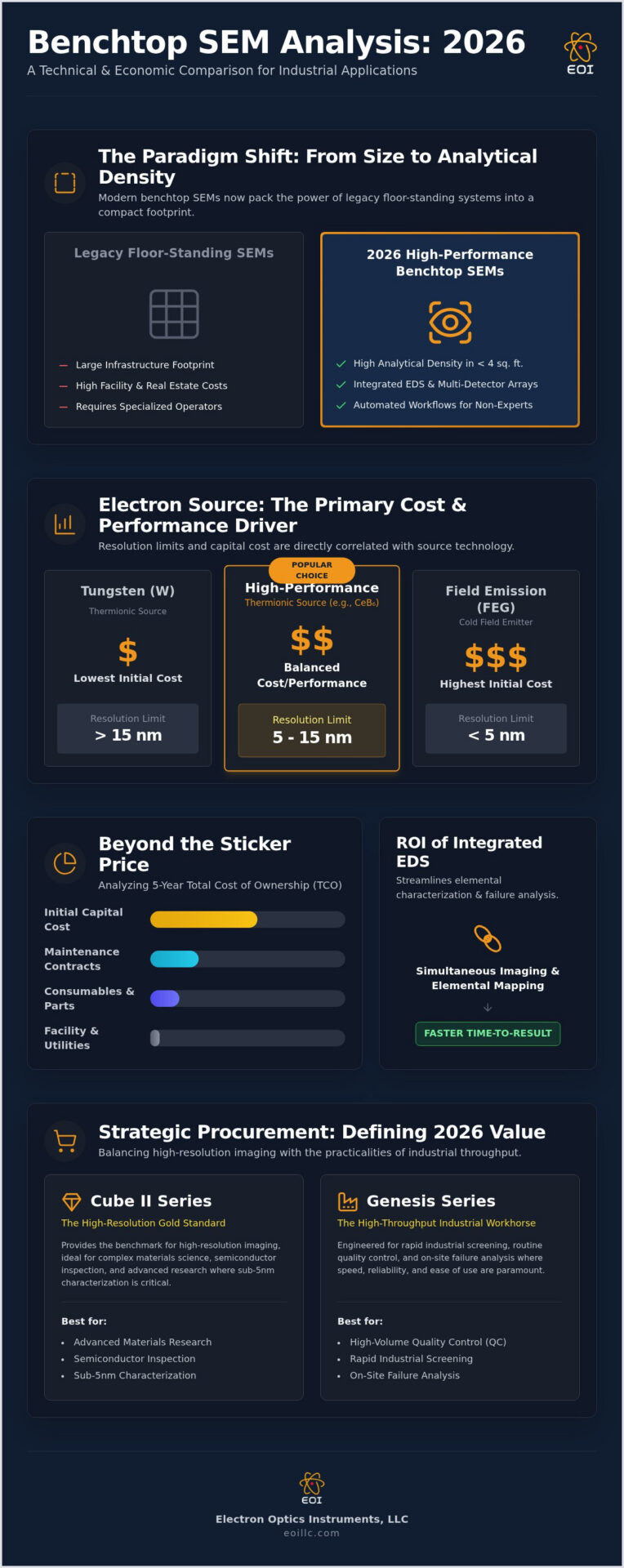
The technical gap that once separated portable systems from their massive counterparts has effectively closed. Modern systems now integrate field emission sources and multi-detector arrays into chassis that occupy less than four square feet of bench space. Analytical Density is defined as the quantifiable ratio of multi-modal characterization capabilities, such as simultaneous EDS and high-resolution imaging, relative to the instrument’s physical footprint. This metric has become the primary standard for 2026, driven largely by the integration of automated workflows that allow non-expert operators to generate research-grade data. The adoption of these systems reflects a broader movement toward decentralized R&D, where the synergy between technical integration and industrial performance necessitates a reduction in facility requirements.
Defining Your Laboratory’s Imaging Objectives
Selecting the appropriate instrument requires a meticulous alignment of technical specifications with specific industrial outcomes. A thorough cost comparison benchtop sem models 2026 evaluation must prioritize the intended application, whether that involves routine quality control or complex materials science research. High-performance models like the Cube II series provide the gold standard for high-resolution imaging, while the Genesis series acts as a high-throughput workhorse for rapid industrial screening and failure analysis.
Laboratories must also weigh the necessity of variable pressure environments against the resolution benefits of high vacuum systems. While high vacuum remains essential for sub-5nm characterization, variable pressure capabilities are indispensable for examining non-conductive samples without traditional coating methods. Ultimately, the choice hinges on sample throughput requirements and the practicalities of logistical excellence. In high-volume QC environments, the economic impact of vacuum cycle times and automated stage movements often outweighs the initial acquisition cost, making the efficiency of modern benchtop units a superior long-term investment for the seasoned global innovator.
Evaluating Optical Performance and Resolution as Primary Cost Drivers
Electron optical performance remains the most significant variable in the capital equipment market, as the choice of source technology dictates both the resolution ceiling and the long-term maintenance trajectory. When conducting a comprehensive SEM price tiers analysis, it’s evident that the transition from 15nm to sub-5nm resolution represents a substantial shift in procurement strategy. A rigorous cost comparison benchtop sem models 2026 requires professionals to evaluate whether their specific application, such as semiconductor inspection or advanced polymer research, justifies the premium associated with field emission (FE) sources or if high-performance thermionic sources provide a more sustainable return on investment. The correlation between resolution limits and market pricing is established by the complexity of the electromagnetic lenses and the stability of the power supplies required to maintain a coherent beam at nanometric scales.
Electron Source Comparison: Tungsten vs. Veritas LaB6 Technology
The distinction between thermionic and field emission sources is the primary driver of instrument categorization and acquisition cost. Tungsten filaments, while offering the lowest entry cost, require frequent replacement and provide limited brightness for high-magnification characterization. Conversely, the Veritas series utilizes LaB6 technology to offer a significant increase in source longevity and beam brightness, effectively bridging the technical gap between entry-level systems and high-end FE models. This middle-ground approach allows laboratories to achieve superior imaging standards without the extreme vacuum requirements and sensitive electronics typical of field emission systems, thereby optimizing the synergy between technical performance and logistical reality. Maintenance intervals for LaB6 sources are considerably longer, reducing the frequency of system downtime and the associated labor costs of filament exchange.
Vacuum Systems and Imaging Throughput
Vacuum system architecture is a critical, yet often overlooked, component of imaging throughput and operational reliability. The efficiency of internal pumping systems determines the speed at which a sample can be introduced and imaged, which is a vital metric for high-volume industrial environments where every minute of vacuum cycle time impacts the bottom line. Modern benchtop units utilize advanced turbo-molecular pumps that require minimal maintenance compared to legacy oil-based systems, though their integration adds to the initial acquisition price. Precise vacuum stability directly influences the signal-to-noise ratio and prevents beam deflection, ensuring that image clarity is maintained at the highest magnification levels. Analyzing the cost-per-nanometer reveals that resolution gains often follow a curve of diminishing returns for routine quality control. For most industrial applications, the high resolution of the Cube II or the robust throughput of the Genesis series provides the optimal economic balance. If you are evaluating how these performance tiers align with your specific budget, exploring our range of high-performance benchtop SEM models can help clarify the ideal configuration for your facility.
The Impact of Analytical Attachments: EDS and Advanced Detector Integration
In 2026, the definition of value in microscopy has shifted from raw magnification to the integration of multi-modal characterization within a singular, compact environment. A rigorous cost comparison benchtop sem models 2026 must account for the capital requirement of Energy Dispersive Spectroscopy (EDS) systems, which often represent a significant portion of the total investment. While basic imaging satisfies routine inspection, the synergy between high-resolution optics and elemental characterization is what defines a modern research or quality control facility. Integrated analytical attachments generally offer superior performance over third-party additions because they utilize a unified software interface and optimized detector geometry, ensuring that signal collection is maximized within the confined chambers of benchtop units.
Backscattered Electron Detectors (BSED) also play a vital role in topographical and compositional analysis, providing essential contrast that secondary electron detectors cannot achieve alone. The value of these detectors lies in their ability to highlight atomic number differences across a sample surface, which is indispensable for identifying phase distributions or metallic inclusions. When evaluating different SEM architectures, the inclusion of high-sensitivity BSED should be viewed as a standard requirement for industrial failure analysis rather than an optional luxury.
Quantifying the ROI of Integrated EDS Systems
Transitioning elemental characterization in-house eliminates the logistical delays and per-sample fees associated with external contract laboratories. The Cube II EDS integration is particularly effective for rapid screening, allowing operators to identify contaminants or verify alloy compositions in minutes rather than days. In manufacturing sectors, the payback period for such analytical hardware often falls within 18 to 24 months, depending on sample volume and the frequency of critical failure events. By reducing reliance on external providers, organizations regain control over their intellectual property and accelerate their developmental timelines, reinforcing their status as global innovators in their respective fields.
Specialized Stages and Environmental Controls
Specialized stages, including cooling, tensile, and tilt configurations, extend an instrument’s utility into the realm of dynamic testing and 3D reconstruction. A thorough cost-benefit analysis reveals that while these stages increase the initial sticker price, they provide the flexibility needed for future-proofing a laboratory against evolving research requirements. Chamber size remains a critical factor; a larger internal volume allows for more complex stages and the characterization of larger samples without destructive sectioning. Integrating these hardware capabilities with advanced SEM techniques ensures that a facility remains at the forefront of material characterization, balancing the grounded realities of production with the visionary goals of technical advancement.
Beyond the Sticker Price: Analyzing Total Cost of Ownership (TCO)
A sophisticated capital investment strategy extends beyond the initial purchase order to encompass the full lifecycle of the instrument. When executing a cost comparison benchtop sem models 2026, stakeholders must account for the five-year Total Cost of Ownership (TCO), which integrates acquisition, preventative maintenance, and specialized consumables such as filaments and apertures. While benchtop architectures are often marketed as “zero-infrastructure” systems, practical installation still requires a stable power supply and environments with controlled electromagnetic interference (EMI) and vibration levels. Ignoring these foundational requirements can lead to degraded optical performance and increased long-term operational costs that far exceed the initial savings of a compact form factor.
Staff development and technical proficiency represent another critical, yet frequently overlooked, component of the TCO equation. The value of an SEM is inherently tied to the operator’s ability to extract high-fidelity data and interpret complex elemental maps. Budgeting for recurring professional training ensures that the laboratory maximizes the utility of advanced hardware, such as the Veritas or Cube II series, while minimizing the risk of accidental damage to sensitive components like the electron source or vacuum pumps. This investment in human capital acts as a force multiplier, transforming a piece of equipment into a robust analytical asset that scales with your organization’s research objectives.
Strategic Maintenance and Service Agreement Tiers
Reliability in high-throughput industrial environments is predicated on a proactive maintenance strategy. Comparing preventative maintenance visits against comprehensive parts-and-labor coverage reveals that priority service contracts significantly mitigate financial risk by reducing potential downtime. The economic impact of a single week of system unavailability can often exceed the annual cost of a premium service agreement. For a deeper analysis of how to protect your investment through methodical care, refer to our SEM maintenance guide, which outlines strategies for maximizing precision and longevity over a decade of operation.
Logistics, Installation, and On-Site Training Fees
The physical transition of sensitive optics requires meticulous logistical excellence to prevent misalignment or mechanical failure. Professional decommissioning and relocation services are essential when facilities expand or reorganize, as standard freight providers lack the expertise to handle high-precision electron columns safely. A typical 2026 desktop SEM installation requires a standard 110-220V power outlet, a vibration-dampened surface, and approximately four square feet of dedicated space with adequate ventilation for the cooling systems. To ensure your team is prepared for immediate operation and high-end results, you can request a comprehensive quote for on-site training and installation services to secure your facility’s technical readiness.
Strategic Procurement: Why the Cube II and Genesis Series Define 2026 Value
Selecting a scanning electron microscope in 2026 is a sophisticated calculation of analytical density versus operational overhead. A meticulous cost comparison benchtop sem models 2026 requires more than a cursory glance at resolution specifications; it’s about finding the synergy between hardware capability and the practical realities of international production. The market has shifted toward instruments that provide specialized industrial performance without the infrastructure burden of legacy systems. For the seasoned global innovator, the decision rests on which architecture offers the most stable platform for long-term growth and technical integration.
Comparative Advantage of EmCraft Architectures
The Cube II series stands as the gold standard for high-resolution imaging, offering a refined electron column that rivals the performance of traditional floor models. It’s engineered for facilities where sub-nanometric precision is a non-negotiable standard for failure analysis and materials science research. In contrast, the Genesis series serves as a high-throughput workhorse, optimized for rapid quality control environments where volume and reliability are the primary drivers. For laboratories requiring the pinnacle of analytical versatility, the Veritas series provides floor-model performance in a compact footprint, effectively bridging the gap between desktop convenience and research-grade depth.
Budget-conscious organizations can achieve high-end quality by evaluating refurbished electron microscopes as a capital-efficient alternative. Industry data indicates that these units are typically 40% to 70% less expensive than new models, providing a visionary path to advanced characterization without the full expenditure of a new acquisition. When sourced from a partner with 30+ years of expertise, refurbished hardware undergoes rigorous validation to ensure it meets original performance standards, maintaining the meticulousness your industrial processes demand.
Navigating the 2026 Capital Equipment Purchase
Final procurement decisions should rely on a structured checklist that accounts for vacuum cycle times, detector integration, and long-term service stability. It’s vital to assess the manufacturer’s US-based support infrastructure, as on-site training and rapid maintenance response are the anchors of industrial uptime. Don’t overlook the importance of software compatibility and the ease of automated workflows, as these factors directly impact the return on investment. We invite you to leverage our deep technical authority to guide your next investment. Request a technical consultation for your Cube II or Veritas system to ensure your facility maintains its status as a leader in specialized industrial innovation.
Optimizing Your Capital Investment for the 2026 Analytical Landscape
The transition toward decentralized, high-performance characterization requires a fundamental shift in how we evaluate capital equipment. As this analysis demonstrates, a thorough cost comparison benchtop sem models 2026 necessitates looking beyond the initial sticker price to the long-term value of analytical density and technical integration. Whether your facility prioritizes the sub-nanometric resolution of the Cube II or the high-throughput reliability of the Genesis series, the ultimate objective remains the same: achieving superior standards through meticulous hardware selection and operational excellence. It’s clear that the synergy between advanced electron optics and integrated EDS systems provides a robust return on investment that scales with your industrial requirements.
As the sole US distributor for EmCraft SEM technology, Electron Optics Instruments, LLC leverages over 30 years of technical authority to ensure your facility remains at the forefront of innovation. We provide comprehensive service support for all major SEM brands, anchoring our commitment to your laboratory’s long-term stability and logistical excellence. Request a 2026 Benchtop SEM Price Quote and Technical Consultation today to align your research objectives with the most cost-effective, high-performance solutions available. We look forward to supporting your next breakthrough in material characterization.
Frequently Asked Questions
What is the average price range for a high-resolution benchtop SEM in 2026?
In 2026, the market for high-resolution benchtop systems is segmented by analytical density and source technology, with pricing tiers reflecting the transition from tungsten to field emission optics. While entry-level tabletop units remain accessible for basic screening, high-performance models equipped with integrated EDS and sub-5nm resolution represent a larger capital commitment. A comprehensive cost comparison benchtop sem models 2026 requires evaluating these acquisition costs against the reduced facility requirements and lower power consumption typical of compact architectures.
How does the resolution of the Cube II compare to traditional floor-standing models?
The Cube II series effectively bridges the performance gap between compact systems and traditional floor-standing models by utilizing advanced electron optics and high-sensitivity detectors. While legacy floor models once held a monopoly on sub-nanometric characterization, the 2026 performance standard allows the Cube II to achieve comparable resolution within a significantly smaller footprint. This advancement enables laboratories to conduct sophisticated failure analysis and materials research without the extensive infrastructure modifications required by larger, more cumbersome hardware.
Are there hidden costs associated with installing a benchtop SEM in a standard lab?
While benchtop SEMs are designed for “zero-infrastructure” integration, laboratories must still account for environmental factors such as vibration, electromagnetic interference, and stable power supply. These secondary costs can include specialized isolation tables or shielding if the facility is located near heavy machinery or high-traffic areas. Additionally, budgeting for initial technical training and the ongoing acquisition of consumables like filaments and apertures is essential to prevent operational disruptions and maintain high-fidelity imaging standards.
Can a benchtop SEM be upgraded with an EDS system after the initial purchase?
Most high-performance benchtop architectures, including the Cube II and Veritas series, are designed with modularity in mind, allowing for the integration of EDS systems after the initial installation. However, procuring these analytical attachments as part of the original configuration often ensures better software synergy and detector geometry optimization. Upgrading later requires careful calibration by a field service engineer to maintain the integrity of the electron column and ensure accurate elemental characterization during routine industrial screening.
What is the typical lifespan of an electron source in a Genesis tabletop SEM?
The lifespan of an electron source in a Genesis tabletop SEM is primarily dictated by the source material and the quality of the vacuum environment maintained during operation. Tungsten filaments typically offer several hundred hours of service, whereas LaB6 sources provide significantly higher brightness and extended longevity. Regular preventative maintenance and adhering to proper vacuum cycling protocols are critical factors in maximizing the interval between source replacements, thereby reducing the total cost of ownership for high-throughput industrial facilities.
Do refurbished SEM units come with a service warranty or maintenance contract?
High-quality refurbished SEM units sourced from established distributors typically include a standard service warranty to protect the initial capital investment. These units undergo rigorous validation processes to ensure they meet original performance specifications before being redeployed in a research or production environment. Organizations can further secure operational stability by pairing a refurbished instrument with a comprehensive service contract, which covers routine maintenance and provides priority access to technical support and replacement components.
How often does a benchtop SEM require preventative maintenance?
Preventative maintenance for a benchtop SEM is generally recommended on a bi-annual or annual basis, depending on the volume of sample throughput and the sensitivity of the research applications. These scheduled visits involve cleaning the electron column, calibrating the detection systems, and inspecting vacuum pumps to prevent catastrophic hardware failure. Adhering to a methodical maintenance rhythm ensures that the instrument maintains its resolution standards and extends the overall functional lifespan of the sensitive electron optics.
Is on-site training included in the purchase price of a new Veritas series SEM?
On-site technical training is typically structured as a specialized service fee rather than being bundled into the base acquisition price of a Veritas series SEM. This professional investment ensures that laboratory staff are fully proficient in advanced imaging techniques and elemental characterization, which is vital for maximizing the utility of high-end hardware. Customized training sessions focus on the practical realities of industrial production, empowering teams to generate research-grade data and maintain the instrument’s meticulous performance standards.