

Could the primary bottleneck in your production evolution be the decision latency inherent in outsourced microscopy? While external laboratory fees often exceed $95 per hour with surcharges reaching 90% for industrial partners, the true financial erosion stems from protracted turnaround times that stall critical failure analysis. You’ve likely recognized that maintaining a competitive edge in 2026 requires precise, internal control over characterization workflows. This necessity makes calculating roi for a benchtop sem a vital exercise for any laboratory seeking to eliminate the high costs and logistical friction of third-party dependencies.
We’ll provide a sophisticated framework to justify your investment and maximize your laboratory’s financial yield. You’ll master a clear ROI formula that integrates cost displacement with the strategic value of immediate data acquisition, specifically for advanced models like the Cube II. Our analysis explores how modern digital integration and automated defect classification facilitate a sustainable transition from volatile external services to a reliable, in-house technical authority. By the end of this guide, you’ll possess the quantitative evidence required to present a visionary CAPEX justification to non-technical executives.
Key Takeaways
- Establish a strategic framework that transforms a benchtop SEM from a simple capital expense into a catalyst for sustained operational excellence.
- Identify and quantify the displacement of escalating third-party fees to prevent budget erosion from administrative overhead and shipping logistics.
- Reduce decision latency by integrating real-time characterization, ensuring your research and development teams iterate with high-frequency velocity.
- Master the precise quantitative and qualitative variables required for calculating roi for a benchtop sem to present a visionary justification to your organization’s stakeholders.
- Evaluate the Cube II’s long-term yield by analyzing the synergy between technical precision and the 30-year industrial legacy of Electron Optics Instruments, LLC.
The Financial Architecture of Benchtop SEM Procurement
Procuring an electron microscope in 2026 represents a strategic pivot from reactive analysis to proactive industrial intelligence. For organizations seeking to maintain a competitive edge, the traditional reliance on centralized core facilities has introduced a critical friction point known as “Decision Latency.” This is the temporal gap between identifying a potential failure and obtaining the high-resolution data required to rectify it. By internalizing this capability through a partner like Electron Optics Instruments, LLC, firms transition from a simple Capital Expenditure (CAPEX) mindset to one of sustained Operational Excellence. True return on investment isn’t a static figure; it’s the synergy between immediate cost displacement and the acceleration of innovation cycles. When calculating roi for a benchtop sem, one must look beyond the initial purchase price to consider how localized imaging transforms the rhythm of the entire production line.
The Microscopy ROI Equation
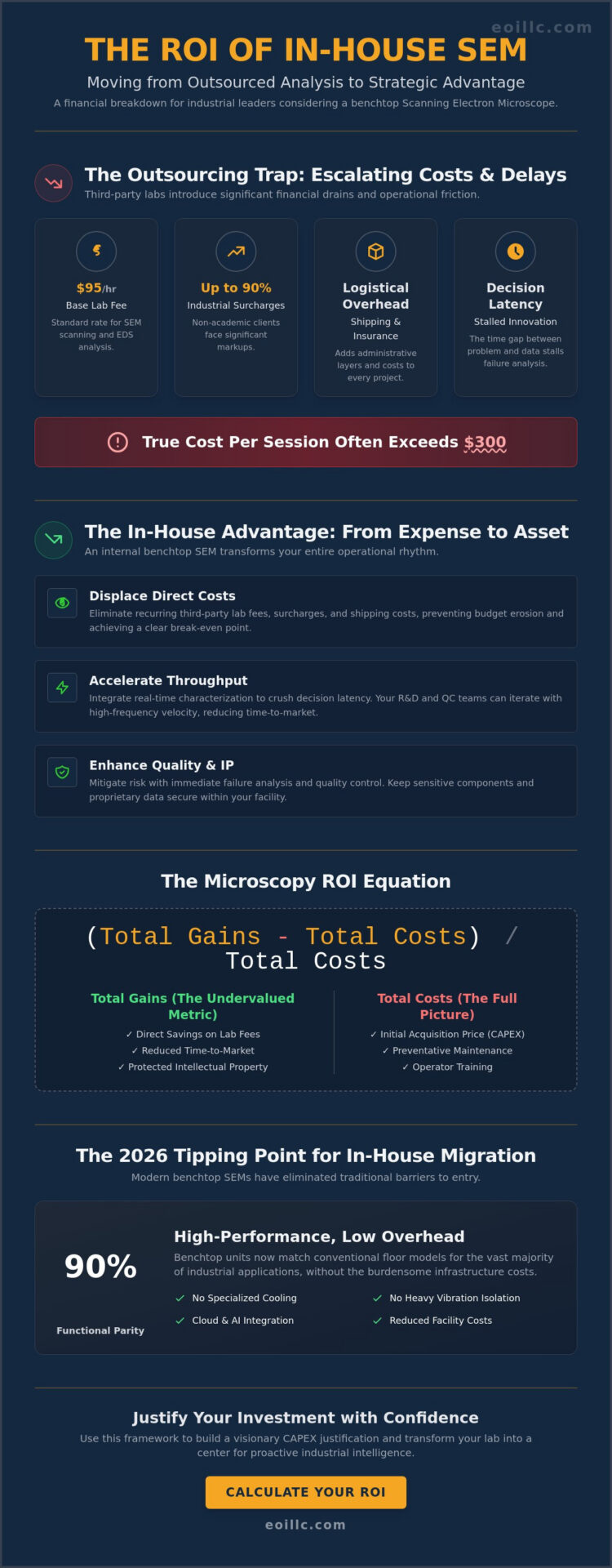
The fundamental formula for calculating roi for a benchtop sem is expressed as (Total Gains – Total Costs) / Total Costs. While Total Costs include the acquisition price and preventative maintenance, the “Total Gains” variable is multifaceted and often undervalued in traditional accounting. It encompasses direct savings from eliminated third-party lab fees, reduced time-to-market for new components, and a higher yield of protected intellectual property. Integrating scanning electron microscope technology with Energy Dispersive Spectroscopy (EDS) significantly elevates this value. EDS allows for simultaneous elemental characterization, effectively doubling the analytical output of a single session. This capability provides deeper insights into material composition that are vital for high-precision automotive and optical engineering.
Benchtop Evolution: Why 2026 is the Year for In-House Migration
The year 2026 marks a definitive evolutionary milestone where the desktop SEM has achieved functional parity with conventional floor models for approximately 90% of industrial applications. This shift toward decentralized microscopy eliminates the logistical bottlenecks of shipping samples and navigating external lab schedules. Modern benchtop units provide high-resolution imaging without the burdensome infrastructure requirements of yesterday. You don’t need specialized liquid cooling systems or heavy-duty vibration isolation platforms. This reduction in facility modification costs, combined with the precision of current-generation optics, makes the transition to in-house imaging a logical step for organizations prioritizing global manufacturing excellence. The 2026 baseline for benchtop performance now includes cloud connectivity and AI-assisted analysis, features that were once exclusive to high-end, room-sized installations.
Quantifying Direct Cost Displacement: In-House vs. Outsourced Analysis
Analyzing the fiscal landscape of 2026 reveals a significant escalation in third-party analytical service fees. Industrial partners now face a standard rate of approximately $95 per hour for SEM scanning and EDS analysis, yet this figure is frequently eclipsed by surcharges of up to 90% for non-academic clients. When you add human interface time at $60 per hour and specialized sample preparation, the true cost of a single analytical session often exceeds $300. These recurring expenditures represent a substantial leak in operational budgets. By calculating roi for a benchtop sem, organizations can identify the precise “Break-Even Sample Volume” where the transition to in-house characterization becomes a financial imperative rather than a technical luxury.
The hidden costs of outsourcing extend far beyond the line items on an invoice. Shipping sensitive microelectronic or automotive components requires high-tier insurance and climate-controlled logistics; these add layers of administrative overhead to every project. There’s also the intangible cost of “re-work” that occurs when external technicians misinterpret complex sample orientations. Transitioning to an in-house model facilitates immediate iteration. Your engineering team can adjust parameters in real-time, effectively eliminating the three-to-five-day latency period typical of external laboratories. For those managing high-stakes projects, implementing strategic financial management requires a rigorous audit of these cumulative delays.
The Outsourcing Audit: Identifying Leaks in the Budget
To establish a baseline for your investment, conduct a comprehensive audit of your last 12 months of external lab invoices. Include every ancillary charge, from expedited shipping to data processing fees. Many organizations find that their actual expenditure is 30% higher than the quoted hourly rates due to these administrative variables. Procuring a system through Electron Optics Instruments, LLC allows your team to bypass these bottlenecks, ensuring that your capital remains focused on innovation rather than logistics. If your current workflow requires more than 15 hours of SEM analysis per month, the financial argument for calculating roi for a benchtop sem and moving toward procurement is already established. You might consider exploring our refurbished SEM units as an entry point to accelerate this transition.
Total Cost of Ownership (TCO) Comparison Table
A five-year horizon provides the most accurate view of the J-curve of ROI. While the initial CAPEX for a mid-range system like the Cube II might range between $60,000 and $120,000, the elimination of external fees typically results in the system paying for itself within 18 to 24 months. Proper SEM maintenance is a critical variable in this timeline; consistent preventative care ensures the equipment reaches its full evolutionary lifespan without unexpected downtime.
| Variable | External Lab (5 Years) | Cube II Ownership (5 Years) |
|---|---|---|
| Initial Investment | $0 | $90,000 (Estimated Mid-Range) |
| Annual Service/Fees | $93,600 (10 hrs/wk @ $180/hr) | $8,500 (Maint. & Consumables) |
| Administrative/Shipping | $12,000 | $0 |
| Total 5-Year Cost | $528,000 | $132,500 |
This comparison demonstrates that after the initial 24-month period, the in-house unit generates significant capital surplus that can be reinvested into sustainable innovation or further laboratory expansion. The precision of the Cube II ensures that this cost displacement doesn’t come at the expense of analytical quality.
Accelerating Industrial Throughput: The Impact of Real-Time Imaging
While the displacement of external laboratory fees provides a clear fiscal baseline, the most profound impact on your organization’s financial yield stems from the acceleration of industrial throughput. Integrating a benchtop SEM directly into the production floor or quality control laboratory fundamentally alters the cadence of characterization. In an outsourced model, throughput is often measured in samples per week due to shipping and external scheduling. Conversely, localized imaging transitions this metric to samples per hour. This velocity is essential for modern “Agile R&D” environments where the ability to fail fast and iterate faster determines market leadership. A comprehensive framework for calculating ROI emphasizes that the speed of data acquisition is as critical as the accuracy of the data itself, particularly when precision characterization is required to validate a production batch.
The efficiency of your SEM operation dictates the overall project timeline. When an engineer can move from the assembly line to the microscope in minutes, the feedback loop remains tight. This immediate availability ensures that minor deviations don’t evolve into systemic failures that stall entire departments. In 2026, over 70% of newly sold SEMs feature cloud connectivity and AI-assisted analysis, further compressing the time required to translate raw imagery into actionable engineering decisions. This technological evolution makes calculating roi for a benchtop sem a prerequisite for any firm aiming to maintain a high-frequency innovation cycle.
Reducing Time-to-Market for New Product Development
In high-tech sectors, the daily revenue loss associated with a delayed product launch can reach staggering figures, often exceeding the total cost of the analytical equipment itself. In-house SEM verification can shave weeks off the prototyping phase by providing instant feedback on material performance and structural integrity. This synergy is especially visible in additive manufacturing workflows. 3D printing requires immediate verification of powder morphology and layer adhesion to prevent catastrophic build failures. By utilizing the Cube II for real-time inspection, organizations ensure that their prototyping remains a continuous process rather than a series of disjointed events waiting for external validation.
Maximizing Staff Productivity and Expertise
The transition to on-site microscopy also generates a significant “Upskilling ROI.” Having a benchtop SEM available improves the technical capability of your entire engineering team, fostering a culture of precision and deep-dive analysis. While initial on-site training fees are often viewed as a cost, they’re actually a long-term asset that builds internal technical authority. Modern interfaces, such as those found on the Cube II, are designed for intuitive use by non-specialists. This accessibility allows a broader range of staff to perform routine inspections, freeing up your senior scientists for more complex characterization tasks. This strategic distribution of labor maximizes human capital and ensures that your most expensive assets—your people—aren’t idling while waiting for data.
Mitigating Risk and Enhancing Quality Control: The Indirect ROI
Beyond the tangible displacement of laboratory fees lies a more significant, albeit indirect, financial yield: the mitigation of systemic risk. In high-precision sectors like automotive electronics and optical manufacturing, the cost of a single component failure can escalate into a catastrophic market exit or a global product recall. By internalizing high-resolution characterization, organizations move toward a “Zero Recall” strategy. This proactive stance ensures that material defects are identified during the pilot phase rather than in the hands of the end consumer. When calculating roi for a benchtop sem, one must account for this protective layer that safeguards brand reputation and reinforces customer trust through verified excellence.
The role of localized microscopy extends into the complexities of global supply chain verification. As counterfeit electronic components become increasingly sophisticated in 2026, the ability to perform rapid, on-site authentication is a vital defense mechanism. Utilizing advanced SEM techniques allows quality control teams to scrutinize the micro-structural integrity of incoming materials, ensuring they meet rigorous ISO and SEMI safety guidelines. This capability transforms the quality control department from a cost center into a strategic asset that preserves the integrity of the entire manufacturing pipeline.
Failure Analysis as a Profit Protector
A single prevented product recall can effectively pay for the procurement of a benchtop SEM ten times over by averting the massive legal fees and logistical nightmares associated with large-scale failures. Documenting material integrity with high-resolution imagery provides a robust legal and insurance ROI, offering indisputable proof of compliance with industrial standards. The speed of Root Cause Analysis (RCA) also serves as a competitive differentiator. When a failure occurs, the organization that identifies the catalyst within hours, rather than waiting days for an external report, can implement corrective actions before the problem propagates through the supply chain. If you are ready to fortify your quality control infrastructure, contact EOI LLC today to discuss our Veritas Series SEM solutions.
Intellectual Property and Proprietary Security
Sending sensitive prototypes or proprietary materials to third-party laboratories introduces an inherent risk of intellectual property leakage. In the competitive landscape of 2026, maintaining data sovereignty is a non-negotiable requirement for many in the defense and aerospace sectors. By keeping “Trade Secret” materials entirely within the organization’s walls, you eliminate the possibility of external exposure. The value of this security is difficult to quantify on a standard balance sheet, yet it’s a critical component in calculating roi for a benchtop sem for firms involved in cutting-edge R&D. Protecting your evolutionary milestones from prying eyes ensures that your innovation remains your exclusive market advantage.
Strategic Selection: Maximizing Long-Term Yield with the Cube II
The selection of an appropriate analytical platform represents the final, critical variable when calculating roi for a benchtop sem. While previous sections established the fiscal advantages of cost displacement and reduced decision latency, the hardware’s inherent reliability determines the sustainability of those gains. The Cube II emerges as the evolutionary peak for organizations requiring a meticulous balance between procurement price and technical precision. While the Genesis and Veritas series provide specialized modularity for labs with scaling requirements, the Cube II is engineered for high-frequency industrial environments where downtime is a direct threat to profitability. EOI LLC supports these investments with thirty years of expertise, ensuring that your characterization capabilities remain a stable component of your global manufacturing strategy.
Why the Cube II Offers the Fastest Payback Period
Operational efficiency is the primary driver of rapid capital recovery. The Cube II features a five-minute vacuum start-up sequence, a specification that significantly enhances daily throughput compared to traditional systems requiring lengthy stabilization periods. This rapid cycling allows technicians to process more samples per shift, directly lowering the cost-per-image. Integrated EDS options further consolidate the analytical workflow, effectively eliminating the need for secondary elemental analysis tools and the associated maintenance costs. Unlike high-end FE-SEM systems that require expensive specialized components, the Cube II utilizes cost-effective filaments. This low consumable overhead ensures that the “Total Costs” variable in your ROI equation remains predictable and manageable over the equipment’s entire lifecycle.
Partnering with EOI LLC for Sustained ROI
A visionary financial framework must account for the asset’s performance well beyond the initial warranty period. EOI LLC’s commitment to industrial excellence is reflected in our comprehensive preventative maintenance contracts, which are designed to extend the evolutionary lifespan of your SEM and prevent the performance degradation that can lead to costly re-works. For organizations operating under tighter budget constraints, exploring our refurbished SEM units offers a strategic pathway to accelerate ROI. These units provide the same high-resolution precision as new models but at a reduced entry point, allowing for a faster break-even timeline. By choosing a partner with a deep understanding of optical and automotive integration, you ensure that your laboratory’s characterization tools evolve in tandem with your production requirements. Contact EOI LLC for a customized ROI calculation for your laboratory.
Advancing Your Laboratory’s Financial and Technical Authority
Transitioning to an in-house benchtop SEM platform represents a definitive shift toward industrial autonomy and sustained competitive advantage. By eliminating the decision latency associated with external laboratories and securing proprietary characterization data, organizations achieve a state of continuous, high-velocity innovation. The integration of high-resolution imaging into your daily workflow ensures that precision remains a constant rather than a variable in your quality control process. Mastering the methodology for calculating roi for a benchtop sem allows you to transform technical requirements into a compelling strategic vision that resonates with executive stakeholders.
EOI LLC brings over 30 years of electron microscopy expertise to your procurement process, providing the specialized support required for global manufacturing excellence. As the sole US distributor for EmCraft and a provider of comprehensive service contracts for all major brands, we ensure your equipment maintains its peak evolutionary performance. Request a Strategic ROI Consultation for the Cube II Benchtop SEM to see how localized imaging can redefine your production yield. Your laboratory’s evolution into a center of characterization excellence is the next logical step in your organization’s journey toward total precision.
Frequently Asked Questions
What is the average payback period for a benchtop SEM in an industrial setting?
The average payback period for a benchtop SEM typically ranges from 18 to 24 months in a standard industrial environment. This timeline is accelerated when a laboratory averages 15 or more hours of analytical work per month. By displacing external lab fees that often exceed $180 per hour with surcharges, organizations realize a rapid return on their capital investment.
How do I include service contracts and maintenance in my ROI calculation?
Service contracts should be categorized as an operational expense that protects the longevity of the initial CAPEX. Including these costs in your framework for calculating roi for a benchtop sem ensures that you account for the sustained precision of the instrument. Consistent preventative maintenance reduces the risk of unexpected downtime, which can otherwise erode the financial gains achieved through in-house characterization.
Can a benchtop SEM really replace the need for an external microscopy lab?
A benchtop SEM can effectively replace external laboratory services for approximately 90% of routine industrial tasks. Modern units like the Cube II provide the resolution and magnification necessary for most quality control and failure analysis workflows. Specialized, ultra-high-resolution characterization may still require a centralized facility, but the vast majority of daily characterization needs are met by the decentralized benchtop model.
What are the hidden costs of owning an SEM that I should account for?
Hidden costs of ownership include consumables such as tungsten filaments, sample preparation supplies, and the labor hours dedicated to instrument operation. While these are significantly lower than external fees, they must be tracked to maintain an accurate total cost of ownership. Software updates and potential facility power conditioning should also be evaluated during the initial procurement phase to avoid unexpected budgetary deviations.
How does Energy Dispersive Spectroscopy (EDS) affect the ROI of my microscope?
Integrating Energy Dispersive Spectroscopy (EDS) significantly enhances the ROI by providing elemental composition data alongside topographical imaging. This dual-capability effectively doubles the analytical output of each session, allowing for more comprehensive root cause analysis. The additional data depth justifies the higher initial investment by providing the technical certainty required for high-stakes automotive and optical engineering projects.
Is it better for ROI to buy a new benchtop SEM or a refurbished floor model?
Choosing a new benchtop SEM often provides a superior ROI due to significantly lower infrastructure requirements and reduced maintenance costs compared to older floor models. While refurbished floor models offer high performance, their total cost of ownership is often inflated by specialized cooling and vibration isolation needs. A new benchtop unit ensures access to the latest digital integration and AI-assisted analysis features.
How much space and infrastructure does a benchtop SEM require compared to a floor model?
Benchtop SEMs require minimal infrastructure, typically needing only a standard laboratory bench and a conventional power outlet. In contrast, traditional floor models often necessitate dedicated rooms with specialized electromagnetic shielding, liquid cooling systems, and heavy-duty vibration isolation. This lack of facility modification costs is a primary driver when calculating roi for a benchtop sem for a decentralized manufacturing environment.
What is the ROI of training my staff to use the SEM in-house?
Training staff to operate an SEM in-house generates a substantial upskilling ROI by building internal technical authority and reducing decision latency. Having an expert team on-site allows for immediate sample iteration and more nuanced failure analysis. This internal capability becomes a long-term organizational asset that facilitates faster innovation cycles and reduces the dependency on external technical consultants.