
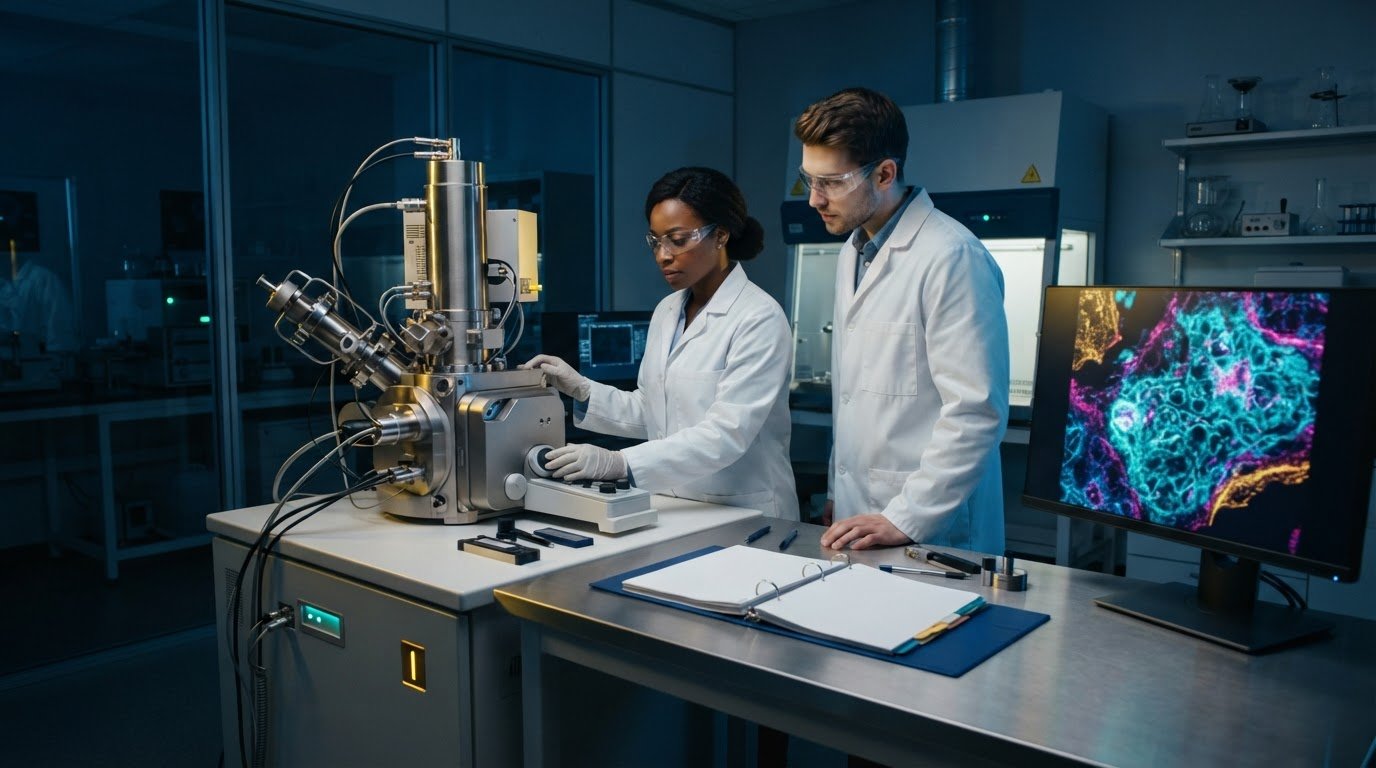
A compliant SEM lab doesn’t need to pursue every certificate it encounters. The first step is to identify which obligations apply to its work, location, customers, and quality commitments, then show that the related controls are maintained. That’s the practical meaning of compliance and certification for sem labs: a scoped evidence system, not one universal credential. Laboratory accreditation evaluates a lab’s competence and processes; equipment documentation addresses the instrument and its operation. Confusing the two can leave gaps in both planning and audit preparation.
This 2026 checklist helps you identify relevant safety, quality, and customer requirements, assign owners, and organize current records for your SEM, maintenance, calibration, and personnel processes. It also distinguishes formal obligations from standards and customer expectations that apply only to particular work. The sections ahead move from scope and applicable requirements to evidence management and equipment lifecycle practices, so your lab can build a documented approach without assuming every facility needs the same accreditation or certification.
Key Takeaways
- Map your lab’s activities, samples, customers, funding, and operating locations to identify which requirements apply.
- Distinguish laboratory accreditation, equipment conformity, and workplace compliance before building your checklist.
- Use the article’s compliance and certification for sem labs framework to assign owners and organize evidence by process.
- Keep equipment identification, service history, operating procedures, personnel competence, and sample records current and traceable.
- Align SEM selection, planned maintenance, and staff training with your lab’s analytical needs and documented workflows.
SEM Lab Compliance and Certification: What Do the Terms Actually Mean?
Laboratory accreditation, equipment conformity, and workplace compliance address different things. Accreditation evaluates a laboratory’s competence within a defined scope. Equipment conformity concerns whether an instrument meets applicable design, safety, or regulatory requirements. Workplace compliance covers the obligations that govern how people perform work and manage hazards. These categories can intersect, but one doesn’t automatically satisfy the others.
Certification is a formal attestation that an organization, person, process, or product meets specified criteria. Accreditation is a specific recognition, generally granted by an independent body, of a laboratory’s competence for defined activities. A lab can operate a documented quality system without third-party accreditation, while an accredited lab still has to address equipment and workplace requirements relevant to its operations.
No single certification automatically covers every SEM lab. Applicable requirements depend on what the lab does, where it operates, and the commitments it has made. A lab performing contract measurements may face different expectations from one using SEM for internal research or routine production checks. Customer specifications, grant conditions, organizational policies, and local jurisdiction can all shape the applicable scope of compliance and certification for sem labs.
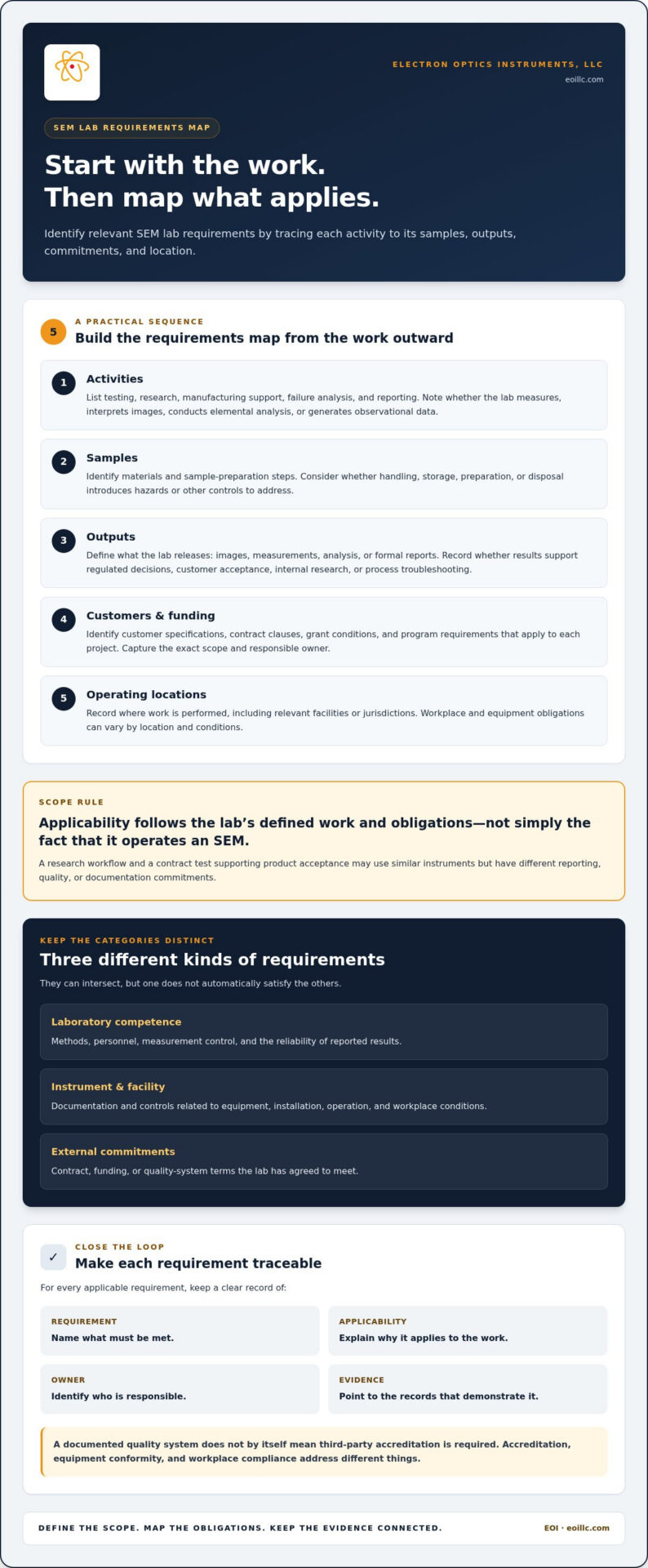
Start by separating requirements into three practical categories:
- Laboratory competence: Requirements for methods, personnel, measurement control, and the reliability of reported results.
- Instrument and facility: Documentation and controls related to equipment, installation, operation, and workplace conditions.
- External commitments: Contract, funding, or quality-system terms the lab has agreed to meet.
The Scanning Electron Microscope (SEM) can support varied imaging and analytical work. Define the lab’s actual activities first, then map requirements to those activities rather than inferring them from the presence of an SEM alone.
Does every SEM lab need formal accreditation?
No. Accreditation may be required by a customer contract, a funding or program condition, or a defined scope of testing or calibration. In other settings, an internal quality system may be appropriate without independent accreditation. Before deciding, identify the work covered, who relies on its results, and the governing terms. Verify sector-specific eligibility rules and current accreditation requirements against the relevant program and jurisdiction.
What does SEM equipment compliance cover?
Equipment conformity documentation relates to the instrument. It doesn’t accredit the laboratory or establish that every lab process is controlled. Retain applicable manufacturer documentation alongside records such as instrument identification, installation and operating information, service history, and status. Together, these records help show that the SEM is managed consistently and that changes or maintenance can be traced. Don’t assume there is one universal SEM certification scheme for every instrument or use.
Keep the distinctions clear in your compliance register: name each requirement, explain why it applies, identify the responsible owner, and point to the evidence that demonstrates it. This structure helps the lab address relevant obligations without collecting certificates that don’t match its work.
How to Identify SEM Lab Requirements for Your Work
Build the requirements map from the work outward, rather than starting with a list of standards. For each activity, record what the lab does, who uses the result, and what commitments govern the process. This helps prevent a requirement tied to one customer or program from being treated as universal across all SEM work.
- Activities: List testing, research, manufacturing support, failure analysis, and reporting. Note whether the lab performs measurements, interprets images, conducts elemental analysis, or only generates observational data.
- Samples: Identify the materials and sample-preparation steps involved. Consider whether handling, storage, preparation, or disposal introduces hazards or other controls that need to be addressed.
- Outputs: Define what the lab releases, such as images, measurements, analysis, or formal reports. Record whether results support regulated decisions, customer acceptance, internal research, or process troubleshooting.
- Customers and funding: Identify customer specifications, contract clauses, grant conditions, and program requirements that apply to each project. Capture the exact scope and responsible owner.
- Operating locations: Record where work is performed, including relevant facilities or jurisdictions. Applicable workplace and equipment obligations can vary by location and conditions.
Applicability follows the lab’s defined work and obligations, not simply the fact that it operates an SEM. A research workflow and a contract test supporting product acceptance may use similar instruments but have different reporting, quality, or documentation commitments.
Map the lab’s work before selecting a standard
Document activities and intended uses before assessing whether a particular standard fits. ISO/IEC 17025 may be relevant when a laboratory performs testing or calibration and customers, programs, or other obligations call for demonstrated competence. It isn’t an automatic requirement for every SEM facility. Determine whether the standard’s scope matches the actual methods and results, and verify current applicability with the relevant accreditation program and qualified compliance personnel.
Keep a requirement register that connects each obligation to the activity it covers, its source, the person responsible, and the evidence needed. This makes project-specific conditions visible without extending them to unrelated work. Quality-system commitments may also impose internal controls even when no external accreditation is required.
Check standards, agencies, and contractual obligations
Verify regulatory and workplace requirements using current, authoritative sources and personnel qualified to interpret them. OSHA-related duties depend on workplace hazards and the rules that apply to the facility. Don’t infer specific obligations from the presence of an SEM alone. Where radiation-safety questions are relevant, assess whether the FDA Radiation Safety Guidelines for SEMs apply to the instrument and work in question, and document the basis for that determination.
Use NIST as a metrology reference when a defined measurement requires traceability, not as a general certification authority for SEM operation. When planning scope alongside instrument lifecycle documentation, SEM equipment and maintenance support can help inform how service records and operational processes fit into the lab’s controls.
SEM Equipment, Safety, and Measurement Controls to Document
Reliable equipment records connect each SEM’s configuration and operating history to the work performed with it. They help staff establish which instrument was used, whether it was in an appropriate operating state, and what maintenance or changes occurred over time. For compliance and certification for sem labs, the goal isn’t paperwork for its own sake. It’s making controls traceable to actual laboratory activities and requirements.
Keep maintenance and calibration distinct. Maintenance supports the instrument’s condition and operation; calibration evaluates a defined measurement against an appropriate reference. A lab doesn’t need to label every service activity as calibration. First identify whether a method relies on a measurement, such as a dimensional result, then document the calibration or verification controls specified by that method or applicable quality commitment.
Build a controlled SEM equipment record
Maintain a record for each instrument and its relevant accessories. Include enough detail to identify the equipment, understand its status, and link its history to the procedures staff use.
- Identification and ownership: Record model, serial number, installation details, location, assigned equipment owner, and current operational status.
- Lifecycle history: Log maintenance, repairs, service visits, and relevant software or configuration changes. Record post-service checks when needed to show the instrument is suitable for its intended use.
- Operational evidence: Link the record to current operating procedures, applicable staff training records, and instrument logs, such as use, fault, or status entries maintained by the lab.
- Measurement controls: When a defined method requires measurement traceability, document the reference or verification approach, acceptance criteria, results, and review. Tie this evidence to the relevant procedure.
Set a process for updating the record after a service event or change, and make clear how staff can identify equipment that’s unavailable or restricted from use. Consistent entries make instrument history easier to reconstruct than informal notes held by individual operators.
Assess SEM and EDS risks without overgeneralizing
Base safety documentation on the instrument configuration, installation, sample workflow, and facility. An SEM may involve electrical systems, high-voltage components, vacuum systems, moving parts, and generated X-rays during operation. Assess the presence and significance of particular hazards, along with appropriate safeguards, for the equipment and work in question rather than assuming all SEMs present identical risks.
Record the site-specific hazard assessment, relevant controls, responsible personnel, and the instructions staff follow. Verify safety statements and control requirements against current manufacturer documentation and authoritative agency guidance for the applicable jurisdiction. A generic checklist or instrument label isn’t a substitute for evaluating actual conditions.
Document EDS as part of the lab’s analytical workflow when it’s used. Its procedures, operator training, data records, and measurement controls should reflect the lab’s purpose and reporting commitments. Review these records when the configuration, method, or intended use changes.
SEM Lab Compliance Checklist: Records, Reviews, and Audit Readiness
An audit-ready file should show how each applicable requirement is put into practice, not just that a policy exists. Adapt the checklist below to the lab’s defined scope: include requirements that apply, mark others as not applicable with a brief rationale, and assign an owner, review date, retention rule, and change log to every item. This creates a working control system rather than a static document collection.
What evidence should an SEM lab organize?
Use separate record groups so reviewers can move from requirement to procedure, responsible person, and evidence. Keep current revisions available and make superseded versions identifiable. Use this SEM operation guide as a reference when developing procedures, then tailor them to the lab’s methods and commitments.
- Controlled procedures: Maintain applicable policies, work instructions, safety processes, sample-handling steps, reporting practices, and document approval and revision histories.
- Personnel competence: Retain role assignments, training records, authorization where used, and evidence of relevant competency reviews. Tie records to the procedures and equipment each person operates.
- Equipment records: Keep the equipment inventory, operating status, maintenance and repair history, and any required calibration or verification evidence linked to the instrument record.
- Sample and analytical records: Where the workflow requires them, preserve sample identification, preparation details, instrument or method settings, acquired data, analysis, and the resulting report. Maintain a traceable link between sample, operator, instrument, and output.
- Findings and corrective actions: Record review findings, decisions, assigned actions, completion evidence, approvals, and any procedure or training revisions that follow.
Define how long each record type is retained in line with applicable requirements and commitments. Make the source of each retention period clear, and avoid applying one blanket rule if different record types have different obligations. A change log should identify what changed, when, who approved it, and whether related procedures or training required updates.
How should the lab prepare for an internal review?
Review the requirement register line by line. Confirm that each applicable requirement has a current procedure, an accountable owner, and accessible evidence. Then sample records across equipment and personnel, not just policies. For example, trace a completed analytical record back to the sample, operator qualification, instrument status, and relevant procedure. Note gaps as findings, assign corrective actions, and document their closure and approval.
Maintenance records are useful in this review because they show whether planned work and service history are managed as the lab intends. Use a SEM maintenance guide to inform maintenance-program planning, then retain records that demonstrate the lab’s own process.
For practical support with SEM maintenance and equipment lifecycle planning, explore SEM service and maintenance resources.
Choose and Maintain SEM Equipment to Support a Compliant Lab
Equipment selection shapes how a lab performs its work and documents control over time. A suitable SEM should align with the lab’s analytical needs, sample workflow, facility constraints, and documentation requirements. A benchtop or tabletop system, a refurbished unit, or another SEM configuration may suit different operating contexts, but no instrument by itself provides laboratory accreditation. For compliance and certification for sem labs, the instrument is one part of a wider system of procedures, trained personnel, and maintained records.
Evaluate equipment against the lab’s documented scope
Start with the methods and outputs the lab has defined. Consider imaging and analytical tasks, sample types and preparation steps, expected throughput, operator workflow, and facility conditions. If elemental analysis is part of the work, include the EDS system and its role in the documented method. An advanced SEM techniques guide can provide context for evaluating analytical needs, but it doesn’t replace the lab’s own method requirements.
- Analytical fit: Match the instrument configuration and any analytical systems to the outputs the lab needs to produce.
- Workflow and facility: Consider sample movement, operator access, installation requirements, and the space and operating conditions available.
- Documentation: Identify the manufacturer materials, operating instructions, and conformity documentation that will support the lab’s equipment records.
- Lifecycle planning: Include installation, staff training, maintenance planning, service history, and recordkeeping in procurement decisions.
Define acceptance and operating criteria before installation, then incorporate relevant procedures and staff preparation into the lab’s controlled workflow. These steps support consistent use, but they don’t turn an equipment feature or document into laboratory accreditation.
Plan ongoing support as part of the compliance system
Planned maintenance, repair documentation, and staff training help make equipment lifecycle oversight visible. Record completed service, relevant findings, and any follow-up checks or changes required by the lab’s procedures. If service affects configuration or operation, update associated documentation and ensure affected personnel understand the current process. Link training to each person’s tasks and maintain records according to the lab’s requirements.
Electron Optics Instruments, LLC provides SEM equipment, preventative maintenance, repairs, and on-site training. Its offerings include benchtop and tabletop systems, Veritas Series models, refurbished units, and EDS systems.
As you plan equipment selection and lifecycle needs, explore SEM systems and support to consider how instrument options, maintenance, and training can fit into your lab’s documented processes.
Turn Your Compliance Framework Into a Maintained Practice
Convert your requirement register into a living review cycle. Set clear triggers for reassessment, such as changes in sample types, analytical methods, customer commitments, equipment configuration, or operating location. That keeps compliance and certification for sem labs aligned with the work as it evolves, rather than leaving the checklist tied to a past audit.
Equipment decisions are part of that ongoing framework. Electron Optics Instruments, LLC is the sole U.S. distributor for EmCraft Scanning Electron Microscopes and supports SEM selection and lifecycle planning. Treat equipment, maintenance, and staff capability as connected elements of controlled operations, while keeping certification decisions within the appropriate accreditation or regulatory process.
Explore SEM systems and support to plan the next stage of your lab’s equipment lifecycle. Contact Electron Optics Instruments, LLC to discuss SEM equipment, maintenance, repairs, or on-site training for your lab.
Frequently Asked Questions
Does every SEM laboratory need ISO/IEC 17025 accreditation?
No, ISO/IEC 17025 accreditation isn’t automatically required for every SEM laboratory. It may be relevant when a contract, funding program, or the lab’s testing or calibration scope calls for demonstrated competence. An internal quality system can establish document control, reviews, and corrective actions without third-party accreditation. Before making claims about accredited results, verify current scope-specific obligations with the relevant accreditation body, customer, or program authority.
Is SEM equipment itself certified, or is the laboratory certified?
Equipment conformity documentation and laboratory accreditation address different things. Where accreditation applies, it evaluates a laboratory’s competence for activities within a defined scope, not every instrument or use across the facility. A SEM’s documentation can support control of that equipment, but it doesn’t establish that the laboratory is accredited or meets all its obligations. Assess each instrument’s documentation in relation to the lab’s methods, intended use, and applicable requirements.
What safety requirements apply to an SEM laboratory?
Applicable safety requirements depend on the instrument configuration, workplace hazards, and federal, state, and local rules. Electrical systems, vacuum components, and generated X-rays may warrant assessment, but the presence of an SEM doesn’t establish one universal set of controls. Document the facility’s assessment and the reasoning behind its controls. Verify current obligations using authoritative safety sources and qualified personnel familiar with the equipment and workplace.
Does an SEM need calibration for compliance?
Calibration needs depend on the measurements performed, intended use of results, quality commitments, and applicable requirements. Calibration isn’t the same as routine maintenance, which addresses equipment condition, or a performance check, which evaluates operation against defined criteria. If calibration is required for a measurement, document the rationale, method, results, and traceability. Don’t assume every SEM component requires calibration; connect each control to a defined measurement or obligation.
What records should an SEM lab keep for an audit?
Organize current procedures, staff competence and training evidence, equipment identification and service history, relevant sample and analytical records, and documented corrective actions. For example, a report should be traceable to its sample and the records needed to interpret how it was produced. Retention periods and required evidence depend on the lab’s obligations and policies. Assign record owners, control revisions, and make approvals and changes traceable.
Can a benchtop SEM make a laboratory compliant?
No instrument alone establishes laboratory compliance or accreditation. A benchtop SEM may fit a particular workflow, but suitability depends on the lab’s defined work, procedures, staff competence, equipment controls, and applicable obligations. For compliance and certification for sem labs, assess the complete operating system around the instrument, including how results are reviewed and documented. Select equipment to support the lab’s processes, then maintain evidence that those processes are followed.
How often should an SEM lab review its compliance checklist?
Set a review schedule that fits the lab’s obligations, and review the checklist after meaningful changes. Triggers may include new equipment, a revised method, changes in personnel or facility conditions, new customer commitments, or updated applicable requirements. There’s no single interval suitable for every lab. Record who completed each review, what findings were identified, which actions were assigned, and evidence that actions were completed or resolved.