
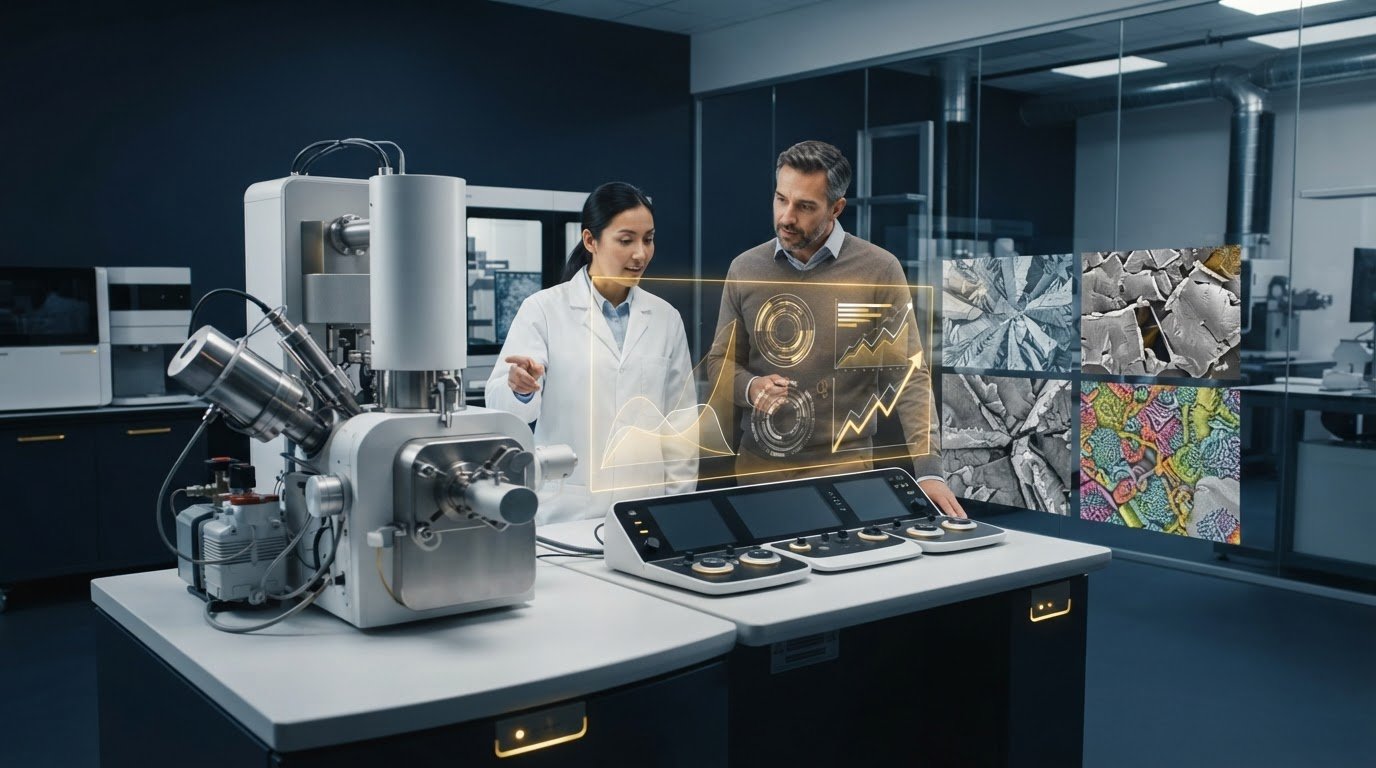
Treating advanced analytical instrumentation purely as a volume-driven expenditure is a costly strategic miscalculation. While traditional procurement models assume sample throughput alone dictates capitalization, long-term operational profitability actually hinges on iteration velocity and intellectual asset security. A comprehensive cost-benefit analysis of in-house sem deployment must therefore evaluate both direct testing expenditures and the institutional drag imposed by decentralized diagnostic workflows.
Technical leaders are familiar with the operational friction when an outsourced bureau can’t match production pace. Multi-week turnaround queues stall root-cause failure analysis, unpredictable third-party fees disrupt fiscal forecasts, and shipping proprietary formulations off-site introduces unnecessary exposure. To resolve these structural inefficiencies, this guide provides a rigorous quantitative framework contrasting commercial testing expenses against total cost of ownership. Ahead, we evaluate equipment overhead, operational support requirements, and sample breakeven thresholds to deliver the financial justification required for executive stakeholder approval.
Key Takeaways
- Execute a structured cost-benefit analysis of in-house sem adoption using formal capital budgeting metrics like net present value and internal rate of return rather than surface-level invoice comparisons.
- Uncover hidden outsourcing liabilities, factoring in recurring logistics, administrative purchase order friction, and production delays caused by external analytical backlogs.
- Establish accurate total cost of ownership models that account for preventative maintenance protocols, consumables, and utility requirements alongside initial instrument acquisition.
- Quantify the velocity dividend to capture how rapid microstructural iteration cycles and on-site intellectual property containment protect long-term enterprise value.
- Align analytical requirements with right-sized instrumentation categories, evaluating how compact benchtop platforms or floor-standing systems shift the operational breakeven threshold.
The In-House vs. Outsourced SEM Decision Framework
Relying on external characterization labs creates an ongoing operational dependency that compounds fiscal risk over time. While recurring service contracts appear low-risk on monthly balance sheets, they inevitably expose operations to cumulative fee inflation and analytical bottlenecks. A structured cost-benefit analysis establishes whether continuing down this fee-for-service path remains viable, or whether internal instrument acquisition presents a superior economic trajectory.
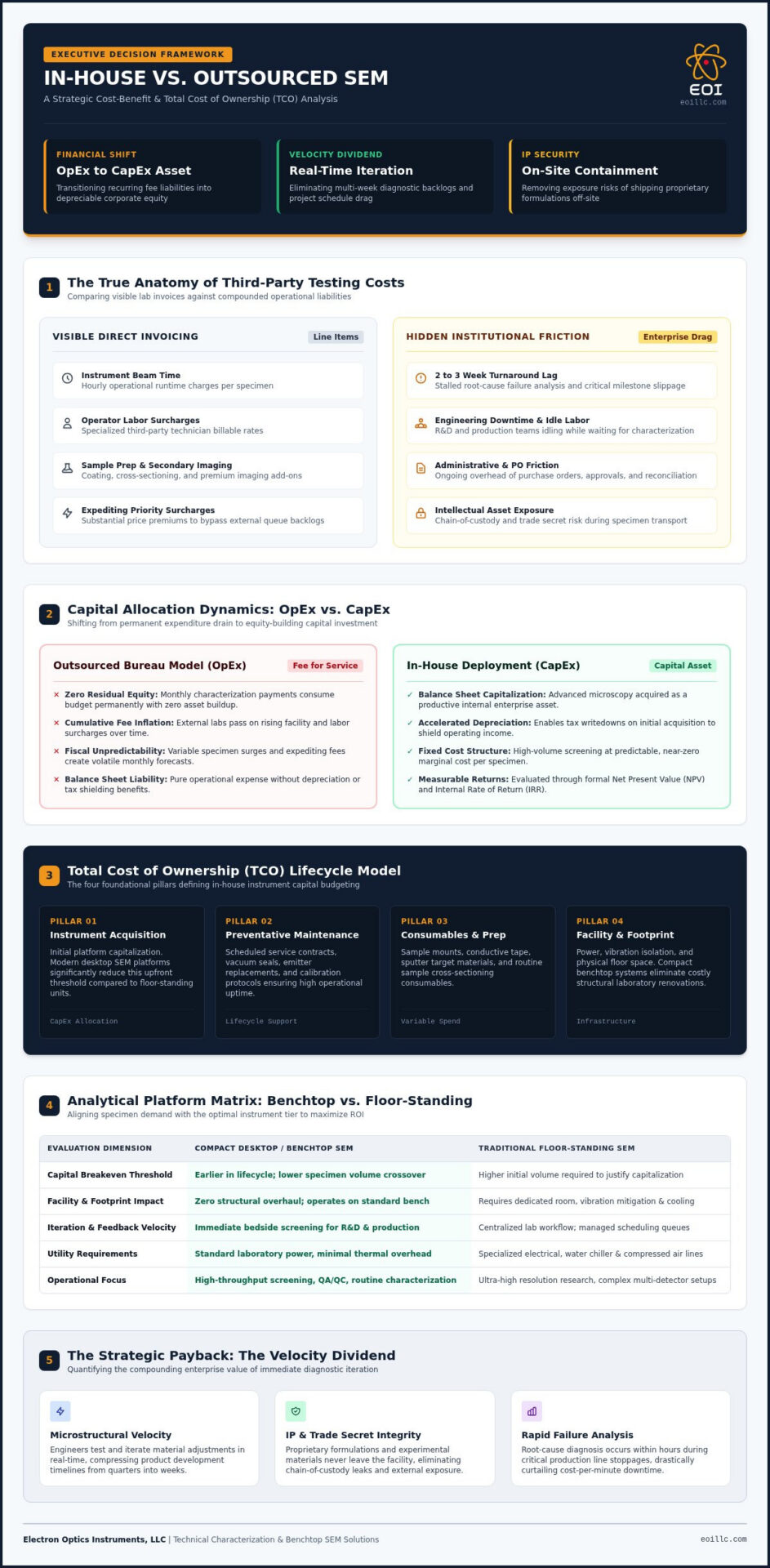
Determining this pivot requires formal capital budgeting metrics rather than intuitive estimates. Organizations evaluate Net Present Value (NPV), Payback Period, and Internal Rate of Return (IRR) to gauge true asset performance. At its core, the crossover point occurs where cumulative outsourced testing fees surpass the total lifecycle cost of internal ownership. The emergence of modern desktop sem platforms alters this calculation by lowering floor space, utility, and facility modification requirements, allowing operations to achieve capital breakeven much earlier in the operational lifecycle.
Core Variables in the Analytical Payback Equation
Quantifying analytical spend begins with auditing historical invoicing patterns across all external testing bureaus. Laboratories must account for standard instrument runtime, operator labor surcharges, and sample preparation line items. A robust cost-benefit analysis of in-house sem deployment aggregates these elements against specimen demand:
- Specimen Throughput: Monthly analytical volume, including routine screening and intermittent surges.
- Rate Structures: External core facility rates, variable staffing surcharges, and secondary imaging fees.
- Schedule Drag: Project downtime and delivery delays created by standard two-to-three-week third-party turnaround windows.
Capital Allocation vs. Operational Expenditure Dynamics
The choice between outsourcing and procurement represents a fundamental accounting shift from operational expenditure (OpEx) to capital allocation (CapEx). Retained service fees deliver zero residual value, consuming operating budgets indefinitely. Capitalizing an instrument transfers analytical capability onto the balance sheet as a productive corporate asset.
This transition introduces distinct financial advantages. Enterprise tax frameworks often allow accelerated equipment depreciation schedules, enabling firms to write down initial acquisition expenses while shielding operating income. Compact benchtop instruments minimize upfront capital commitments, eliminating complex structural renovations. Internal assets generate operational equity, whereas third-party testing fees remain permanent balance sheet liabilities.
Quantifying Direct and Hidden Costs of Third-Party Lab Testing
Invoices from external analytical service providers obscure the true financial burden of outsourced electron microscopy. A typical billing statement details instrument beam time, specialized operator hours, specimen coating or cross-sectioning fees, and expediting surcharges. Internal procurement friction adds administrative weight to these direct line items. Processing purchase orders, securing technical service approvals, and managing invoice reconciliation consume valuable administrative resources, inflating transaction costs for every specimen batch submitted.
A realistic evaluation of in-house vs. outsourced testing requires auditing indirect operational waste alongside billing receipts. When evaluating overall expenditures, a comprehensive cost-benefit analysis of in-house sem capabilities must factor in the financial drag of engineering idle time and administrative overhead. Exploring tailored instrument configurations through Electron Optics Instruments can illuminate how internal screening directly mitigates these compounding processing fees.
The True Cost of Latency and Turnaround Delays
External queues impose significant operational delays. When commercial analytical bureaus operate on two- to four-week lead times, engineering teams stall while awaiting structural verification. If a critical manufacturing line experiences an unresolved contamination crisis, waiting weeks for particulate characterization halts production, idling high-cost labor and threatening delivery schedules.
Direct comparisons expose the contrast in operational friction:
- Outsourced Queue: Multi-week turnaround cycles, high rush fees for priority slots, and disrupted production schedules.
- In-House Deployment: Immediate sample mounting, rapid imaging iteration, and live root-cause adjustments within minutes.
Instant visual and compositional feedback keeps R&D projects moving and prevents isolated defect events from turning into costly factory shutdowns.
Risk Management and Intellectual Property Exposure
Shipping proprietary specimens off-site creates significant operational liabilities. Standard non-disclosure agreements cannot completely eliminate the risk of intellectual property exposure when novel alloy compositions, proprietary coatings, or unpatented semiconductor topographies leave corporate control. Off-site physical transfer exposes trade secrets to unnecessary third-party scrutiny.
Courier transit introduces substantial physical vulnerabilities. Fragile, air-sensitive, or vacuum-critical specimens degrade rapidly under fluctuating ambient pressures, elevated humidity, or rough mechanical handling. External specimen contamination can distort energy-dispersive spectroscopic outcomes, triggering erroneous engineering hypotheses. Retaining analytical workflows internally maintains a closed chain of custody, safeguarding proprietary formulations and specimen integrity.
Calculating Total Cost of Ownership for In-House SEM Instrumentation
Asset capitalization requires looking past the purchase order to evaluate the entire lifecycle expenditure. A precise total cost of ownership (TCO) model aggregates initial acquisition, site engineering, recurring utilities, consumables, and technical labor overhead. Laboratory planners can reference our detailed electron microscope cost evaluation guide to establish baseline capital tiers before projecting multi-year operational commitments. Synthesizing these line items completes a realistic cost-benefit analysis of in-house sem ownership across a standard five- to ten-year service horizon.
Facility Footprint, Infrastructure, and Utility Demands
Site readiness establishes the physical baseline for electron optics performance. Traditional floor-standing units often demand dedicated rooms with active acoustic cancellation, vibration isolation slabs, magnetic field shielding, and continuous chilled-water loops. These infrastructural renovations introduce substantial upfront expenses that inflate startup budgets.
Modern benchtop and tabletop architectures substantially compress these site requirements. Designed for standard laboratory benchtops, they run on clean 110V to 220V power circuits with internal passive isolation. This design sidesteps complex mechanical ducting, auxiliary water chillers, or structural foundation modifications.
Long-Term Maintenance Contracts and Consumables Lifecycle
Preserving sub-nanometer resolving power requires consistent maintenance. Operating budgets must account for routine consumables, including replacement tungsten hairpin filaments or field emission source replacements, vacuum pump fluids, aperture strips, and sample mounting media. Source longevity varies based on operational run hours and vacuum integrity.
System stability depends on regular service routines. Proactive laboratories mitigate downtime through scheduled preventative maintenance visits, which ensure proper column centering, aperture alignment, and detector calibration. Reviewing the tiered service agreements detailed in our sem maintenance breakdown enables financial controllers to convert unpredictable breakdown risks into fixed, manageable operating expenses.
Operator Onboarding and Workforce Productivity
Human capital represents the final pillar of the TCO framework. Historically, operating an electron optical column demanded a dedicated, doctoral-level microscopist. Modern systems feature intuitive user interfaces and automated alignment protocols, radically flattening the learning curve for staff.
Facilities can cross-train internal materials scientists and quality assurance technicians rather than expanding dedicated headcount. Implementing structured on-site training protocols, such as those outlined in our sem operation handbook, transforms existing laboratory personnel into proficient operators. This workforce efficiency enhances analytical independence without imposing prohibitive staffing overhead onto the corporate ledger.
Strategic Value Creation: Velocity, Data Integrity, and Innovation
Conventional fiscal models often treat strategic velocity as an intangible benefit rather than an economic driver. In practice, analytical agility delivers measurable balance-sheet returns. This advantage emerges through the velocity dividend: the compounding financial gain realized when development teams operate within an unbroken, immediate feedback loop. Incorporating dynamic operational responsiveness into a cost-benefit analysis of in-house sem acquisition reveals significant fiscal upsides that invoice-level comparisons routinely overlook.
Internalizing characterization workflows transforms how enterprises compete for high-value contracts. Delivering verifiable microstructural documentation alongside customer proposals reassures enterprise partners of stringent internal process control. To capture these analytical efficiencies across your operations, explore in-house electron microscopy solutions engineered for rapid diagnostic integration.
Accelerating the R&D Prototyping Cycle
Research and development teams thrive on continuous feedback loops. When material synthesis, mechanical stress testing, and topographical characterization happen in immediate succession, engineering teams iterate within hours rather than waiting through external administrative queues.
Eliminating multi-day characterization pauses fundamentally alters development timelines:
- Dynamic Iteration: Surface grain structures, porosity anomalies, and interfacial boundary behaviors can be verified directly after sample extraction.
- Compressed Development Cycles: Prototyping phases drop from quarters to weeks, accelerating commercial product release dates.
- Market Capture: Faster validation allows advanced hardware, medical device, and precision component manufacturers to secure patents and client contracts ahead of competitors.
Speed to market secures revenue windows that permanently overshadow marginal equipment savings.
Quality Assurance and Immediate Failure Interception
Immediate defect diagnosis acts as a vital firewall on high-throughput production lines. When microscopic flaws emerge during precision manufacturing, continuous line operation rapidly generates scrap material. At-line inspection lets engineers isolate tool wear, chemical contamination, or particulate inclusion early, containing suspect production lots before they propagate through the facility.
This operational containment protects bottom-line capital in three critical ways:
- Scrap Mitigation: Pinpointing micro-cracking mechanisms or layer delamination within minutes prevents complete production run condemnation.
- Supply Chain Auditability: Discrepancies in raw powder grain size or alloy phase distribution can be verified upon delivery, holding external vendors to strict specifications.
- Client Certification: Incorporating high-resolution structural micrographs directly into lot acceptance certificates verifies conformance, mitigating liability and preventing downstream return disputes.
Real-time microstructural screening turns high-resolution diagnostics into an active loss-prevention engine.
Selecting the Optimal In-House Platform to Maximize Return on Investment
Maximizing return on capital requires matching specific organizational analytical needs with the appropriate instrument class. Deploying an over-engineered column drains financial resources through unneeded capacity, while under-specifying hardware creates resolution ceilings that force continued reliance on external bureaus. A comprehensive cost-benefit analysis of in-house sem investments aligns magnification requirements, workflow throughput, and elemental characterization capabilities against the right equipment tier.
Instrument selection maps across three primary operational categories:
- Streamlined Screening: The Cube II Benchtop SEM offers rapid sample turnaround and a compact physical profile, ideal for high-throughput screening and rapid quality checks.
- Industrial Workhorse Inspection: The Genesis Tabletop SEM provides expanded chamber flexibility and robust imaging performance for daily failure analysis and routine materials testing.
- Advanced Research and Nanoscale Resolution: The floor-standing Veritas Series SEM platforms deliver advanced electron optics, extended stage travel, and higher beam deceleration controls for rigorous research demands.
- Integrated Elemental Characterization: Coupling these platforms with EDS (Energy Dispersive Spectroscopy) Systems captures morphology and qualitative elemental composition simultaneously, eliminating secondary third-party laboratory runs.
Benchtop vs. Floor-Standing Form Factor Financial Trade-offs
Form factor directly dictates startup and infrastructure capital demands. Compact architectures such as the Cube II and Genesis models operate directly in standard laboratory or production floor environments. They avoid specialized vibration isolation slabs or active magnetic cancellation fields, shortening the deployment schedule and substantially lowering initial facility overhead.
Floor-standing systems demand higher initial commitments but serve irreplaceable analytical roles. The Veritas Series SEM justifies dedicated facility space when teams require sub-nanometer resolution, low-voltage beam deceleration for beam-sensitive polymers, or large sample chambers to examine intact engineering components without destructive sectioning.
Building the Executive Capital Justification Proposal
Executive approval hinges on presenting a defensible business case. Technical leadership must synthesize historical third-party invoice ledgers, projected specimen growth, and hidden delay liabilities into a unified multi-year cash flow model. Showing how an internal asset replaces perpetual service fees with balance-sheet value simplifies the capital requisition path.
A rigorous cost-benefit analysis of in-house sem deployment frames equipment acquisition as an engine for enterprise velocity rather than an isolated expense. Consulting Electron Optics Instruments technical specialists ensures your team pairs the appropriate column geometry and EDS configurations to your exact operational specifications, maximizing analytical yield while satisfying institutional capital parameters.
Transforming Analytical Expense Into Strategic Laboratory Capital
Transitioning from recurring fee-for-service outsourcing to capitalized in-house microscopy eliminates analytical bottlenecks, safeguards proprietary intellectual property, and restores operational predictability. When evaluated across multi-year development cycles, a structured cost-benefit analysis of in-house sem adoption demonstrates that indirect delay costs and external markups routinely outpace the total lifecycle cost of internal ownership.
Backed by over three decades of specialized electron optics expertise, Electron Optics Instruments provides complete deployment, installation, and on-site operator training infrastructure nationwide across the United States. Whether your facility demands high-throughput screening with the Cube II Benchtop SEM, routine industrial failure analysis on the Genesis Tabletop SEM, or nanoscale precision via the Veritas Series SEM, internalizing characterization protects institutional margins. Request a Custom SEM Cost-Benefit Consultation to quantify your analytical throughput and establish a high-return capital pathway for your laboratory.
Frequently Asked Questions
How do I calculate the breakeven sample volume for an in-house SEM?
Calculate breakeven volume by dividing annualized ownership overhead by your net outsourced expenditure per specimen. First, sum baseline capital financing or depreciation with expected maintenance contracts and consumable supplies. Next, establish total external expense per run, combining billing rates, expedited handling surcharges, and internal procurement processing hours. Breakeven occurs where cumulative third-party invoicing equals fixed internal ownership operating costs.
What are the typical ongoing operational costs of an in-house electron microscope?
Ongoing operations demand budgeting for electron sources, routine vacuum supplies, preventative maintenance agreements, and utility usage. Tungsten hairpin sources or field emission replacements represent recurring optical expenses based on active column runtime. Proactive laboratories also integrate annual preventative maintenance visits and spare aperture consumables to stabilize vacuum chambers, preventing unexpected diagnostic downtime across multi-year testing programs.
Can existing laboratory technicians operate modern benchtop SEM instruments without a microscopy degree?
Yes, modern benchtop platforms feature automated optical column alignments and graphical interfaces designed for broad accessibility. Quality control staff and materials engineers can master core topographical screening after structured on-site training sessions. Dedicated academic microscopists aren’t required for standard operational workflows, enabling facilities to cross-train internal personnel without expanding recurring staffing lines.
How do facility preparation requirements differ between benchtop and floor-standing SEMs?
Benchtop instruments require minimal site renovation, operating on standard laboratory electrical connections without dedicated active cancellation enclosures. In contrast, large floor-standing systems require substantial infrastructure planning. These full-scale platforms frequently necessitate specialized acoustic damping chambers, isolated concrete foundation slabs to eliminate structural vibration, and dedicated auxiliary cooling loops to support high-power optical columns.
What are the main financial risks of continuing to outsource SEM analysis?
Continuing to outsource exposes organizations to persistent invoice inflation, scheduling latency, and intellectual property liabilities. Two- to three-week analytical backlogs delay production release milestones and leave manufacturing defects unaddressed. In a formal cost-benefit analysis of in-house sem acquisition, persistent third-party dependencies consume operating capital while providing zero balance-sheet asset value or equity retention.
Does integrating an Energy Dispersive Spectroscopy (EDS) detector significantly alter the ROI?
Adding an EDS detector accelerates capital returns by uniting microstructural imaging and elemental identification on a single platform. Without integrated microanalysis, laboratories must pay separate bureau fees for chemical mapping or secondary spectrometry. In-house EDS functionality eliminates repeated sample preparation steps, allowing engineering teams to isolate contaminants or verify alloy compositions instantly within one automated analytical session.
How does equipment depreciation impact the cost-benefit analysis of an SEM purchase?
Capital equipment depreciation allows enterprises to write down the acquisition value of an electron microscope over its established service lifetime, directly offsetting taxable income. In contrast to outsourced testing fees that consume operating cash reserves with zero residual recovery, capitalized instrumentation builds corporate balance-sheet value while providing predictable, tax-advantaged financial deductions across standard corporate depreciation schedules.