
The lowest sticker price on a benchtop SEM is rarely the cheapest instrument you’ll ever own. For procurement teams and lab directors conducting a cost comparison of benchtop SEM models in 2026, that counterintuitive reality sits at the center of almost every acquisition decision that goes wrong: a system acquired on capital budget alone frequently generates far greater expenditure through consumables, service gaps, and analytical limitations discovered only after installation.
You already know the challenge. Comparing specifications across competing platforms is genuinely difficult when one manufacturer leads with resolution figures and another emphasizes a 5-axis motorized stage, and when neither quote surfaces the true cost of electron source replacement, vacuum system maintenance, or EDS integration over a five-year horizon. The complexity is real, and the financial stakes are significant.
This guide is designed to resolve that complexity. Drawing on technical architecture, electron source economics, and total cost of ownership methodology, it delivers a structured framework for evaluating capital costs against long-term operational realities, providing the analytical depth needed to build a defensible business case for stakeholder approval.
Key Takeaways
- A rigorous cost comparison of benchtop SEM models in 2026 reveals that acquisition price represents only a fraction of the true investment, with operational expenditures frequently eclipsing capital costs over a five-year horizon.
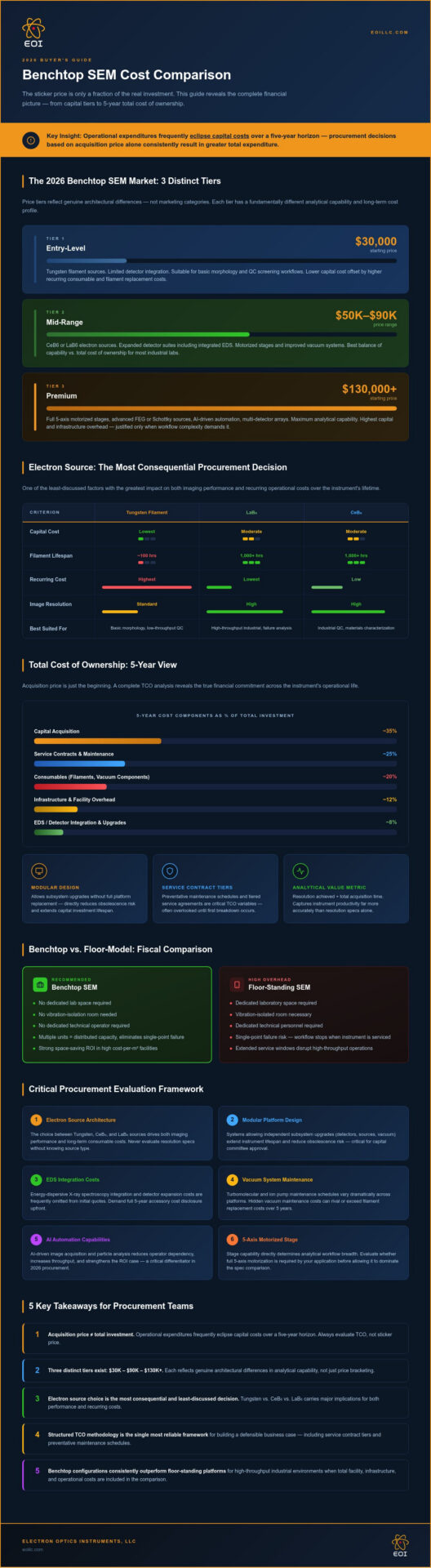
- The 2026 benchtop SEM market spans three distinct performance tiers—from $30,000 entry-level systems to $130,000+ premium platforms—each with fundamentally different analytical capabilities and long-term cost profiles that must be matched precisely to your application requirements.
- Electron source selection is one of the most consequential and least-discussed procurement decisions, as the choice between tungsten filament, CeB6, and LaB6 architectures carries significant implications for both imaging performance and recurring consumable costs.
- Structured total cost of ownership methodology, including a detailed evaluation of service contract tiers and preventative maintenance schedules, is the single most reliable framework for building a defensible business case for stakeholder approval.
- Understanding where purpose-built industrial solutions like the Cube II and Genesis Tabletop SEM sit within the 2026 competitive landscape enables procurement teams to identify genuine value rather than optimizing for specification figures that may be irrelevant to their core workflows.
The 2026 Economic Landscape of Benchtop SEM Procurement
Something fundamental has shifted in how industrial laboratories justify electron microscopy investment. What was once categorized as specialized capital equipment, accessible primarily to well-funded research institutions, has undergone a structural repositioning. Benchtop SEM is no longer a premium option sitting at the edge of a procurement conversation; it’s a production-floor necessity in sectors ranging from semiconductor failure analysis to advanced materials quality control. Understanding that shift is prerequisite to any meaningful cost comparison of benchtop SEM models in 2026.
Supply chain stabilization following the disruptions of the early 2020s has played a measurable role in this transition. High-precision electron optics components, which were subject to extended lead times and significant price volatility, have returned to more predictable availability cycles. That stabilization has enabled manufacturers to offer more consistent pricing tiers and, critically, to invest in modular hardware architectures that extend instrument service life without requiring full platform replacement. For procurement teams, this means capital expenditure decisions carry less technical obsolescence risk than they did even three years ago.
The parallel shift from floor-standing to compact systems reflects a convergence of fiscal and operational pressures. Floor-model SEMs demand dedicated laboratory space, specialized vibration-isolated rooms, and in many cases, dedicated technical personnel. Benchtop configurations eliminate or substantially reduce each of those overhead categories, and the space-saving ROI compounds quickly in facilities where laboratory square footage carries a meaningful cost per square meter. For a detailed breakdown of how acquisition price relates to total instrument investment, the electron microscope cost guide provides a useful reference framework.
Capital Expenditure Trends in Electron Optics
Modular hardware design has emerged as one of the most consequential architectural decisions a manufacturer can make in 2026. Systems built on modular platforms allow individual subsystems, detector arrays, electron sources, and vacuum components to be upgraded independently, which directly addresses the obsolescence concern that has historically made capital committee approval difficult to secure. The integration of AI-driven automation, particularly in image acquisition and particle analysis workflows, has further strengthened the investment case by reducing operator dependency and increasing analytical throughput. In this context, Analytical Value is best understood as the ratio of image resolution achieved to total acquisition time required, a metric that captures instrument productivity far more accurately than resolution specifications alone.
Benchtop vs. Floor-Model: A Fiscal Comparison
A growing number of laboratories are restructuring their electron microscopy capacity around multiple benchtop units rather than a single floor-model installation. The operational logic is straightforward: distributed capacity eliminates the single-point-of-failure bottleneck that grounds analytical workflows when a primary instrument requires service. When that distributed model is evaluated against the combined costs of dedicated floor-space, infrastructure modification, and extended service windows associated with floor-standing platforms, the cost comparison of benchtop SEM models in 2026 consistently favors compact configurations for high-throughput industrial environments.
Tiered Price Comparison: From Entry-Level to Premium Systems
Price tiers in the benchtop SEM market aren’t arbitrary marketing categories; they reflect genuine architectural differences that determine whether an instrument is analytically sufficient for your specific workflow or merely adequate on paper. A structured cost comparison of benchtop SEM models in 2026 reveals three distinct performance bands, each carrying a fundamentally different value proposition that procurement teams must evaluate against their application requirements before a single quote is solicited.
Entry-level systems in the $30,000 to $60,000 range deliver resolution figures typically between 15 and 30nm and are well-suited to educational environments and basic quality control tasks where throughput demands are modest and sample types are relatively uniform. The acquisition cost is attractive, but the analytical ceiling is real. Limited stage movement, manual focus workflows, and restricted detector options mean that any application requiring compositional analysis or complex sample geometry will quickly exhaust what these platforms can deliver.
The premium benchtop tier, spanning $130,000 to $250,000 and above, occupies a different category entirely. Systems at this level offer sub-5nm resolution, integrated EDS and EBSD detector arrays, and field emission sources that approach the analytical performance of floor-standing instruments. For semiconductor failure analysis laboratories or advanced materials research groups where measurement uncertainty carries direct financial consequence, the investment is defensible. For routine industrial QC, it frequently represents significant over-specification.
Identifying the Mid-Range Analytical Tier
The $75,000 to $110,000 band consistently delivers the highest return on investment for industrial laboratories conducting failure analysis, materials characterization, and multi-material quality assurance. Systems in this tier combine meaningful resolution capability with the operational features that determine daily productivity: 5-axis motorized stages that eliminate manual repositioning bottlenecks, variable pressure modes that accommodate non-conductive and hydrated samples without sputter coating, and automated focus routines that reduce operator dependency on high-skill personnel. For a deeper examination of how this generation of compact instruments has redefined analytical capability at the industrial level, the desktop SEM evolution guide provides essential context.
Within this tier, the competitive field narrows to a handful of platforms that procurement teams regularly evaluate side by side. The SNE-Alpha offers a solid entry into mid-range performance with a straightforward user interface that shortens operator training cycles. The Phenom ProX is a well-established platform with a strong service network and a proven record in pharmaceutical and polymer analysis. The Cube II, however, distinguishes itself through a combination of analytical versatility and a total cost of ownership profile that the other platforms in this band struggle to match, particularly when service contract economics are factored into a five-year projection.
Technical Trade-offs at Different Price Points
Resolution specifications are the most visible differentiator in any benchtop SEM comparison, but they’re rarely the most consequential one for industrial buyers. The more operationally significant variable is the relationship between resolution and acquisition speed. Entry-level systems that require extended dwell times to achieve acceptable image quality at moderate magnifications translate directly into billable hours lost, a cost that rarely appears in capital budget discussions but compounds significantly across a high-throughput analytical environment.
Stage geometry limitations in entry-level models create a subtler but equally damaging constraint. Restricted tilt ranges and manual X-Y translation force analysts to remount samples repeatedly during complex failure investigations, adding procedural steps that erode throughput and introduce repositioning error. Where the Genesis Tabletop SEM delivers motorized multi-axis stage control with repeatable positioning accuracy suited to systematic industrial inspection workflows, comparable entry-level Hitachi configurations require manual stage adjustment that introduces operator variability into what should be a reproducible analytical process.
Procurement teams conducting a rigorous cost comparison of benchtop SEM models in 2026 should build these throughput variables into their evaluation framework from the outset, not as secondary considerations, but as primary drivers of long-term instrument value. Exploring how the Cube II and Genesis series position within this analytical context is a productive starting point for any laboratory developing a structured acquisition case.
Technical Drivers Influencing Benchtop SEM Procurement Costs
Capital cost is only one dimension of what makes a benchtop SEM expensive. The deeper cost drivers are architectural, embedded in the electron source, vacuum system, and detector configuration that determine both analytical capability and the recurring expenditure profile that follows installation. A rigorous cost comparison of benchtop SEM models in 2026 demands that these technical variables be evaluated with the same discipline applied to acquisition price.
The ROI of High-Brightness Electron Sources
Electron source selection is where long-term cost divergence between platforms becomes most pronounced. Tungsten filaments carry the lowest initial cost and are standard in entry-level configurations, but they operate at relatively low brightness and require frequent replacement under continuous-use conditions. CeB6 and LaB6 sources deliver substantially higher brightness and coherence, which translates directly into sharper imaging at lower accelerating voltages and meaningfully longer operational lifespans between replacements.
The Veritas series’ LaB6 source architecture is specifically engineered for high-resolution nanotechnology and materials characterization applications where sub-nanometer surface detail is analytically consequential. The initial cost premium over tungsten configurations is real, but when filament replacement cycles, associated downtime, and the technician labor required for source exchange are factored across a five-year horizon, the LaB6 architecture frequently delivers lower total consumable expenditure than tungsten platforms operating under comparable duty cycles. Laboratories evaluating this trade-off in depth will find the technical analysis in the advanced SEM techniques guide a useful reference for understanding how source architecture influences analytical outcomes.
Analytical Add-ons and Detector Integration
Detector configuration is the second major cost lever, and it’s one that procurement teams frequently underestimate during initial budgeting. Secondary electron (SE) detectors are standard across all tiers. Backscattered electron (BSE) detectors, which enable compositional contrast imaging critical to failure analysis workflows, are standard on mid-range and premium platforms but often represent an add-on cost on entry-level configurations.
EDS integration carries the most significant incremental cost. Third-party solutions such as the Bruker XFlash detector are well-regarded for sensitivity and spectral resolution, but their integration costs, including calibration, software licensing, and compatibility validation, can add substantially to a system’s total acquisition price. Proprietary integrated EDS solutions bundled by the instrument manufacturer typically offer smoother software integration but less flexibility for future upgrades.
The Cube II’s modular detector architecture addresses this directly. Rather than requiring laboratories to commit to a fully configured analytical suite at point of purchase, the platform supports phased capital investment: core imaging capability is acquired first, with EDS and additional detector arrays integrated as analytical requirements and budget cycles permit. That flexibility is particularly valuable for industrial laboratories managing capital expenditure across fiscal years.
Vacuum system architecture also carries cost implications that rarely surface in specification comparisons. Oil-free scroll pumps, now standard on higher-tier benchtop platforms, eliminate the contamination risk associated with oil-sealed rotary pumps and reduce scheduled maintenance intervals. The cleaner vacuum environment they produce also improves image quality at low accelerating voltages, a direct analytical benefit with measurable impact on throughput in sensitive materials applications. The compounding effect of these technical variables is precisely why any serious cost comparison of benchtop SEM models in 2026 must extend well beyond the purchase order.
Beyond the Purchase: Quantifying the Total Cost of Ownership (TCO)
Capital budget approval is only the opening transaction. For laboratories conducting a rigorous cost comparison of benchtop SEM models in 2026, the acquisition price frequently represents less than half of what an instrument will actually cost over its operational lifetime. Service contracts, consumables, training, relocation, and software maintenance accumulate steadily across a five-year horizon, and procurement teams that fail to model these variables before signing a purchase order routinely discover that their “affordable” system carries a considerably less affordable operational footprint.
This isn’t an abstract concern. The ratio of capital cost to total lifecycle expenditure is a well-established challenge in precision analytical instrumentation, and benchtop SEM platforms are no exception. Understanding where those downstream costs originate is the prerequisite for building a procurement case that holds up to scrutiny from finance committees and laboratory directors alike.
Maintenance Strategies: Preventative vs. Reactive
The vacuum system is the most mechanically sensitive subsystem in any benchtop SEM, and it’s also the most expensive to repair when failure occurs without warning. Scheduled preventative maintenance, including turbomolecular pump inspections, o-ring assessments, and detector calibration checks, intercepts degradation before it becomes catastrophic. In a high-throughput manufacturing environment, even a single unplanned instrument outage can cascade into measurable production delays. The SEM maintenance guide provides a detailed framework for structuring inspection schedules that align with your operational duty cycle. Reactive maintenance, by contrast, carries unpredictable cost spikes and, more damaging, unpredictable downtime windows that no analytical workflow can absorb cleanly.
Annual service contract tiers vary considerably across manufacturers and independent service providers. A structured evaluation should examine what each tier actually covers:
- Basic coverage: Remote diagnostic support and discounted labor rates for on-site visits, with consumables billed separately
- Comprehensive coverage: Scheduled preventative maintenance visits, priority response windows, and parts included for defined component categories
- Full-service agreements: All-inclusive coverage encompassing vacuum system components, electron source replacement, and detector servicing within a fixed annual fee
EOI LLC’s service contracts are structured to cover instruments across all major manufacturers, a capability grounded in more than 30 years of multi-manufacturer repair experience. That breadth of technical knowledge matters practically: a service provider whose engineers understand the vacuum architecture of competing platforms is better positioned to diagnose cross-system anomalies and provide maintenance guidance that’s genuinely instrument-specific rather than generic.
Operational Logistics and Hidden Expenditures
Consumables budgeting deserves more structured attention than it typically receives. Filament replacement cycles vary significantly by source type and duty intensity, and laboratories that don’t model these costs annually tend to absorb them as unplanned operational expenses that erode departmental budgets without appearing in instrument-level cost tracking. EOI LLC supplies SEM filaments and consumables directly, which simplifies procurement logistics and ensures compatibility with the specific platforms in service.
Equipment relocation is another cost category that appears rarely in initial TCO projections but surfaces reliably when facilities reorganize or laboratories expand. Professional re-calibration following physical relocation is not optional for instruments where alignment tolerances are measured in nanometers; it requires qualified field engineers and carries both labor and travel costs that should be anticipated rather than discovered.
Software and firmware longevity represent a subtler but compounding expenditure. Instruments that receive sustained software updates from their manufacturers retain analytical relevance across longer service windows, while platforms with discontinued firmware support require either costly third-party workarounds or premature capital replacement. When evaluating the Cube II and Genesis series within a full TCO framework, the modular software architecture and ongoing manufacturer support represent a meaningful long-term cost advantage that sticker-price comparisons will never surface.
Building a defensible five-year TCO model is the single most effective tool for securing stakeholder approval on a benchtop SEM acquisition. Contact EOI LLC to discuss service contract structures and total cost of ownership planning for your specific application requirements.
Strategic Procurement: Why Cube II and Genesis Define 2026 Value
Every procurement decision eventually reduces to a single question: which platform delivers the most analytical capability per dollar invested, across the full operational lifetime of the instrument? For industrial laboratories conducting a rigorous cost comparison of benchtop SEM models in 2026, that question consistently points toward two platforms that EOI LLC distributes as sole US distributor for EmCraft: the Cube II and the Genesis Tabletop SEM. Neither instrument wins on sticker price alone. Both win on the compound value they deliver when acquisition cost, operational performance, and service economics are evaluated together.
Cube II: The Professional’s Choice for Analytical Precision
The Cube II is engineered for laboratories where measurement accuracy carries direct financial consequence. Its 5-axis motorized stage delivers repeatable, programmable positioning across complex sample geometries, eliminating the manual repositioning cycles that erode throughput in systematic failure analysis workflows. The detector architecture supports phased integration, allowing laboratories to begin with core SE and BSE imaging capability and expand to EDS and additional analytical configurations as application requirements evolve. That modularity is what makes the Cube II’s price-per-nanometer ratio genuinely competitive against platforms positioned at higher acquisition costs: you’re not paying for analytical capability you don’t yet need, but the infrastructure to add it is already in place. For laboratories building out their operational protocols, the SEM operation guide provides a detailed framework for maximizing instrument performance from day one.
Genesis and Veritas: Tailoring the Investment to the Application
Choosing between the Genesis Tabletop SEM and the Veritas series is fundamentally a question of application specificity. The Genesis is built for environments where sample throughput is high, operator turnover is a real variable, and the analytical requirement centers on reliable, reproducible imaging across standardized material types. High-throughput QC environments and educational laboratories consistently find that the Genesis delivers the operational consistency they need without the complexity overhead of a fully configured analytical suite.
The Veritas series addresses a different requirement entirely. Where sub-nanometer surface characterization is analytically non-negotiable, the Veritas platforms provide the source brightness and resolution architecture to support it. For academic institutions and research groups operating under constrained capital budgets, EOI LLC’s refurbished SEM units represent a strategically sound alternative: rigorously reconditioned instruments that deliver verified analytical performance at acquisition costs that align with tighter fiscal envelopes.
What separates a well-structured SEM acquisition from a costly miscalculation is rarely the specification sheet. It’s the quality of the consultation that precedes the purchase order. With more than 30 years of multi-manufacturer field experience, EOI LLC provides the application-specific guidance and TCO modeling that transforms a procurement decision into a defensible, long-term investment. Contact EOI LLC to request a customized configuration analysis and five-year cost projection for your specific laboratory requirements.
Making Your Benchtop SEM Investment Count in 2026
A disciplined cost comparison of benchtop SEM models in 2026 consistently reveals the same truth: the procurement teams that secure the strongest long-term value are those who evaluate electron source economics, service contract structures, and throughput variables alongside acquisition price, not after the purchase order is signed.
Three principles should anchor every acquisition decision. Match the performance tier precisely to your application requirements. Model the full five-year operational cost before committing capital. And choose a distribution and service partner whose technical depth extends well beyond the sale itself.
That’s where EOI LLC’s 30+ years of electron optics expertise and position as the sole US distributor for EmCraft translate into practical procurement advantage. With comprehensive service contracts covering all major SEM brands, EOI LLC provides the application-specific guidance and TCO modeling that transforms a complex capital decision into a defensible, long-term investment.
Your laboratory deserves an instrument that performs as well in year five as it does on day one. Request a professional quote and TCO analysis for the Cube II Benchtop SEM and take the first step toward a procurement decision you can stand behind.
Frequently Asked Questions
What is the average price of a benchtop SEM in 2026?
Benchtop SEM pricing in 2026 spans three broadly defined tiers. Entry-level configurations typically begin around $30,000, mid-range analytical platforms occupy the $75,000 to $110,000 band, and premium systems with field emission sources and integrated detector suites can reach $130,000 to $250,000 or higher. The tier that delivers the strongest return for most industrial laboratories sits in the mid-range, where analytical capability and operational features align most closely with high-throughput quality control and failure analysis requirements.
How does the cost of a benchtop SEM compare to a traditional floor-model?
Floor-model SEMs carry a higher acquisition cost than benchtop configurations, but the more significant financial gap lies in infrastructure requirements. Dedicated laboratory space, vibration isolation systems, and specialized installation work add substantial overhead that rarely appears in direct equipment comparisons. Benchtop systems eliminate most of those ancillary costs and support distributed deployment across multiple workstations, which reduces single-point-of-failure risk without requiring proportionally larger capital investment.
What technical factors most significantly influence the price of an SEM?
Electron source type, stage configuration, and detector integration are the three architectural variables that most directly drive price differentiation. Tungsten filament sources carry lower acquisition costs but higher long-term consumable expenditure; LaB6 and CeB6 sources command a premium at purchase but deliver longer operational lifespans and superior brightness. Stage geometry, particularly the presence of motorized multi-axis control, adds meaningful cost but eliminates manual repositioning bottlenecks that erode throughput in systematic inspection workflows.
Are refurbished SEM units a viable cost-saving option for research labs?
Rigorously reconditioned refurbished SEM units represent a strategically sound option for academic institutions and research groups operating under constrained capital budgets. The critical variable is the reconditioning standard applied: instruments that have undergone verified vacuum system inspection, electron source replacement, and detector calibration can deliver analytical performance comparable to new configurations at a substantially reduced acquisition cost. EOI LLC supplies refurbished SEM units that meet verified performance benchmarks, making them a credible alternative for laboratories where acquisition budget is the primary constraint.
What is included in a typical SEM service contract fee?
Service contract scope varies considerably across providers and coverage tiers. Basic agreements typically include remote diagnostic support and discounted labor rates for on-site visits, with consumables billed separately. Comprehensive contracts add scheduled preventative maintenance visits, priority response windows, and parts coverage for defined component categories. Full-service agreements bundle vacuum system components, electron source replacement, and detector servicing into a fixed annual fee. EOI LLC structures service contracts to cover instruments across all major manufacturers, grounded in more than 30 years of multi-manufacturer field experience.
How much should I budget for annual SEM maintenance and consumables?
Annual maintenance and consumables budgeting depends heavily on instrument duty cycle, electron source type, and whether a comprehensive service contract is in place. Filament replacement cycles vary significantly between tungsten and high-brightness source architectures, and laboratories that don’t track these costs at the instrument level tend to absorb them as unplanned departmental expenses. A structured cost comparison of benchtop SEM models in 2026 should model consumables expenditure explicitly across a five-year horizon rather than treating it as a variable overhead category.
Can I upgrade a base benchtop SEM model with EDS or EBSD later?
Upgrade compatibility depends entirely on the platform’s underlying architecture. Instruments built on modular hardware frameworks, such as the Cube II, support phased detector integration, allowing laboratories to acquire core SE and BSE imaging capability first and add EDS systems or additional analytical configurations as application requirements and budget cycles permit. Platforms with fixed detector architectures don’t offer that flexibility, meaning any analytical expansion requires either a costly retrofit or full instrument replacement. Confirming upgrade pathway compatibility before purchase is one of the most consequential questions a procurement team can ask.
What is the expected lifespan and ROI for a mid-range benchtop SEM?
Mid-range benchtop SEMs, when maintained under structured preventative schedules, routinely deliver operational service windows exceeding ten years. ROI calculation for this tier should incorporate throughput gains from motorized stage automation, reductions in sample preparation time enabled by variable pressure modes, and the elimination of outsourced analytical costs that many laboratories incur before acquiring in-house capability. Platforms with modular architectures extend that ROI further by allowing subsystem upgrades that preserve analytical relevance without requiring full capital replacement.