

Why should an academic laboratory commit to the substantial overhead of a traditional floor-model system when contemporary benchtop technology delivers comparable resolution within a significantly reduced footprint? Securing cost-effective sem for academic research has become a critical objective for principal investigators who must reconcile the pursuit of high-impact data with increasingly rigid grant constraints and the escalating costs of facility maintenance. It’s an established reality that limited capital equipment budgets often conflict with the rigorous technical requirements of sophisticated material characterization.
We recognize that managing a multi-user university facility requires a meticulous approach to both spatial efficiency and long-term operational stability. This guide provides a comprehensive framework for analyzing the 2026 procurement landscape to ensure your research goals remain achievable. You’ll discover how to leverage benchtop innovations, such as the Cube II and Genesis series, to achieve peer-review quality imaging without the financial burden of large-scale infrastructure. We’ll examine strategic acquisition models, including the integration of refurbished units and tailored academic incentives, to ensure your lab maintains its technical prowess while minimizing long-term expenditures.
Key Takeaways
- Analyze the transition from high-overhead floor-model systems toward high-throughput benchtop architectures that align with contemporary grant limitations.
- Confirm how technical innovations in the Cube II Benchtop SEM facilitate high-resolution SE and BSE imaging suitable for rigorous peer-reviewed analysis.
- Discover strategic methods to secure cost-effective sem for academic research through the utilization of specialized academic incentives and high-performance refurbished units.
- Quantify the total cost of ownership by evaluating the synergy between annual preventative maintenance visits and the minimization of long-term consumable expenses.
- Establish a partnership with technical experts who provide on-site training to optimize the operational proficiency of graduate researchers and facility staff.
What Constitutes a Cost-Effective SEM for Academic Research?
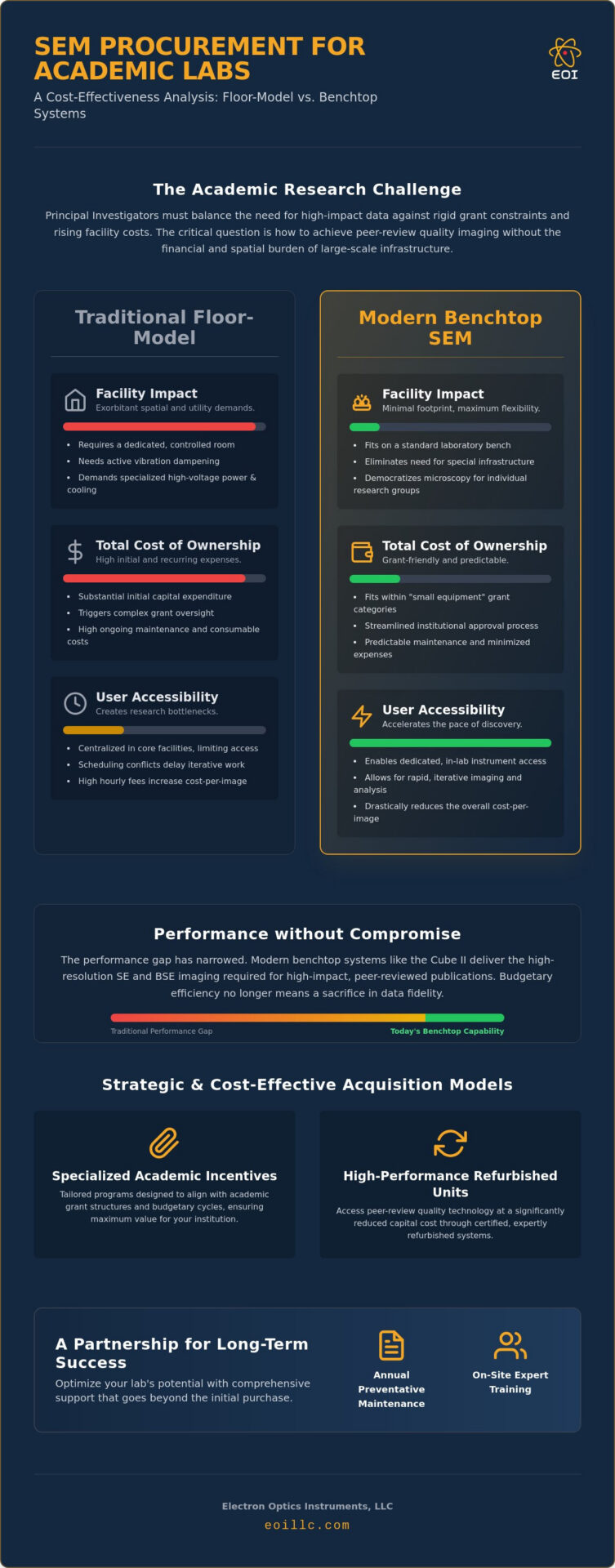
Defining cost-effectiveness in 2026 requires a rigorous departure from simplistic capital expenditure analysis. For the modern principal investigator, cost-effective sem for academic research represents a strategic equilibrium between the initial procurement price and the sustained analytical throughput of the laboratory over its operational lifespan. Traditional floor-model systems frequently evolve into institutional cost traps because their perceived performance advantages are often eclipsed by the exorbitant expenses associated with specialized infrastructure and high-voltage power requirements. A true Scanning electron microscope (SEM) solution for an academic setting must prioritize three critical pillars: hardware accessibility, minimal facility requirements, and predictable maintenance schedules. Achieving publication-ready resolution remains the non-negotiable baseline; any instrument failing to meet the standards of high-impact journals serves no practical purpose in a research-intensive environment.
The Shift from Floor Models to Benchtop SEMs
The transition toward benchtop architectures, exemplified by the Cube II Benchtop SEM, reflects a broader shift in institutional strategy. Floor-standing units necessitate rigorous environment controls, including active vibration dampening and dedicated cooling systems, which can easily double the effective cost of installation. Benchtop models eliminate these barriers, facilitating the democratization of microscopy by allowing individual research groups to operate dedicated units. This localized access drastically reduces the cost-per-image for graduate students. They no longer face the scheduling bottlenecks and hourly fees characteristic of centralized core facilities. The ability to perform rapid, iterative imaging within the lab’s own footprint accelerates the pace of discovery while maintaining a high standard of technical precision.
Grant Compliance and Budgetary Constraints
Grant compliance often dictates the strict parameters of instrumentation procurement. Many NSF and NIH funding streams feature specific thresholds for capital equipment, where instruments exceeding certain price points trigger more complex administrative oversight and rigorous competitive bidding. Benchtop systems often fall within the more accessible “small equipment” or “mid-range” categories, streamlining the institutional approval process and allowing for faster deployment. Incorporating specialized hardware like the Genesis Tabletop SEM into a proposal demonstrates a commitment to technical precision and logistical efficiency. This approach ultimately strengthens the competitive standing of the grant application by showing a clear path toward high-resolution data acquisition within a responsible budgetary framework. Choosing an instrument that fits within these established grant categories ensures that funds are utilized for maximum scientific impact rather than being consumed by administrative overhead.
Evaluating Benchtop SEM Performance for Peer-Reviewed Publications
The assumption that budgetary efficiency necessitates a compromise in data fidelity is an obsolete paradigm. In 2026, the performance gap between compact architectures and traditional floor models has narrowed significantly; contemporary cost-effective sem for academic research now utilizes advanced electron optics that deliver the precision required for high-impact journals. The Cube II Benchtop SEM, for instance, provides the necessary resolution for secondary electron (SE) imaging of delicate surface topographies and backscattered electron (BSE) imaging for compositional contrast. These capabilities ensure that researchers can produce micrographs that meet the rigorous aesthetic and technical requirements of peer-reviewed analysis without the overhead of a dedicated microscopy suite.
Acquiring high-quality data requires a deep understanding of how signal detection and acceleration voltage interact within a compact vacuum chamber. A foundational grasp of Scanning Electron Microscopy (SEM) principles is essential for interpreting how these tabletop systems manage to achieve nanometer-scale resolution. Research teams seeking to validate these performance metrics should examine the technical data sheets of the Cube II series to confirm alignment with their specific imaging protocols and publication goals.
Resolution and Magnification Thresholds
Modern benchtop systems have redefined the nanometer resolution baseline for diverse academic fields. Whether the research involves the characterization of metallic alloys or the examination of biological scaffolds, the integration of high-brightness filaments ensures a stable electron beam that rivals older field-emission models. Digital imaging software plays a critical role here. It optimizes signal-to-noise ratios and provides sophisticated post-processing tools that enhance data clarity for publication. This technical synergy allows for clear visualization of features that were previously the sole domain of centralized core facilities.
Analytical Capabilities: EDS and Beyond
Integrated Energy Dispersive Spectroscopy (EDS) has transitioned from an optional luxury to a non-negotiable requirement for material characterization papers. The Genesis Tabletop SEM exemplifies this integration by offering high-speed elemental mapping and quantitative analysis within a single software interface. These automated features significantly reduce the time-to-data for busy research teams, facilitating rapid iteration during the experimental phase. By consolidating topographical imaging and elemental analysis into one workflow, laboratories can streamline their publication pipeline and maximize the utility of their cost-effective sem for academic research.
PI Procurement Checklist for Journal Standards
- Verified nanometer-scale resolution at both high and low acceleration voltages.
- Presence of a multi-segment BSE detector for enhanced compositional mapping.
- Integrated EDS hardware with low dead-time for accurate elemental quantification.
- Software capabilities for exporting high-bit-depth TIF or RAW files to maintain image integrity.
- Compatibility with charge-reduction modes for imaging non-conductive samples without heavy metal coating.
Maximizing Budgets: Academic Discounts and Refurbished SEM Options
Maximizing the utility of research funds requires a sophisticated understanding of the procurement mechanisms available to university departments. Securing cost-effective sem for academic research often hinges on a laboratory’s ability to navigate specialized educational pricing structures that go beyond simple rebates. These programs are frequently structured as long-term technical partnerships, where distributors provide tiered incentives to foster institutional growth and graduate student development. By aligning procurement with university fiscal cycles and departmental initiatives, principal investigators can often unlock deeper value that isn’t immediately apparent in a standard quote.
Navigating Academic Discount Programs
Educational pricing is a foundational element of the academic hardware market. Specialized distributors often provide significant price adjustments for accredited institutions, recognizing that these placements serve as training grounds for the next generation of industry professionals. It’s often beneficial to time these acquisitions relative to the university fiscal year-end, when departments may have residual capital that must be allocated. Additionally, leveraging multi-unit purchases for departmental core facilities can create collective bargaining power, resulting in more favorable terms for both the hardware and the associated service agreements. Engaging early with a distributor to discuss these “educational tiers” ensures that the final configuration meets both technical and budgetary requirements.
The Value Proposition of Refurbished SEMs
For undergraduate teaching laboratories or early-career researchers operating on start-up grants, Refurbished SEM Units represent a highly strategic alternative to new hardware. These systems provide a bridge for labs that require high-resolution imaging but operate within restrictive budgetary tiers. The industry standard suggests that refurbished equipment can offer savings of 30% to 70% compared to new models, provided the units undergo a rigorous certification process. Electron Optics Instruments ensures the reliability of these systems through a methodical reconstruction of the electron column and a complete diagnostic overhaul of the vacuum and electronic systems. This meticulous approach, backed by over 30 years of industry expertise, ensures that a pre-owned instrument maintains the operational stability required for peer-reviewed research.
The choice between a new benchtop unit and a refurbished floor model often depends on the specific analytical goals of the lab. While new benchtop systems like the Cube II offer the latest in automated software and compact design, a refurbished floor model may provide larger chamber volumes for specialized metallurgical or geological samples. Regardless of the path chosen, verifying the vendor’s service history is paramount. A cost-effective sem for academic research is only truly economical if it is supported by a robust warranty and a proven track record of technical excellence. Ensuring that the vendor provides the same level of on-site training and preventative maintenance for refurbished units as they do for new installations is a critical step in de-risking the procurement process.
Total Cost of Ownership: Maintenance, Training, and Consumables
Evaluating the financial viability of an electron optics system requires a lifecycle perspective that extends far beyond the initial purchase order. For an institution to maintain a truly cost-effective sem for academic research, the procurement team must account for the logistical realities of high-vacuum maintenance and the recurring costs of SEM Filaments and Consumables. Academic departments often find that the most significant hidden expense isn’t the hardware itself, but the cumulative cost of unplanned downtime and the gradual degradation of analytical precision. A service-first philosophy, anchored by localized US technical support, is indispensable for ensuring that a laboratory’s research output remains consistent and competitive throughout the life of the instrument.
Preventative Maintenance and Service Contracts
The distinction between reactive repairs and structured Preventative Maintenance Visits is fundamental to institutional fiscal health. While a pay-as-you-go approach might seem attractive for labs with fluctuating budgets, it often leads to catastrophic vacuum system failures that far exceed the cost of an annual agreement. Implementing a rigorous SEM maintenance protocol ensures that the instrument operates at peak performance, preserving the integrity of the data required for high-impact publications. Priority support within a tiered service agreement provides a critical safety net for researchers facing rigid grant deadlines or conference submissions. This proactive strategy transforms maintenance from an unpredictable burden into a manageable, fixed operational cost.
Training the Next Generation of Researchers
The longevity of sophisticated instrumentation is inextricably linked to the proficiency of its operators. Professional on-site technical training for graduate students acts as a high-yield investment in the lab’s infrastructure. When researchers receive formal instruction in advanced sample preparation and electron beam management, the incidence of hardware damage and consumable waste decreases significantly. Establishing a super-user within the department creates an internal knowledge base that facilitates rapid troubleshooting and peer-to-peer mentorship. This level of institutional expertise maximizes the ROI of the equipment and ensures that the laboratory remains a hub of technical excellence. It’s a strategic move that protects the hardware while accelerating the development of student researchers.
Securing a reliable partner who understands the unique demands of the university environment is the final step in de-risking your procurement. To ensure your facility maintains its technical edge with predictable annual costs, request a consultation regarding our academic service contracts and training modules.
Conclusion: Selecting the Right SEM Partner for Your Lab
The procurement of a cost-effective sem for academic research in 2026 requires a transition from viewing hardware as a standalone purchase to evaluating it as a long-term technical partnership. Benchtop innovations, specifically the Cube II and Genesis series, have demonstrated that high-resolution imaging and elemental analysis are achievable within the spatial and financial constraints of modern university departments. These systems represent the leading choices for labs that prioritize analytical throughput without the institutional burden of floor-model infrastructure. By selecting an instrument that aligns with both peer-review standards and grant-specific budgetary tiers, principal investigators can ensure their facilities remain at the forefront of scientific discovery.
Why Electron Optics Instruments for Academia?
Success in microscopy depends as much on the expertise of the distributor as it does on the technical specifications of the electron column. With a 30-year track record in US-based electron microscopy service and sales, Electron Optics Instruments provides the stability that academic institutions require for multi-year research projects. We understand that the synergy between high-end hardware and comprehensive technical support is what prevents research bottlenecks. For those in the preliminary stages of budget planning, referring to our 2026 SEM price guide provides the detailed financial mapping necessary for administrative approval and grant writing.
Next Steps for Your Grant Application
Submitting a competitive grant application requires precise technical documentation and formal quotes that reflect the realities of your research goals. Whether your lab requires integrated EDS for elemental mapping or specialized detectors for low-vacuum imaging, customization options are available to tailor the instrument to your specific workflow. We facilitate the procurement process by providing detailed specifications that strengthen the “Broader Impacts” and “Facilities, Equipment, and Other Resources” sections of your proposal. Early consultation with our technical specialists ensures that your configuration is optimized for the data you intend to publish.
Finalizing your selection involves a rigorous verification of institutional needs against hardware capabilities. Use this checklist to guide your final decision:
- Confirm the instrument meets the resolution requirements for your specific sub-discipline.
- Verify the availability of academic discounts or tiered institutional pricing.
- Assess the proximity and responsiveness of US-based technical support.
- Evaluate the total cost of ownership, including consumables and annual maintenance.
- Ensure the software interface is accessible for graduate student training.
Our team is prepared to assist you in securing the instrumentation necessary to advance your department’s analytical capabilities. Contact us today for an academic SEM quote tailored to your research budget.
Advancing Institutional Research Through Strategic Microscopy Procurement
Transitioning from high-overhead floor models to agile, high-performance benchtop systems represents a significant evolution in institutional strategy. By prioritizing instruments that balance nanometer-scale resolution with manageable facility requirements, departments achieve superior analytical throughput. This approach ensures that sophisticated material characterization remains accessible to both seasoned investigators and graduate students. Precision matters in every micrograph, whether it is used for peer-reviewed research or for high-impact departmental displays; to see how custom graphics can enhance your facility, visit Coker Exhibition Systems Ltd (CokerExpo).
Securing cost-effective sem for academic research is not merely about the initial purchase. It’s about cultivating a technical ecosystem supported by expert service and comprehensive training. As the sole US distributor for EmCraft and a partner with over 30 years of SEM expertise, we provide the specialized knowledge and logistical excellence required to maintain the operational stability of advanced hardware in a high-demand academic environment. Our comprehensive service contracts ensure that your facility remains operational during critical research cycles. We look forward to accelerating the transformation of your laboratory’s analytical capabilities through reliable technical support.
Request an Academic SEM Quote for Your 2026 Grant Application
Frequently Asked Questions
Is there a specific academic discount for SEM purchases in 2026?
Specialized academic discount programs remain a standard procurement mechanism for accredited universities and research institutes. These incentives are often structured as tiered pricing models that account for the educational impact of the placement. Principal investigators should coordinate with their distributors to align these cost-effective sem for academic research acquisitions with university fiscal year-end cycles to maximize institutional value.
Can a benchtop SEM provide high enough resolution for peer-reviewed material science journals?
Modern benchtop architectures, such as the Cube II series, deliver nanometer-scale resolution that meets the rigorous standards of high-impact peer-reviewed publications. Technical advancements in electron optics and high-brightness filaments allow these systems to produce the secondary electron (SE) and backscattered electron (BSE) imagery required for sophisticated material characterization. The data fidelity provided by these instruments is now comparable to many traditional floor-model systems.
How much should a university lab budget for annual SEM maintenance?
Annual maintenance budgets typically range between 5% and 15% of the instrument’s initial capital cost, depending on the complexity of the configuration. This allocation should cover Preventative Maintenance Visits and the replacement of SEM Filaments and Consumables. Securing a multi-tiered service contract is the most reliable method for ensuring predictable annual expenditures while minimizing the risk of unplanned research downtime.
Are refurbished SEM units reliable for long-term academic research?
Refurbished SEM units provide exceptional long-term reliability when they undergo a certified reconstruction process by experienced technicians. High-quality used systems are completely overhauled, involving a meticulous cleaning of the electron column and a modernization of the electronics and vacuum systems. These units represent a highly strategic option for laboratories operating on start-up grants or those focused on undergraduate training.
What are the facility requirements for installing a cost-effective benchtop SEM?
One of the primary advantages of a cost-effective sem for academic research is the minimal infrastructure required for installation. Unlike floor models that necessitate active vibration dampening and specialized cooling, benchtop units generally require only a standard laboratory bench and a conventional wall outlet. This flexibility allows researchers to integrate high-resolution imaging directly into their existing laboratory footprint without expensive renovations; furthermore, this adaptability makes it easier to implement smart environment controls, with resources like senic.com providing guidance on modernizing workspace lighting and switch systems.
Does a cost-effective SEM include EDS for chemical analysis?
Integrated Energy Dispersive Spectroscopy (EDS) is frequently included in cost-effective configurations to facilitate comprehensive elemental mapping and quantitative analysis. Systems like the Genesis Tabletop SEM are specifically engineered to accommodate EDS detectors, allowing researchers to perform topographical imaging and chemical characterization within a single, streamlined workflow. This integration is essential for modern material science and geological research applications.
How long does on-site SEM training take for a research team?
Professional on-site technical training typically requires two to three days of intensive instruction. This period covers the fundamental principles of electron beam management, software proficiency, and advanced sample preparation techniques. Establishing this baseline expertise within the research team is critical for protecting the hardware from operator error and ensuring the consistent quality of the analytical data produced by the lab.
Can I use grant funding to purchase a refurbished electron microscope?
Major federal and private funding agencies, including the NSF and NIH, generally permit the use of grant funds for the procurement of refurbished instrumentation. In many cases, selecting a certified refurbished unit is viewed as a fiscally responsible strategy that allows a laboratory to allocate more of its budget toward other research activities. It’s important to ensure the vendor provides a comprehensive warranty to satisfy institutional compliance requirements.