
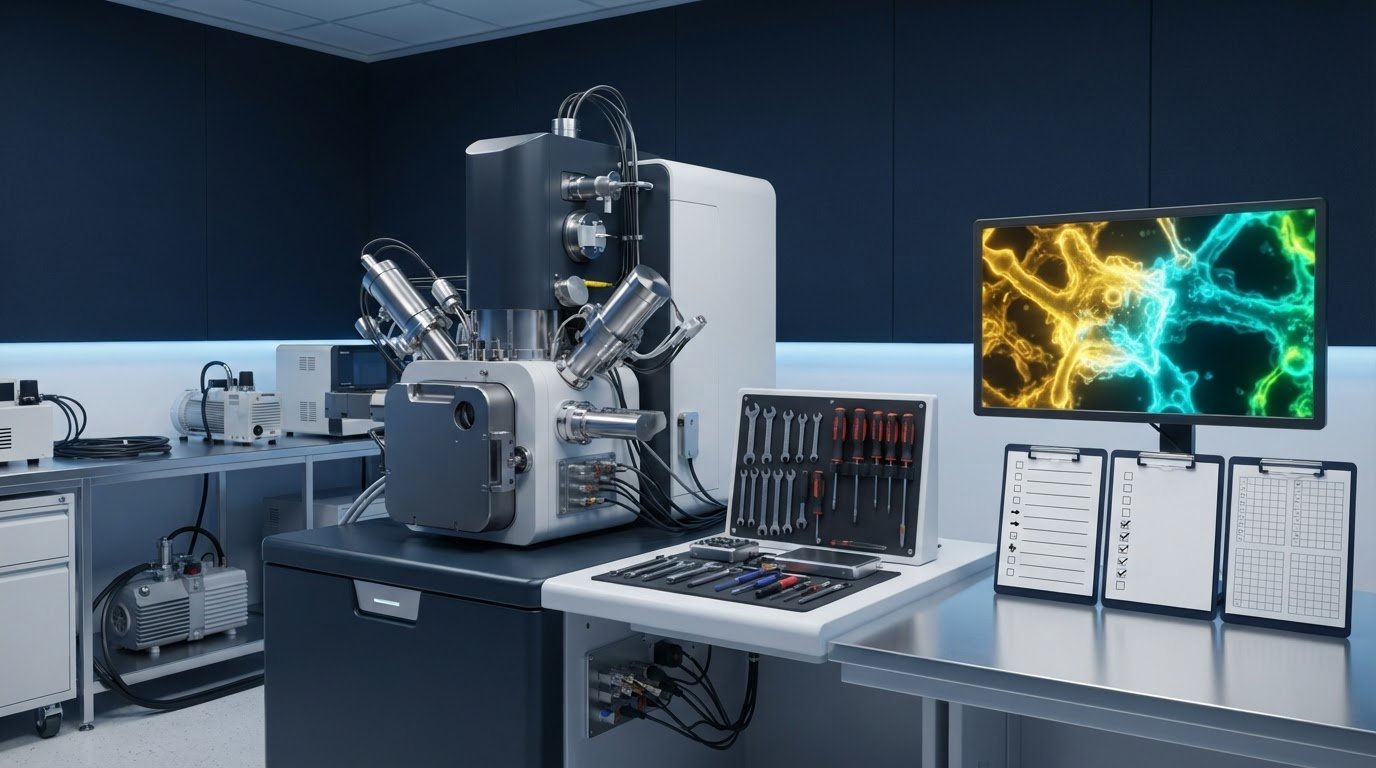
What if an SEM service contract with a broad-sounding tier still leaves your laboratory exposed to the downtime that matters most? Evaluating sem service contracts means looking beyond tier names to the specific risks each agreement addresses, from scheduled maintenance and support terms to parts coverage and repair exclusions.
Comparing proposals can be difficult when providers describe coverage differently. A low headline price or premium label alone won’t show how well a contract fits your instrument’s workload. To make a useful comparison, identify the maintenance and support your lab needs, then check where each agreement states, limits, or excludes that coverage.
This practical checklist will help you assess agreements against consistent criteria, identify potential gaps, and prepare focused questions before signing. You’ll review maintenance scope, support access, parts and labor terms, exclusions, documentation, and the process for out-of-scope repairs. The goal is to understand how each agreement supports instrument performance and laboratory continuity, then compare options against your actual operating needs.
Key Takeaways
- Assess contract value against your SEM’s role, workload, sample schedule, and the maintenance expertise available in your lab.
- When evaluating sem service contracts, compare written scope, scheduled maintenance, support access, parts coverage, exclusions, and documentation.
- Use a consistent comparison table to assess proposals against the same instrument needs and coverage categories.
- Before signing, define operational priorities, review the written scope, resolve gaps, and record agreed terms alongside key instrument details.
- Consider how a maintenance agreement fits with preventative maintenance and repair planning, including scheduled inspections and support needs.
Why Evaluate an SEM Service Contract Around Your Lab’s Downtime Risks?
A service agreement sets out a defined maintenance and support framework. Without one, a laboratory may arrange repairs only after a problem interrupts operation. That approach can suit an instrument with limited use and low operational impact. It can create greater exposure when SEM access is essential to scheduled analyses, production decisions, or time-sensitive research.
An SEM service contract is a written agreement that defines the maintenance activities and support terms available for a specific instrument. Its practical value depends on what the document commits to, not the name assigned to a service tier. A service-level agreement (SLA) is a useful framework for understanding how service expectations may be documented, including the difference between stated commitments and informal assumptions.
Instrument criticality, utilization frequency, sample schedules, and in-house technical expertise all affect the risks a contract should address. A heavily used SEM with limited backup capacity may need different support priorities from an instrument used periodically by a team with substantial troubleshooting experience. For labs evaluating sem service contracts, the key question is how well the written scope matches the consequences of interruption.
What operational risks can an SEM service contract address?
Scheduled inspections and maintenance can help identify developing issues before they disrupt planned work, although they can’t eliminate unexpected faults. A delay might postpone a materials analysis, extend a sample queue, or put an internal project milestone at risk. Planned maintenance is distinct from troubleshooting and repair support. A contract may describe these separately, so read the scope rather than assuming an inspection includes corrective work.
Review the relevant service-level agreement (SLA) concepts when assessing how response expectations and other service commitments are recorded. The contract itself should make clear which commitments apply.
When might a service agreement fit your laboratory?
Consider how often the SEM runs, whether other instruments can absorb its workload, how quickly samples must be analyzed, and whether staff can handle routine maintenance or initial troubleshooting. If an interruption would leave a critical process without an alternative, planned inspections and defined support terms may have greater operational value. If use is occasional and delays are manageable, the lab may prioritize a narrower maintenance plan.
A service agreement can make maintenance planning more predictable, while repairs arranged only after a fault arise according to uncertain needs. Electron Optics Instruments offers multi-tiered SEM maintenance agreements that include scheduled inspections, priority support, and parts coverage. Compare the written terms with your instrument’s workload and the impact of downtime rather than relying on a tier label alone.
Which SEM Service Contract Terms Should Your Evaluation Checklist Cover?
A useful checklist turns broad service-tier descriptions into specific provisions you can compare. Record what the agreement says about coverage, maintenance scheduling, support access, parts, exclusions, and documentation. Keep written commitments separate from verbal explanations or assumptions. If a detail could affect instrument availability or repair exposure, make sure it is clear in the contract before comparing proposals.
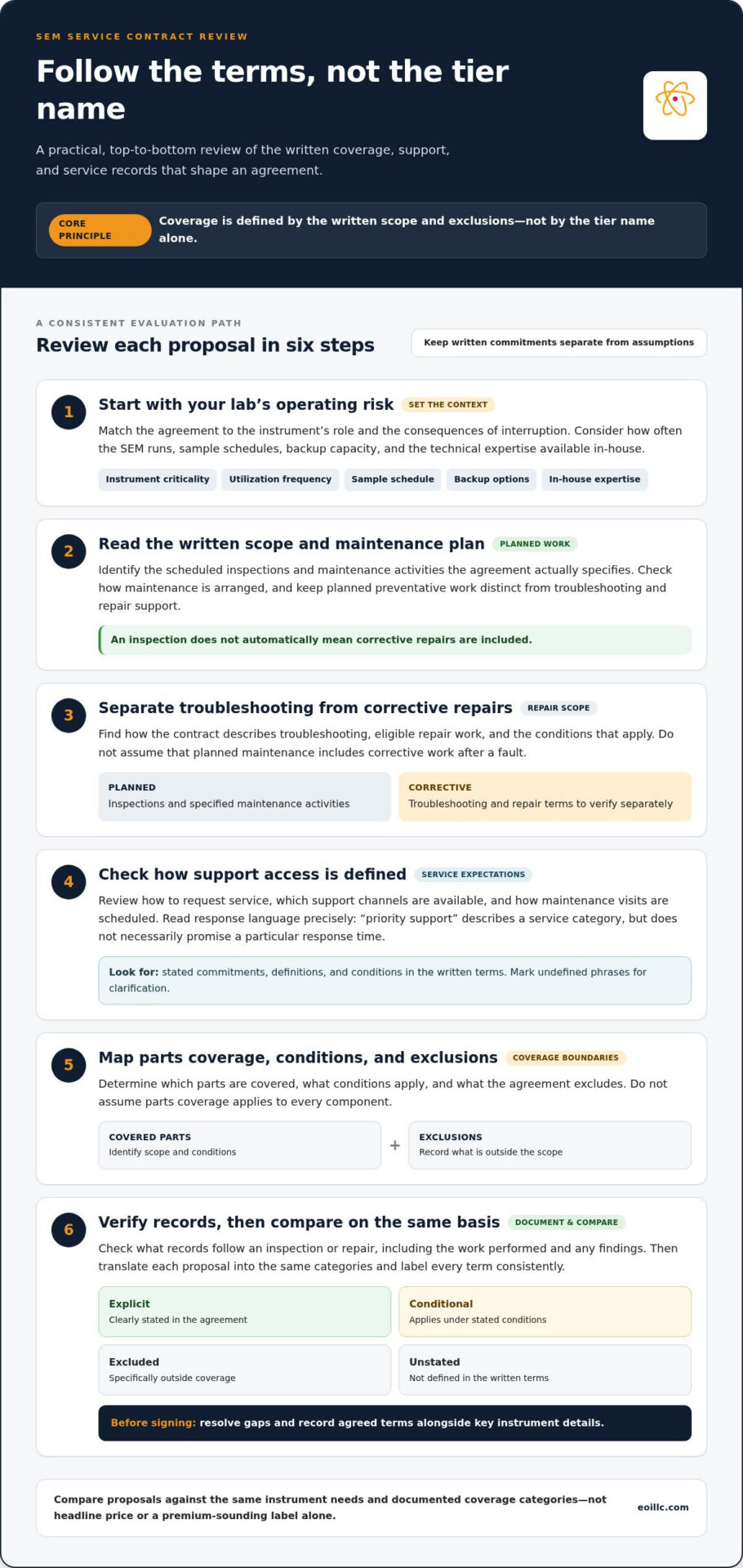
Coverage is defined by the agreement’s written scope and exclusions, not by the tier name alone. This distinction is central to evaluating sem service contracts: a label such as “priority” or “comprehensive” doesn’t, by itself, establish what work or components are included. A consistent review helps you evaluate competitive proposals against documented criteria rather than descriptions that may mean different things across agreements.
How should you assess maintenance, repairs, and parts coverage?
Start with the preventative work. Check whether scheduled inspections are specified, how maintenance is arranged, and which activities the agreement identifies. Then distinguish that planned work from troubleshooting and corrective repairs. Determine how the contract describes eligible repair work, covered parts, parts conditions, and exclusions. Don’t assume parts coverage applies to every component or that an inspection automatically includes repairs.
Read support language precisely. Priority support describes a service category, but it doesn’t necessarily promise a particular response time. If a proposal refers to a response target, covered repair, or another commitment, look for its definition and conditions in the written terms. Note any undefined phrases as points to resolve before selection.
What support and documentation details matter?
Review how the agreement explains requesting service, available support channels, and scheduling maintenance visits. Check what records are provided after an inspection or repair, and whether they identify the work performed and any findings. Clear records can help laboratory teams maintain continuity across staff changes and understand the instrument’s service history.
Before comparing tiers, translate each description into the same categories. Note whether a term is explicit, conditional, excluded, or unstated. This makes gaps visible and separates confirmed provisions from expectations that need clarification.
- Scope: What maintenance and service activities are described?
- Schedule: How are inspections and visits defined and arranged?
- Support: What access and response language is actually stated?
- Parts and exclusions: Which conditions shape coverage?
- Documentation: What service records are provided?
For laboratories assessing maintenance and repair needs across major SEM manufacturers, Electron Optics Instruments provides service support and multi-tiered maintenance agreements. Apply the same written-terms framework to determine how each agreement fits your operational requirements.
How Can You Compare SEM Service Contract Proposals Consistently?
Build a side-by-side comparison using the same categories for every proposal. Before filling it in, make sure each proposal addresses the same SEM, operating context, and maintenance priorities. Otherwise, one proposal may appear broader simply because it describes its scope in more detail, while another leaves key terms unstated.
Use a blank matrix like this, and enter only what each agreement states in writing:
- Scope: Proposal A: ____ | Proposal B: ____
- Scheduled visits: Proposal A: ____ | Proposal B: ____
- Support access and response terms: Proposal A: ____ | Proposal B: ____
- Parts coverage and conditions: Proposal A: ____ | Proposal B: ____
- Exclusions: Proposal A: ____ | Proposal B: ____
- Service records and documentation: Proposal A: ____ | Proposal B: ____
Use a consistent status for each entry, such as “stated,” “excluded,” or “needs clarification.” Missing information is not the same as an explicit exclusion: the former identifies an unanswered question, while the latter defines a limit in the proposed coverage. Keeping these separate makes follow-up precise and prevents assumptions from becoming part of your evaluation.
How do service tiers differ in practical terms?
Compare provisions, not tier labels or marketing language. One lab may place greater value on scheduled inspections, while another may focus on parts conditions or support access. Record the exact agreement language for each priority, and don’t treat a feature as included unless the proposal says so. This makes tier comparisons meaningful without assuming services or parts are included.
How should you weigh coverage against operational fit?
Assess each proposal against the instrument’s role, utilization, and the consequences of interrupted work. Consider whether internal staff can handle routine maintenance, what preventative practices are already in place, and where outside expertise would address a genuine gap. The broadest apparent coverage isn’t automatically the best fit if it emphasizes provisions your lab doesn’t need while leaving a critical requirement unclear.
As you’re evaluating sem service contracts, use the matrix to identify meaningful differences and areas that need more detail. Then compare how each documented provision supports the lab’s operational priorities. This shifts the decision from choosing the most impressive tier name to selecting terms that fit instrument use and maintenance requirements.
What Should You Clarify and Negotiate Before Signing an SEM Contract?
Use a defined review sequence before committing to an agreement. Start with the instrument’s operating context, then resolve unclear provisions while there’s still time to compare the proposed terms with your laboratory’s priorities. As you’re evaluating sem service contracts, focus negotiation on operational requirements and written commitments, not just a preferred tier label.
- Define priorities. Record the SEM’s manufacturer, model, usage pattern, role in laboratory workflows, and the consequences of an interruption. Note existing preventative maintenance practices and the support your internal team can provide.
- Review the scope. Identify how the agreement describes scheduled inspections, preventative maintenance, troubleshooting, repairs, support access, parts, and documentation.
- Clarify gaps. Flag vague wording, unstated conditions, and exclusions that could affect maintenance or repair needs. Request precise written explanations for ambiguous provisions.
- Document agreed terms. Ensure negotiated clarifications are reflected in the final agreement, then have the appropriate procurement or legal team review the complete terms.
This sequence gives your team a record of why particular provisions matter, whether the SEM supports routine analysis or time-sensitive work.
Which questions reveal unclear contract language?
Ask how scheduled inspections and preventative maintenance are defined, and how visits are arranged. Clarify which parts or repairs are addressed, what exclusions or conditions apply, and how support is requested. If a proposal uses broad terms such as “covered” or “priority,” request a written explanation of what those terms mean in the agreement. Don’t treat an informal explanation as a substitute for the contract language.
How can your lab prepare a negotiation checklist?
Rank requirements by operational importance. Planned maintenance, parts coverage, support access, and service records may not carry equal weight for every lab. Separate essential requirements from preferences so discussions stay focused on the provisions that address your most consequential risks. For broader context on maintenance planning, refer to this SEM maintenance guide.
- Essential: Terms the lab needs to support core workflows or manage significant downtime exposure.
- Preferred: Provisions that would improve planning or convenience but aren’t critical to operations.
- Unresolved: Scope, exclusions, parts conditions, or documentation that need written clarification.
Use this preparation to discuss your instrument and maintenance requirements with Electron Optics Instruments’ SEM service team. A clearly documented agreement helps align support expectations with the laboratory’s operating needs.
How Can SEM Service Support Align With Your Long-Term Maintenance Plan?
A service agreement works best as one component of a broader maintenance and repair plan, not as a substitute for laboratory oversight. Align scheduled service with instrument usage, internal maintenance practices, and the work the SEM supports. This gives your team a framework for planning maintenance while preserving a clear distinction between routine inspections and repairs that may fall outside the agreement’s written scope.
Electron Optics Instruments provides multi-tiered SEM maintenance agreements that include scheduled inspections, priority support, and parts coverage. Align the selected scope with your laboratory’s maintenance priorities rather than assuming all tiers cover the same work or components. Electron Optics Instruments also supports electron microscopes from major manufacturers and brings more than 30 years of industry experience to SEM service and maintenance.
What should ongoing SEM service support help your team manage?
Scheduled inspections can help your team build maintenance activities into a deliberate calendar instead of treating every service need as an unplanned interruption. Maintain a consistent service record that captures inspection dates, work performed, reported observations, and follow-up actions. These records help the lab track instrument condition over time and provide useful context when discussing future maintenance or repair needs. They don’t, by themselves, guarantee uptime or a particular service outcome.
For a wider view of planning and care, consult the SEM service and maintenance guide and the SEM operation guide. Together, these resources can help connect day-to-day instrument use with longer-term maintenance considerations.
How can your team move from evaluation to a service discussion?
Bring the practical context behind your decision: the instrument’s make and model, how frequently it’s used, the work it supports, existing maintenance practices, and your highest-priority support needs. Summarize questions about coverage, scheduled visits, parts, and support access so the discussion can focus on the terms that matter to your lab.
Use that information to discuss your laboratory’s requirements with Electron Optics Instruments and explore a suitable service-contract approach. A well-aligned plan connects documented agreement terms with the realities of instrument operation, maintenance planning, and repair needs. This is the final step in evaluating sem service contracts: turning a structured comparison into support that fits your laboratory’s operational priorities.
Build a Service Plan That Supports Your SEM’s Role
A well-matched SEM service agreement is defined by how its written scope addresses your laboratory’s maintenance priorities, support needs, and exposure to downtime, not by its tier name alone. Use consistent criteria to compare proposals, distinguish exclusions from unanswered questions, and document essential terms before signing.
Electron Optics Instruments brings more than 30 years of industry experience and supports electron microscopes from major manufacturers. Its multi-tiered agreements include scheduled inspections, priority support, and parts coverage, with specific terms defined by the agreement. Consider how those provisions can fit into your broader preventative maintenance and repair plan.
With a clear picture of your instrument, operating context, and support priorities, evaluating sem service contracts becomes a more structured decision. Discuss your SEM service contract needs with Electron Optics Instruments and explore an approach aligned with your laboratory’s requirements. A deliberate review can help your team move forward with greater clarity and confidence.
Frequently Asked Questions
What should an SEM service contract include?
An SEM service contract should clearly define its maintenance scope, scheduled inspections, support access, parts provisions, exclusions, and service documentation. It should distinguish routine preventative work from troubleshooting and repairs, and explain how visits are scheduled and support is requested. Coverage depends on the agreement’s written terms, so don’t infer included work from a tier name. Review conditions carefully, particularly where parts or repairs may be subject to limits.
How do I evaluate an SEM service contract?
Evaluate an SEM service contract by comparing its written provisions with your instrument’s operating demands and the consequences of downtime. Record what the agreement says about scheduled maintenance, support, parts, repairs, exclusions, and documentation. Separate explicit coverage from unanswered questions, and request written clarification for ambiguous terms before deciding. Evaluating sem service contracts against the same criteria makes it easier to identify meaningful differences between proposals.
Are SEM service contracts worth it for a laboratory?
An SEM service contract may be valuable when the instrument is heavily used, supports time-sensitive work, or has limited backup capacity. Scheduled inspections can help the lab plan maintenance, while defined support and parts provisions can clarify how service needs are handled. A lower-use instrument with flexible schedules and strong in-house technical capacity may have different priorities. Assess the contract against your operating context rather than assuming one service level suits every laboratory.
What is usually excluded from an SEM service contract?
Exclusions vary by agreement, so there isn’t a universal list of items that are “usually” outside coverage. Review the written terms for limits on parts, repairs, service activities, or conditions that affect eligibility. Check whether the agreement distinguishes scheduled maintenance from corrective repair work, and note any component-specific conditions. Treat an unstated provision as a gap to clarify, not as evidence that the work is covered or excluded.
Can an independent service provider maintain SEMs from different manufacturers?
Yes. Service support can cover electron microscopes from multiple major manufacturers. Electron Optics Instruments provides service support for SEMs from major manufacturers, including repair and maintenance support. For any agreement, compare its documented scope with the specific instrument make and model, then review how scheduled work, support access, and parts provisions apply. This helps ensure the proposal reflects your equipment and laboratory requirements rather than relying on a general description.
How should I compare SEM service contract proposals?
Compare proposals in a side-by-side table using consistent categories: scope, scheduled visits, support access, parts, exclusions, and documentation. Match each proposal to the same instrument and operational needs. Mark each provision as stated, excluded, or requiring clarification. A missing detail is not the same as an explicit exclusion, and tier labels alone don’t establish equivalent coverage. This method helps your team focus on documented differences and resolve gaps systematically.
Does an SEM service contract guarantee that the microscope will not experience downtime?
No. A service contract can define maintenance and support provisions, but it shouldn’t be treated as a guarantee that the SEM will never experience downtime. Scheduled inspections may help identify issues, yet unexpected faults can still occur. Review the agreement for any specific service commitments and their conditions, and plan for the operational impact of an interruption. Don’t assume that priority support means a guaranteed response time unless the written terms state one.
What information should I prepare before discussing an SEM service contract?
Prepare the SEM’s manufacturer and model, how frequently it’s used, the work it supports, existing maintenance practices, and the impact an interruption would have on laboratory operations. List your highest priorities, such as scheduled inspections, parts provisions, support access, or service documentation. Bring specific questions about scope, exclusions, and repair terms. This context helps make the discussion more focused and supports a service approach aligned with your instrument’s role.