
The cessation of original equipment manufacturer support does not necessitate the decommissioning of critical laboratory infrastructure; instead, it offers a strategic opportunity to optimize the intersection of innovation and reliability within your existing hardware fleet. You likely understand that the escalating costs of proprietary replacement parts and the persistent threat of unpredictable downtime can compromise the integrity of long-term research initiatives. Maintaining the meticulousness required for high-resolution imaging demands a shift from reactive repair to a visionary lifecycle management strategy focused on extending the life of your sem beyond traditional expectations.
This article provides the technical blueprints and strategic protocols essential for maximizing instrument longevity by an additional five to ten years. By implementing precise environmental stabilization and targeted digital retrofitting, you can ensure your legacy instruments consistently adhere to the rigorous ISO TS 21383 standards for quantitative measurements. We will analyze the methodologies for securing reliable third-party service contracts and upgrading core components, such as EDS systems and vacuum assemblies, to sustain superior analytical accuracy. This preview of decadal maintenance strategies ensures your facility remains at the forefront of industrial performance without the immediate necessity of large-scale capital expenditure.
Key Takeaways
- Differentiate between manufacturer-driven end-of-support and actual technical obsolescence to identify high-value opportunities for continued instrument deployment.
- Execute rigorous vacuum system hygiene and electromagnetic interference (EMI) mitigation strategies to protect the long-term alignment and precision of your electron optics.
- Develop a multi-tiered maintenance schedule that prioritizes proactive component management, a fundamental requirement for extending the life of your sem in high-throughput environments.
- Integrate modern image acquisition systems and high-speed EDS technology with legacy columns to achieve state-of-the-art analytical capabilities through digital retrofitting.
- Secure a sustainable operational lifecycle by partnering with specialized technical distributors who provide access to refurbished units and critical consumables.
The Lifecycle of a Scanning Electron Microscope: Defining the ‘End of Support’ Era
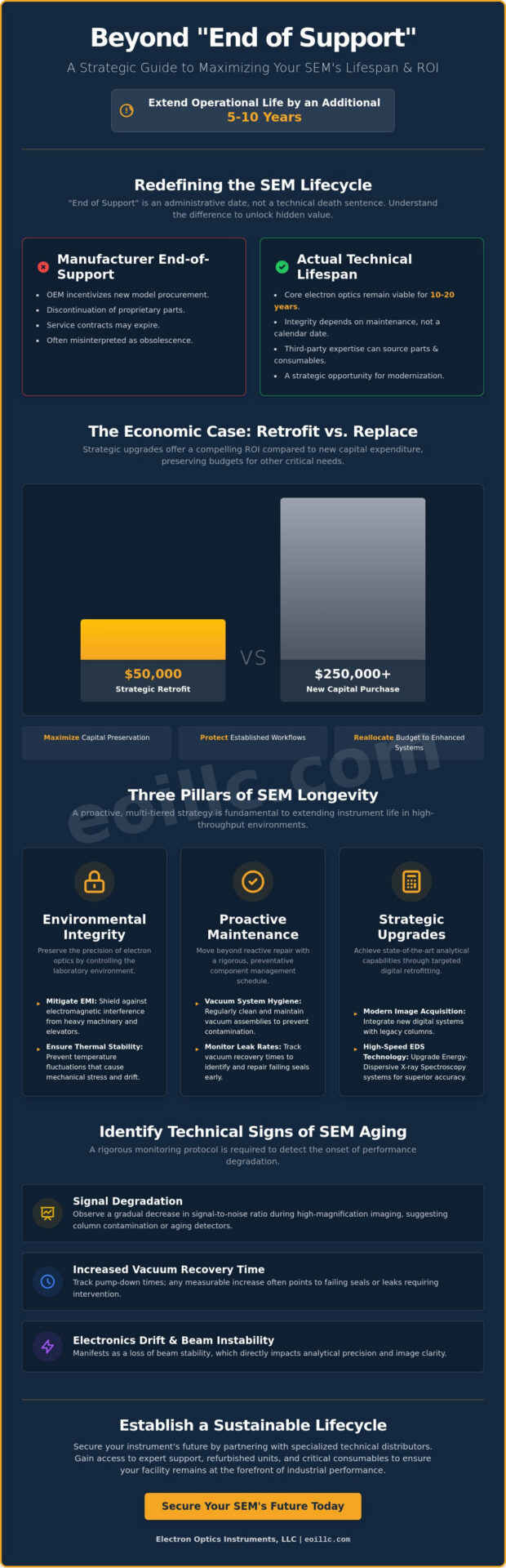
The receipt of an “End of Support” notification from an original equipment manufacturer (OEM) often triggers premature concern within laboratory management circles. This administrative designation is frequently misinterpreted as a declaration of technical obsolescence, yet the two concepts remain distinct within the operational lifecycle of a Scanning Electron Microscope (SEM). While an OEM may choose to discontinue proprietary parts or service contracts to incentivize the procurement of newer models, the core physical components often remain entirely viable. High-end electron optics typically possess an operational arc spanning 10 to 20 years, provided the underlying vacuum systems and column integrity are preserved through meticulous care. Optics don’t simply expire because a calendar date has passed; they require a shift in maintenance strategy rather than a total replacement.
Defining the true operational lifespan of an electron microscope reveals it is fundamentally a function of sustained component availability and the enduring integrity of its vacuum environment. When OEM support reaches its conclusion, third-party technical expertise becomes the primary mechanism for extending the life of your sem, offering specialized pathways for sourcing consumables and maintaining legacy hardware. These experts understand that a well-maintained column can continue to deliver high-resolution data long after the manufacturer has moved on to subsequent iterations. This transition to independent support creates a bridge between older, robust hardware and the latest digital processing capabilities, ensuring your instrument remains a productive asset in the modern laboratory.
Identifying the Technical Signs of SEM Aging
Detecting the onset of degradation requires a rigorous monitoring protocol focused on three primary indicators. First, researchers must observe the gradual decrease in signal-to-noise ratios during high-magnification imaging, which often suggests contamination within the column or aging of the detector electronics. Second, tracking vacuum recovery times is essential; any measurable increase in leak rates usually points to the failure of seals requiring intervention. Finally, electronics drift manifests as a loss of beam stability, directly impacting analytical precision. Precision isn’t optional for these systems.
The Economic Case for Life Extension
Strategic financial rationale for maintaining existing infrastructure is compelling when analyzed through the lens of corporate strategy. When you compare the ROI of a $50,000 retrofit against a $250,000 new capital purchase, the benefits of capital preservation become clear. Retaining a legacy system for routine screening eliminates the steep learning curve of new platforms while protecting established workflows. Extending the life of your sem through strategic upgrades allows for the reallocation of budget toward enhanced EDS systems, maximizing the utility of laboratory hardware.
Environmental Integrity and the Preservation of Electron Optics
Precision in scanning electron microscopy isn’t solely a product of internal engineering; it’s a reflection of the stability within the laboratory’s physical environment. High-end systems require a controlled atmosphere to prevent the gradual erosion of analytical accuracy. Electromagnetic interference (EMI) originating from nearby heavy machinery, elevators, or electrical infrastructure can induce subtle beam instabilities that, over time, degrade the precision of your imaging. Protecting the long-term integrity of the electron optical path necessitates the implementation of active or passive shielding to mitigate these external stressors. Thermal stability is equally paramount. Minute fluctuations in ambient temperature exert mechanical stress on sensitive filaments and apertures, leading to premature fatigue and electronics drift. Maintaining environmental integrity is not merely a logistical necessity but a strategic commitment to extending the life of your sem through the preservation of its most sensitive optical components.
Mechanical stability must also be addressed through the implementation of rigorous vibration isolation protocols. These measures preserve the mechanical stage precision, ensuring that sub-nanometer movements remain repeatable over decades of use. Whether utilizing passive damping pads or active pneumatic systems, the goal remains the same: isolating the column from the structural resonance of the building. Establishing these environmental safeguards is a critical component of a broader sem maintenance strategy that prioritizes long-term reliability over reactive repair. By stabilizing the external conditions, you reduce the operational burden on the internal vacuum and alignment systems, which is a foundational pillar for extending the life of your sem and ensuring its performance remains consistent with rigorous imaging standards.
Vacuum System Maintenance Rituals
Vacuum system hygiene serves as the primary defense against column contamination. Scheduled oil changes for mechanical pumps are mandatory; neglecting this ritual allows for the backstreaming of hydrocarbons into the high-vacuum chamber, where they can polymerize under the electron beam. Monitoring ion pump currents provides a visionary window into the health of the system, allowing operators to predict high-vacuum failure points before they manifest as critical downtime. This predictive meticulousness is essential for maintaining international capability. When venting the system, using dry nitrogen is a best practice that minimizes moisture ingress, which otherwise complicates the pump-down cycle and stresses the vacuum assembly through repeated thermal cycling.
Contamination Control in the SEM Column
Contamination control extends to the samples themselves, as the accumulation of carbonaceous deposits on apertures and pole pieces is often a direct result of inadequate sample preparation. These deposits create charging effects and astigmatism that compromise image resolution. The strategic deployment of plasma cleaners can effectively maintain the cleanliness of the electron optical path, removing organic residues without damaging sensitive components. It’s a process that ensures the synergy between ecological responsibility and industrial performance is maintained. Recognizing the visual artifacts of contamination, such as localized darkening or “scan squares” at high magnification, is critical for early intervention and the maintenance of superior imaging standards.
Preventative Maintenance: Moving Beyond Reactive Component Repair
Transitioning from a reactive repair model to a structured preventative framework is the most effective method for extending the life of your sem. A robust maintenance strategy isn’t merely a series of superficial checks; it’s a rigorous engineering ritual that ensures every subsystem operates within its precise design parameters. Central to this approach is the consistent application of sem maintenance protocols that address the underlying causes of hardware degradation before they manifest as critical failures. By establishing a multi-tiered schedule, laboratory managers can identify subtle performance drifts that often precede catastrophic vacuum failures or electronic breakdowns. Meticulousness in these early stages preserves the intersection of innovation and reliability.
Daily operational checks should focus on vacuum stability and basic column alignment, while monthly protocols involve monitoring pump oil quality and assessing aperture integrity. Annual maintenance, however, requires a high degree of technical authority to perform deep-system cleaning and comprehensive electronic recalibration. Calibrating the electron gun for optimal emission is a critical component of this process, as improper saturation levels significantly accelerate filament wear and compromise beam brightness. Laboratories implementing professional preventative maintenance contracts frequently observe a measurable increase in Mean Time Between Failures (MTBF), often exceeding 30 percent compared to reactive service models. This stability is essential for maintaining international capability in specialized research sectors.
Filament Management and Electron Source Optimization
The choice between Tungsten and Lanthanum Hexaboride (LaB6) sources dictates specific saturation requirements to maximize operational lifespan. For Tungsten filaments, avoiding over-saturation is the primary defense against rapid thinning and eventual breakage. Vacuum quality plays a decisive role in this equation, as even minor pressure increases accelerate the evaporation rate of the electron source through chemical etching. Implementing proactive filament replacement strategies based on recorded operational hours ensures that research remains uninterrupted by sudden source failure. Foresight remains a cornerstone of industrial reliability.
Mechanical and Electronic Calibration
Physical drift and aperture wear are inevitable consequences of high-throughput operation, requiring periodic column alignment to maintain sub-nanometer precision. This process involves more than just software adjustment; it requires verifying the linearity of scan generators and the responsiveness of secondary electron detectors. Simultaneously, the motorized stage must undergo routine lubrication and mechanical adjustment to preserve micron-level repeatability during automated imaging sequences. These technical integrations are fundamental to extending the life of your sem, ensuring the hardware continues to meet rigorous analytical standards long into its second decade of service.
Modernizing Legacy Systems through Strategic Hardware Upgrades
The preservation of industrial performance within the laboratory requires a visionary approach to hardware modernization, where the core electron optical assembly acts as a stable foundation for the integration of state-of-the-art digital components. Digital retrofitting represents a sophisticated technical integration that replaces legacy analog scan generators with high-speed, PC-based control interfaces, allowing for the capture of high-resolution datasets that meet 2026 imaging standards. This methodology is central to extending the life of your sem, as it addresses the primary cause of system failure: the obsolescence of proprietary electronic boards. By replacing degraded scintillators and photomultiplier tubes, you can recover the lost sensitivity that often plagues older systems, ensuring that signal-to-noise ratios remain consistent with the requirements of specialized industrial sectors. These upgrades don’t just maintain the status quo; they transform a legacy instrument into a modern analytical powerhouse.
Beyond imaging, the analytical capabilities of a legacy instrument can be significantly augmented through the adoption of advanced sem techniques, such as the integration of modern Energy Dispersive Spectroscopy (EDS) hardware. High-speed Silicon Drift Detectors (SDD) provide a transformative leap in elemental mapping speed and accuracy, effectively neutralizing the performance gap between older columns and contemporary models. Transitioning to oil-free scroll pumps further secures the vacuum integrity, preventing the carbonaceous contamination that can compromise both the column and the sample while reducing the overall maintenance burden. These pumps align laboratory operations with the global shift toward sustainable development by eliminating the need for oil disposal. To optimize your current imaging fleet, explore our comprehensive range of specialized hardware at eoillc.com.
Software and Controller Integration
Bypassing obsolete operating systems is a critical milestone in the lifecycle of any high-end instrument. Modern PC-based control interfaces offer a structured environment for data management while enabling the implementation of AI-driven image processing. These algorithms can effectively enhance the resolution of older optics by mitigating the effects of electronic noise. The integration of remote diagnostics in 2026 allows for rapid troubleshooting and calibration from international centers of expertise, ensuring that downtime remains minimal and predictable.
Detector and Accessory Upgrades
Upgrading to SDD technology facilitates faster elemental mapping, while adding Backscattered Electron (BSE) detectors enhances compositional contrast for complex material characterization. These technical upgrades, combined with modernized cooling stages, improve sample preservation and imaging throughput. It’s a strategic investment that ensures your hardware remains a reliable partner in pushing the boundaries of what’s possible in advanced technical systems. Meticulousness in these hardware choices secures the synergy between industrial performance and long-term reliability.
Establishing a Sustainable Lifecycle with Expert Technical Support
The long-term viability of high-precision imaging hardware depends on the synergy between technical upgrades and the expertise of an established support network. Partnering with a national distributor for both desktop sem and full-size systems provides the logistical depth required to source critical components when original manufacturers cease production. This partnership is a fundamental element in extending the life of your sem; it ensures that specialized industrial sectors maintain their analytical edge without the constant pressure of new procurement cycles. Leveraging Refurbished SEM Units and high-quality secondary parts offers a sustainable alternative that aligns industrial performance with ecological responsibility, a recurring anchor in modern corporate strategy. Reliability is built through these steady, expert-driven narratives.
The Role of Professional Service Contracts
Multi-tiered service contracts provide the budget predictability necessary for large-scale production environments, transforming unpredictable repair costs into manageable operational expenses. These agreements often include:
- Priority support and parts-inclusive coverage to mitigate the rising costs of specialized hardware in a post-OEM support era.
- Professional relocation and installation services to ensure performance standards are met during facility reorganizations or logistical transitions.
- Expert repairs for non-proprietary brands to bridge the gap between disparate generations of hardware in a diverse laboratory.
This comprehensive support structure is what truly secures the decadal longevity of your scanning electron microscope by ensuring that every component, from the vacuum pump to the electron source, is managed with meticulousness. It’s a matter of reliability.
Training and Operator Competency
Technical prowess in hardware must be matched by operator meticulousness to prevent equipment stress. Customized on-site training sessions are designed to reduce the frequency of filament burnouts by teaching precise saturation protocols and beam alignment techniques. Proper sample preparation is another critical focus; it’s the first line of defense in minimizing column contamination and maintaining vacuum integrity over thousands of hours of operation. Establishing internal “Super User” protocols empowers senior staff to handle basic troubleshooting and routine maintenance, fostering a culture of technical authority within the lab. This investment in human capital is a visionary step toward extending the life of your sem, ensuring that the instrument’s operational lifespan is maximized through expert handling and informed oversight. When operators understand the practical realities of electron optics, the synergy between human expertise and industrial performance is fully realized.
Securing the Future of Your Analytical Infrastructure
The transition from manufacturer-dependent maintenance to a comprehensive lifecycle management strategy represents a critical shift in preserving the intersection of innovation and reliability within your laboratory. You’ve identified that the synergy between environmental stabilization and strategic digital retrofitting is paramount for extending the life of your sem beyond traditional operational limits. By prioritizing preventative engineering rituals and modernizing legacy detectors, facilities can maintain rigorous imaging standards while significantly reducing capital expenditure. This methodical approach ensures that your existing hardware remains a high-performance asset in an increasingly competitive industrial landscape.
As the sole US distributor for EmCraft Scanning Electron Microscopes with over 30 years of industry experience in electron optics, we provide the technical authority required to sustain your laboratory’s international capability. Our comprehensive service contracts cover all major SEM manufacturers, offering a reliable pathway for those seeking to bypass OEM limitations through meticulous professional care. It’s time to transform your legacy systems into visionary tools for future discovery.
Request a Professional SEM Service Consultation or Quote to begin the process of optimizing your instrumentation for its next decade of service. Your commitment to technical excellence ensures that your research capabilities will continue to thrive well into the future.
Frequently Asked Questions
How long can a scanning electron microscope realistically last?
A scanning electron microscope can realistically remain operational for 30 years or longer when supported by a rigorous lifecycle management strategy. While original manufacturers often suggest a 10 to 15 year replacement cycle, the core electron optics and vacuum assemblies are inherently robust. Extending the life of your sem beyond these manufacturer-driven timelines requires a commitment to environmental stabilization and the periodic integration of modernized electronic components to ensure continued analytical accuracy.
What are the most common causes of SEM image quality degradation?
Image quality degradation is most frequently attributed to carbonaceous contamination within the column or the gradual loss of vacuum integrity. These factors induce charging effects and astigmatism that compromise resolution at high magnification. External stressors, such as electromagnetic interference and floor vibrations, also play a significant role in destabilizing the electron beam. Consistent monitoring of signal-to-noise ratios allows for the early detection of these technical drifts, preventing long-term damage to sensitive optical components.
Is it possible to upgrade an SEM that is no longer supported by the OEM?
It’s entirely possible to upgrade an instrument that has reached its official end-of-support era through strategic digital retrofitting and hardware modernization. Third-party technical experts can bypass obsolete proprietary hardware by installing modern PC-based control interfaces and high-speed detectors. These upgrades restore the analytical precision of legacy analog columns, ensuring they remain compatible with contemporary data management standards and 2026 imaging protocols. This approach transforms legacy assets into high-performance tools without the cost of total replacement.
How often should a professional preventative maintenance visit be scheduled?
Professional preventative maintenance visits should be scheduled at least once annually to ensure deep-system cleaning and comprehensive electronic recalibration. While daily and monthly internal protocols manage routine vacuum checks and filament saturation, an annual professional visit addresses complex issues like aperture wear and stage lubrication. This methodical approach is a foundational pillar for extending the life of your sem in high-throughput industrial environments, ensuring that every subsystem operates within its precise design parameters.
Can a benchtop SEM like the Cube II last as long as a full-size system?
A benchtop SEM like the Cube II is engineered with the same focus on industrial reliability as its full-size counterparts and can achieve comparable longevity. The more compact footprint doesn’t compromise the quality of the vacuum assembly or the precision of the electron source. Provided the laboratory adheres to the same rigorous maintenance rituals and environmental controls, these benchtop systems offer a durable, high-performance solution for decadal research initiatives and routine material characterization tasks.
What is the impact of vacuum leaks on the life of an SEM filament?
Vacuum leaks introduce moisture and oxygen into the high-vacuum environment, which leads to the rapid oxidation and thinning of the electron source. This chemical etching process significantly accelerates the evaporation rate of tungsten or LaB6 filaments, resulting in premature failure and increased downtime. Sustaining a stable, low-pressure environment is critical for maximizing source life and ensuring the consistent beam brightness required for high-resolution imaging and accurate elemental analysis.
Are refurbished SEM units a reliable option for extending lab capabilities?
Refurbished SEM units represent a highly reliable and sustainable alternative for expanding laboratory capabilities without the capital burden of new procurement. These instruments are meticulously restored to meet original performance specifications and are often equipped with modernized digital interfaces and detectors. Choosing refurbished hardware aligns laboratory growth with ecological responsibility while providing a stable, proven platform for routine screening, ensuring that your facility maintains its technical authority and international capability.
How does digital retrofitting improve the performance of a legacy SEM?
Digital retrofitting replaces aging analog electronics with modern scan generators and sophisticated image acquisition software to restore lost performance and sensitivity. This technical integration enables the use of AI-driven image processing, which can enhance the effective resolution of older optics by mitigating electronic noise. By modernizing the control interface, laboratories can achieve faster mapping speeds and improved data integrity, effectively bridging the performance gap between legacy hardware and the latest analytical standards.