

Analytical precision in modern microscopy is a function of environmental isolation, where laboratory infrastructure serves as the primary shield against image-degrading volatility. You’ve likely seen how even sophisticated hardware can’t compensate for an unstable power supply or subtle thermal gradients that lead to frustrating image drift. Effectively managing the power and cooling needs for a benchtop sem is essential for any facility aiming to achieve sub-nanometer resolution without the frequent downtime caused by electrical surges. While 2026 models like the Cube II are designed for functional density, their performance remains tethered to the stability of their local surroundings.
This guide provides a technical roadmap to mastering the critical electrical and thermal requirements necessary to maintain the integrity of your modern benchtop electron microscopy systems. We’ll provide a comprehensive checklist for electrical preparation, focusing on the standard 1kVA requirements of the Cube II and Genesis series. You’ll gain a thorough understanding of heat dissipation versus ambient cooling standards, ensuring your laboratory environment supports consistent, long-term instrument stability. By the end of this integration guide, you’ll have the confidence to optimize your infrastructure for peak analytical performance and operational longevity.
Key Takeaways
- Understand the critical synergy between environmental stability and electron beam consistency to prevent image drift and maintain sub-nanometer precision.
- Master the specific power and cooling needs for a benchtop sem, including the standard 1kVA electrical requirements and the necessity of dedicated circuits to eliminate interference.
- Learn to calculate BTU output for units like the Cube II and Genesis series to accurately assess HVAC load requirements and manage passive heat dissipation.
- Identify how to mitigate the combined impact of electromagnetic interference (EMI) and mechanical vibration on your microscopy results.
- Utilize a professional installation checklist to ensure seamless integration, from initial power verification to the final calibration of EDS systems.
Power and Cooling Fundamentals for Benchtop Scanning Electron Microscopy
The operation of a modern Scanning Electron Microscope (SEM) within a benchtop configuration represents a triumph of engineering miniaturization, yet this compact form factor does not exempt the system from the fundamental laws of physics. Achieving sub-5nm resolution requires an environment where external volatility is rigorously suppressed. The power and cooling needs for a benchtop sem are often underestimated by facilities accustomed to less sensitive analytical equipment. While these units occupy a smaller footprint, they possess an “Infrastructure Gap” where the requirements for electrical purity and thermal equilibrium exceed what a standard office or basic laboratory bench provides.
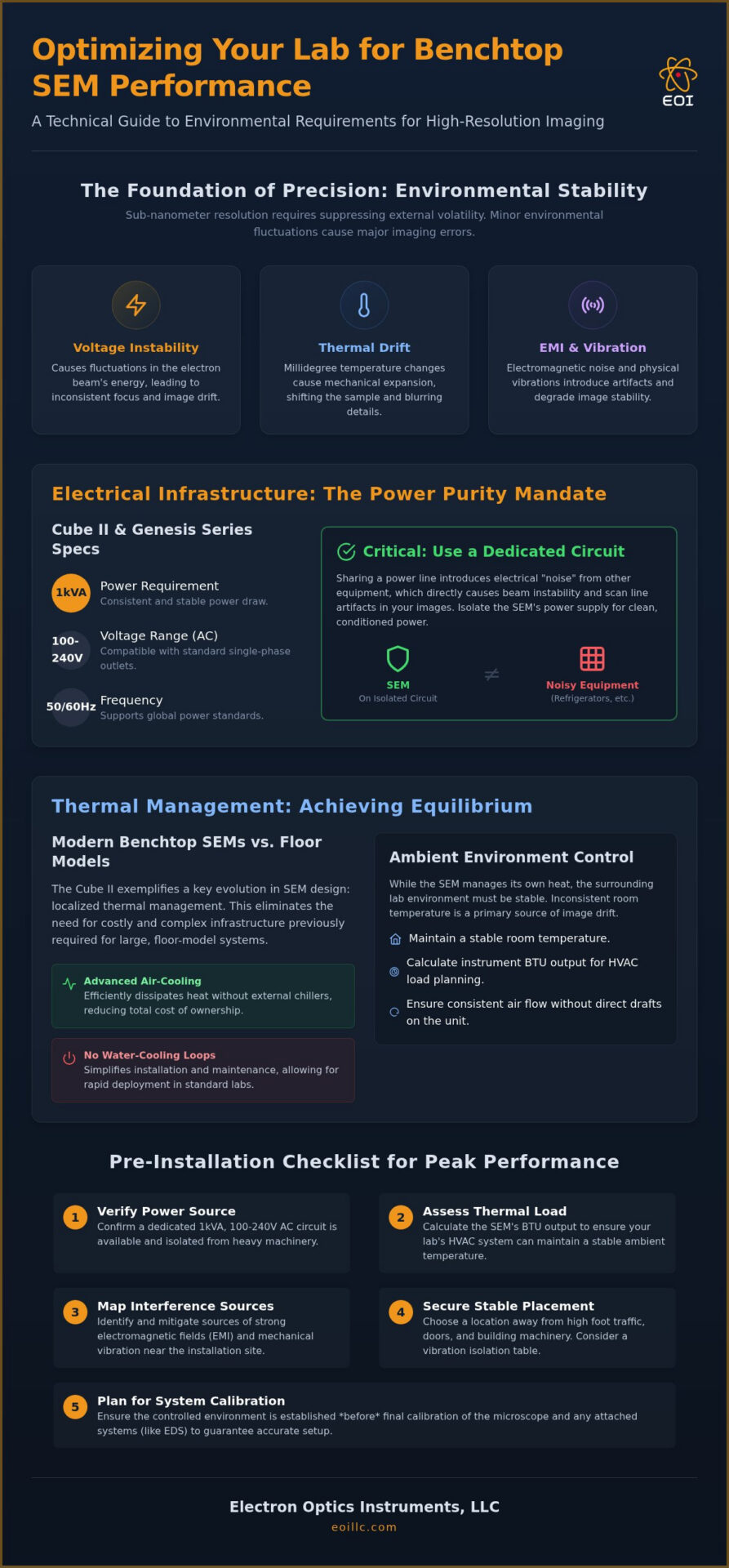
Primary stressors that degrade imaging performance include voltage instability, which causes fluctuations in the electron beam’s landing energy; thermal drift, which shifts the sample relative to the optics; and electromagnetic noise that introduces artifacts into the detector signal. As we look toward 2026 laboratory standards, the emphasis has shifted toward functional density. This means packing higher analytical power into smaller spaces without sacrificing the resource efficiency that makes benchtop units attractive for on-site industrial applications. Reliability in these settings is built upon a foundation of meticulous environmental control.
The Physics of Sensitivity in Electron Optics
Micro-fluctuations in electrical supply can manifest as macro-errors in the final micrograph. Even a minor deviation in the accelerating voltage, which typically ranges from 1 to 30kV in systems like the Genesis series, can alter the beam’s focal point or specimen interaction volume. Similarly, thermal expansion is a constant challenge. As the SEM column or sample stage absorbs heat, even at millidegree increments, the resulting mechanical shift can blur the high-magnification details necessary for advanced materials characterization. Thermal drift is the parasitic displacement of the electron beam or specimen stage caused by temperature-induced expansion or contraction of mechanical components, which directly compromises the spatial accuracy of sub-5nm imaging.
Benchtop vs. Floor Model Infrastructure Requirements
Traditional floor-model SEMs historically demanded dedicated, climate-controlled rooms with specialized high-voltage wiring and complex water-cooling loops. In contrast, the current generation of hardware has transitioned toward localized thermal management and superior electrical efficiency. The Cube II Benchtop SEM exemplifies this evolution, operating on a single-phase 100-240VAC supply while utilizing advanced air-cooling to eliminate the need for external chillers. This infrastructure-light design allows for rapid deployment on production floors or in standard labs, provided that the underlying power quality remains consistent and protected from the interference of adjacent heavy machinery. By reducing the total cost of ownership through simplified utilities, these systems allow for a democratization of high-end microscopy across diverse industrial sectors.
Electrical Infrastructure: Voltage, Stability, and Power Conditioning
The operational success of advanced electron optics is inextricably linked to the purity of the electrical supply. While the Cube II and Genesis series are engineered for compatibility with standard single-phase 100-240V AC (50/60Hz) outlets, the distinction between “available” power and “conditioned” power remains a critical factor for laboratory managers. Achieving the 1kVA power requirement is straightforward, yet the necessity of a dedicated circuit cannot be overstated. Sharing a power line with high-draw equipment, such as industrial centrifuges or laboratory refrigerators, introduces electrical transients that manifest as scan line noise or beam instability. Adhering to professional Electron Microscope Room Design standards ensures that the power and cooling needs for a benchtop sem are met with the necessary isolation from the broader facility’s electrical noise.
A nuanced understanding of amperage draw is essential for proper circuit sizing. During the initial vacuum sequence, the rotary pumps utilized in systems like the Genesis series demand a higher inrush current compared to the steady-state operation of the electron gun and electronics. Furthermore, managing Total Harmonic Distortion (THD) is paramount in industrial environments where variable frequency drives and heavy machinery pollute the local grid. High THD levels can lead to subtle heating in sensitive electronic components, eventually causing premature wear or drift in the accelerating voltage. Meticulous grounding serves as the final barrier against electronic noise, providing a low-impedance path that prevents stray currents from interfering with the SEM detector’s sensitive signal processing units.
Uninterruptible Power Supply (UPS) and Surge Protection
Implementing a double-conversion online UPS is a non-negotiable requirement for protecting sensitive electron optics from the volatility of the municipal grid. Unlike standard standby units, a double-conversion system continuously regenerates power, providing a pure sine wave that is completely isolated from external surges or brownouts. When calculating the required KVA rating, facility managers must account for both the SEM unit and peripheral EDS systems to ensure sufficient overhead. This protection is especially vital for the vacuum system; a sudden power loss can lead to uncontrolled venting, which risks contaminating the column and requires extensive downtime for recovery. For long-term reliability, investing in professional preventative maintenance ensures that your power conditioning hardware and SEM internals remain in peak synchronization.
Electromagnetic Interference (EMI) and Power Cabling
Effective cable management is a primary strategy for minimizing inductive coupling, where power lines inadvertently transfer noise to sensitive data cables. Laboratory layouts should prioritize the physical separation of ‘dirty’ power sources from the SEM’s dedicated lines to maintain signal integrity. To verify ground loop integrity before installation, technicians must measure the potential difference between the SEM chassis and the building’s primary earth ground. Any reading exceeding 0.5V AC indicates a ground loop that requires immediate isolation. This meticulous attention to electrical detail prevents the subtle detector artifacts that can compromise the accuracy of sub-nanometer characterization in high-performance benchtop systems.
Thermal Management and Atmospheric Cooling Requirements
The transition from traditional floor-model systems to high-performance benchtop units has fundamentally altered the cooling landscape. While older systems necessitated external water-cooling chillers and dedicated plumbing, modern instruments like the Cube II rely on sophisticated passive heat dissipation and localized internal air-cooling. This shift doesn’t eliminate the thermal challenge; instead, it transfers the responsibility to the laboratory’s HVAC system. To accurately master the power and cooling needs for a benchtop sem, facility managers must treat the instrument as a constant heat source. A system drawing 1kVA generates approximately 3,412 BTUs per hour. In a confined laboratory space, failing to account for this thermal load can lead to rapid temperature spikes that destabilize the electron optics.
High-resolution imaging demands an environment where ambient temperatures remain within a narrow window, typically between 20°C and 25°C. Absolute temperature is often less critical than rate of change; fluctuations exceeding ±1°C per hour trigger mechanical expansion in the SEM column, manifesting as frustrating image drift at high magnifications. Relative humidity is a secondary but vital atmospheric factor. Maintaining a range of 20% to 80% RH is essential to prevent internal condensation on sensitive electronics while simultaneously mitigating the risk of high-voltage arcing within the electron gun assembly. These environmental parameters act as the invisible scaffolding for sub-nanometer characterization.
Airflow Dynamics and Benchtop Placement
Strategic placement of the Cube II chassis is vital for maintaining internal thermal balance. It’s a common mistake to position the unit directly under an HVAC supply vent to maximize cooling. This placement is a recipe for imaging failure, as the fluctuating air currents and rapid temperature cycles from the building’s climate control system introduce thermal noise. Clearance is equally important. The Cube II requires at least 100mm of unobstructed space around its intake and exhaust ports to ensure internal fans move air across the heat sinks efficiently. Achieving a state of stability requires balancing adequate air exchange with the need for a vibration-free, stagnant-air environment immediately surrounding the column.
Localized Heat Sources and Their Mitigation
Parasitic heat sources can disrupt localized thermal equilibrium even in a well-regulated room. Direct sunlight from windows, high-performance workstation monitors, and even the proximity of other laboratory staff can cause subtle, localized heating of the SEM’s exterior. In multi-user environments, implementing thermal shielding or using non-reflective barriers is a prudent strategy to isolate the instrument. The stakes are high; internal data shows that a mere 2-degree shift in ambient temperature can cause significant drift in EDS calibration. This drift compromises the accuracy of elemental quantification, proving that thermal stability is not just about image quality, but about the integrity of the entire analytical dataset.
Mitigating Environmental Interference: EMI and Vibration Synergy
Environmental isolation in 2026 demands a holistic approach that transcends basic electrical supply. While the power and cooling needs for a benchtop sem establish the operational baseline, the synergy between electromagnetic interference (EMI) and mechanical vibration often determines the ceiling of achievable resolution. These two forces frequently act in concert; for instance, a large motor in an adjacent room might produce both a mechanical tremor and a fluctuating magnetic field. Identifying these “hot zones” through professional electromagnetic field mapping before installation is a prerequisite for maintaining sub-5nm precision in high-traffic industrial settings.
Internal sources of instability are equally critical to the analytical narrative. The SEM’s vacuum system, particularly the roughing pump, generates persistent mechanical frequencies that must be decoupled from the optical column. High-end benchtop units utilize advanced internal dampening mounts, but in environments where floor-borne vibrations from heavy machinery are prevalent, these internal measures require external reinforcement. The distinction between floor-borne tremors and the resonance of the laboratory bench itself is a vital diagnostic factor. Identifying whether interference is bench-borne or floor-borne allows for a targeted mitigation strategy that avoids the high cost of unnecessary laboratory retrofitting.
Vibration Isolation Platforms for Benchtop SEMs
Standard laboratory benches, while sufficient for basic chemistry, often lack the structural rigidity required for the Veritas Series SEM when operating at its highest magnification. Passive dampening pads offer a reliable solution for high-frequency noise, yet they struggle with the low-frequency oscillations typical of building sway or nearby traffic. For facilities aiming for maximum stability, active piezoelectric isolation tables provide the necessary counter-force to neutralize environmental tremors in real-time. To assess your current infrastructure, you can perform a preliminary resonance test by placing a high-sensitivity accelerometer app on your benchtop; any persistent peaks above 5Hz suggest that a standard bench is insufficient for high-resolution characterization.
Electromagnetic Shielding Strategies
EMI symptoms are technically distinctive, often manifesting as jagged edges on sample features or a periodic distortion that appears to “roll” through the live scan. These artifacts are frequently traced to external sources like elevators, large power transformers, or high-current cabling hidden within laboratory walls. Because the electron beam is a stream of charged particles, it’s inherently susceptible to deflection by stray magnetic fields. Practical mitigation involves strategic relocation of the instrument away from identified “hot zones” or the installation of Mu-metal enclosures to redirect magnetic field lines. If you’re experiencing persistent imaging artifacts despite a stable power supply, it’s time to consult with an electron optics specialist to evaluate your laboratory’s electromagnetic profile.
Strategic Implementation: Integrating the Cube II and Genesis Series
The successful deployment of high-performance microscopy systems like the Cube II and Genesis series requires a transition from theoretical planning to rigorous technical execution. While modern automation features simplify the user interface, they can’t compensate for a foundational failure to address the underlying power and cooling needs for a benchtop sem. Electron Optics Instruments, LLC leverages 30 years of electron optics expertise to ensure that the transition from delivery to data acquisition is characterized by meticulousness and technical accuracy. This process bridges the gap between hardware capability and real-world analytical performance, ensuring that the instrument operates within its peak design parameters from day one.
Integrating advanced analytical tools, such as Energy Dispersive Spectroscopy (EDS) and specialized EDS Cool Stages, necessitates an even higher degree of environmental control. These peripheral systems introduce additional thermal and electrical variables that must be synchronized with the SEM’s primary power and cooling needs for a benchtop sem. For instance, an EDS detector requires extreme thermal stability to maintain energy resolution and prevent calibration drift. Our integration process includes a comprehensive validation of these synergies, ensuring that the addition of elemental analysis hardware doesn’t compromise the spatial resolution of the electron beam.
The Professional Installation Protocol
The installation of a Genesis or Cube II system follows a structured, three-step protocol designed to eliminate infrastructure anxiety. This methodical approach ensures that every environmental variable is accounted for before the first electron beam is generated. The protocol includes:
- Step 1: Environmental Site Survey: Technicians perform detailed EMI and vibration mapping to identify potential interference zones that could degrade image quality.
- Step 2: Electrical Load Testing: We verify the stability of the dedicated circuit and integrate double-conversion UPS systems to provide a pure, uninterrupted power supply.
- Step 3: Vacuum and Thermal Optimization: The system undergoes a period of thermal stabilization, followed by vacuum system tuning to ensure the internal environment is optimized for high-resolution characterization.
Maximizing ROI through Infrastructure Resilience
Infrastructure resilience is a primary driver of long-term return on investment. By providing a stable electrical and thermal environment, laboratories can significantly extend the operational lifespan of sensitive components, including SEM filaments and detectors. Fluctuating power levels and thermal cycles are the leading causes of premature hardware failure; mitigating these risks through proper facility preparation reduces the total cost of ownership. Beyond the initial setup, adhering to a schedule of SEM preventative maintenance ensures that the synergy between the instrument and its environment remains intact over years of heavy use. To secure the future of your microscopy capabilities, contact Electron Optics Instruments, LLC for a comprehensive facility assessment and SEM consultation to ensure your laboratory is ready for the next generation of benchtop analysis.
Securing the Future of High-Resolution Analytical Precision
The evolution of benchtop electron microscopy in 2026 has fundamentally redefined the requirements for laboratory infrastructure. Achieving sub-nanometer resolution is no longer solely a function of the hardware; it’s a direct result of the meticulous management of the power and cooling needs for a benchtop sem. By prioritizing electrical purity and maintaining strict thermal equilibrium, facilities can eliminate the frustrations of image drift and unexpected hardware failures. Proper integration ensures that the functional density of systems like the Cube II and Genesis series translates into reliable, repeatable analytical data.
As the sole US distributor for EmCraft, Electron Optics Instruments, LLC provides more than just advanced hardware. With over 30 years of industry experience, we offer expert on-site training and professional installation services that address the unique environmental challenges of your specific facility. Request a Technical Consultation for Your Lab’s SEM Integration to ensure your infrastructure is optimized for maximum precision and long-term instrument stability. We’re ready to help you establish a foundation for excellence in your laboratory.
Frequently Asked Questions
Does a benchtop SEM require a dedicated electrical circuit?
Yes, a dedicated electrical circuit is mandatory to isolate the instrument from the transients and noise generated by other laboratory equipment. Sharing a circuit with heavy machinery or refrigerators introduces electrical interference that can destabilize the electron beam and degrade image quality. Ensuring a dedicated line is a foundational step in meeting the power and cooling needs for a benchtop sem while maintaining sub-nanometer precision.
Can I plug my benchtop SEM into a standard surge protector?
A standard surge protector is insufficient for the precision requirements of modern electron optics. You should utilize a double-conversion online Uninterruptible Power Supply (UPS) instead. Standard protectors only guard against voltage spikes; however, a double-conversion UPS continuously regenerates a pure sine wave, providing the conditioned power necessary to protect sensitive detectors and maintain consistent accelerating voltage during grid fluctuations.
What is the ideal room temperature for operating a Cube II SEM?
The ideal ambient temperature for operating a Cube II SEM is between 20°C and 25°C. While the unit features advanced internal air-cooling, maintaining a stable room temperature is critical to prevent thermal expansion within the column and stage. Fluctuations exceeding ±1°C per hour can cause significant image drift, compromising the spatial accuracy of high-magnification characterization.
How much heat does a benchtop SEM generate during operation?
A benchtop SEM typically generates approximately 3,412 BTUs of heat per hour based on a standard 1kVA power draw. This thermal load must be accounted for when assessing your laboratory’s HVAC capacity. In smaller or poorly ventilated rooms, the localized heat dissipation from the chassis can quickly elevate the ambient temperature beyond the recommended operating range, necessitating adequate airflow and clearance.
Do I need an active vibration isolation table for my tabletop SEM?
An active vibration isolation table is highly recommended for facilities located in industrial environments or multi-story buildings where floor-borne tremors are prevalent. While systems like the Veritas Series feature internal dampening, active piezoelectric isolation provides real-time neutralization of low-frequency vibrations. This is often the deciding factor in achieving sub-5nm resolution on a standard laboratory bench.
What happens to the SEM if the power suddenly goes out?
A sudden power loss can result in an uncontrolled venting of the vacuum system, which risks contaminating the electron gun and column internals. Without a UPS to provide a managed shutdown, the transition from high vacuum to atmospheric pressure occurs too rapidly. This event often requires extensive downtime for system cleaning and vacuum recovery, highlighting why power stability is a core component of the power and cooling needs for a benchtop sem.
How often should the cooling fans and filters be cleaned on a benchtop unit?
Cleaning of cooling fans and internal filters should occur during scheduled preventative maintenance visits, typically every six to twelve months. Dust accumulation restricts airflow, forcing internal fans to work harder and increasing the risk of thermal instability within the electronics. Meticulous maintenance of these cooling components is essential for protecting the long-term health of the vacuum pumps and high-voltage power supplies.
Can electromagnetic interference from other lab equipment affect my SEM images?
Electromagnetic interference from nearby elevators, transformers, or even high-current cabling can cause periodic image distortion and jagged feature edges. Because the electron beam is a stream of charged particles, it’s highly susceptible to deflection by stray magnetic fields. Identifying these “hot zones” through field mapping before installation allows for strategic relocation or the implementation of Mu-metal shielding to maintain image integrity.