
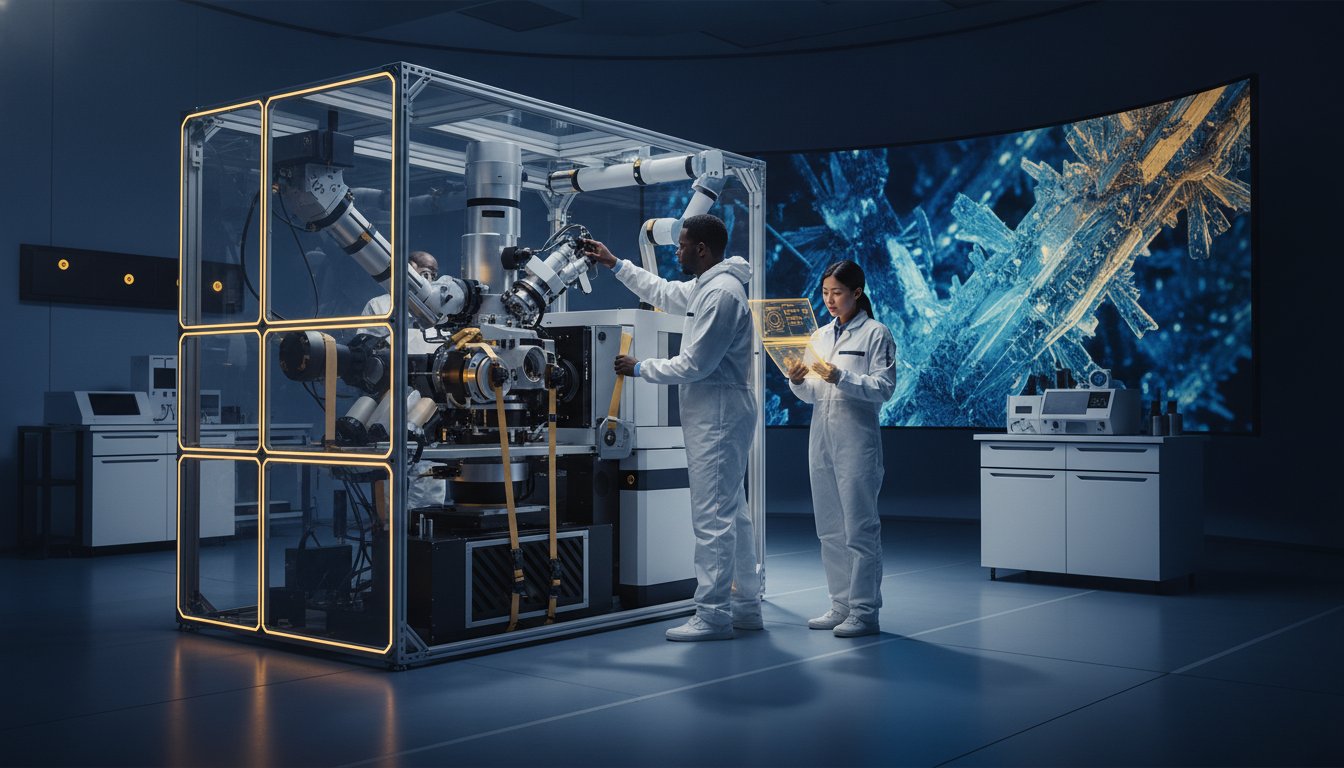
Treating the transport of a scanning electron microscope as a standard logistics task is a strategic error that often results in the permanent degradation of nanometer-scale resolution. While a general contractor might prioritize the physical movement of crates, an expert understands that sem equipment relocation services must function as a comprehensive optical recalibration event. As the global electron microscopy market approaches a projected $5.23 billion valuation in 2026, the technical stakes for maintaining instrument integrity during facility transitions have reached an unprecedented level of complexity. You’ve likely recognized that even a minor failure in vibration dampening or vacuum stabilization during transit can lead to months of unexpected downtime and expensive service interventions.
This technical guide provides the rigorous protocols necessary to relocate sophisticated systems like the Veritas HR or Genesis Tabletop SEM without compromising beam stability or aperture alignment. We’ll examine how to maintain compliance with the latest 2026 standards, including the updated OSHA rigging qualifications and IATA’s revised state-of-charge requirements for internal lithium-ion components. By following these documented validation procedures, you’ll ensure your instrument meets its original performance specifications in the new site. We’ll show you how to integrate these moves with existing service contracts to achieve a seamless transition that preserves your laboratory’s analytical capabilities.
Key Takeaways
- Recognize that relocating a scanning electron microscope is a complex optical recalibration event requiring technical mastery over electron physics and vacuum integrity.
- Implement systematic stabilization protocols for the electron column and stage assembly to mitigate the risk of internal component shifting or mechanical strain during transit.
- Utilize rigorous site analysis and environmental validation to identify potential imaging interference before initiating professional sem equipment relocation services.
- Follow a structured timeline from baseline performance testing to final certification to ensure the instrument meets its original specifications in the new facility.
- Leverage the expertise of specialized engineers to integrate the relocation process seamlessly with existing service contracts and preventative maintenance schedules.
The Critical Risks of Scanning Electron Microscope (SEM) Relocation
Relocating a Scanning Electron Microscope (SEM) represents one of the most demanding logistical challenges in modern industrial and academic environments. Unlike standard laboratory equipment, these instruments rely on the precise orchestration of electromagnetic lenses, ultra-high vacuum environments, and nanometer-scale mechanical tolerances. Consequently, professional sem equipment relocation services must be viewed as a high-precision technical operation rather than a simple transport task. Standard logistics providers, while proficient in heavy lifting, typically lack the specialized engineering knowledge required to safeguard the sensitive electron optics that define the instrument’s resolution and beam stability.
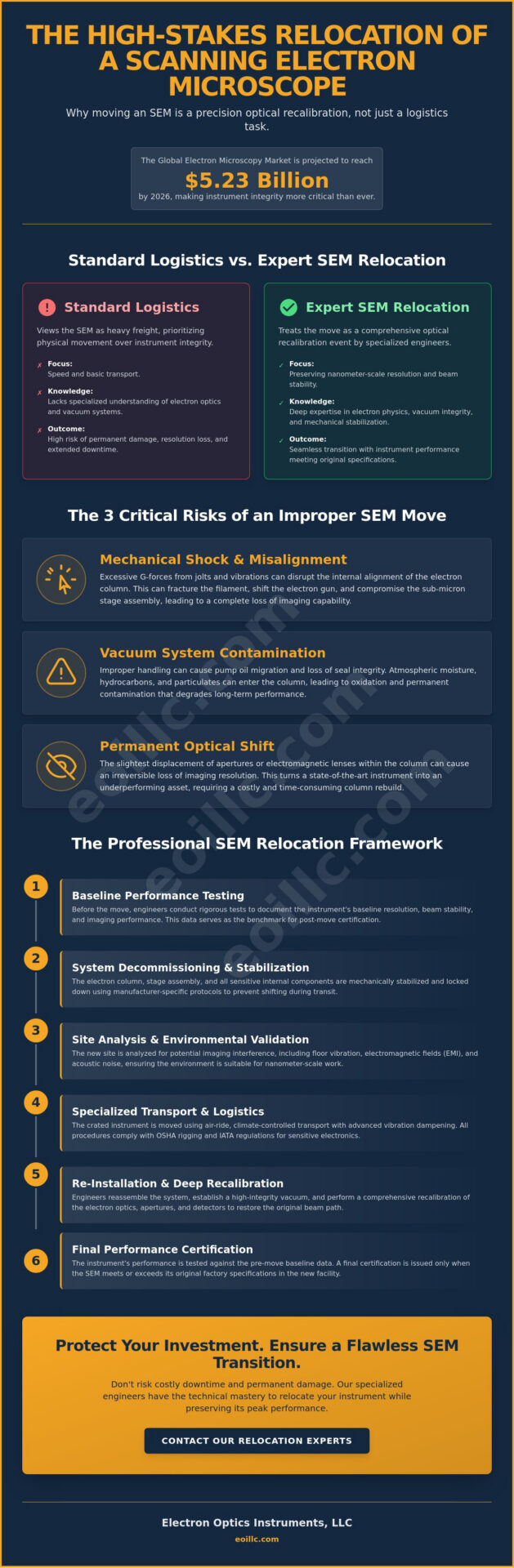
Failure to recognize the distinction between general freight and precision instrumentation often leads to catastrophic results. Technical teams must account for three primary failure points during the transition process:
- Mechanical Shock: Disruption of the internal alignment of the electron column due to excessive G-forces.
- Vacuum Contamination: Migration of hydrocarbons or loss of seal integrity during environmental fluctuations.
- Optical Shift: Displacement of apertures or lenses that results in a permanent loss of imaging resolution.
The financial implications of improper handling extend far beyond the immediate cost of the move. When an instrument is compromised, organizations face the high cost of unexpected downtime and the potential for permanent hardware degradation. A professional approach to sem equipment relocation services mitigates these risks by treating the instrument as a sensitive optical system rather than a piece of heavy machinery. This meticulousness is what separates a successful site transition from a costly technical failure that could necessitate a complete column rebuild.
Mechanical Shock and Optical Misalignment
Even minor G-force impacts during transit can disturb the precision-aligned apertures and electromagnetic lenses within the column. When an instrument experiences vibration beyond its design tolerances, the filament and electron gun assembly are at significant risk of fracturing or shifting. This mechanical strain also compromises the delicate stage assembly and motor drives, which are engineered for sub-micron positioning. Without specialized dampening and stabilization, a single jolt can render the entire imaging system unusable until an engineer performs a deep-level recalibration of the optical path.
Vacuum System Contamination and Seal Integrity
Maintaining the integrity of the vacuum system is paramount to preventing column oxidation and ensuring long-term performance. During temperature fluctuations or improper orientation during transport, pump oil migration can occur, leading to permanent contamination of the specimen chamber. It’s essential that the team managing the move possesses deep sem operation knowledge to execute a clean decommissioning. This technical expertise ensures that seals remain intact and the internal environment is protected against atmospheric moisture and particulate matter throughout the transition.
Preparing Sensitive Electron Optics for Transport
The preparation phase of sem equipment relocation services demands a methodical approach to mechanical stabilization that transcends basic industrial crating. Each instrument, whether it is a high-resolution Veritas FE SEM or a compact Cube II Benchtop SEM, possesses a unique center of gravity and specific internal tolerances that must be addressed before any physical movement occurs. The execution of these protocols ensures that the delicate interplay between electromagnetic lenses and the specimen stage remains undisturbed; a necessity for maintaining nanometer-scale resolution in 2026. Specialized engineering teams must deploy model-specific mechanical constraints to prevent the internal shifting of components that are typically suspended to mitigate operational vibration.
While larger floor-standing models require extensive disassembly, compact units like the Genesis Tabletop SEM present their own set of challenges due to their highly integrated architectures. These systems often house complex vacuum pumps and electronics in a single chassis, making them susceptible to internal resonance during transit. Professional relocation involves more than just external packing. It requires the internal securing of the specimen chamber and the electronics chassis to avoid mechanical strain on high-voltage connectors and integrated EDS systems. For laboratories managing a fleet of diverse instruments, scheduling Preventative Maintenance Visits alongside the move can provide a baseline for post-relocation performance validation.
Securing the Electron Column and Stage
The structural integrity of the electron column is maintained through the application of specialized lockdown kits and shipping brackets designed specifically for the SEM model in question. These brackets immobilize the column relative to the frame, preventing the pendulum-like motion that can occur during transport. Simultaneously, the vibration dampening system, whether it is pneumatic or active, must be isolated and locked to prevent bottoming out or seal damage. Particular care is directed toward the detector array; sensitive Backscatter (BSE) and Secondary Electron (SE) detectors are often retracted or removed and packed separately to avoid impact damage from the stage assembly.
Electronics Protection and ESD Safety
Modern SEM systems rely on sophisticated PCB assemblies and control units that are exceptionally sensitive to environmental factors. A rigorous labeling system is utilized during the methodical disconnection of high-voltage cables and data lines, ensuring that re-integration at the new site is both accurate and efficient. To mitigate the risks of electrostatic discharge (ESD), all sensitive electronic components are encased in anti-static packaging before being secured within climate-controlled enclosures. This level of meticulousness is vital, as a single ESD event during the packing or moving process can lead to intermittent logic errors or total hardware failure post-installation.
Environmental Validation and Site Analysis for SEM Re-installation
The successful conclusion of professional sem equipment relocation services is fundamentally contingent upon the destination environment meeting or exceeding the manufacturer’s rigorous technical specifications. It’s a strategic oversight to assume that any modern laboratory space is inherently suitable for high-resolution imaging. In reality, the integration of advanced sem techniques in 2026 requires environmental tolerances that are significantly tighter than those of previous decades. A comprehensive pre-move site survey is therefore an indispensable prerequisite, serving to identify latent imaging interference that could nullify the performance of even the most meticulously transported instrument.
Technical teams must evaluate the cumulative impact of environmental stressors that dictate beam stability and overall image quality. While previous sections detailed the mechanical stabilization of the internal column, this phase addresses the external variables that define the instrument’s operational ceiling. Engineers focus on three primary pillars of site suitability: structural stability, electromagnetic purity, and thermal consistency. Neglecting any of these factors during the planning phase of sem equipment relocation services often results in post-installation resolution loss that cannot be corrected through software or standard calibration alone.
Managing Acoustic and Structural Vibrations
Identifying and mitigating vibration sources is critical for maintaining sub-nanometer resolution in high-end systems like the Veritas HR or Veritas Ultra SEM. Common culprits include high-volume HVAC systems, elevators, and adjacent heavy machinery found in industrial corridors. Beyond visible movement, engineers must assess floor loading capacity and the structural resonance of the building itself to ensure the floor doesn’t amplify low-frequency harmonics. For high-magnification applications, the deployment of active vibration isolation tables is often necessary to decouple the instrument from the building’s floor harmonics and ensure a stable imaging environment.
Electromagnetic Interference (EMI) Shielding
Stray magnetic fields from high-voltage power lines or large industrial motors can exert a profound influence on the electron beam’s trajectory, leading to image distortion or “jitter.” Rigorous testing protocols must be executed in the new laboratory space to map EMI levels across the frequency spectrum before the equipment arrives. If the laboratory is located in a high-interference industrial environment, technical teams might recommend passive or active shielding solutions to neutralize external fields. This meticulous environmental validation ensures that the re-installation process results in an instrument that performs at its peak theoretical capacity in its new location.
The Professional SEM Relocation Process: A Step-by-Step Framework
Executing sem equipment relocation services requires a disciplined, multi-phase engineering framework that prioritizes instrument safety over logistical speed. This isn’t a mere transfer of property; it’s a meticulously timed sequence of technical events that spans from the initial pre-move consultation to the final performance certification. Because the electron microscope cost represents a significant capital investment, every step of the process must be documented to satisfy insurance requirements and asset protection protocols. Whether you’re moving a Veritas FE SEM or a compact Genesis Tabletop SEM, the following framework ensures that imaging performance remains uncompromised.
A central pillar of this process is the establishment of a performance baseline before any hardware is touched. This technical “snapshot” acts as the gold standard against which the instrument will be measured following its re-installation. In 2026, professional sem equipment relocation services leverage real-time environmental telemetry to ensure that the transition between facilities doesn’t introduce latent defects. By treating the relocation as a continuous engineering project, laboratories can avoid the common pitfalls of standard commercial moving and ensure a seamless return to analytical operations.
Phase 1: Decommissioning and Professional Packing
- Step 1: Conduct baseline imaging and resolution tests using standard reference samples to document current beam stability and vacuum performance.
- Step 2: Execute a methodical power-down and controlled venting of the vacuum system according to OEM specifications to prevent pump backstreaming.
- Step 3: Apply model-specific stabilization for all moving parts, including the stage and column, followed by custom crating for the electronics chassis.
Phase 2: Secure Logistics and Environmental Monitoring
- Step 4: Utilize specialized rigging to load the instrument into air-ride suspension vehicles that are specifically equipped with climate and vibration control.
- Step 5: Implement real-time monitoring of temperature, humidity, and G-force impacts during transit to provide a verifiable record of transport conditions.
- Step 6: Perform controlled unloading and delivery to the validated laboratory site, ensuring the instrument remains in a stable orientation throughout the final placement.
Phase 3: Re-installation and Performance Validation
- Step 7: Perform the technical re-assembly of the column, vacuum connections, and electronics, followed by a rigorous inspection of all high-voltage interfaces.
- Step 8: Initiate a system bake-out and vacuum pull-down to verify seal integrity and ensure the turbo-molecular pumps reach target pressures without contamination.
- Step 9: Conduct final calibration and imaging validation, comparing the results against the pre-move baseline benchmarks to certify that the SEM meets its original specifications.
To ensure your instrument maintains peak performance through its next transition, explore our specialized Veritas Series SEM relocation and support solutions.
Why Technical Expertise is Non-Negotiable for SEM Equipment Moves
The transition of a scanning electron microscope is not merely a logistical challenge; it’s a critical juncture in the instrument’s operational lifecycle. While previous sections detailed the technical protocols of environmental validation and mechanical stabilization, the success of these measures depends entirely on the proficiency of the engineers executing them. Professional sem equipment relocation services require a deep understanding of electron physics that standard commercial movers cannot replicate. Utilizing specialized electron optics engineers ensures that the intricate calibration of electromagnetic lenses and the integrity of ultra-high vacuum systems are maintained throughout the transition. This level of technical authority is particularly vital for protecting manufacturer warranties on high-end systems like the Veritas Ultra or Veritas HR SEM.
Organizations that partner with a seasoned global innovator like Electron Optics Instruments, LLC for EmCraft systems gain access to a narrative of reliability that extends beyond the move itself. By leveraging engineers who are intimately familiar with the internal architecture of the Cube II or Genesis series, laboratories can mitigate the risks of permanent resolution loss. This expertise is a prerequisite for maintaining the high-end quality and superior standards expected in modern semiconductor and nanotechnology research. It’s the difference between a successful re-commissioning and a permanent degradation of your facility’s analytical capacity.
Integrating Relocation with Preventative Maintenance
The decommissioning and subsequent re-installation phases provide a logical opportunity to execute deep-level maintenance that is often difficult to schedule during peak laboratory operation. Integrating sem equipment relocation services with a scheduled Preventative Maintenance Visit allows for the thorough cleaning of the specimen chamber and the replacement of SEM Filaments and Consumables. This synergy ensures that the instrument doesn’t just return to its previous state but begins its tenure in the new facility at peak performance. Such a methodical approach aligns with annual service contract requirements and provides a documented baseline for post-move validation.
National Coverage and Manufacturer-Agnostic Support
With a foundation of 30 years of experience in high-end scientific instrumentation, our technical team provides comprehensive support for SEMs from all major manufacturers nationwide. This deep institutional knowledge allows for the seamless relocation of diverse fleets, from Refurbished SEM Units to advanced EDS (Energy Dispersive Spectroscopy) Systems. The focus remains on the grounded, practical realities of logistical excellence and technical integration. We invite industry professionals to request a technical consultation to discuss their specific laboratory transition requirements and ensure their high-value assets are handled with the meticulousness they deserve.
Securing Your Analytical Future through Technical Precision
The successful transition of sophisticated instrumentation requires a synthesis of logistical excellence and deep-level engineering expertise. Throughout this guide, we’ve examined how rigorous mechanical stabilization and precise environmental validation act as the primary safeguards for your laboratory’s analytical capabilities. Recognizing that sem equipment relocation services are an extension of the instrument’s service lifecycle allows for the seamless integration of technical re-calibration and preventative maintenance. This holistic approach ensures that your system, whether it’s a Veritas FE SEM or a refurbished unit, returns to full operational status without the risk of permanent resolution loss.
As the sole US distributor for EmCraft Scanning Electron Microscopes and a provider of manufacturer-agnostic support for all major brands, Electron Optics Instruments, LLC brings over 30 years of industry experience to every project. Our technical team is prepared to manage the complexities of your next laboratory transition with the meticulousness required for nanometer-scale accuracy. We invite you to Request a Technical Consultation for Your SEM Relocation to secure the long-term integrity of your scientific assets. We look forward to supporting your continued innovation in the evolving landscape of high-resolution microscopy.
Frequently Asked Questions
Can I move a benchtop SEM myself if it is compact?
Attempting to move a compact system like the Cube II Benchtop SEM independently is not recommended due to the sensitive nature of the internal electron optics and vacuum architecture. While the footprint is smaller than floor-standing models, the mechanical tolerances remain nanometer-scale; any unauthorized handling can lead to the permanent misalignment of the electromagnetic lenses. Professional sem equipment relocation services ensure that these integrated systems are secured internally to prevent hardware degradation during transit.
How long does a typical SEM relocation take from start to finish?
A standard relocation typically requires three to seven business days to execute correctly from the initial decommissioning to final performance certification. This timeline accounts for the methodical venting of the vacuum system, secure transport in climate-controlled vehicles, and the subsequent “bake-out” period required after re-installation. Complex cross-country moves or high-resolution systems like the Veritas HR SEM may require additional time for site-specific environmental tuning.
What environmental conditions are most likely to affect my SEM in a new lab?
Electromagnetic interference (EMI) and structural vibrations are the primary environmental stressors that threaten imaging stability in a new laboratory space. Even minor stray magnetic fields from adjacent power lines or vibration from HVAC systems can introduce beam jitter that negates high-magnification resolution. It’s essential to perform a pre-move site survey to verify that the destination environment meets the 2026 technical requirements for advanced microscopy.
Does my SEM service contract cover relocation costs?
Standard service contracts generally exclude the logistical costs of physical transport, though they often cover the labor for technical re-commissioning. You should consult your specific agreement to determine if professional sem equipment relocation services are required to maintain your warranty. Coordinating the move with a scheduled preventative maintenance visit is an effective strategy to ensure the instrument remains compliant with manufacturer standards.
What is the risk of moving an older or refurbished SEM unit?
Older or refurbished SEM units present a higher risk for vacuum seal failure and mechanical fatigue due to the natural aging of elastomer components. Moving these systems requires a more conservative decommissioning protocol to prevent the displacement of internal particulates that could contaminate the electron gun assembly. Expert handling is necessary to ensure that these seasoned instruments continue to meet their original resolution specifications after the transition.
Do I need to recalibrate my EDS system after the move is complete?
Recalibration of the Energy Dispersive Spectroscopy (EDS) system is a mandatory step in the re-installation process to ensure analytical accuracy. Because the detector’s geometric relationship to the specimen stage is critical for X-ray collection efficiency, even a microscopic shift during transport can skew elemental quantification data. Engineers must perform a full spectral calibration against a known standard once the vacuum has been re-established at the new site.
How do you protect the vacuum pumps during a cross-country relocation?
Vacuum pumps are protected through a combination of physical isolation and model-specific mechanical constraints. For systems utilizing turbo-molecular pumps, it’s vital to prevent rotor movement that could lead to bearing damage from gyroscopic forces during vehicle maneuvers. Oil-based pumps are typically drained and sealed to prevent hydrocarbon migration into the specimen chamber, which would otherwise cause permanent optical contamination during the move.
Will my SEM imaging performance be the same in the new location?
Imaging performance will remain consistent with the pre-move baseline if the new laboratory environment is properly validated and the re-installation is performed by qualified engineers. The final stage of a professional move involves a rigorous comparison of post-relocation images against documented benchmarks. This validation confirms that the beam stability and resolution of your Veritas Series SEM meet or exceed the original performance metrics in the new facility.