
With the global scanning electron microscope market projected to reach a valuation of $5.03 billion in 2026, the reliance on high-resolution imaging for nanotechnology and material science has never been more critical. You recognize that the integrity of your research depends upon the absolute precision of your instrumentation; however, the reality of hardware degradation often leads to costly laboratory downtime and a frustrating loss of analytical accuracy. When image resolution falters or electron optics drift, the requirement for immediate, authoritative intervention becomes paramount to maintaining operational excellence.
This guide serves as a technical roadmap for identifying critical system failures and understanding the sophisticated protocols inherent in professional on-site SEM repair services. We’ll explore how expert technical support restores SEM functionality through meticulous calibration validation and the strategic integration of high-end components. By the end of this article, you’ll understand how to secure a cost-effective alternative to expensive OEM service calls while ensuring your system meets the rigorous standards required for quantitative measurement and industrial performance.
Key Takeaways
- Gain an advanced understanding of the systemic interdependence between vacuum integrity and electron optical alignment necessary for high-resolution imaging.
- Recognize early diagnostic markers of hardware failure, including vacuum leaks and filament burnout, to preemptively address analytical inaccuracies.
- Assess the strategic benefits of expert on-site SEM repair services as a versatile and cost-effective alternative to rigid OEM service contracts.
- Establish rigorous post-repair calibration workflows that validate system performance against established industry benchmarks and ISO guidelines.
- Learn the specialized decommissioning procedures required to protect sensitive electron optics during equipment relocation or infrastructure upgrades.
Navigating the Complexity of Professional SEM Repair Services
The restoration of a Scanning electron microscope (SEM) demands a sophisticated mastery of vacuum physics, electron optics, and digital signal processing. These systems operate at the intersection of complex physical disciplines where even a minor deviation in column alignment or a microscopic leak in the vacuum manifold can terminate critical research projects. Expert on-site SEM repair services aren’t merely a convenience; they’re a technical necessity for facilities where precision is the primary metric of success. Because these instruments utilize focused electron beams to interact with atoms in a sample, the diagnostic process demands an understanding of electromagnetic lens theory and high-voltage electronics that exceeds the capabilities of general industrial maintenance providers.
When instrumentation fails, the ripple effect through research and manufacturing timelines is immediate and costly. A professional approach to repair recognizes that these systems are the backbone of modern innovation, requiring a shift from reactive troubleshooting to a comprehensive system restoration framework. This transition ensures that the equipment doesn’t just return to a functional state but achieves the high-end quality and reliability expected in international production environments.
The Distinction Between SEM Maintenance and Repair
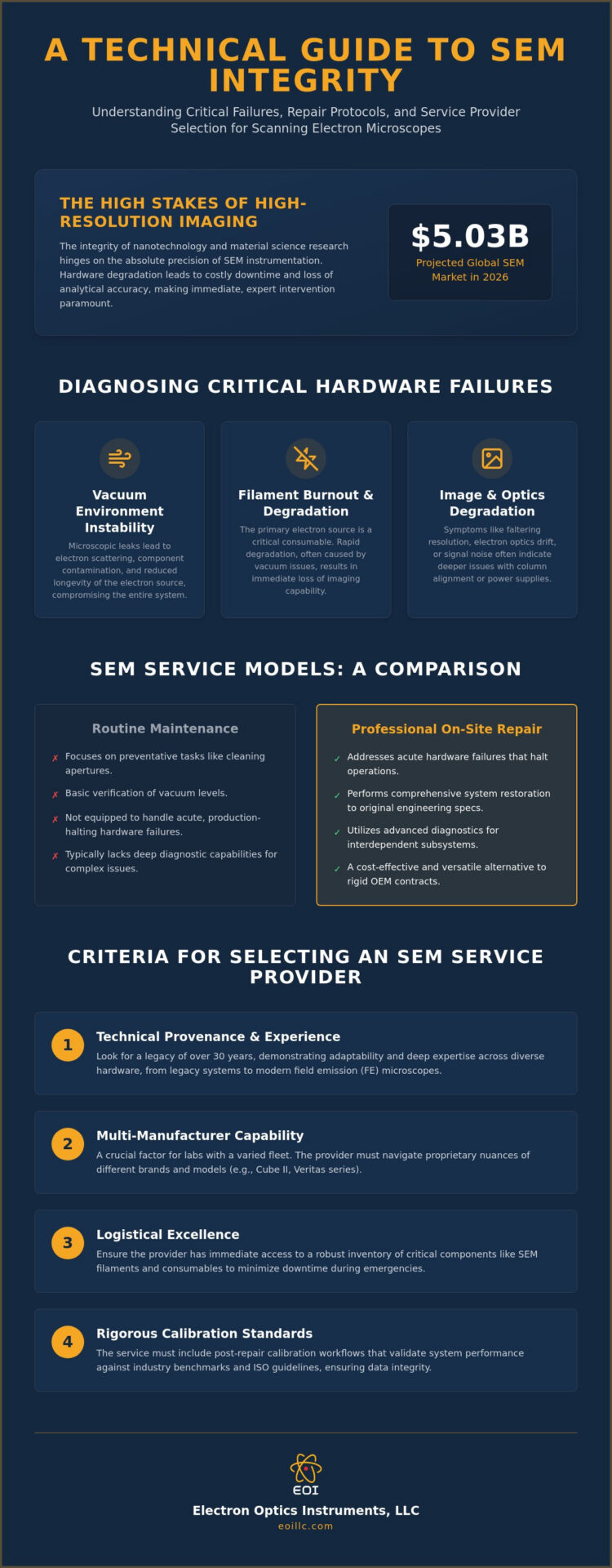
While routine preventative maintenance visits focus on the systematic cleaning of apertures and the verification of vacuum levels, professional repair addresses acute hardware failures that halt production. You must recognize when a subtle degradation in image resolution or a loss of analytical accuracy in EDS (Energy Dispersive Spectroscopy) systems signals an impending component failure. A comprehensive restoration ensures every subsystem, from the secondary electron detector to the mechanical stage, operates within its original engineering specifications. This level of meticulousness is essential for maintaining the integrity of data in high-stakes manufacturing and academic research settings.
Criteria for Selecting an SEM Service Provider
Selecting a partner for on-site SEM repair services involves evaluating their depth of experience across diverse hardware architectures. A provider should demonstrate a legacy of over 30 years of industry expertise, reflecting a history of adapting to the rapid evolution of electron microscopy. Multi-manufacturer capability is particularly crucial for laboratories managing a fleet of varied instruments, from benchtop models like the Cube II to high-resolution Veritas series systems.
Key considerations for your selection process include:
- Technical Provenance: The engineer’s ability to navigate the proprietary nuances of both legacy systems and modern field emission (FE) microscopes.
- Logistical Excellence: Immediate access to critical SEM filaments and consumables to minimize downtime during emergency calls.
- Calibration Standards: Adherence to rigorous protocols that validate system performance post-repair, ensuring compliance with international quality standards.
Relying on a seasoned innovator ensures that technical integration is handled with the precision required for large-scale production and sustainable industrial development.
Diagnosing Critical SEM Hardware Failures and Vacuum System Issues
The diagnostic phase of SEM restoration requires an analytical rigor that parallels the scientific research the equipment supports. Identifying the root cause of image degradation or system instability involves a systematic evaluation of several interdependent subsystems. Unlike simpler laboratory instruments, a failure in a scanning electron microscope is rarely isolated. A fluctuation in the power supply might manifest as signal noise, while a microscopic vacuum leak could lead to rapid filament degradation. Professional on-site SEM repair services provide the specialized diagnostic tools and technical intuition necessary to isolate these variables without risking further damage to sensitive electron optics.
Vacuum Environment Instability
Maintaining a high-vacuum environment is fundamental to preventing electron scattering and ensuring the longevity of the electron source. In compact systems like the Genesis tabletop SEM or the Cube II benchtop model, vacuum degradation often presents as increased pump-down times or visible “shadowing” on the sample surface due to hydrocarbon contamination. While older systems frequently utilized oil-based diffusion pumps, modern high-resolution units like the Veritas series rely on turbomolecular pumps to achieve the ultra-clean environments necessary for field emission sources. Outgassing, which is the spontaneous release of trapped gases from internal surfaces or samples under vacuum, remains a primary obstacle to achieving the stable pressures required for consistent imaging.
Electron Optics and Column Misalignment
Precision in electron microscopy is predicated on the perfect alignment of the electron beam through a series of electromagnetic lenses and apertures. As noted by the University of Maine CORE Electron Microscopy Laboratory, the operational integrity of these systems depends on both user training and rigorous maintenance. Over time, residual contaminants can accumulate on the inner walls of the column or within the apertures, causing beam deflection and severe astigmatism. This contamination reduces image clarity and analytical resolution, necessitating a professional cleaning and re-alignment of the electron optics. If you’re experiencing persistent drift or blurriness at high magnifications, it’s often a sign that your column requires expert attention. For laboratories seeking to restore their systems to peak performance levels, scheduling preventative maintenance visits or emergency repairs can prevent permanent damage to the electromagnetic lens assembly.
Beyond the column, detection system degradation represents a significant hurdle for quantitative analysis. Secondary electron (SE) detectors, essential for topographical detail, and backscattered electron (BSE) detectors, used for compositional contrast, are susceptible to aging and electronic noise. Addressing these glitches requires a deep understanding of signal processing boards and high-voltage power supplies. Expert on-site SEM repair services ensure that these components are calibrated to provide the accuracy required for sophisticated material characterization and industrial quality control.
Comparing SEM Service Models: On-Site Field Service vs. Service Contracts
Deciding between billable hourly labor and recurring maintenance agreements involves more than just a budgetary calculation; it’s a strategic assessment of risk and operational uptime. Industrial laboratories often require guaranteed service windows to prevent the cascading delays that follow a system failure. When you utilize professional on-site SEM repair services, you’re investing in a rapid restoration of functionality that minimizes the volatility of unpredictable capital expenditures. High-stakes environments, such as a world-class Electron Microscopy Core facility, demonstrate that the synergy between expert staff and reliable service models is essential for sustained scientific progress.
The Advantages of Tiered Service Contracts
Tiered service contracts provide a structured framework for long-term equipment stability by covering parts, labor, and travel expenses within a predictable annual fee. These agreements are particularly effective for managing high-resolution systems like the Veritas series or compact units such as the Cube II and Genesis tabletop models. By integrating scheduled preventative maintenance visits into the contract, you ensure that potential failure points are identified before they escalate into catastrophic hardware breakdowns. This proactive approach doesn’t just extend the equipment’s lifespan; it validates the system’s calibration against rigorous industry standards, ensuring that every scan remains accurate and reproducible.
Hourly Field Service for Specialized Repairs
There are instances where a specific hardware failure or a unique analytical glitch makes a one-time field service visit the most pragmatic choice. This model is often preferred for specialized repairs that fall outside the scope of routine upkeep, such as the replacement of a specific electronic board or a complex vacuum pump overhaul. Modern on-site SEM repair services often incorporate remote troubleshooting protocols to diagnose issues before the technician arrives, which significantly reduces on-site labor hours and improves the first-fix rate. To maximize efficiency during these visits, your laboratory should prepare by ensuring the system is accessible and that all relevant performance logs are available for review.
Balancing these two models requires a deep understanding of your facility’s specific throughput requirements and technical capabilities. For a more exhaustive analysis of how to protect your investment, consult The Definitive Guide to SEM Maintenance: Maximizing Precision and Longevity in 2026. Establishing a reliable service partnership is the most effective way to ensure your electron microscopy systems continue to deliver the precision your research demands without the threat of prolonged downtime.
Best Practices for Equipment Relocation and Post-Repair Calibration
The physical relocation of a scanning electron microscope represents a high-risk logistical operation that demands a level of meticulousness far exceeding standard industrial transport. Unlike general heavy machinery, the sensitive electron optics within a Veritas FE SEM or a Genesis tabletop model are susceptible to permanent misalignment from even minor vibrational shocks. Professional decommissioning protocols involve the mechanical stabilization of the electron column and the dampening of internal components to ensure that the structural integrity of the electromagnetic lenses remains uncompromised during transit. Without these precautions, the cost of restoring a system after a move can easily exceed the initial relocation budget.
Professional SEM Relocation Protocols
Successful relocation concludes only after a comprehensive suite of recalibration procedures is performed at the new installation site. The transition to a new environment often introduces variables in electromagnetic interference and floor vibration that require the fine-tuning of the isolation system. Expert on-site SEM repair services ensure that the vacuum integrity is re-verified and that the electron beam path is perfectly centered to restore original performance specifications. For a deeper understanding of maintaining peak performance during daily use, consult SEM Operation: The Professional Guide to Scanning Electron Microscopy in 2026. This structured approach to re-installation guarantees that your research or production timelines remain intact despite the complexities of facility upgrades.
Analytical Accuracy and System Validation
Following any significant hardware repair or relocation, the validation of analytical accuracy is a technical necessity. This process involves verifying resolution limits using standard reference materials, such as gold-on-carbon or tin-on-carbon, to ensure the system meets its documented engineering benchmarks. If your laboratory utilizes EDS (Energy Dispersive Spectroscopy) systems, the re-installation phase must include the recalibration of X-ray detectors to maintain precise elemental analysis. Precision is non-negotiable. Adhering to standards like ISO 16700:2016 for magnification calibration and ISO/TS 21383:2021 for quantitative measurement qualification ensures that your data remains defensible during regulatory audits.
Ensuring this level of compliance across all laboratory equipment is vital, and specialized providers like zenithinstruments.com.au offer the professional calibration services required to meet these rigorous industry standards.
To prevent recurring failures, it’s essential to integrate staff training into the post-repair workflow. Technicians should be briefed on any updated operating parameters or hardware modifications made during the service call. Documenting every step of the service history within a centralized management system provides the transparency required for long-term industrial excellence. By combining expert on-site SEM repair services with rigorous validation protocols, you protect the synergy between your technical infrastructure and your organization’s developmental goals. Contact Electron Optics Instruments to secure a professional relocation and calibration plan tailored to your specific instrumentation needs.
Electron Optics Instruments, LLC: National Authority in SEM Repair
Electron Optics Instruments, LLC represents a cornerstone of technical stability within the microscopy sector, offering a legacy of over 30 years of specialized experience. As the sole US distributor for EmCraft, our technical reach extends beyond sales to provide authoritative universal repair for all major SEM brands. Our national network of field service engineers delivers on-site SEM repair services that prioritize the rapid restoration of system functionality while maintaining the rigorous standards required for advanced material characterization. This national capability ensures that whether your facility operates in a metropolitan research hub or a remote industrial site, expert intervention is accessible, reliable, and grounded in logistical excellence.
Our approach to system restoration is visionary, focusing on the intersection of innovation and long-term reliability. We recognize that your laboratory’s throughput depends on the seamless integration of vacuum physics and electron optics. By maintaining a steady, expert-driven narrative of meticulousness, we’ve established ourselves as a reliable partner for B2B entities that value depth and technical prowess over superficial maintenance routines.
This dedication to technical precision often translates to other areas of professional infrastructure, such as high-end Bose and Epson audiovisual integration for corporate environments; you can learn more about SoundXcel for specialized solutions.
The EOI Advantage: Expert-Driven Technical Support
Technical excellence at EOI is driven by direct access to senior engineers who possess a profound understanding of the nuanced requirements of both compact systems, such as the Cube II and Genesis tabletop models, and high-performance units like the Veritas series. Our commitment to meticulousness ensures that every repair is more than a temporary fix; it’s a strategic enhancement of your laboratory’s operational stability. By focusing on precision and the strategic use of high-end components, we provide a cost-effective alternative to expensive OEM service calls, effectively maximizing the return on investment for your critical instrumentation. This expert-driven model allows us to resolve complex failures that general maintenance providers simply cannot address.
Securing Your SEM Service Solution
Initiating a technical assessment with EOI is a structured process designed to align our expertise with your specific laboratory requirements. Whether you require an emergency repair or a comprehensive system validation, our team provides detailed quotes that reflect the practical realities of international production and research. In instances where legacy hardware has reached a state where it’s no longer repairable, we offer a range of refurbished SEM units as a reliable and high-quality replacement option. Understanding the financial implications of these decisions is vital for corporate strategy and large-scale production planning. For a detailed analysis of current market trends and instrumentation investments, you may consult our guide on How Much Does an Electron Microscope Cost? A Comprehensive 2026 Price Guide.
Partnering with a leader in advanced hardware ensures that your technical systems are handled with the rigor they deserve. We don’t just restore equipment; we validate the future of your research. By choosing our on-site SEM repair services, you’re securing a synergy between technical integration and industrial performance that keeps your facility at the forefront of scientific discovery.
Advancing Analytical Precision Through Technical Excellence
Achieving consistent excellence in electron microscopy requires a proactive commitment to technical maintenance and authoritative hardware restoration. We’ve examined how the intersection of vacuum physics and electron optics demands a level of meticulousness that general industrial providers cannot replicate. By understanding the nuances of hardware diagnostics and selecting the appropriate service model, your facility can effectively mitigate the risks of prolonged downtime and analytical degradation. Whether you’re managing a high-resolution Veritas series system or a compact tabletop unit, the validation of system calibration remains the ultimate safeguard for your research integrity.
Securing professional on-site SEM repair services is a strategic investment in the longevity of your laboratory’s most sensitive instrumentation. Electron Optics Instruments provides a stable foundation for your technical operations by leveraging over 30 years of microscopy expertise and acting as the sole US distributor for EmCraft. Our national service coverage ensures that universal repair support is available for all major SEM brands, providing the reliability you need to push the boundaries of industrial innovation. You don’t have to navigate the complexities of system failure alone. Request Expert SEM Repair Services from Electron Optics Instruments to restore your systems to their peak engineering specifications. We’re here to ensure your laboratory continues to deliver the precision required for the next generation of scientific advancement.
Frequently Asked Questions
What are the signs that my SEM requires professional repair rather than just maintenance?
Indicators of systemic hardware failure include persistent electromagnetic drift, the inability to reach target vacuum pressures, or catastrophic filament burnout. While routine maintenance ensures apertures remain clean and aligned, professional repair is required when core subsystems fail to meet original engineering specifications. Identifying these markers early prevents the degradation of analytical integrity and protects sensitive electron optics from compounding damage.
Can you provide repair services for SEM models from other major manufacturers?
Universal repair capabilities are offered for all major SEM manufacturers, leveraging over 30 years of specialized experience in electron microscopy. As the sole US distributor for EmCraft, our expertise encompasses benchtop models, tabletop units, and the high-resolution Veritas series. This multi-manufacturer proficiency ensures that varied laboratory environments receive consistent, authoritative technical support regardless of the original equipment’s provenance.
How long does a typical on-site SEM repair service visit take?
A typical visit for on-site SEM repair services generally spans one to two business days, though the exact duration depends upon the complexity of the hardware failure. Simple column alignments or filament replacements are often resolved within hours, whereas comprehensive vacuum system overhauls or electronic board diagnostics may require extended technical engagement. Every visit is structured to minimize laboratory downtime while validating the system’s operational stability.
What is included in an SEM preventative maintenance visit?
A preventative maintenance visit involves a meticulous evaluation of the vacuum manifold, cleaning of the final apertures, and verification of the system’s resolution limits. Engineers also assess the integrity of EDS (Energy Dispersive Spectroscopy) systems and replace critical consumables such as filaments when necessary. This proactive approach acts as a strategic safeguard against unpredictable hardware failures and extends the equipment’s lifespan through rigorous technical integration.
Is it possible to repair the vacuum system on a benchtop SEM?
Vacuum system restoration is indeed possible for benchtop and tabletop models, including the Cube II and Genesis series. These compact systems utilize sophisticated pumping architectures that require specialized knowledge of vacuum physics to troubleshoot effectively. Expert on-site SEM repair services include the detection of microscopic leaks and the replacement of failing turbomolecular or diaphragm pumps to restore the clean high-vacuum environment necessary for precision imaging.
Do you provide on-site technical training for laboratory staff after a repair?
Technical briefings for laboratory staff are standard protocol following any major system restoration or component replacement. This training ensures that users understand updated operating parameters and post-repair calibration requirements to prevent recurring user-error failures. Providing this authoritative guidance reinforces the synergy between advanced hardware and the researchers who operate it, fostering a culture of meticulousness and operational excellence.
What is the typical turnaround time for critical SEM component replacements?
Turnaround times for critical component replacements are highly dependent upon part availability, though common consumables like filaments are typically stocked for immediate deployment. For more complex components, such as power supply boards or specialized detectors, the logistical timeframe is dictated by global supply chain realities. Our strategic focus remains on securing high-end parts rapidly to restore your system’s performance and maintain international production standards.
How do I determine if my SEM failure is hardware-related or a software glitch?
Determining the nature of a system failure involves isolating physical symptoms from software-driven glitches through a series of diagnostic tests. Hardware failures often manifest as audible vacuum leaks, visual noise in the secondary electron signal, or physical stage movement errors. Software issues are more likely to present as graphical user interface freezes or data processing errors, which can sometimes be addressed through remote technical support before a field visit is scheduled.