
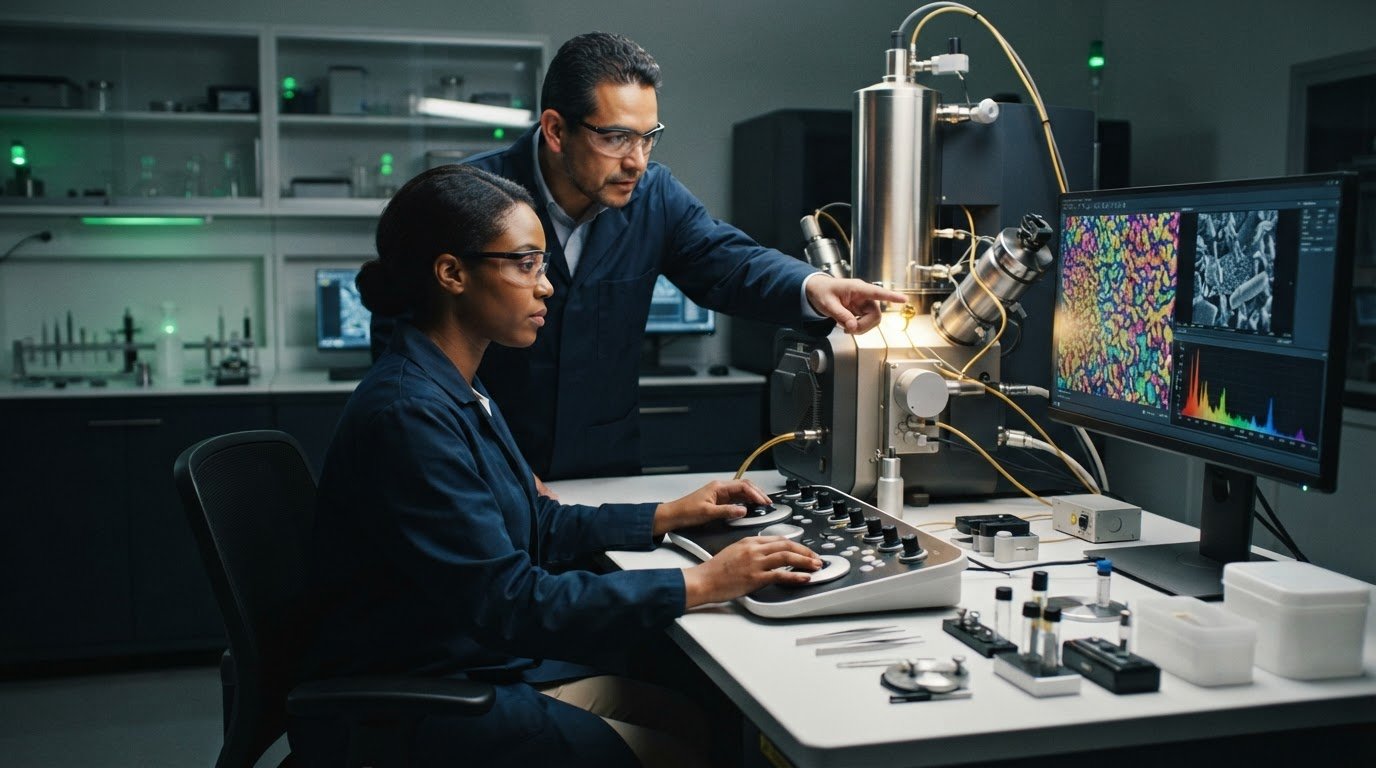
Passive tool demonstrations don’t cultivate dependable electron microscopists; they merely produce operators who memorize which software controls to avoid. High-vacuum columns and sensitive electron sources demand systematic operational reflexes rather than ad-hoc trial and error. If your facility regularly contends with vacuum degradation, premature filament blowouts, or mismatched micrograph resolution between shifts, you already know that informal onboarding leaves costly technical liabilities. Establishing a structured sem operator training program is the only proven method to translate fundamental electron optics theory into disciplined, repeatable instrument execution.
In this guide, you will learn how to design, execute, and evaluate a comprehensive sem operator training program that ensures imaging precision, eliminates specimen contamination, and protects column integrity. We examine a four-tier qualification framework aligned with ISO/IEC 17025 personnel competency benchmarks, rigorous milestones for beam alignment and EDS microanalysis, and the standardized evaluation protocols required to cultivate fully self-sufficient analysts across your organization.
Key Takeaways
- Implementing a structured sem operator training program protects delicate column hardware and electron sources by replacing informal shadowing with documented, standardized competency milestones.
- A modular four-tier syllabus establishes clear operational boundaries, progressing analysts methodically from basic secondary electron imaging to advanced analytical spectroscopy and beam alignment.
- Standardized sample preparation protocols eliminate charging artifacts, hydrocarbon contamination, and vacuum degradation before specimens ever enter the sample chamber.
- Objective evaluation frameworks using blind resolution tests and international calibration standards ensure full alignment with ISO/IEC 17025 laboratory competency mandates.
- Deploying training on accessible benchtop platforms accelerates core technical qualification while preserving advanced floor-model beam time for high-level microanalysis.
Foundations of an Industrial SEM Operator Training Program
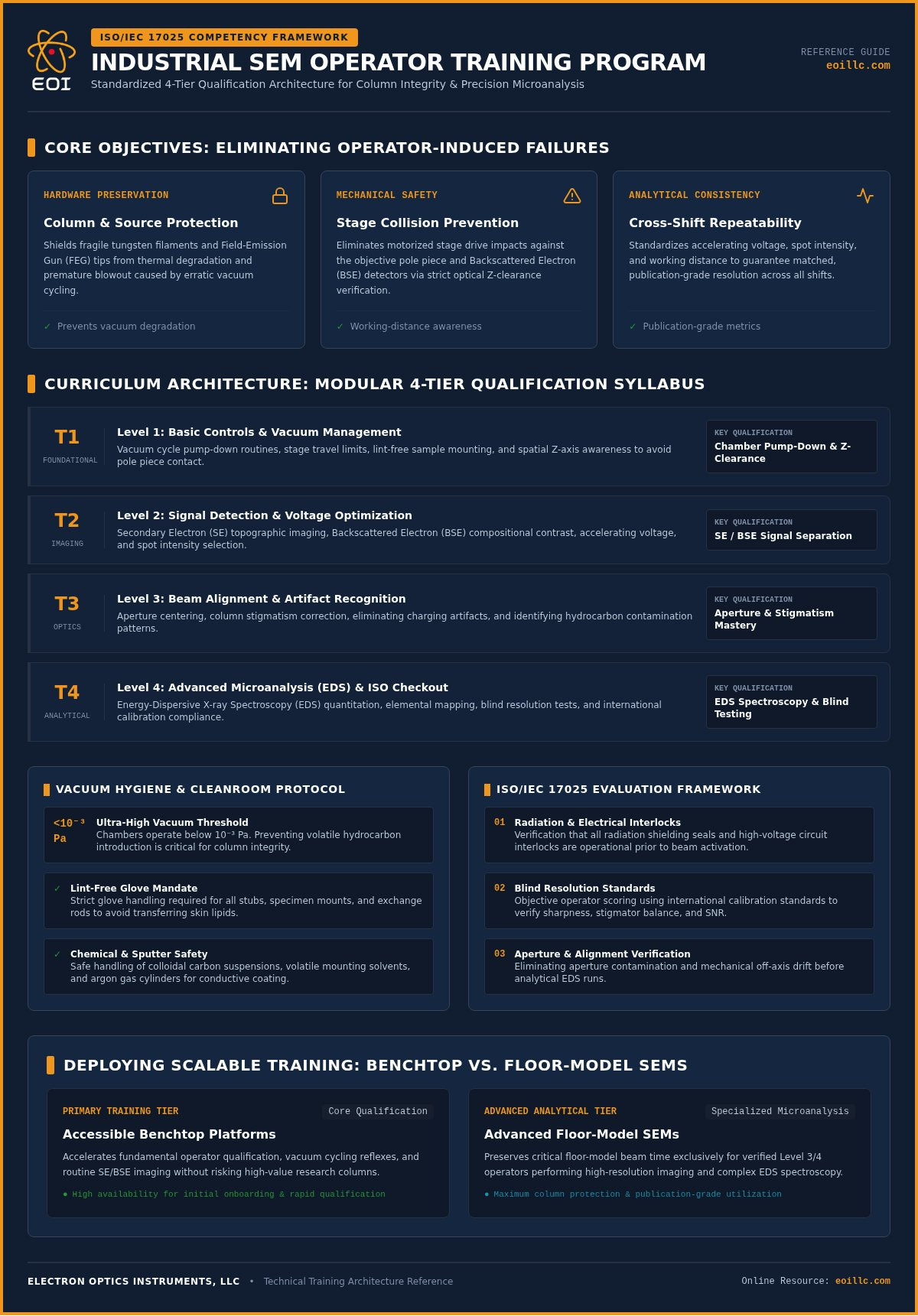
An industrial sem operator training program represents a formal, staged qualification architecture designed to transition personnel from rudimentary tool familiarity to verifiable analytical competence. Rather than relying on informal peer shadowing, which often perpetuates suboptimal habits across rotating shifts, a standardized syllabus establishes rigorous operating baselines. Electron optical instruments integrate high-vacuum assemblies, sensitive electromagnetic lenses, and fragile thermal or field-emission electron sources. Structured instruction prevents preventable hardware failures, shielding delicate components such as tungsten filaments and field-emission gun (FEG) tips from premature thermal degradation while ensuring consistent, publication-grade micrograph resolution across the enterprise.
Core Objectives of Structured Microscope Instruction
Modern electron microscopy combines deep theoretical principles with automated digital interfaces. The primary mandate of a formal training framework is to bridge electron optics theory with daily instrument software controls, eliminating operator-induced mechanical accidents. Untrained technicians frequently risk column-venting errors, aperture contamination, or catastrophic stage collisions against the objective pole piece and backscattered electron detectors. Establishing standardized protocols links foundational knowledge directly to validated SEM operation benchmarks, transforming mechanical tasks into methodical, defensive routines.
- Eliminate stage drive collisions through rigorous working-distance awareness and optical z-clearance verifications.
- Prevent filament thermal shock and gun-chamber contamination via disciplined vacuum pump-down routines.
- Ensure cross-shift micrograph repeatability by standardizing accelerating voltage selection, spot intensity, and working distance parameters.
Prerequisites and Laboratory Safety Fundamentals
Before touching a control console, trainees must master foundational physics, vacuum hygiene, and cleanroom handling protocols. High-voltage generation inside the electron column presents potential electrical hazards, requiring full comprehension of instrument radiation interlocks and vacuum safety switches. Furthermore, the longevity of ultra-high vacuum columns depends entirely on preventing volatile hydrocarbon introduction during sample insertion.
- Radiation and Electrical Interlocks: Operators must verify that all radiation shielding seals and high-voltage circuit interlocks remain fully operational prior to beam energization.
- Vacuum System Hygiene: Candidates learn strict lint-free glove handling for stubs, specimen mounts, and exchange rods to avoid introducing skin lipids into chambers operating below 10-3 Pa.
- Chemical and Sputter Safety: Instruction covers the safe handling of volatile mounting solvents, colloidal carbon suspensions, and argon gas cylinders utilized in conductive sputter-coating systems.
Establishing these safety baselines at the inception of a sem operator training program ensures that every subsequent operational milestone rests on a foundation of hardware preservation and regulatory compliance.
Curriculum Architecture: A Modular 4-Tier SEM Training Syllabus
Academic checkout models and vendor sales materials rarely provide an actionable blueprint for industrial qualification. To eliminate operational blind spots, an effective sem operator training program relies on a modular, four-tier syllabus. This architecture establishes defined boundaries, restricting complex adjustments until foundational hardware manipulation becomes second nature. Technicians advance through measurable stages, systematically building technical intuition across electron beam behavior, multi-detector setups, and analytical spectroscopy.
Level 1 & 2: Primary Controls, Detectors, and Vacuum Cycling
Initial instruction focuses on mechanical survivability and fundamental signal collection. Level 1 isolates chamber vacuum cycles, motorized stage limits, and Secondary Electron (SE) collection. Trainees must demonstrate instinctive spatial awareness along the Z-axis, verifying clearances before driving stages to short working distances where pole piece damage risk peaks.
Level 2 introduces the Backscattered Electron (BSE) detector, shifting focus from pure surface topography to compositional contrast. Candidates learn how high-energy elastic backscattering reveals differences in mean atomic number (Z-contrast), establishing the criteria for selecting solid-state quadrant detectors over standard Everhart-Thornley detectors depending on matrix density.
- Level 1 (Core Operation): Chamber pump-down cycles down to working pressures, manual and joystick-driven stage translation, beam generation, and SE focus optimization below 10,000× magnification.
- Level 2 (Analytical Contrast): BSE segment balancing, compositional phase differentiation, topography-versus-composition mode switching, and low-vacuum charge dissipation routines.
Level 3 & 4: Beam Alignment, Astigmatism, and Microanalysis
Upper-tier certification addresses fine probe formation and microanalytical characterization. Level 3 demands manual mastery over lens aberrations. Operators diagnose stigmatism at 20,000× to 50,000× by observing directional stretching during through-focus sweeps, applying orthogonal stigmator corrections to achieve circular beam profiles. This tier also introduces beam deceleration and low-accelerating-voltage protocols to resolve delicate nanometer features without penetrating substrate layers.
Level 4 integrates Energy Dispersive X-ray Spectroscopy (EDS). Here, analysts balance accelerating voltage against critical ionization energies, selecting appropriate dead times between 20% and 40% to prevent pulse pile-up. Understanding these interactions prepares personnel for the rigorous characterization workflows detailed in advanced SEM techniques.
- Level 3 (Beam Mastery): Gun tilt and shift alignment, objective aperture centering, through-focus stigmator correction, and working distance optimization.
- Level 4 (EDS Microanalysis): Dead-time throttling, quantitative ZAF and Phi-Rho-Z corrections, peak deconvolution, elemental line scans, and high-throughput drift-corrected hypermaps.
Structuring your sem operator training program around this four-tier framework guarantees that instrument users possess validated competencies at every operational stage. To supplement internal qualification efforts with factory-certified instruction, labs often partner with EOI LLC to conduct structured, on-site technical training sessions.
Specimen Preparation and Artifact Recognition Protocols
Micrograph distortion rarely originates from lens aberrations alone. In practice, defective specimen preparation causes the vast majority of non-reproducible scans, column contamination, and image blur. A complete sem operator training program must treat sample staging with the same technical rigor applied to beam alignment. When novices insert insufficiently grounded, oily, or outgassing materials into the chamber, they do not just corrupt their own micrographs; they foul final apertures and degrade gun vacuum levels for every subsequent user.
Specimen Mounting, Outgassing, and Sputter Coating Standards
Achieving stable high-vacuum imaging requires strict grounding and stabilization protocols. Candidates must learn to match mounting media to specimen geometry, choosing between double-sided conductive carbon tape, copper bridges, and colloidal silver paint to establish low-resistance discharge paths to the aluminum stub. For volatile or porous specimens, strict desiccation regimes prevent prolonged pump-down cycles that tax turbomolecular pumps.
- Substrate Grounding: Ensure uninterrupted conductive paths from the upper sample plane to the stage receptacle, eliminating high-resistance boundaries that induce localized voltage spikes.
- Sputter Deposition Parameters: Calibrate noble metal coatings (Au, Au-Pd, or Pt) between 2 nm and 10 nm for high-resolution topographical work to prevent grain clustering from masking sub-micron features.
- Carbon Evaporation: Enforce 15 nm to 25 nm carbon coatings for quantitative EDS to eliminate heavy-metal X-ray line absorption and background continuum distortion.
Identifying and Resolving Common Imaging Anomalies
Distinguishing actual microstructural morphology from physical artifacts forms the core of interpretive training. Technicians frequently misidentify charging anomalies as real topological variations. Unbalanced negative surface charge creates bright tracking flares, image tearing, and electron probe deflection. Operators must master practical remedies: dropping accelerating voltages below the sample’s second crossover point, reducing probe current, or introducing low-vacuum conditions between 10 Pa and 150 Pa.
Beyond electrostatic charging, trainees must systematically isolate environmental disruptions. Image elongation along a single scan axis signals high-frequency mechanical vibration from adjacent compressors, while cyclic sawtooth distortion reveals 60 Hz stray electromagnetic fields. Recognizing hydrocarbon cracked deposits (“beam burn” squares) teaches analysts to clean stubs properly rather than blaming detector sensitivity. Integrating these root-cause diagnostics into your sem operator training program instills the daily defensive routines covered in standard SEM maintenance protocols, ensuring stable imaging environments across the lab.
Evaluating Operator Competency: Objective Assessment Checklists
Informal checkout demonstrations introduce subjective bias that jeopardizes analytical integrity. In contrast, an accredited sem operator training program employs empirical assessment metrics aligned with ISO/IEC 17025 Clause 6.2 mandates. Laboratories must establish transparent scoring rubrics that evaluate a technician’s technical reflexes under real operating constraints, ensuring that solo keycard privileges reflect validated instrument stewardship rather than mere attendance.
Practical Examination and Time-to-Resolution Metrics
Standardized practical evaluations require candidates to execute precise alignment protocols under observation. Rather than allowing indefinite tweaking, programs should enforce strict time-to-resolution thresholds on unknown reference specimens. Candidates must rapidly diagnose optical anomalies and establish optimized imaging conditions without supervisor intervention.
- Stigmation and Focus Velocity: The candidate must correct severe orthogonal astigmatism and achieve sharp focus on a gold-on-carbon resolution standard at 30,000× magnification within five minutes.
- Aperture Alignment Stability: The operator must center the physical objective aperture across voltage transitions (such as stepping from 15 kV down to 1 kV) without inducing visible beam shift or field clipping.
- Vacuum and Stage Discipline: Trainees must verify stage homing coordinates, confirm load-lock interlock cycles, and ensure chamber vacuum levels meet high-vacuum baseline criteria prior to gun ramp-up.
- Emergency Response Audit: Candidates must demonstrate immediate, correct reflexes during simulated chiller failures, sudden vacuum pressure spikes, or pneumatic stage stalls.
Logbook Governance and Continuing Skill Audits
Initial certification marks the beginning of operational governance, not its conclusion. Facilities maintain long-term imaging accuracy through mandatory digital logbooks that track accelerating voltages, cumulative beam hours, chamber base pressures, and gun emission profiles. These records establish an auditable trail that isolates anomalies before they trigger hardware faults.
To ensure consistent quality across changing shifts, management should schedule annual proficiency audits. These evaluations test operators on updated system patches, newly integrated detectors, and blind sample resolution metrics using certified reference grids. Unreported vacuum crashes, broken stage limits, or repeated aperture fouling must result in the immediate revocation of independent access until remediation occurs. If your facility seeks to build or audit its internal qualification frameworks, contact EOI LLC for expert guidance on implementing factory-level training standards across your operations.
Deploying Scalable Training Across Modern Benchtop and Floor SEMs
Scaling institutional microscopy expertise across production shifts requires matching instrument hardware to operator development stages. Relying exclusively on complex floor-model systems for entry-level onboarding creates severe bottlenecks, tying up high-end analytical beam time while exposing delicate vacuum manifolds to novice error. Integrating compact benchtop platforms into an industrial sem operator training program flattens the learning curve. Technicians build baseline confidence on accessible platforms before advancing to demanding multi-user field emission systems.
Benchtop vs. Floor-Model Training Considerations
Modern compact instruments eliminate much of the apprehension associated with high-vacuum electron optics. Intuitive platforms like the Cube II Benchtop SEM or Genesis Tabletop SEM utilize streamlined software interfaces and automated pump-down cycles that isolate trainees from accidental column venting. Hardware-level interlocks and motorized stage limiters prevent mechanical collisions, allowing candidates to master astigmatism correction, focus balancing, and brightness settings without fear of damaging expensive pole piece assemblies.
Once operators achieve baseline competency on a desktop SEM, transitioning to advanced platforms becomes a methodical step rather than an overwhelming leap. Technicians transfer their established optical reflexes directly to floor-standing columns such as the Veritas Series SEM, including specialized configurations like the Veritas FE SEM or Veritas Ultra SEM. This tiered hardware deployment protects primary research instrumentation while maintaining steady operator throughput.
Partnering for Professional On-Site Operator Certification
While internal curricula establish routine operational cadence, external vendor collaboration ensures technical instruction aligns with rigorous engineering standards. Partnering with seasoned field specialists brings factory-level insight directly into your production environment, tailoring hands-on modules to your facility’s exact specimen matrices, whether analyzing metallurgical cross-sections, polymer blends, or semiconductor wafers.
- Application-Specific Protocols: Expert instructors structure practical workflows around your proprietary parts, optimizing accelerating voltage and beam current parameters for your exact material densities.
- Hardware Preservation: Hands-on coaching instills disciplined preventative care routines, showing operators how proper column hygiene safeguards sensitive tungsten, LaB6, and Schottky field-emission sources.
- Standardized Qualification: Professional instruction delivers auditable documentation confirming that technicians meet internal quality management benchmarks before working unassisted.
Embedding certified vendor instruction into your sem operator training program bridges theoretical optics and industrial production, establishing self-reliant microscopy teams capable of safeguarding hardware while generating repeatable, high-resolution data.
Standardizing Electron Optics Proficiency for Next-Generation Labs
Transforming routine instrument operation into reproducible scientific precision requires moving beyond informal demonstrations. A structured sem operator training program establishes the defensive protocols needed to safeguard high-vacuum columns, prevent costly source degradation, and generate repeatable, publication-grade micrographs across every shift. When technicians advance through defined competency tiers and verified artifact diagnostics, laboratories secure both ISO-compliant traceability and sustained operational throughput.
Achieving this level of organizational self-reliance becomes seamless with the right technical partner. Backed by over three decades of technical expertise servicing and supporting electron microscopes across domestic facilities, Electron Optics Instruments provides customized on-site instruction tailored specifically to your industrial QA/QC and research personnel. As an authorized US distributor for high-performance benchtop and floor-standing SEM solutions, EOI equips your staff with the operational reflexes required to protect critical equipment while maximizing analytical output. Explore On-Site SEM Training Programs with Electron Optics Instruments and establish lasting imaging precision across your facility.
Frequently Asked Questions
How long does a comprehensive SEM operator training program typically take?
A comprehensive sem operator training program typically spans two to four weeks depending on candidate background and instrument complexity. Initial classroom optics instruction and safety orientation consume the first week. Trainees then dedicate 15 to 25 supervised beam hours over the following weeks toward alignment, stigmation, and specimen staging before completing their independent certification exams.
What is the difference between basic and advanced SEM operator certification?
Basic certification qualifies technicians for routine secondary electron imaging, low-to-moderate magnification adjustments, and safe vacuum chamber exchange protocols. Advanced certification authorizes operators to perform gun alignments, low-kV beam deceleration, orthogonal stigmation on challenging non-conductive specimens, and quantitative Energy Dispersive Spectroscopy (EDS) microanalysis using complex background filtering and peak deconvolution models.
Can non-scientific technicians learn to operate a benchtop SEM safely?
Non-scientific technicians can quickly master safe benchtop operation when guided by standardized standard operating procedures. Instruments such as the Cube II Benchtop SEM incorporate automated vacuum routines, fixed optical limits, and collision interlocks that protect internal components. This hardware-level protection allows quality assurance personnel to mount specimens and execute routine dimensional inspections without risking pole piece damage.
How often should trained SEM operators undergo refresher training or recertification?
Certified microscopists should complete formal competency audits on an annual basis to satisfy ISO/IEC 17025 compliance guidelines. Annual reviews verify that analysts maintain sharp alignment reflexes, execute proper vacuum chamber hygiene, and understand new firmware enhancements. Immediate recertification should also occur if an unrecorded vacuum fault, stage drive overload, or aperture fouling incident occurs during an operator shift.
What sample preparation competencies must be included in operator training?
An effective sem operator training program must teach mechanical mounting, conductive bridge placement, volatile desiccation, and noble metal sputter coating. Technicians must demonstrate how to measure coating thickness between 2 nm and 10 nm to prevent topography masking. They must also identify outgassing risks from porous substrates to avoid contaminating column apertures during routine chamber pump-down cycles.
How do modern benchtop SEMs simplify the training process for new operators?
Modern benchtop SEMs flatten the learning curve through simplified touch-screen graphical user interfaces, automated focus routines, and integrated optical navigation cameras. By presenting essential voltage and beam parameters without confusing multi-lens alignment arrays, these compact instruments allow entry-level technicians to build foundational microscopy reflexes rapidly before transitioning to larger, high-vacuum floor-standing columns.