

Can a laboratory truly afford the perceived savings of a reactive maintenance model when a single electron column misalignment can jeopardize months of critical research data? For many facility directors, the decision regarding an sem service contract vs time and materials is often framed as a simple budgetary preference, yet this choice fundamentally dictates the long-term viability of your high-precision hardware. You’re likely familiar with the stress of balancing unpredictable fifteen thousand dollar repair bills against the necessity of maintaining nanometer-scale resolution. It is a complex equilibrium where the stakes include both your fiscal integrity and the prevention of weeks of downtime that halt institutional progress.
This 2026 ROI guide analyzes the technical and financial trade-offs between structured service agreements and reactive repair models to secure your laboratory’s analytical throughput. We’ll demonstrate how proactive protocols convert technical volatility into a predictable annual budget while maximizing the fifteen to twenty year lifespan of your Veritas or Cube II systems. By examining the synergy between preventative maintenance and logistical excellence, we provide a framework for prioritizing priority response times and sustained instrument performance through expert-driven narrative and technical meticulousness.
Key Takeaways
- Transitioning from reactive “break-fix” models to structured performance protocols ensures that analytical throughput remains uninterrupted by technical volatility.
- Determining the optimal sem service contract vs time and materials approach requires a meticulous analysis of instrument age and the specific resolution requirements of your research.
- Systematic preventative maintenance preserves nanometer-scale precision by proactively managing vacuum integrity and mitigating the column contamination that leads to resolution loss.
- Multi-tiered coverage options allow laboratories to align their maintenance strategies with institutional throughput metrics and long-term capital equipment lifecycle goals.
- Strategic partnerships for systems like the Veritas Series SEM and Cube II Benchtop SEM leverage factory-trained expertise to maintain peak operational efficiency for decades.
The Strategic Role of SEM Service Contracts in Modern Microscopy
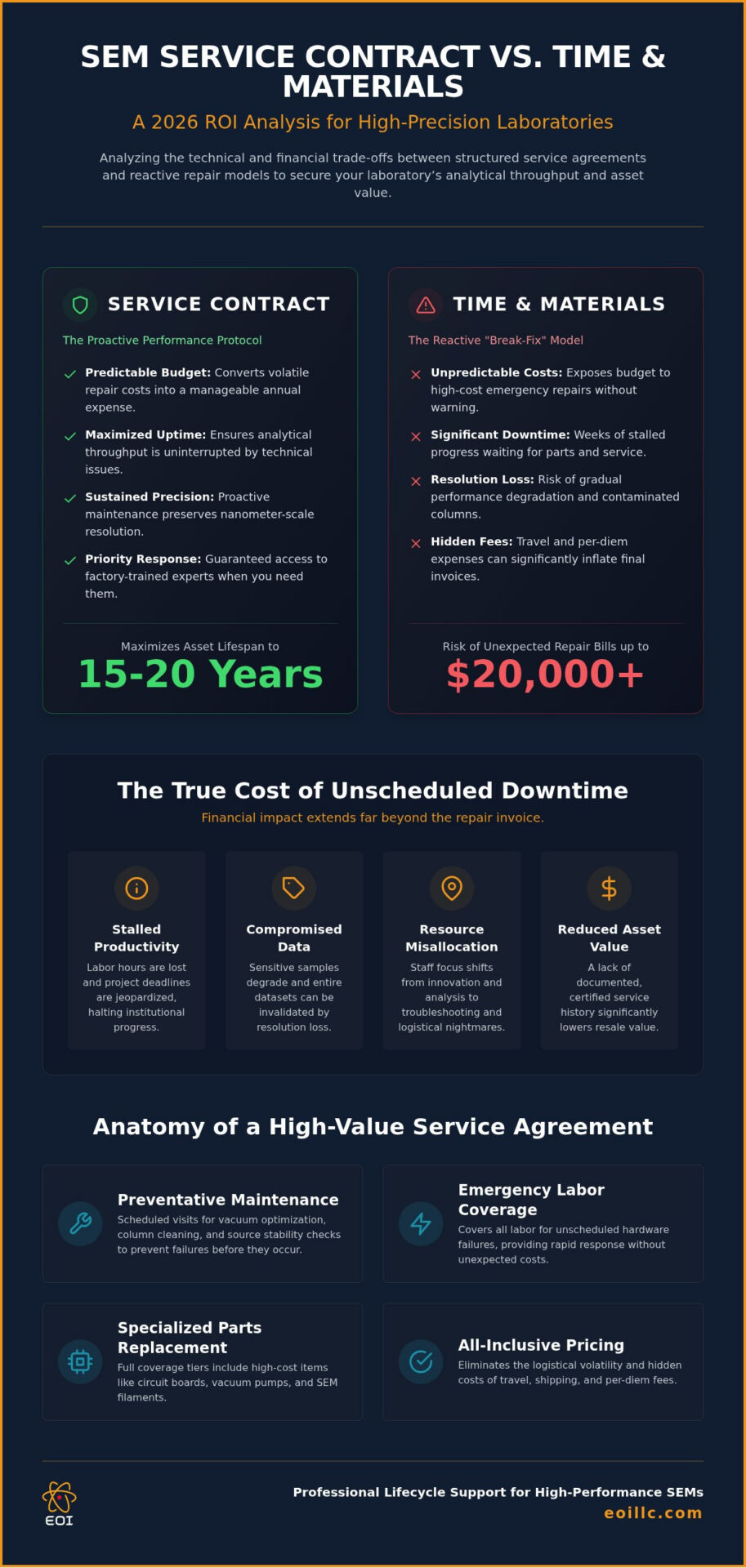
The decision between an sem service contract vs time and materials represents a fundamental choice between institutional risk mitigation and reactive financial exposure. A structured service agreement functions as a proactive uptime management protocol, shifting the focus from the antiquated “break-fix” mentality toward a paradigm of sustained performance. As the technical complexity of the scanning electron microscope (SEM) continues to escalate, the necessity for structured maintenance becomes undeniable. By formalizing support, laboratories convert the potential for twenty thousand dollar emergency optic repairs into a predictable, manageable operating expense. This stability is vital for maintaining the nanometer-scale precision required by 2026 industrial standards, where even minor resolution degradation can invalidate entire datasets. Such meticulousness ensures that every analytical session yields the highest possible standards of accuracy and reliability.
The True Cost of Unscheduled SEM Downtime
In high-throughput failure analysis environments, the financial impact of a non-functional SEM extends far beyond the immediate repair invoice. Calculating lost productivity requires an assessment of labor hours stalled and the potential for compromised sample stability when sensitive materials await analysis. Project deadlines don’t pause for hardware failures. Beyond the balance sheet, a service contract provides a psychological anchor for laboratory personnel. Knowing that priority response times are guaranteed allows staff to focus on analytical innovation rather than troubleshooting vacuum leaks or source alignments. It’s this synergy between operational readiness and technical expertise that defines a leading laboratory environment.
Lifecycle Management and Capital Asset Value
Strategic lifecycle management begins the moment an instrument transitions out of its initial warranty period. This first year is the most critical inflection point for establishing a long-term service trajectory. A documented, factory-certified service history doesn’t just ensure daily reliability; it significantly enhances the resale value of refurbished SEM units in the secondary market. Integrating these agreements into the initial acquisition strategy for a desktop sem ensures that the instrument remains a high-value asset throughout its fifteen to twenty year operational lifespan. This foresight transforms a capital expenditure into a resilient, high-performance analytical engine that maintains its integrity through decades of intensive use.
Anatomy of a High-Value SEM Service Agreement
A high-value service agreement transcends basic insurance; it’s a comprehensive framework for technical reliability and institutional progress. When evaluating an sem service contract vs time and materials, the distinction lies in the inclusion of critical components:
- Preventative maintenance visits aimed at vacuum integrity and source stability.
- Emergency labor coverage for unscheduled hardware failures.
- Specialized parts replacement including circuit boards and high-voltage power supplies.
Full coverage tiers typically encompass high-cost items such as circuit boards and vacuum pumps; labor-only agreements provide a more targeted fiscal hedge for institutions with significant in-house parts inventories. A significant advantage of structured agreements is the inclusion of specialized SEM filaments and consumables, ensuring that apertures and sources are replaced before resolution loss occurs. Contracts also eliminate the logistical volatility of travel and per-diem fees. These expenses often act as hidden multipliers in reactive T&M quotes, causing final invoices to deviate significantly from initial estimates.
Preventative Maintenance (PM) Protocols
Preventative Maintenance (PM) Protocols are the cornerstone of instrument longevity and data integrity. These meticulous interventions involve column cleaning to remove carbon deposits and vacuum optimization to ensure electron source stability. Aligning apertures and calibrating against NIST-traceable standards guarantees that measurements remain accurate to international benchmarks. Frequency should mirror throughput. A Veritas HR SEM in a 24/7 industrial facility requires more frequent interventions than a low-utilization academic unit to maintain peak performance. These visits are not mere check-ups; they are essential restoration events that return the system to its factory-specified tolerances. To ensure your hardware maintains this level of precision, you can explore the comprehensive support tiers available for modern microscopy systems.
Priority Response and Technical Support Tiers
Priority Response and Technical Support Tiers define the speed of recovery and the preservation of research timelines. High-value contracts offer 24-hour on-site guarantees, ensuring that critical research doesn’t stall for extended periods. In 2026, the integration of AR-assisted remote diagnostics allows engineers to visualize hardware failures in real-time. This often allows for the resolution of vacuum or software issues without a physical site visit. For complex electron optics failures, established escalation paths ensure that factory-trained specialists are deployed immediately to restore analytical capability. This methodical approach to troubleshooting minimizes the downtime associated with traditional diagnostic cycles, providing a stable foundation for institutional research and development.
Preventative Maintenance vs. Reactive Repair: A Performance Analysis
Analyzing the technical trade-offs of an sem service contract vs time and materials reveals that reactive models often ignore the underlying degradation of critical subsystems. In a reactive repair environment, technicians address isolated failures without considering the interdependencies of the electron optical column. This approach frequently triggers cascading hardware failures. For example, a minor vacuum seal leak might not stop an instrument immediately, but the resulting atmospheric ingress increases the partial pressure of oxygen, which rapidly accelerates filament burnout. By the time a “break-fix” repair is initiated, the laboratory faces multiple component replacements rather than a single seal adjustment. Reactive repair is inherently inefficient.
Long-term data suggests that instruments maintained through structured annual protocols consistently achieve a fifteen to twenty year operational lifespan. Conversely, systems relying on time and materials often face terminal obsolescence much earlier due to cumulative column contamination. This contamination doesn’t just impact resolution; it necessitates aggressive, high-cost cleaning procedures that can eventually damage sensitive apertures and liners. Meticulousness in maintenance is the only path to sustained analytical throughput.
Vacuum System Integrity and Pump Longevity
Maintaining vacuum integrity is the primary defense against premature component failure. Engineers monitor oil-sealed pumps for particulate accumulation and dry scroll pumps for tip seal wear during routine visits. Proactively replacing a vacuum seal is a minor operational expense, whereas the catastrophic failure of a turbo-molecular pump represents a significant capital loss. Vacuum leaks introduce atmospheric contaminants that destabilize the electron beam through increased scattering and ionization events. This instability directly compromises the precision of Energy Dispersive Spectroscopy (EDS) and high-magnification imaging.
Optimizing the Electron Optical Path
The accumulation of carbonaceous deposits on apertures and column liners is an inevitable byproduct of electron beam interaction with residual hydrocarbons. These deposits cause beam charging, which manifests as image drift and resolution degradation. Routine cleaning protocols restore the signal-to-noise ratio, ensuring that the Veritas Series or Cube II systems continue to meet their original technical specifications. For detailed procedures on maintaining these standards, laboratory managers should consult the definitive guide to SEM maintenance. Consistent intervention prevents the “snowball effect” of contamination, where neglected surfaces become increasingly difficult to restore to nanometer-scale precision.
Evaluation Framework: Choosing the Right Coverage for Your Lab
Selecting the appropriate maintenance strategy requires a technical assessment of the laboratory’s specific operational parameters rather than a generic budgetary preference. The age of the instrument serves as a primary indicator of risk; while a newly installed system may perform reliably under a reactive model, older units inevitably face the degradation of high-voltage components and vacuum seals. For these legacy systems, the decision regarding an sem service contract vs time and materials favors the structured agreement, as the cost of a single major board failure often exceeds the annual premium of a comprehensive parts-and-labor plan. This meticulous approach to risk management ensures that technical volatility does not disrupt institutional research goals.
Throughput metrics further refine this evaluation. Industrial facilities operating in high-volume failure analysis or quality control sectors prioritize uptime above all other variables. In these environments, the “EDS Factor” must be considered; analytical capabilities are only as resilient as the Energy Dispersive Spectroscopy (EDS) systems integrated with the column. A failure in the EDS detector or its cooling interface can halt production as effectively as a column misalignment. Ensuring that both the SEM and its analytical attachments are covered under a unified agreement prevents the logistical friction of coordinating multiple service events and disparate invoices.
Multi-Brand Service Integration
Modern laboratories frequently maintain a heterogeneous fleet of instruments, often incorporating JEOL, Hitachi, and EmCraft units within a single facility. Managing individual OEM contracts for each manufacturer introduces significant administrative overhead and complicates the scheduling of preventative maintenance. A single-source service provider offering multi-brand integration streamlines these complexities into a unified service contract. This consolidated approach relies on the expertise of factory-trained engineers who possess the cross-platform certifications necessary for complex hardware repairs. By centralizing support, labs achieve a higher degree of operational synergy and logistical excellence across their entire analytical suite.
Budgeting for Total Cost of Ownership (TCO)
A strategic fiscal outlook prioritizes a “flat” annual expense profile to eliminate the unpredictability of emergency repair bills. When conducting a 5-year comparison of the total cost of ownership, the sem service contract vs time and materials debate reveals that reactive per-diem models often hide substantial secondary costs related to expedited shipping and technician travel. As the global laboratory equipment services market is projected to reach 25.04 billion dollars in 2026, the shift toward structured maintenance is driven by the need for fiscal stability. For institutional directors seeking a detailed analysis of these financial variables, our electron microscope cost guide provides the data necessary for informed budget planning. To secure your facility’s long-term analytical throughput, request a consultation regarding multi-tiered support options for your Veritas or Cube II systems.
The Electron Optics Instruments Advantage: Professional Lifecycle Support
The choice between an sem service contract vs time and materials isn’t merely a financial calculation; it’s a strategic commitment to the long-term integrity of your analytical infrastructure. Electron Optics Instruments, LLC prioritizes a lifetime relationship that begins at the point of acquisition and extends through decades of intensive use. For laboratories utilizing the Cube II Benchtop SEM or the Veritas high-resolution series, this partnership ensures that technical support is a constant, integrated resource rather than a distant, transactional one. Unlike reactive models where parts procurement can stall research for weeks, our unrivaled availability of in-stock electron optics components minimizes downtime. This proactive inventory management is a cornerstone of our logistical excellence, ensuring that your research never waits on a global supply chain.
Expertise Across Proprietary and Third-Party Systems
With over 30 years of industry experience, our factory-trained engineers maintain deep proficiency across proprietary systems and third-party hardware. As the sole US distributor for EmCraft, Electron Optics Instruments, LLC provides specialized support that bridges the gap between different manufacturer standards. This institutional knowledge is particularly valuable when troubleshooting legacy systems that other providers might consider obsolete. Whether it’s customizing service levels for a Genesis Tabletop SEM in an industrial quality control setting or providing priority field repairs for a multi-brand facility, our engineers apply a meticulousness that restores nanometer-scale precision. This technical versatility ensures that your entire fleet operates under a unified standard of excellence, regardless of the original manufacturer.
Beyond Repair: Training and Consultation
The most effective way to reduce the frequency of service calls and the associated costs of maintenance is through comprehensive operator education. Our on-site technical training focuses on the critical relationship between sample preparation and column contamination. When operators understand how to mitigate outgassing and particulate introduction, the signal-to-noise ratio remains optimized for longer intervals, preserving the resolution of your Veritas FE SEM. This consultative approach extends to site evaluations and equipment relocation, ensuring that environmental factors like vibration or electromagnetic interference don’t compromise your instrument’s performance. For those seeking to deepen their technical proficiency, you can learn more about SEM operations and best practices to enhance your laboratory’s internal capabilities. By investing in training, laboratories move beyond the cycle of reactive repair and toward a model of sustainable, high-performance microscopy.
Securing Analytical Continuity through Strategic Maintenance
The analytical landscape of 2026 demands a transition from reactive technical interventions toward a framework of sustained operational excellence. By meticulously evaluating the trade-offs of an sem service contract vs time and materials, laboratories can convert the inherent volatility of hardware failure into a predictable, high-performance asset lifecycle. A structured agreement ensures that vacuum integrity and electron optical precision aren’t left to chance; they’re instead maintained through rigorous, factory-certified protocols. This strategic foresight preserves institutional research timelines and maximizes the total cost of ownership across your entire microscopy suite.
With 30+ years of expertise in electron optics and an extensive inventory of in-stock SEM parts, Electron Optics Instruments, LLC provides the stability your facility requires. Our factory-trained engineers support all major brands to restore and maintain nanometer-scale precision. Request a customized SEM service contract consultation today to stabilize your laboratory’s future. Your commitment to technical meticulousness will ensure your analytical throughput remains a leader in specialized industrial innovation.
Frequently Asked Questions
What is typically included in a standard SEM service contract?
A standard SEM service contract typically includes one or two annual preventative maintenance visits, on-site labor for emergency repairs, and travel expenses for factory-trained engineers. Many high-value agreements also provide priority response times and comprehensive parts coverage. By securing a fixed annual fee, these agreements resolve the budgetary unpredictability found in an sem service contract vs time and materials comparison. This structure ensures that your Veritas or Cube II system maintains peak analytical throughput through factory-certified technical audits.
Is a service contract necessary for a new benchtop SEM still under warranty?
While a new Cube II Benchtop SEM includes a standard factory warranty, a service contract adds essential preventative maintenance visits that are often excluded from basic coverage. These visits are critical for managing vacuum integrity and column cleanliness before contamination affects your research. Furthermore, a contract provides priority response times that exceed basic warranty support. Establishing this protocol early ensures a seamless transition into a long-term maintenance strategy once the initial warranty period expires.
Can Electron Optics Instruments, LLC service SEMs from other manufacturers like JEOL?
Yes, Electron Optics Instruments, LLC provides comprehensive field repairs and maintenance for all major SEM manufacturers, including JEOL and other specialized industrial brands. With over 30 years of industry experience, our factory-trained engineers possess the cross-platform expertise required to troubleshoot legacy systems and modern hardware alike. This capability allows laboratories with a heterogeneous fleet to consolidate their support under a single, unified service agreement, significantly reducing administrative overhead and streamlining technical logistics across the facility.
How quickly can I expect a field service engineer to arrive for an emergency repair?
Response times for emergency repairs depend on your specific agreement tier, but priority contract holders typically receive on-site support within 24 to 48 hours. This guaranteed window is a primary advantage when comparing an sem service contract vs time and materials, as reactive repairs are subject to engineer availability and travel logistics. Rapid deployment is essential for high-throughput industrial facilities where even a single day of downtime results in significant productivity losses and project delays.
Are consumables like filaments and apertures covered under a service agreement?
Many full-coverage service agreements include the cost of standard SEM filaments and consumables, such as apertures and scintillator tips. Including these items ensures that laboratory managers don’t hesitate to replace aging components that might otherwise degrade image quality. Proactive replacement of these specialized parts is vital for maintaining the nanometer-scale precision of the Veritas series. You should verify your specific contract terms to confirm which proprietary consumables are included in your maintenance plan.
What is the difference between a preventative maintenance visit and a service call?
A preventative maintenance visit is a scheduled, proactive intervention designed to optimize vacuum integrity and clean the electron optical column before failures occur. In contrast, a service call is a reactive response to a specific hardware malfunction or software error that has already halted operation. While service calls address immediate crises, regular preventative maintenance visits are what truly extend the 15 to 20 year operational lifespan of your scanning electron microscope.
How do I determine if my lab needs a “Full Parts” or “Labor Only” contract?
The decision depends on your instrument’s age and your laboratory’s risk tolerance. Older systems or those in high-use industrial settings benefit most from “Full Parts” coverage, which hedges against the high cost of replacement circuit boards or vacuum pumps. Newer units or labs with a significant internal inventory of spare components might find a “Labor Only” agreement more cost-effective. This choice allows you to align your maintenance strategy with your institutional budget and long-term capital goals.
Does a service contract cover the relocation of an electron microscope?
Instrument relocation is typically handled as a separate professional service fee rather than a standard inclusion in a maintenance contract. Moving sensitive electron optics requires specialized decommissioning, transport, and re-installation to ensure performance standards are met post-move. However, established contract holders often receive discounted rates for these relocation services. Electron Optics Instruments, LLC provides the necessary calibration and testing to restore your Veritas or Genesis system to factory specifications after any laboratory move.