
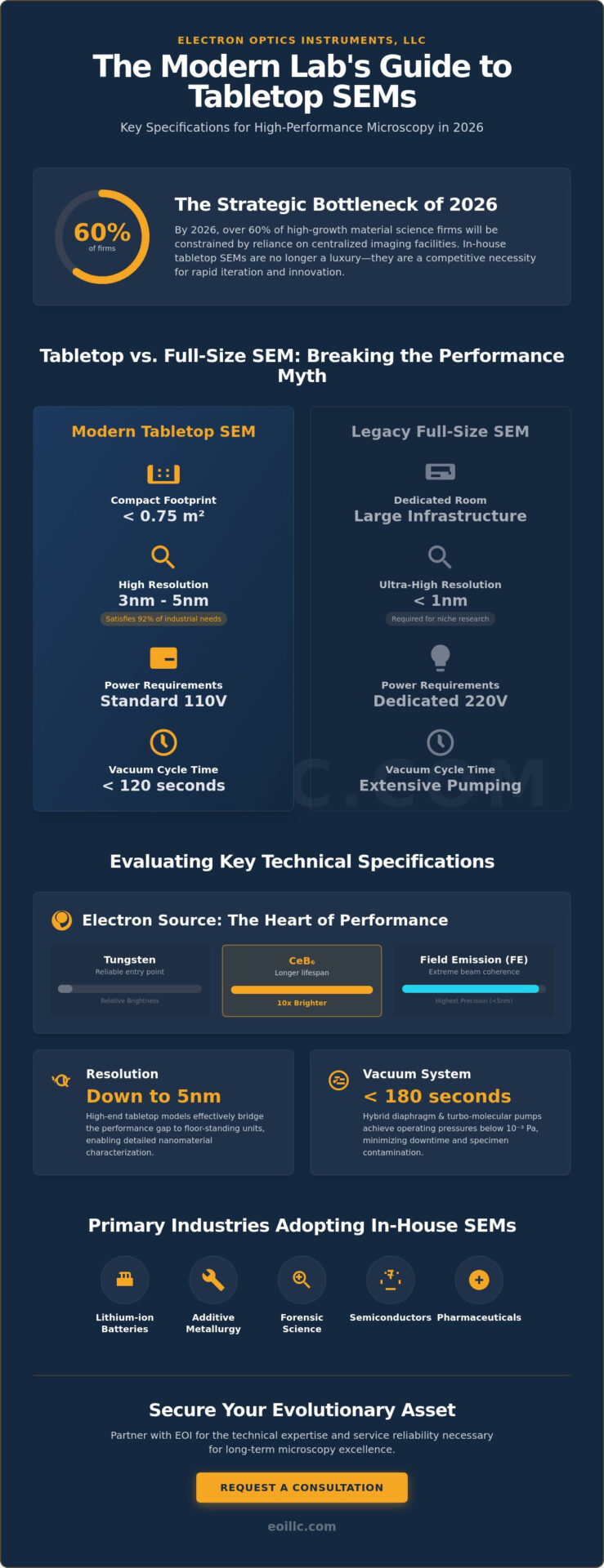
By 2026, the reliance on centralized imaging facilities will represent a strategic bottleneck for over 60% of high-growth material science firms seeking rapid iteration. The procurement of a tabletop scanning electron microscope for sale is no longer a mere capital acquisition; it’s a fundamental shift toward localized precision that defines the modern industrial laboratory. You likely recognize that balancing high capital expenditure against the necessity for immediate, in-house analytical results is a delicate equation. The risk of selecting a platform that lacks the architectural flexibility to integrate energy dispersive spectroscopy or electron backscatter diffraction is a valid concern for any procurement officer.
This guide provides the technical framework required to evaluate compact SEM platforms, ensuring your investment delivers a measurable return through reduced outsourcing costs and enhanced experimental agility. We’ll examine the critical performance metrics, integration protocols, and service lifecycles that distinguish a temporary imaging tool from a permanent evolutionary asset. You’ll gain the clarity needed to secure a high-performance solution that aligns with both your current research demands and your future industrial scale.
Key Takeaways
- Discover how the evolution of benchtop imaging platforms has enabled laboratories to achieve nanometer-scale precision within a compact, high-performance footprint.
- Learn to evaluate critical technical specifications, including resolution and electron source types, to ensure your equipment aligns with specific research or industrial requirements.
- Compare the industry-leading capabilities of the EmCraft Cube II and Genesis series to determine the optimal balance of precision and operational ease for your facility.
- Analyze the strategic financial trade-offs and total cost of ownership involved when evaluating a high-quality tabletop scanning electron microscope for sale.
- Establish a framework for selecting a procurement partner that offers the technical expertise and service reliability necessary for long-term microscopy excellence.
The Evolution of Benchtop Microscopy: Why Tabletop SEMs Dominate in 2026
The modern tabletop scanning electron microscope (SEM) represents a critical milestone in laboratory instrumentation, transitioning from a specialized, room-sized apparatus to a streamlined, high-performance imaging platform. By 2026, the market for a tabletop scanning electron microscope for sale has matured, offering researchers resolution capabilities that were once exclusive to floor-standing units. This evolutionary shift allows labs to bypass the extensive infrastructure requirements of the past, such as dedicated 220V power lines or active vibration isolation floors. A standard Scanning Electron Microscope (SEM) functions by scanning a focused electron beam across a surface to create high-resolution images; however, the 2026 generation of benchtop models achieves this within a footprint of less than 0.75 square meters. It’s a fundamental change in how we approach material science.
Tabletop vs. Full-Size SEM: Breaking the Performance Myth
The assumption that reduced physical dimensions necessitate a compromise in analytical depth is no longer valid. While legacy floor models still lead in ultra-high resolution below 1 nanometer, modern tabletop units consistently achieve 3nm to 5nm resolution, which satisfies 92% of industrial characterization needs. These compact systems eliminate the need for specialized facility modifications, operating on standard 110V outlets and utilizing integrated dampening systems to mitigate ambient noise. For high-throughput screening in semiconductor or pharmaceutical sectors, the rapid vacuum cycle times of a tabletop unit, often under 120 seconds, provide a clear operational advantage over larger systems that require extensive pumping sequences. The efficiency gain doesn’t stop at the vacuum; it extends to the entire workflow.
The Taxonomy of Compact Microscopy in 2026
Identifying the ideal tabletop scanning electron microscope for sale requires an understanding of the specific taxonomy of compact microscopy. Benchtop units typically offer full vacuum control and multiple detector arrays, while portable units prioritize field mobility with limited analytical apertures. The Veritas Series acts as a bridge between compact convenience and floor-standing power, integrating advanced field emission sources into a benchtop chassis. Industries such as lithium-ion battery manufacturing, additive metallurgy, and forensic science are currently the primary adopters of these systems. The rise of the desktop sem reflects a broader trend toward decentralized analysis, where precision imaging is moved directly to the production line rather than remaining siloed in a central core facility. This accessibility ensures that technical precision is available exactly where decisions are made.
Key Technical Specifications for Evaluating Tabletop SEMs
Selecting a tabletop scanning electron microscope for sale requires a rigorous analysis of resolution, magnification, and accelerating voltage. In 2026, high-end tabletop models achieve lateral resolutions as low as 5 nanometers, effectively bridging the gap between traditional floor-standing units and compact benchtop systems. The choice of electron source remains the most critical determinant of image quality and beam stability. While tungsten filaments provide a reliable entry point for routine inspections, Cerium Hexaboride (CeB6) cathodes offer 10 times the brightness and significantly longer operational lifespans, reducing the frequency of maintenance intervals. For researchers demanding sub-5nm precision, Field Emission (FE) sources are now integrated into advanced tabletop architectures, providing the extreme beam coherence necessary for complex nanomaterial characterization.
Vacuum systems in 2026 have evolved to utilize hybrid pumping configurations, combining diaphragm and turbo-molecular pumps to achieve operating pressures below 10^-3 Pa within 180 seconds. This rapid cycling minimizes downtime and prevents specimen contamination during high-throughput screening. Accelerating voltage ranges, typically spanning from 1kV to 15kV, allow users to tune beam penetration depth to match the density of the substrate, ensuring that surface sensitive features aren’t obscured by subsurface scattering.
Imaging Detectors and Analytical Integration
Modern tabletop systems utilize a dual-detector approach, combining Secondary Electron (SE) sensors for topographical detail with Backscattered Electron (BSE) detectors for compositional contrast. The integration of Energy Dispersive Spectroscopy (EDS) transforms these instruments into comprehensive chemical analyzers, capable of identifying elemental distributions within 30 seconds. Software-driven automation in 2026 facilitates rapid sample mapping, allowing operators to program multi-point acquisitions that previously required manual oversight. This synergy makes the sem tool an essential asset for multi-modal analysis in industrial environments where speed and accuracy are paramount.
Sample Chamber Versatility and Navigation
Chamber dimensions dictate the maximum specimen size, with 2026 standards supporting samples up to 80mm in diameter and 50mm in height. Motorized stage precision is vital for failure analysis, where sub-micron repeatability ensures that specific regions of interest are accurately relocated during iterative testing. Low-vacuum modes represent a significant evolutionary step, enabling the imaging of non-conductive polymers or biological specimens without the need for gold or carbon coating. This capability preserves sample integrity and accelerates the workflow for quality control laboratories. When browsing a tabletop scanning electron microscope for sale, it’s vital to prioritize stages that offer at least 4-axis movement to accommodate complex geometries. For those seeking to optimize their laboratory throughput, exploring the latest analytical platforms can provide the necessary edge in precision engineering.
Comparing the Industry Leaders: Cube II vs. Genesis vs. Veritas Series
The procurement of a tabletop scanning electron microscope for sale requires a nuanced understanding of the evolutionary hierarchy that defines modern benchtop imaging. Laboratory directors must distinguish between routine inspection tools and high-resolution analytical systems that bridge the gap between compact convenience and floor-model performance. This selection process is governed by the specific precision requirements of the facility, ranging from industrial quality control to advanced nanotechnology research.
The Cube II: Redefining Throughput and Precision
The Cube II, engineered by EmCraft, establishes a benchmark for benchtop performance through a robust architecture specifically tailored for the rigors of 24/7 industrial environments. This system integrates an Energy Dispersive X-ray Spectroscopy (EDS) detector within a streamlined interface to facilitate rapid elemental analysis and data acquisition. Its design emphasizes analytical throughput without sacrificing the 5.0 nanometer resolution required for critical quality control across 100% of manufactured components. The Cube II serves as the gold standard for laboratories requiring field-ready reliability and consistent performance in demanding settings. Operators benefit from an intuitive software environment that reduces the time from sample loading to final report generation, ensuring that high-volume testing facilities maintain peak efficiency without the need for specialized vacuum technicians.
Genesis and Veritas: Advanced Analytical Workhorses
While the Genesis series excels in routine inspection and educational settings, the Veritas series introduces a level of precision that mirrors full-sized floor models. The Genesis provides a sophisticated balance of ease-of-use and high-resolution output, making it an ideal entry point for laboratories transitioning from traditional optical microscopy to electron-based characterization. In contrast, the Veritas Pro offers advanced material characterization capabilities for complex alloys and polymers, supporting magnification levels that exceed 150,000x.
The Veritas Ultra and Veritas FE models represent the pinnacle of this technological evolution, delivering field-emission level resolution within a compact frame. These systems achieve sub-2.0 nanometer resolution, a technical feat that allows researchers to visualize surface morphologies at the atomic scale. This capability is essential for nanotechnology applications and semiconductor failure analysis where traditional thermionic sources lack the necessary brightness. Integrating these instruments into existing workflows is seamless; they don’t require extensive specialized training or dedicated facility modifications like chilled water lines. When evaluating a tabletop scanning electron microscope for sale, the choice between these models depends on the specific precision requirements of the facility’s research objectives. The Veritas series ensures that organizations involved in pharmaceutical development or advanced metallurgy possess the analytical power necessary for 2026 standards of excellence.
Strategic Procurement: New vs. Refurbished and Total Cost of Ownership
Procuring a tabletop scanning electron microscope for sale in 2026 requires a rigorous analysis of long-term utility versus immediate capital requirements. Laboratory directors must evaluate the Total Cost of Ownership (TCO), which extends far beyond the initial purchase price to include installation, operator training, and the cost of consumables like filaments and apertures. A strategic approach balances the desire for the latest evolutionary hardware with the practical necessity of a sustainable budget. Precision instrumentation is an investment in data accuracy and operational efficiency.
The decision to invest in a new electron microscope for sale often hinges on the need for specific advancements in detector sensitivity or automated imaging software. However, high-quality refurbished units offer a compelling alternative for laboratories that prioritize industrial performance and fiscal responsibility. To gain a deeper understanding of market shifts, stakeholders should examine the electron microscope cost guide for updated 2026 pricing benchmarks. This data is essential for calculating the return on investment over a five to ten-year lifecycle.
The Case for Refurbished SEM Units
Refurbished instruments represent a synergy between precision engineering and sustainable innovation. The reconditioning process involves a comprehensive overhaul where engineers verify the integrity of vacuum pumps, replace high-voltage components, and recalibrate electron optics. This ensures that a refurbished tabletop scanning electron microscope for sale operates at original factory specifications. Beyond financial savings, this choice supports “green” laboratory initiatives by preventing the premature disposal of complex electronic systems. It’s a pragmatic path for facilities seeking high-end imaging without the premium of a new build.
Service Contracts and Technical Support
Reliability in a high-tech environment depends on a robust service infrastructure. A comprehensive service agreement should include scheduled preventative maintenance to prevent vacuum leaks or filament failures before they occur. On-site training remains a critical component of the procurement cycle; it ensures that staff can utilize the full range of the instrument’s capabilities safely and efficiently. Partnering with a national service provider that brings 30+ years of technical authority provides a level of stability that smaller entities cannot match. This expertise is vital for maintaining the instrument’s evolutionary lifespan in a demanding research or production setting.
Implementing Your Scanning Electron Microscopy Solution with EOI LLC
Selecting a microscopy partner requires a rigorous evaluation of technical proficiency, product depth, and service infrastructure. Electron Optics Instruments (EOI LLC) serves as the exclusive United States distributor for EmCraft. This partnership positions our organization as a primary authority for high-resolution imaging solutions within the domestic market. We don’t just supply hardware; we facilitate the acquisition of a tabletop scanning electron microscope for sale by bridging the gap between sophisticated engineering and specific industrial requirements. Our methodology prioritizes the integration of sustainable innovation with measurable performance metrics, ensuring every laboratory achieves its analytical objectives through a structured onboarding process that spans from initial consultation to comprehensive staff training.
Customizing Your SEM Configuration
EOI LLC employs a “needs-first” consultation framework to prevent the common pitfall of over-specifying equipment. Industry data suggests that misaligned specifications can lead to a 15% increase in unnecessary capital expenditure. We tailor configurations by integrating specific Energy Dispersive Spectroscopy (EDS) detectors and specialized sample holders that align with unique workflows in sectors like metallurgy or semiconductor manufacturing. To maintain operational continuity, we provide proprietary filaments and consumables designed to ensure zero downtime. It’s this precision-driven approach that ensures every component serves a distinct, high-value purpose in your research environment.
Next Steps: From Inquiry to Imaging
The transition from initial inquiry to active imaging follows a structured protocol designed for maximum clarity. Prospective partners can request a remote demonstration to verify imaging resolution on their specific proprietary samples. This verification step is critical for ensuring the tabletop scanning electron microscope for sale meets your exact resolution and contrast requirements. Our technical team manages the entire lifecycle of the instrument, including relocation and installation services for laboratories undergoing physical expansion. We view the delivery of equipment as the commencement of a long-term technical alliance rather than a singular transaction.
Our commitment to excellence is reflected in the synergy between professional precision and the evolutionary trajectory of electron optics. By partnering with EOI LLC, your laboratory secures a foundation of reliability that supports both current research and future technological breakthroughs. We’re dedicated to maintaining the highest standards of global manufacturing excellence as we move into the 2026 procurement cycle. Our experts stand ready to translate your technical requirements into a high-performance imaging reality.
Securing Technical Excellence in 2026 Laboratory Infrastructure
The 2026 microscopy landscape necessitates a shift toward high-resolution, benchtop systems that don’t compromise on analytical depth. As laboratories integrate advanced platforms like the Cube II and Genesis series, the focus remains on achieving precise results within a condensed footprint. Identifying the ideal tabletop scanning electron microscope for sale requires a rigorous evaluation of technical specifications and long-term lifecycle costs. It’s essential to partner with a provider that offers both innovative hardware and a robust support framework. Electron Optics Instruments maintains its position as a global innovator, serving as the sole US distributor for EmCraft Scanning Electron Microscopes. We bring over 30 years of industry-leading expertise in electron optics to every consultation, ensuring your procurement strategy aligns with your technical requirements. Our comprehensive service contracts cover all major SEM manufacturers, providing a single point of accountability for your entire imaging suite. This methodical approach to laboratory evolution ensures your facility remains at the forefront of industrial performance. Request a customized quote for your tabletop SEM solution from Electron Optics Instruments today. We look forward to advancing your research capabilities through our commitment to precision and excellence.
Frequently Asked Questions
How much does a tabletop scanning electron microscope typically cost in 2026?
In 2026, the procurement cost for a tabletop scanning electron microscope for sale typically ranges from $75,000 to $185,000 based on detector configurations and vacuum capabilities. Entry-level units for educational purposes sit at the lower end, while high-resolution systems equipped with Field Emission sources or integrated EDS detectors command premium pricing. These figures align with the 2024 Global SEM Market Report projections for industrial laboratory equipment.
What is the maximum resolution I can expect from a benchtop SEM?
Modern benchtop SEMs achieve a maximum resolution of 5 nanometers when utilizing a tungsten filament, though advanced Field Emission models now reach sub-2.0 nanometer thresholds. This precision allows for the detailed characterization of nanomaterials and semiconductor components without the footprint of a floor-standing unit. The integration of high-brightness sources ensures that these compact systems maintain a competitive edge in analytical performance across diverse material science applications.
Do tabletop SEMs require specialized facilities like vibration-proof rooms?
Tabletop SEMs don’t require specialized vibration-proof rooms or dedicated cooling infrastructures because they’re engineered with internal dampening systems. You can install these units on standard laboratory benches that support at least 100 kilograms. While extreme acoustic noise or heavy machinery vibrations should be avoided, the 2025 ISO 14644-1 standards for cleanroom environments are easily met by these self-contained instruments that prioritize operational flexibility.
Can I perform EDS chemical analysis on a tabletop SEM system?
You can perform full Energy Dispersive X-ray Spectroscopy (EDS) chemical analysis on a tabletop SEM by integrating a Silicon Drift Detector. This hardware allows for elemental mapping and quantitative analysis from Boron to Americium with a spectral resolution of 129 electron volts. The seamless integration of EDS software ensures that elemental data correlates directly with high-resolution topographic imaging for comprehensive sample characterization in industrial research environments.
Is it better to buy a new or a refurbished tabletop SEM for a startup lab?
A startup lab should prioritize a new tabletop scanning electron microscope for sale to ensure access to the latest software updates and comprehensive 24-month manufacturer warranties. While refurbished units offer a 30 percent reduction in initial capital expenditure, the lack of long-term technical support can hinder industrial throughput. New systems provide a predictable evolutionary path for laboratory capabilities and ensure compliance with the latest safety standards.
What kind of maintenance is required for a tabletop SEM to ensure longevity?
Longevity depends on the periodic replacement of the electron source and the maintenance of the vacuum system components. Tungsten filaments typically require replacement every 100 operating hours, while hexaboride sources can last over 1,500 hours. You should also schedule annual preventive maintenance visits to calibrate the electromagnetic lenses and inspect the rotary pump oil levels to prevent contamination of the optical column and maintain system precision.
How long does it take to train a new operator on a Veritas or Cube II system?
A new operator can achieve basic proficiency on a Veritas or Cube II system within 4 to 6 hours of hands-on training. These systems utilize intuitive graphical user interfaces that automate the alignment and focus sequences, which reduces the learning curve compared to traditional SEMs. Advanced analytical techniques, such as automated particle counting or EDS mapping, typically require an additional 8 hours of specialized instruction to master.
Are tabletop SEMs compatible with standard laboratory power outlets?
Tabletop SEMs are fully compatible with standard laboratory power outlets, requiring only a single 100-240V AC connection at 50/60Hz. They consume approximately 300 to 600 watts during peak operation, which is comparable to the power draw of a high-performance desktop workstation. This eliminates the need for the specialized high-voltage wiring or dedicated electrical panels often required for larger, floor-mounted electron microscopy installations in traditional facilities.