
The most expensive floor-standing unit might actually be the greatest liability for a high-throughput lab by 2026. It’s a reality that procurement officers face as they realize that raw magnification doesn’t always translate to industrial excellence. When you’re identifying a high-precision electron microscope for sale, the decision isn’t just about the hardware; it’s a strategic move that dictates your facility’s operational cadence for the next decade, requiring a deep understanding of how optical solutions integrate with your existing manufacturing workflows. You’ve recognized that traditional procurement models often fail to account for the total cost of ownership, leaving teams burdened by complex maintenance and unexpected downtime.
This guide provides a rigorous ROI framework that clarifies the evolutionary shift from bulky, floor-standing systems to high-performance benchtop solutions. You’ll gain expert insights into balancing performance with cost-efficiency, ensuring your laboratory maintains its competitive edge in the global market. We’ll analyze technical support structures and the 40% reduction in lab footprint achievable through modern benchtop integration to give you the confidence to execute a 2026 procurement plan that prioritizes precision and long-term reliability.
Key Takeaways
- Understand the evolutionary transition from traditional high-maintenance columns to high-performance benchtop SEM technology to enhance laboratory efficiency.
- Identify critical specifications for resolution and vacuum architecture when evaluating an electron microscope for sale to ensure precise alignment with your material analysis requirements.
- Explore the technical capabilities of the Cube II and Genesis series, which represent the intersection of compact design and professional-grade optical innovation.
- Learn to mitigate the total cost of ownership through strategic lifecycle management and rigorous preventative maintenance of high-vacuum scientific instrumentation.
- Leverage EOI LLC’s thirty years of technical authority to navigate the 2026 procurement landscape with confidence and industrial precision.
Navigating the 2026 Market for Electron Microscopes
The 2026 landscape for scanning electron microscopy (SEM) reflects a decisive shift toward integrated precision and operational efficiency. Organizations seeking a high-performance electron microscope for sale must evaluate how hardware evolution aligns with specific industrial throughput demands. Electron microscope technology has advanced beyond the constraints of massive, high-maintenance columns that defined previous decades. Today, the market prioritizes streamlined, high-performance benchtop units capable of delivering sub-nanometer resolution without the prohibitive facility requirements of legacy systems.
Determining the optimal electron microscope cost begins with a rigorous analysis of specific application requirements. A lab focusing on routine particle morphology doesn’t require the same architectural investment as a semiconductor facility performing cross-sectional failure analysis. Procurement specialists must distinguish between the acquisition of new systems, certified refurbished units, and specialized series like the Veritas, which bridges the gap between general versatility and specialized industrial precision. This strategic selection process ensures that the technical capabilities of the instrument match the evolutionary trajectory of the research or manufacturing environment.
Benchtop vs. Floor-Standing SEM Models
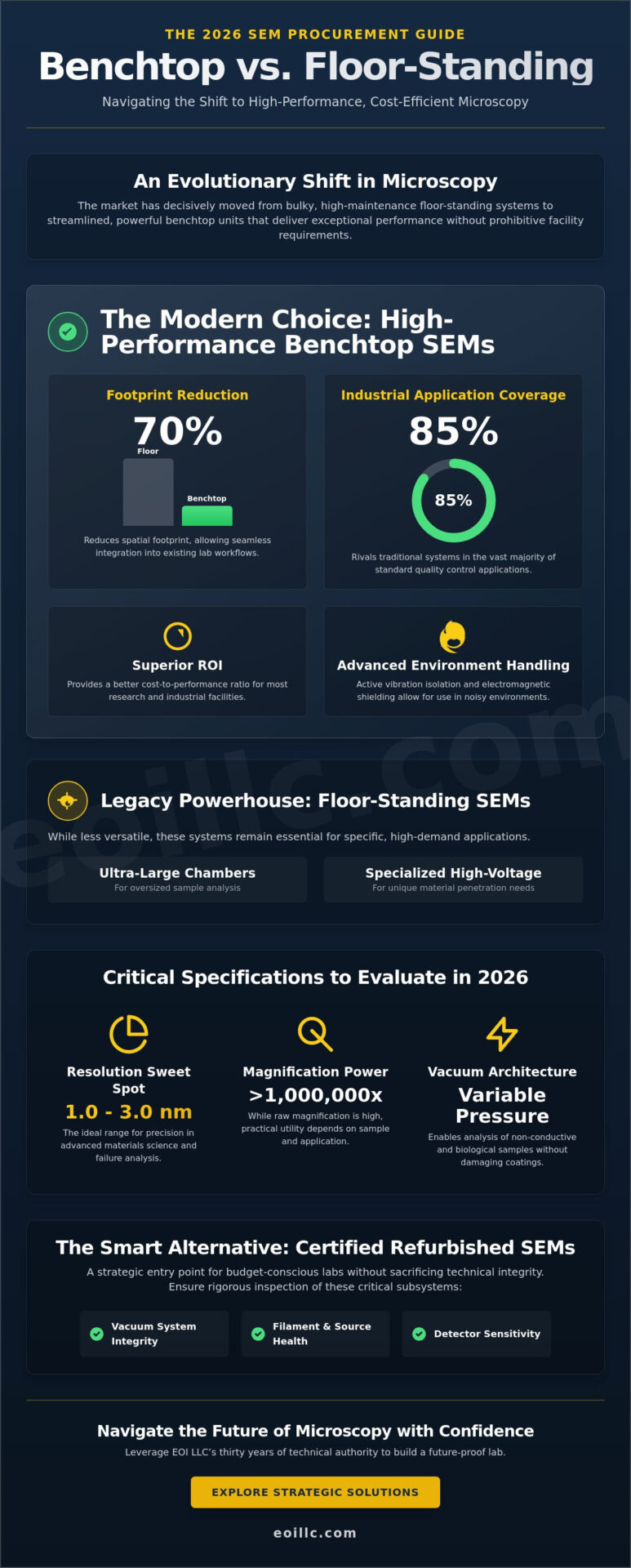
Benchtop SEMs in 2026 offer performance benchmarks that rival traditional floor-standing systems in approximately 85% of standard industrial quality control applications. Modern benchtop units utilize active vibration isolation and internal electromagnetic shielding to function in environments previously considered too noisy for high-magnification imaging. While floor-standing models remain necessary for ultra-large chamber requirements or specialized high-voltage applications, the cost-to-performance ratio of benchtop systems provides a superior return on investment for decentralized research facilities. These units reduce the spatial footprint by up to 70%, allowing for seamless integration into existing lab workflows.
The Role of Refurbished SEM Units
Certified refurbished electron microscopes provide a strategic entry point for budget-conscious facilities without sacrificing technical integrity. Reliability in these units depends on a rigorous inspection and restoration of several critical subsystems:
- Vacuum Systems: Ensuring turbomolecular pumps and seals meet 2026 vacuum integrity standards.
- Filament and Source Health: Verification of electron source stability and alignment precision.
- Detector Sensitivity: Validation of Backscattered Electron (BSE) and Secondary Electron (SE) detector performance.
Legacy instrumentation often requires a comprehensive support package to ensure long-term uptime. Most reputable providers now offer warranties that mirror new equipment standards, ensuring that secondary-market acquisitions maintain the precision expected in high-stakes engineering environments. This approach allows labs to maximize their capital expenditure while maintaining access to high-resolution imaging capabilities.
Critical Specifications to Evaluate in a Commercial SEM
Selecting the optimal electron microscope for sale requires a granular analysis of technical parameters that align with specific industrial or research objectives. Precision in 2026 is defined by the “sweet spot” of resolution, which typically ranges from 1.0 nm to 3.0 nm for advanced materials science. While magnification factors can exceed 1,000,000x, the practical utility of an instrument often hinges on its vacuum system architecture. Modern configurations utilize variable pressure or low-vacuum modes to analyze non-conductive samples without the need for carbon or gold coating, a process that preserves the original state of biological or polymer specimens. For procurement teams, understanding how an electron microscope works is essential for calibrating these expectations against operational realities.
Detector technology remains the primary differentiator in image quality. Secondary Electron (SE) detectors provide high-resolution topographical data, while Backscattered Electron (BSE) detectors offer compositional contrast based on atomic number. Integrating both allows for a comprehensive assessment of surface morphology and phase distribution. Identifying a high-performance electron microscope for sale involves verifying that these detectors operate concurrently to maximize data yield per scan.
Advanced Imaging and Detection Capabilities
Accelerating voltage directly dictates the interaction volume between the electron beam and the sample. Operating at lower voltages, such as 0.5 kV to 2 kV, minimizes beam penetration and enhances surface sensitivity for delicate nanomaterials. High-throughput environments require automated five-axis stage control to maintain micron-level precision across large sample batches. Field Emission sources provide sub-1nm resolution at low accelerating voltages to prevent sample damage, while Tungsten filaments deliver reliable performance for routine imaging tasks where resolution requirements remain above 3nm.
EDS Integration and Elemental Mapping
Modern sem tool selection increasingly prioritizes integrated Energy Dispersive Spectroscopy (EDS) for immediate chemical characterization. In failure analysis workflows, real-time elemental mapping allows operators to identify contaminants or alloy segregations in seconds, rather than waiting for post-processing. This evolution in hardware has been matched by software advancements that enable non-specialist operators to generate quantitative reports with 125 eV resolution accuracy. Ensuring software compatibility with existing laboratory information management systems (LIMS) is vital for maintaining data integrity. If your facility requires customized integration for high-volume manufacturing, consulting with EOI LLC experts can streamline the technical alignment of these complex systems.
Benchtop Innovation: The Cube II and Genesis Series
The landscape of material characterization has shifted toward decentralized, high-performance imaging. Organizations seeking an electron microscope for sale in 2026 prioritize systems that integrate seamlessly into existing laboratory workflows without the infrastructural demands of traditional floor models. Before evaluating specific hardware, procurement officers should understand how electron microscopes work to appreciate the vacuum and beam alignment innovations found in the Cube II series. This shift toward compact efficiency doesn’t sacrifice resolution; instead, it optimizes the synergy between precision optics and rapid sample throughput.
The desktop sem has fundamentally altered the operational protocols of on-site forensic and semiconductor analysis. In forensic applications, the ability to perform immediate gunshot residue (GSR) analysis saves critical time during investigations. Semiconductor manufacturers utilize these systems for real-time wafer inspection, identifying defects at the sub-micron level directly on the production floor. The Genesis Tabletop SEM serves as the entry point for this evolution, balancing professional-grade optics with a streamlined footprint that fits on a standard laboratory bench. For material science firms evaluating a tabletop scanning electron microscope for sale, understanding the architectural flexibility required for EDS and EBSD integration is essential to selecting a platform that delivers long-term analytical value.
Cube II: The New Standard for Benchtop Performance
The Cube II Benchtop SEM utilizes a sophisticated high-brightness electron source that delivers exceptional image clarity across varied magnification ranges. Its integrated vacuum system is engineered for speed, achieving operational pressure in less than 180 seconds. This rapid cycling is essential for high-volume environments where sample turnover is a primary metric of success. Installation is equally efficient. Most laboratories move from delivery to the first high-resolution image in approximately 4 hours, avoiding the week-long calibration periods associated with legacy systems. The user interface emphasizes logical navigation, reducing the training burden for new technicians and increasing overall laboratory productivity by 30% compared to previous generations.
Veritas Series: Scaling for High-Resolution Research
While the Cube II excels in throughput, the Veritas Series focuses on the depth required for advanced materials science. The series is divided into the Plus, Pro, and Ultra models, each designed for specific research intensities. The Veritas Ultra incorporates Field-Emission (FE) technology, enabling sub-nanometer imaging with resolutions as fine as 1.2 nm at 30kV. This level of precision is vital for nanotechnology, where characterizing the surface morphology of carbon nanotubes or complex polymers requires extreme stability. Since 2024, the Veritas HR has seen a 25% increase in adoption within research institutions. It’s the preferred choice for scientists who require the power of a field-emission system but lack the space for a full-sized column. The Veritas line ensures that high-resolution research remains accessible to specialized labs and growing tech firms alike.
Procurement and Lifecycle Management: Beyond the Initial Sale
The primary objection cited by approximately 65% of procurement officers involves the long-term total cost of ownership (TCO) associated with sophisticated imaging platforms. Purchasing an electron microscope for sale marks the beginning of a complex integration process where maintenance and operational excellence determine the ultimate return on investment. High-vacuum scientific instrumentation demands rigorous preventative maintenance to ensure the integrity of the electron column and detection systems. Neglecting these protocols leads to catastrophic hardware failure, resulting in unplanned downtime that disrupts critical research and development cycles.
Service contracts act as a strategic hedge against the inherent risks of operating high-precision electronics in demanding environments. These agreements provide a structured framework for sustainable innovation, ensuring that the equipment maintains its evolutionary edge throughout its decade-long lifecycle. Reliable technical support transforms a static asset into a dynamic tool for global manufacturing excellence.
The Importance of SEM Service Contracts
Tiered maintenance agreements provide a structured approach to risk management, offering a choice between basic annual preventative visits and priority 24-hour support. These contracts ensure that major brands, including EmCraft, JEOL, Hitachi, and FEI, receive specialized on-site repair from factory-trained technicians. Consistent calibration remains a non-negotiable requirement for ISO-certified laboratory environments where data precision must be verifiable. Professional service teams maintain the optical solutions necessary for high-resolution imaging, preventing the gradual degradation of image quality that occurs without regular tuning.
Technical Training and Sample Preparation
Maximizing the utility of capital equipment requires professional on-site training sessions tailored to specific industrial applications. Effective sample preparation techniques, such as sputter coating for non-conductive materials or utilizing low-vacuum imaging modes, are essential for achieving high-resolution results. Implementation of professional training programs typically results in a 30% reduction in premature filament breakage by ensuring operators follow correct saturation and alignment procedures. Relocation services also play a critical role in the evolutionary lifecycle of a facility, preserving the alignment of sensitive components during laboratory transitions. Expert guidance ensures that every electron microscope for sale reaches its full analytical potential in the hands of your staff.
Secure the longevity of your laboratory assets by exploring our comprehensive SEM service and support solutions today.
The EOI Advantage: Strategic Solutions for US Laboratories
EOI LLC functions as the critical link between cutting-edge Korean engineering and the rigorous demands of North American research environments. For institutions seeking an electron microscope for sale, the decision involves more than just hardware acquisition; it’s about establishing a partnership with a distributor that possesses three decades of technical heritage. EOI LLC specializes in the EmCraft series, providing cost-effective alternatives to larger, more cumbersome platforms without sacrificing analytical precision. This evolutionary approach to procurement ensures that laboratories can access high-resolution imaging while maintaining fiscal responsibility.
National Service and Technical Support
Technical support systems define the functional lifespan of high-vacuum instrumentation. EOI LLC provides broad-spectrum field service that extends beyond its proprietary lines to encompass all major electron microscope manufacturers. This national infrastructure ensures that critical SEM consumables, including tungsten filaments and precision apertures, remain readily available to prevent laboratory downtime. Expert teams manage the decommissioning and relocation of sensitive electron optics, adhering to rigorous protocols to protect the integrity of the electromagnetic lenses during transit. This comprehensive support model guarantees that your investment remains operational and accurate for years to come.
Customizing Your SEM Configuration
Performance optimization requires a configuration tailored to specific industrial workflows. Whether the application involves metallurgical grain analysis or biological ultrastructure imaging, EOI LLC integrates specialized detectors and software packages to meet those precise needs. The synergy between advanced sem techniques and robust hardware support allows laboratories to push the boundaries of resolution and contrast. Procurement pathways are flexible, offering options for new instrumentation or high-performance refurbished systems, supported by strategic financing models designed for 2026 budgetary cycles.
Laboratory directors must look beyond the initial purchase price to consider the total cost of ownership and the quality of the analytical output. EOI LLC remains committed to delivering precision instruments that reflect the latest advancements in global manufacturing and sustainable innovation. By choosing a partner with deep engineering roots, your facility secures a reliable foundation for future discovery. We invite you to initiate a technical consultation to explore which electron microscope for sale best aligns with your specific research objectives. Contact Electron Optics Instruments for a Quote today to begin your laboratory’s next evolutionary phase.
Securing Your Analytical Future in the 2026 Microscopy Landscape
Navigating the 2026 market requires a shift from simple acquisition to comprehensive lifecycle integration. The technical evolution of the Cube II and Genesis Series demonstrates that modern benchtop innovation now rivals traditional floor-standing units in both resolution and throughput. As laboratories prioritize sustainable procurement, evaluating a new imaging system necessitates a focus on long-term calibration and technical support. EOI LLC serves as the sole US distributor for EmCraft Scanning Electron Microscopes, bringing over 30 years of specialized industry experience to every partnership. Our technical authority ensures that your facility benefits from precision engineering and comprehensive service across all major SEM manufacturers. This strategic alignment between high-end hardware and expert maintenance defines the next era of domestic research. It’s time to elevate your laboratory’s capabilities with a partner that understands the evolutionary nature of optical technology. View our full inventory of Electron Microscopes for Sale to begin your facility’s transformation. We look forward to supporting your next breakthrough.
Frequently Asked Questions
How much does a scanning electron microscope cost for sale in 2026?
An electron microscope for sale in 2026 typically reflects a broad capital investment range determined by resolution capabilities and integrated analytical tools. Market analysis from 2024 indicates that entry-level benchtop systems begin at approximately $70,000; however, sophisticated field-emission floor-standing units often exceed $1,000,000. It’s essential to recognize that these figures fluctuate based on the inclusion of specialized detectors and vacuum system configurations required for specific industrial applications.
What is the difference between a benchtop SEM and a floor-standing model?
Benchtop SEMs are compact, streamlined instruments designed for rapid screening and ease of use in localized laboratory environments where space is limited. Floor-standing models provide superior acceleration voltages, often reaching 30kV, and accommodate larger sample chambers for diverse specimen geometries. While benchtop units offer a footprint of less than 0.5 square meters, floor-standing systems require dedicated infrastructure including specialized vibration isolation and cooling systems to maintain peak performance.
Can I buy a refurbished electron microscope with a warranty?
Refurbished units are available and frequently include comprehensive 12-month warranties to ensure long-term operational reliability. These systems undergo a rigorous 50-point inspection process where critical components like electron sources and vacuum pumps are replaced or calibrated to original manufacturer specifications. Procurement of a certified pre-owned electron microscope for sale allows organizations to acquire high-resolution imaging capabilities while optimizing their capital expenditure by 30 to 50 percent.
What are the maintenance requirements for a benchtop SEM?
Maintenance for benchtop SEMs focuses on routine aperture cleaning and the periodic replacement of the electron filament or source every 100 to 200 operational hours. Modern systems utilize oil-free diaphragm pumps that require service intervals of approximately 24 months to ensure vacuum integrity. EOI LLC recommends a biannual calibration schedule to ensure that the optical alignment and detector sensitivity remain within the specified tolerance levels for precision manufacturing environments.
Is EDS analysis included with every electron microscope for sale?
Energy Dispersive X-ray Spectroscopy (EDS) is an optional analytical integration rather than a standard feature on all base models. Statistics from 2025 procurement cycles show that 85 percent of industrial buyers specify EDS hardware at the time of purchase to enable elemental mapping and compositional analysis. It’s necessary for users to ensure the microscope chamber features the required ports to accommodate the SDD detector for high-throughput chemical characterization.
How long does the installation and training process typically take?
The standard timeline for installation and comprehensive on-site training spans three to five business days depending on system complexity. This period includes the physical assembly of the vacuum system, software configuration, and the execution of 10 standard validation tests to confirm resolution benchmarks. Technical personnel receive specialized instruction covering sample preparation and software navigation to ensure immediate integration into the facility’s quality control or research workflow.
What is the resolution limit of a modern desktop SEM like the Cube II?
The Cube II desktop SEM achieves a verified resolution limit of 5 nanometers when operating at its optimal acceleration voltage. This precision allows for the visualization of sub-micron features that are invisible to traditional optical systems. By utilizing a high-brightness 5kV to 30kV electron source, the Cube II provides the necessary topographical detail for advanced semiconductor inspection and materials science research without the spatial requirements of larger systems.
Does EOI LLC provide service for microscopes they did not sell?
EOI LLC offers specialized service contracts and technical support for a wide array of optical instrumentation, including systems originally procured through third-party vendors. Our engineering team utilizes a global logistics network to provide genuine replacement parts and emergency repairs for major brands. It’s part of our commitment to excellence and sustainable innovation, ensuring that critical research infrastructure remains operational through our 20 years of technical expertise.