
The decision to acquire a used scanning electron microscope in 2026 represents a strategic pivot between fiscal responsibility and technical risk. While a professionally refurbished system offers a capital expenditure reduction of 30% to 70% compared to new instrumentation, the true value of the investment hinges on the precision of its refurbishment rather than the initial purchase price. You likely recognize that the high cost of new field emission systems, coupled with the current liquid helium crisis driving prices to $55 per liter, makes the secondary market an attractive necessity for expanding laboratory capabilities.
This guide provides a rigorous framework for evaluating pre-owned systems to ensure your facility maintains high-resolution imaging standards without the fear of vacuum system failure or obsolete components. You’ll learn how to secure a reliable SEM that integrates modern Windows 11 interfaces and 8K imaging capabilities while establishing a long-term service agreement for operational stability. We’ll examine the technical benchmarks of certified refurbishment, the impact of geopolitical supply chain disruptions on total cost of ownership, and the specific protocols required to guarantee regulatory compliance in a high-precision environment.
Key Takeaways
- Identify the strategic advantages of acquiring a used scanning electron microscope to achieve a 30-70% reduction in capital expenditure without compromising imaging resolution.
- Evaluate critical technical benchmarks for pre-owned systems, focusing on vacuum integrity and the precision of electromagnetic lenses to prevent unforeseen repair costs.
- Distinguish between the reliability of professional refurbishment protocols and the high-risk nature of “as-is” purchases from non-specialized liquidators.
- Calculate the comprehensive total cost of ownership by accounting for the 2026 surge in consumable prices and the necessity of tiered maintenance agreements.
- Discover how modern benchtop innovations, such as the Cube II, provide a high-performance alternative to aging floor-model systems in space-constrained laboratories.
The Strategic Advantage of Acquiring a Used Scanning Electron Microscope
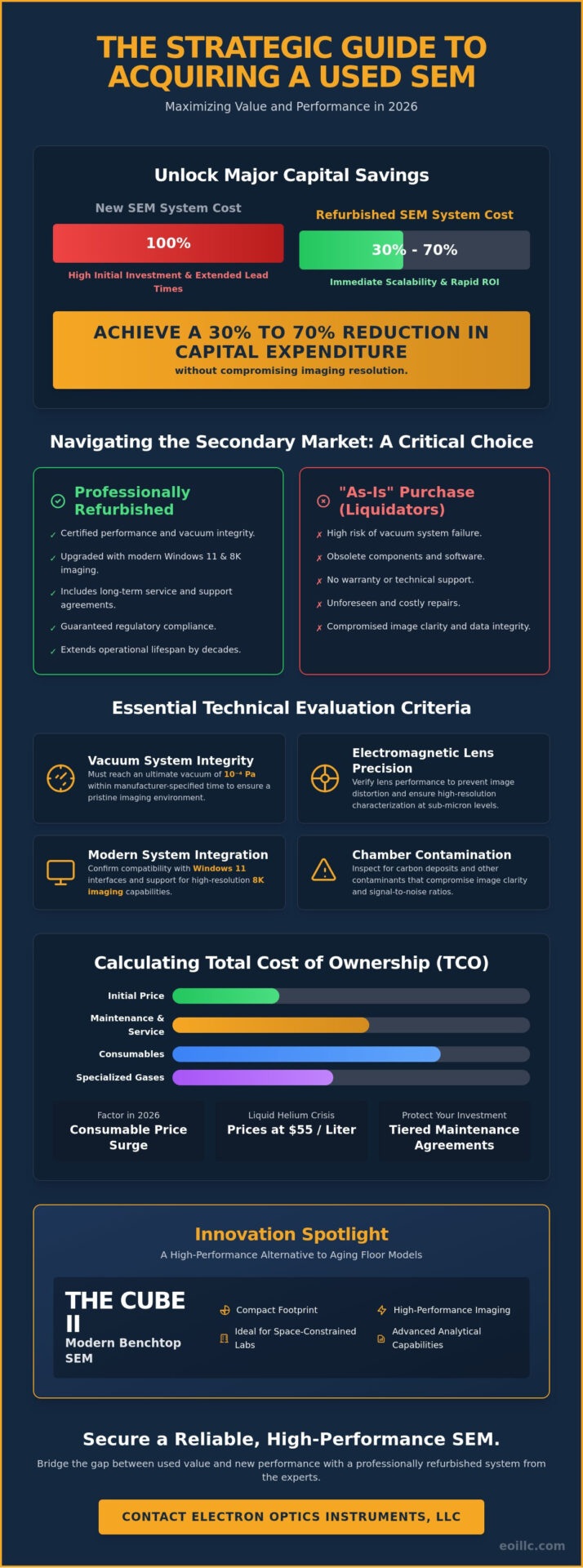
The global demand for high-resolution imaging is accelerating, with the scanning electron microscope (SEM) market projected to reach a valuation as high as $5.28 billion by 2026. Within this expansion, the strategic acquisition of a used scanning electron microscope provides a critical advantage for organizations balancing rigorous technical requirements with disciplined fiscal management. By integrating pre-owned systems, laboratories can achieve a 30% to 70% reduction in initial capital expenditure. This allows for the immediate diversification of analytical tools without the financial strain of a single, high-cost acquisition. Industries specialized in failure analysis, semiconductor inspection, and industrial quality control find that refurbished units offer a rapid return on investment. These systems deliver the precise imaging necessary for sub-micron characterization while preserving the budget for critical consumables and specialized EDS integration.
Capital Expenditure vs. Operational Capability
Justifying the procurement of a pre-owned system requires a detailed analysis of operational throughput against the initial investment. Modern industrial procurement cycles often demand immediate scalability that new instrumentation, with its extended lead times and high entry costs, cannot always accommodate. While a new system might offer the latest software, a professionally updated used scanning electron microscope provides comparable resolution for a fraction of the cost. Capital efficiency in scientific procurement is the optimization of technical throughput and resolution capabilities relative to the total lifecycle cost of the instrumentation. By selecting a high-performance refurbished unit, a facility can deploy multiple workstations for the price of a single new field-emission system. This strategy ensures that high-resolution imaging standards are met across various departments. It’s a method that maintains operational stability while hedging against the rising costs of maintenance and specialized gases.
The Role of Refurbished Systems in Modern Research
Professional refurbishment serves an evolutionary role in the lifecycle of laboratory technology. It bridges the technical gap for institutions transitioning from traditional light microscopy to the advanced topographical and elemental analysis provided by electron optics. Refurbished units are particularly vital for educational institutions and secondary research labs that require reliable performance for training and routine screening. Through the deep cleaning of columns and the replacement of aging electronics, professional refurbishers extend the operational lifespan of legacy optics by decades. This process ensures that precision remains accessible to a broader range of global innovators. It allows smaller firms to compete in the nanotechnology and material science sectors where high-end quality is a prerequisite for success. By choosing a refurbished system, labs secure a reliable partner in their research journey without the prohibitive barriers of new-market pricing.
Essential Technical Criteria for Evaluating Pre-Owned Electron Optics
A rigorous assessment of a used scanning electron microscope begins with the verification of the vacuum system’s hermetic integrity and the performance of the ion pumps. High-resolution imaging depends entirely on the technical principles of SEM, which require a pristine, low-pressure environment to prevent electron scattering. If a system fails to reach an ultimate vacuum of 10⁻⁴ Pa within the manufacturer’s specified timeframe, it often indicates saturated pumps or degraded seals. Contamination within the sample chamber, frequently visible as dark carbon deposits during high-magnification scans, directly compromises image clarity and signal-to-noise ratios. For organizations seeking to avoid these technical pitfalls, investing in refurbished SEM units provides a baseline of certified performance that unverified secondary market listings cannot match.
Beyond the vacuum, evaluating the health of the electron column is paramount. Precision electromagnetic lenses must exhibit consistent focal behavior across the full range of accelerating voltages. Verifying resolution limits involves imaging a gold-on-carbon calibration standard to ensure the secondary electron detector captures topographical detail at the nanometer scale. A degraded filament or misaligned gun assembly will manifest as excessive image noise or astigmatism that cannot be corrected through standard stigmator adjustments. Furthermore, 2026 safety standards require that shielding remains sufficient to maintain exposure rates below 0.5 mrem/hr at 5 cm from any surface, a critical metric for regulatory compliance.
Vacuum System and Column Integrity
The reliability of used instrumentation hinges on pump-down times and leak detection protocols. Technicians must evaluate the state of the apertures; pitted or contaminated apertures lead to beam instability and significant misalignment. Signs of column neglect, such as irregular aperture wear or buildup in the liner tube, suggest a history of improper maintenance that could lead to catastrophic failure in legacy models. Professional cleaning and realignment are essential to restore these components to factory excellence.
EDS and Analytical System Compatibility
Integrating Energy Dispersive Spectroscopy (EDS) with older hardware requires a careful audit of pulse processor compatibility and software handshaking. In 2026, the feasibility of upgrading software interfaces is a primary concern, as modern data standards often necessitate Windows 11 compatibility. Upgrading an older SEM with these modern controls generally costs between $42,500 and $60,000. This investment ensures that legacy hardware can effectively communicate with modern imaging detectors and high-speed analytical software, preserving the system’s utility for another decade of research.
Refurbished vs. As-Is: Navigating the Secondary SEM Market
The secondary market for a used scanning electron microscope is bifurcated between unverified “as-is” listings and factory-certified refurbished systems. While auction platforms and non-specialized liquidators often present enticingly low price points, these acquisitions carry substantial technical debt. A listing that states a unit was “tested for power only” provides zero assurance regarding the integrity of the electron optics or the functionality of the secondary electron detector. In contrast, professional refurbishment represents a comprehensive technical overhaul. This process ensures that a legacy system meets its original factory specifications for resolution and stability. Choosing a high-tier refurbished model, such as a Veritas series unit, often yields superior imaging performance compared to a modern, entry-level system that lacks the same depth of electromagnetic lens precision.
The Professional Refurbishment Standard
A factory-standard refurbishment involves a methodical teardown of the electron column to remove carbon contamination and restore the internal vacuum surfaces. Technicians replace critical consumables, including apertures and filaments, while verifying the alignment of the gun assembly and the calibration of the scan coils. Every unit must undergo a series of preventative maintenance visits during its testing phase to ensure long-term operational stability. A certified refurbishment is superior to a simple cleaning because it involves the proactive replacement of aging electronic components and the integration of modern software to guarantee future-proof data compatibility.
Marketplace Risks and Mitigation
Navigating the “as-is” market requires a high degree of technical scrutiny to identify red flags like missing service records or signs of improper storage. Without a documented history of preventative maintenance, a buyer risks inheriting a system with a failing ion pump or a localized vacuum leak that is costly to diagnose. On-site verification and sample testing are essential protocols before finalizing any unverified acquisition. Specialized distributors like Electron Optics Instruments, LLC mitigate these risks through rigorous testing cycles that simulate real-world laboratory workloads. By providing tiered warranty protections and performance guarantees, these providers transform a high-risk purchase into a stable capital investment. This professional oversight ensures that your laboratory’s imaging standards remain uncompromised by the variables of the secondary market.
- As-Is Acquisition: High risk of component failure; no technical support; potential for obsolete software.
- Professional Refurbishment: Certified imaging resolution; updated Windows 11 interfaces; comprehensive service agreements.
- Performance Guarantee: Verification of signal-to-noise ratios and resolution limits using standardized gold-on-carbon targets.
Calculating the Total Cost of Ownership and Operational Stability
A sophisticated procurement strategy for a used scanning electron microscope must extend beyond the initial purchase price to encompass the multi-year lifecycle of the instrument. Precision in electron optics requires the consistent replacement of SEM filaments and consumables, such as final apertures and high-grade vacuum oils, which maintain the integrity of the electron beam and chamber environment. In 2026, the financial impact of unplanned downtime often exceeds thousands of dollars per day in lost analytical throughput. This risk is compounded by the current helium crisis, where liquid helium prices have reached $30 to $55 per liter, significantly increasing the operational costs of cryo-capable and field-emission systems. Evaluating the supply chain for legacy components ensures that a used system remains a viable asset rather than a liability once original equipment manufacturer support expires.
The Necessity of Annual Service Contracts
Preventative maintenance agreements act as a safeguard for the longevity of pre-owned optics. These tiered plans provide a structured framework for operational stability, contrasting sharply with the volatile costs of hourly emergency repairs. For a detailed roadmap on lifecycle planning, professionals should consult the definitive guide to SEM maintenance. Consistent preventative maintenance visits are the baseline for maximizing precision and preventing the catastrophic failure of vacuum seals or high-voltage power supplies. Secure your lab’s future by investing in tier-one service agreements that prioritize response times and component availability.
Installation, Training, and Relocation
Hidden costs often emerge during the decommissioning and re-installation of sensitive scientific instrumentation. Moving a floor-model SEM requires specialized logistics to prevent mechanical shock to the column. Your facility must also meet stringent vibration and electromagnetic interference requirements to maintain the system’s rated resolution. Professional on-site training is not an optional luxury; it’s a prerequisite for maximizing the utility of a pre-owned system. Proper user education reduces the frequency of filament breaks and sample chamber contamination. This expertise ensures the instrument operates at peak performance from the first day of installation. Every dollar spent on professional calibration and training yields significant returns in data accuracy and instrument lifespan. It’s the only way to guarantee that your investment in secondary hardware translates into primary research excellence.
Electron Optics Instruments, LLC: Bridging the Gap Between Used Value and High-Performance Innovation
Electron Optics Instruments, LLC leverages three decades of technical authority to redefine the acquisition process for electron microscopy. While the market for a used scanning electron microscope offers significant capital advantages, the technical risks associated with unverified hardware necessitate a partner with deep analytical expertise. We provide elite-tier refurbished solutions that undergo rigorous multi-point validation protocols to ensure every system meets factory-standard precision. Our approach goes beyond simple resale; we integrate modern imaging detectors and advanced Energy Dispersive Spectroscopy (EDS) systems into legacy hardware. This effectively bridges the gap between historical value and 2026 performance requirements. This evolutionary strategy allows laboratories to maintain high-resolution standards while optimizing their sustainable innovation budgets through reliable, precision-engineered instrumentation.
Modern Alternatives to Legacy Systems
The Cube II Benchtop SEM represents a paradigm shift for facilities considering a used scanning electron microscope from the previous decade. Traditional floor models often present significant challenges regarding laboratory footprint and specialized infrastructure requirements. In contrast, modern tabletop units like the Genesis and Veritas series offer superior digital integration and automated alignment features that legacy systems lack. These instruments provide the resolution typically associated with high-end floor models but within a compact, vibration-resistant chassis. The Veritas FE and Veritas HR models specifically cater to researchers who require field-emission performance without the logistical complexities or the high maintenance costs of older, oversized instrumentation.
Unrivaled Service and Technical Authority
Our technical prowess extends to comprehensive service and repair solutions for all major manufacturers, including Hitachi, JEOL, and Zeiss. We understand that operational stability depends on more than just the initial acquisition; it requires a steady flow of technical support and precision calibration. Electron Optics Instruments, LLC provides customized preventative maintenance visits and specialized training in advanced sample preparation to maximize the utility of every instrument. By modernizing pre-owned units with updated electronic controls, we can extend the functional life of legacy optics by up to 15 years. This commitment to excellence ensures that your laboratory remains at the forefront of research and global manufacturing. Consult with our experts at Electron Optics Instruments, LLC to find the ideal SEM solution for your laboratory requirements.
- Expert Integration: 30 years of experience in optical and electron beam technology.
- Modernized Hardware: Upgrades for legacy systems to meet 2026 data standards.
- Comprehensive Support: National capability for installation, training, and maintenance.
Securing Technical Excellence Through Strategic SEM Acquisition
The successful procurement of a used scanning electron microscope in 2026 depends on a laboratory’s ability to distinguish between unverified hardware and precision-engineered refurbished systems. We’ve demonstrated that technical benchmarks, including vacuum stability and electromagnetic lens alignment, are the primary indicators of long-term operational stability. By moving beyond the initial purchase price to consider the total cost of ownership, including the rising costs of consumables and specialized service, organizations can secure a sustainable analytical framework that supports global manufacturing excellence.
Electron Optics Instruments, LLC bridges the gap between legacy value and modern innovation with over 30 years of industry experience. As the sole US distributor for EmCraft Scanning Electron Microscopes, we provide a unique synergy of high-end performance and cost-effective acquisition. Our technical team maintains the expertise to provide service and repair for all major SEM brands, ensuring that every instrument meets our rigorous standards for precision and reliability. Explore our inventory of high-performance SEMs and refurbished units to identify the ideal solution for your facility’s specific imaging requirements. Your path toward high-resolution research begins with a partner committed to technical authority and global capability.
Frequently Asked Questions
Is it better to buy a used floor-model SEM or a new benchtop unit?
The choice between a new benchtop system and a used floor-model depends on your specific resolution requirements and available laboratory infrastructure. Modern benchtop instruments like the Cube II provide 5nm resolution and digital integration within a compact footprint. Older floor models might offer superior electromagnetic lens depth but demand higher maintenance and specialized facilities. Your decision should align with your long-term research goals and the complexity of your sample preparation protocols.
What are the most common points of failure in a used scanning electron microscope?
Vacuum system degradation and electron column contamination represent the most frequent points of failure in pre-owned instrumentation. Saturated ion pumps or degraded O-rings often lead to poor ultimate vacuum levels, which compromises imaging stability. Additionally, carbon buildup on apertures and liner tubes can cause beam misalignment and astigmatism. Regular preventative maintenance visits are essential to identify these technical issues before they result in catastrophic component failure or extensive laboratory downtime.
How long can I expect a refurbished SEM to remain operational?
A professionally refurbished SEM can remain operational for 10 to 15 years when supported by a rigorous preventative maintenance schedule. The lifespan of a used scanning electron microscope is largely determined by the availability of replacement electronics and the integrity of the vacuum seals. By proactively replacing aging capacitors and power supplies during the refurbishment process, technicians ensure that legacy optics maintain factory-standard performance. Consistent user training further extends the instrument’s utility.
Can I upgrade the software and EDS system on an older, pre-owned SEM?
Most legacy electron microscopes are compatible with modern software and EDS upgrades to meet 2026 data standards. Integrating a new Windows 11 interface typically costs between $42,500 and $60,000 according to current industry data. These upgrades replace obsolete computer hardware while retaining the high-performance electron optics of the original column. Upgrading the EDS system allows for faster elemental mapping and improved pulse processing, effectively modernizing the analytical capabilities of a secondary market instrument.
What is the typical price range for a professionally refurbished SEM in 2026?
Professionally refurbished SEMs typically range in price from $65,000 to $150,000 in early 2026. High-end refurbished models featuring field-emission sources or specialized detectors can reach costs up to $250,000. These figures represent a significant saving compared to new instrumentation, which often demands a 30% to 70% higher capital investment. The final price reflects the extent of the component replacement and the integration of modern imaging software to ensure long-term stability.
Does EOI LLC provide service and parts for microscopes they did not originally sell?
EOI LLC provides comprehensive service, repair, and replacement parts for all major electron microscope manufacturers, including Hitachi, JEOL, and Zeiss. Our technical authority allows us to maintain systems regardless of their original point of sale. We supply critical consumables such as filaments, apertures, and vacuum oils to ensure operational stability across diverse laboratory environments. This global capability ensures that facilities with mixed fleets can rely on a single, expert-driven service partner for their maintenance needs.
What facility requirements must be met before installing a used electron microscope?
Successful installation requires a facility audit to verify vibration levels, electromagnetic interference (EMI), and stable environmental controls. Floor-model systems demand specialized power circuits and often require acoustic shielding to maintain rated resolution. Your laboratory must also accommodate the footprint of the vacuum pumps and cooling systems. Ensuring these requirements are met before delivery prevents delays and guarantees that the instrument operates at its peak technical specifications from the moment of installation.
How does the resolution of a refurbished SEM compare to modern high-end models?
The resolution of a high-tier refurbished used scanning electron microscope is often comparable to new entry-level or mid-range models. While the latest field-emission systems may offer marginally better sub-nanometer imaging, a professionally restored Veritas FE system provides the precision necessary for most industrial nanotechnology and material science applications. The key to performance lies in the alignment of the electromagnetic lenses and the signal-to-noise ratio of the secondary electron detector during the calibration process.