
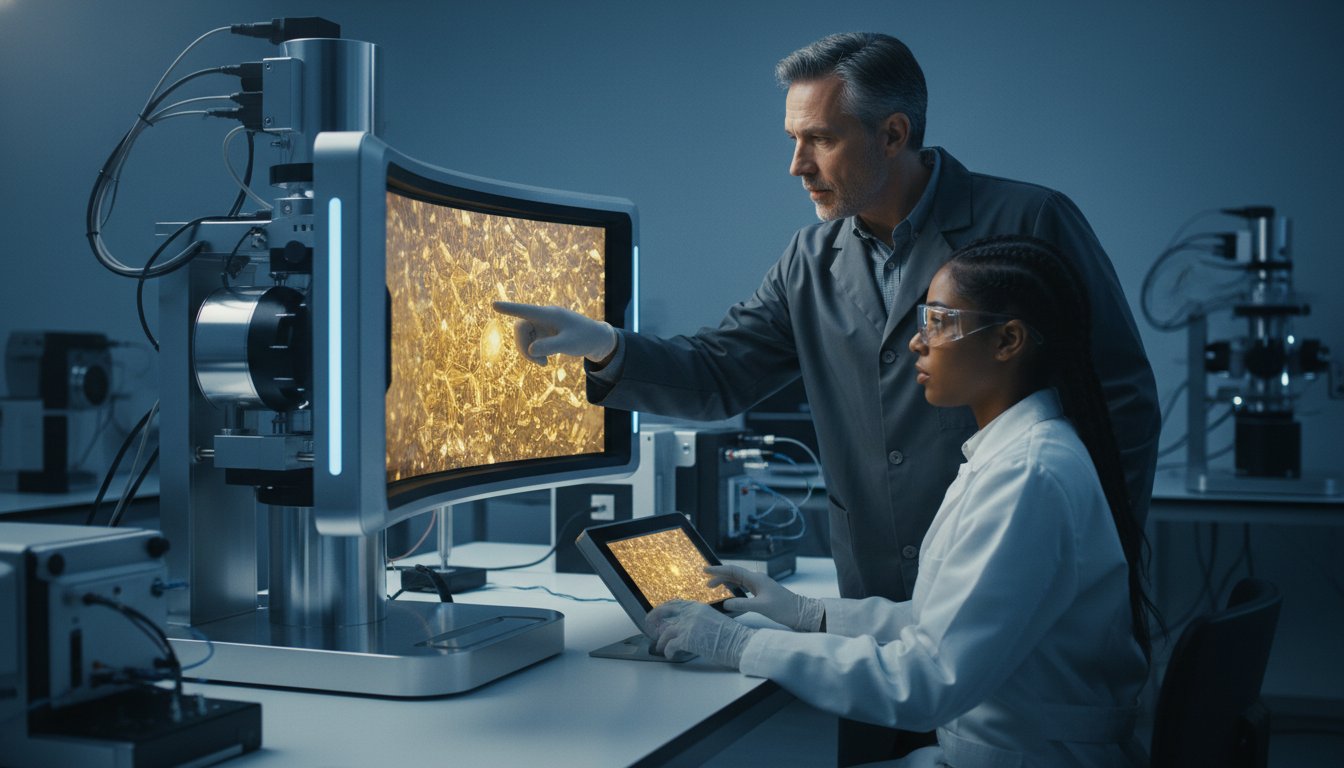
With the global scanning electron microscope market projected to reach 5.1 billion dollars in 2026, the technical disparity between sophisticated hardware and operator proficiency has reached a critical inflection point. You likely recognize that even the most advanced Veritas Ultra or FE series systems are only as precise as the professionals who calibrate them. High staff turnover and the resulting knowledge gaps often lead to frequent equipment downtime and suboptimal image quality that compromises critical research or quality control outcomes. Consequently, investing in comprehensive on-site sem operator training is no longer a discretionary expense; it’s a strategic mandate for maintaining institutional imaging accuracy and operational excellence.
This discussion illustrates how customized, on-site technical training optimizes scanning electron microscope performance, extends hardware longevity, and secures the highest standards of data integrity. We’ll examine the integration of AI-assisted analytics, the necessary transition to Windows 11-supported software like SEMView8000, and the establishment of standardized operating procedures to mitigate maintenance costs. By aligning human expertise with specific hardware requirements, facilities can transform their imaging departments into centers of certified competency and reliable innovation.
Key Takeaways
- Learn how customized instructional programs transition laboratory personnel from basic instrumentation use to technical mastery of electron-matter interactions.
- Understand why specialized on-site sem operator training offers a distinct advantage by calibrating hardware within its permanent environment using facility-specific samples.
- Explore the fundamental principles of vacuum physics and signal generation necessary to ensure the long-term accuracy and precision of institutional imaging.
- Discover how rigorous operational protocols directly extend the service life of SEM filaments and source components while reducing the frequency of emergency repairs.
- Identify the strategic benefits of leveraging multi-manufacturer expertise to standardize operating procedures across Veritas, EmCraft, and legacy systems.
The Strategic Value of On-Site SEM Operator Training
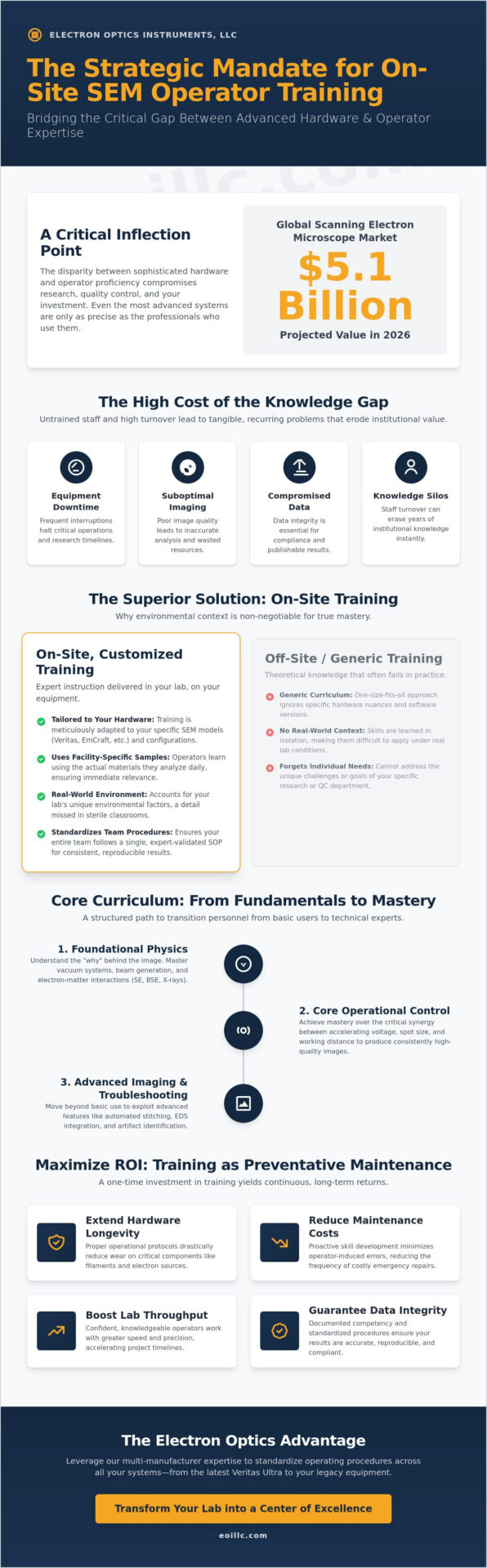
On-site SEM operator training represents a sophisticated instructional paradigm where technical expertise is delivered directly within the client’s operational environment. Unlike generic theoretical modules or self-study programs that often overlook the physical nuances of hardware interaction, this program is meticulously tailored to the specific hardware configurations and sample requirements of an individual laboratory. In the current industrial climate, characterized by a global market projected to reach 5.1 billion dollars in 2026, the acquisition of a high-performance Scanning Electron Microscope is merely the foundational step. The true competitive advantage resides in the transition from passive equipment operation to comprehensive technical mastery. This strategic calibration ensures that the substantial capital investment in microscopy hardware translates into high-fidelity data output and long-term institutional reliability.
Documenting operator competency has become a prerequisite for laboratory compliance and quality assurance in 2026. As industry standards for data integrity evolve, facilities must prove that their personnel possess the rigorous training necessary to manage complex electron optics without risking hardware degradation. Bridging the gap between the physical acquisition of a system and the generation of accurate, publishable results requires more than a manual; it demands a hands-on immersion in the instrument’s specific vacuum and beam dynamics.
Maximizing the Utility of Scientific Instrumentation
Expert-led instruction is the catalyst that transforms a standard imaging tool into a powerful analytical asset. For instance, when technicians receive specialized guidance on the Cube II Benchtop SEM, they move beyond basic surface visualization to exploit advanced features like automated image stitching or integrated EDS systems. This depth of knowledge directly influences laboratory throughput. Confident operators work faster and with greater precision, reducing the time required for sample characterization while maintaining the integrity of the results. It’s about empowering the research team to utilize the full spectrum of their equipment’s capabilities without hesitation.
Addressing the Institutional Knowledge Gap
Staff turnover poses a significant risk to industrial and academic facilities, often leading to “knowledge silos” where only a single individual understands specific instrument nuances. Specialized on-site sem operator training mitigates this vulnerability by standardizing imaging protocols across the entire QC or research team. When every technician follows a rigorous, expert-validated Standard Operating Procedure (SOP), the facility ensures consistency. Results remain reproducible regardless of personnel shifts. This systematic approach to training preserves institutional knowledge, protecting the laboratory from the data fluctuations and equipment errors that typically follow the departure of a senior operator.
Core Curriculum: From Vacuum Physics to Advanced Imaging
Effective on-site sem operator training requires a curriculum that transcends basic software navigation, grounding the operator in the fundamental physics of electron-matter interaction. This instructional framework must include a deep exploration of how the primary electron beam interacts with the sample’s interaction volume to generate secondary electrons, backscattered electrons, and characteristic X-rays. A curriculum modeled after the University of Wisconsin SEM training protocol ensures that technicians understand these underlying mechanisms before they attempt high-resolution imaging. This foundational knowledge is critical for identifying and troubleshooting artifacts that might otherwise be misinterpreted as sample features or hardware failures.
Mastery of the SEM vacuum system is equally vital to the curriculum, as maintaining a high-vacuum environment is necessary to prevent beam scattering and protect the electron source from oxidation. Training should emphasize the intricate synergy between accelerating voltage, spot size, and working distance. For instance, while increasing the voltage may enhance resolution, it can also cause excessive charging on non-conductive specimens. Adjusting these parameters requires a methodical approach that balances signal intensity with beam-induced damage. This level of technical nuance is particularly relevant when operating high-performance systems like the Veritas Series SEM, where precision is paramount.
Technical Mastery of the Electron Column
Achieving optimal resolution requires precise control over the internal optics of the electron column. Training focuses on aperture alignment and focus optimization to ensure the beam remains symmetrical and coherent throughout the imaging process. Astigmatism is defined as the asymmetric distortion of the electron beam cross-section resulting from irregularities in the electromagnetic lenses. Correcting this distortion is essential for capturing crisp, high-fidelity images. Operators also learn to distinguish between the topographic detail provided by secondary electron detectors and the compositional contrast revealed by backscattered electron detectors. This allows for a more sophisticated interpretation of material characteristics across diverse sample types.
Analytical Integration: EDS and Spectroscopy
Modern microscopy often involves elemental characterization through the use of EDS (Energy Dispersive Spectroscopy) Systems. Training provides the expertise needed to optimize X-ray collection geometry, ensuring that the take-off angle and count rate are ideal for accurate quantitative analysis. Effective on-site sem operator training ensures that these analytical tools are used to their full potential, allowing laboratories to move from simple visualization to robust chemical mapping. This analytical integration allows technicians to incorporate complex spectral data into professional reporting structures, ensuring that every scan contributes to the facility’s broader strategic objectives and research outcomes.
On-Site vs. Off-Site: Why Environmental Context Matters
The primary limitation of centralized training facilities involves their inability to replicate the unique environmental variables present within a client’s specific laboratory. While some manufacturers suggest that off-site centers provide a distraction-free environment, this approach fails to account for localized floor vibrations, acoustic noise, or electromagnetic interference that can significantly degrade image quality at high magnifications. By conducting instruction in the instrument’s permanent location, on-site sem operator training allows technicians to identify and mitigate these site-specific challenges in real-time. This ensures that the microscope is calibrated to perform optimally within its actual operational context rather than under idealized factory conditions.
Contextual learning extends to the specimens themselves. Traditional courses, such as the UNH SEM operator training curriculum, often utilize standardized test specimens to demonstrate fundamental principles over several structured sessions. However, industrial laboratories require proficiency with the specific, often difficult, materials they analyze daily. Whether the facility focuses on non-conductive polymers or complex metallurgical alloys, training on actual institutional samples bridges the gap between theory and practice. This eliminates the uncertainty that arises when a technician returns from an off-site course only to find that the ‘standard’ techniques don’t directly translate to their specialized research or quality control workflows.
Customization to Institutional Workflows
On-site instruction facilitates the seamless integration of advanced SEM techniques into the facility’s existing quality management systems. Rather than following a generic syllabus, the curriculum is tailored to address specific institutional objectives, such as precise failure analysis or high-resolution nanotechnology characterization. This alignment ensures that the resulting Standard Operating Procedures (SOPs) are both technically rigorous and practically applicable to current projects. It’s a strategic method for ensuring that every operator maintains the high standards required for international production excellence. For those seeking to enhance their facility’s technical capabilities, exploring specialized SEM solutions provides a foundation for long-term operational success.
Hands-On Problem Solving in Real-Time
Learning on the exact interface the team will use daily provides a significant psychological and practical advantage. Operators don’t have to translate instructions from a different software version or hardware configuration; they master the specific nuances of their own Veritas or Genesis system. This immediate familiarity allows for real-time troubleshooting of hardware issues specific to the lab’s unit. It empowers the team to optimize parameters for challenging samples while the instructor is present to provide immediate corrective feedback, effectively reducing the learning curve and preventing future equipment downtime.
Maximizing ROI: Training as Preventative Maintenance
The fiscal viability of a high-tech microscopy laboratory is inextricably linked to the operational discipline of its personnel. High-performance instruments like the Veritas FE SEM or the Veritas Ultra SEM represent significant capital investments that require meticulous stewardship to maintain their specified resolution and analytical accuracy. By integrating on-site sem operator training as a fundamental component of a comprehensive SEM maintenance strategy, facilities can systematically reduce the incidence of avoidable hardware failures. This proactive approach ensures that the delicate synergy between the electron source, vacuum pumps, and detector electronics is preserved, effectively extending the functional lifespan of critical components such as SEM filaments and apertures.
Expertise in vacuum management is perhaps the most significant factor in reducing emergency repair costs. When operators are trained to recognize the subtle early warning signs of system degradation, such as atypical pump-down times or increased beam instability, they can initiate corrective action before a minor issue escalates into a catastrophic failure. This expert-driven oversight mitigates the hidden costs of downtime, where lost research hours and delayed quality control cycles often exceed the price of the actual hardware repair. Strategic on-site sem operator training thus functions as a form of insurance, protecting the institution against the volatility of equipment failure and the resulting logistical disruptions.
Protecting the Capital Investment
Prevention of catastrophic mechanical failures is a primary objective of specialized technical instruction. Improper sample loading or premature venting can introduce atmospheric contaminants or cause physical damage to the stage and objective lens. Operator error, particularly during the sample exchange process, remains the primary catalyst for internal vacuum contamination and subsequent system degradation. By mastering the correct protocols for sample preparation and chamber evacuation, technicians safeguard the instrument’s internal environment. Facilities seeking to further bolster their equipment’s reliability should consider scheduling regular Preventative Maintenance Visits to complement their internal training programs.
Efficiency and Data Integrity
Operational proficiency also yields substantial dividends in the form of enhanced data integrity and laboratory throughput. High-quality imaging captured correctly on the first attempt eliminates the need for costly re-work, allowing projects to proceed without the delays caused by blurred or artifact-heavy micrographs. As institutional reputations are often built on the clarity and accuracy of their analytical data, the impact of professional operator training extends far beyond the laboratory walls. It ensures that every image produced reflects the high standards of a seasoned, global innovator, reinforcing the facility’s position as a leader in specialized industrial research.
The Electron Optics Advantage: Expert-Led On-Site Solutions
Electron Optics Instruments, LLC leverages more than 30 years of specialized expertise to provide a technical advantage that transcends basic instrumentation sales. Our approach to on-site sem operator training is rooted in a deep understanding of electron beam dynamics across a diverse range of platforms. We don’t just train on our own Veritas or Genesis systems; our engineers possess the multi-manufacturer proficiency required to calibrate and optimize EmCraft and various legacy systems. This breadth of knowledge ensures that your facility maintains a unified standard of excellence regardless of the specific hardware age or manufacturer. By providing these specialized instructional programs, we bridge the gap between complex engineering and practical laboratory application, ensuring that every operator achieves a technical mastery that reflects our status as a global innovator.
At the intersection of industrial innovation and technical reliability, we view education as a critical pillar of equipment longevity and institutional success. Our visionary support model at Electron Optics Instruments, LLC integrates sales, service, and specialized instruction to create a seamless operational ecosystem that prioritizes data integrity. By aligning training with existing service contracts and scheduled Preventative Maintenance Visits, we ensure that your team’s proficiency evolves alongside the hardware. This synergy between education and maintenance is central to our commitment to sustainable development, as well-trained operators significantly reduce the financial costs associated with premature equipment failure. Post-training, institutional partners retain access to our technical experts, fostering a culture of continuous improvement.
A Visionary Approach to Technical Support
The relationship between our technical team and your laboratory is characterized by a steady, expert-driven narrative that emphasizes meticulousness. We understand that the transition to advanced imaging requires ongoing support, which is why our training modules are designed to be dynamic and responsive to your evolving needs. Whether your staff is operating the Cube II Benchtop SEM or the Veritas HR SEM, they receive instruction that’s tailored to the specific nuances of their hardware. This commitment to technical integration ensures that your facility remains established and confident in its technical prowess, projecting an image of a reliable partner in the global research community.
Initiating Your Laboratory Transformation
Every laboratory operates under unique logistical and technical constraints that require a bespoke approach to personnel development. Our consultative process begins by determining the specific training requirements of your team, whether they need beginner modules for basic imaging or advanced analytical spectroscopy techniques for complex material characterization. We offer flexible scheduling to minimize disruption to your facility’s production or research cycles, allowing for a methodical flow of information that respects the grounded realities of international production. This structured transition ensures that your laboratory transformation is both thorough and efficient, yielding a team that’s fully competent in your facility’s specific protocols. Contact us to schedule your customized on-site SEM training session and secure the future of your imaging accuracy and hardware longevity.
Securing the Future of Institutional Imaging Excellence
The convergence of advanced hardware and human expertise defines the next era of microscopy performance. As established throughout this discussion, the transition from basic operation to technical mastery is essential for maintaining the high-fidelity data output required by modern industrial standards. Implementing a rigorous program for on-site sem operator training ensures that your facility isn’t just reacting to equipment issues but proactively optimizing every scan for maximum resolution and accuracy. This approach safeguards your capital investment while fostering a culture of precision that’s vital for long-term institutional success.
Electron Optics Instruments, LLC provides the steady, expert-driven narrative necessary to navigate these technical complexities. With over 30 years of industry experience and our position as the sole US distributor for EmCraft Scanning Electron Microscopes, we offer the meticulousness and multi-manufacturer support your laboratory requires. Request a Professional Consultation for On-Site SEM Training to begin calibrating your team’s expertise to the sophisticated demands of your specific imaging environment. It’s time to transform your laboratory into a visionary center of excellence where innovation and reliability intersect.
Frequently Asked Questions
What are the primary benefits of on-site SEM training compared to online courses?
On-site instruction provides a distinct advantage by allowing technicians to interact with hardware within its specific environmental context. Unlike remote modules, on-site sem operator training facilitates real-time troubleshooting of localized variables like vibration or electromagnetic interference. This hands-on immersion ensures that operators master the precise nuances of their institutional equipment, leading to higher data integrity and more reliable imaging outcomes.
Can you provide training for older SEM models from manufacturers you don’t sell?
We provide technical instruction for a broad spectrum of instrumentation, including legacy systems and models from various manufacturers. Our engineers possess the multi-manufacturer expertise necessary to calibrate and optimize diverse hardware configurations, ensuring that your facility maintains a unified standard of excellence. This capability allows laboratories with mixed instrument fleets to standardize their operating procedures without requiring separate training sessions for every individual unit.
How long does a typical on-site SEM operator training session last?
A typical instructional engagement generally spans two to three business days, depending on the complexity of the hardware and the specific analytical requirements of the laboratory. This timeframe allows for a methodical transition from fundamental vacuum physics to advanced imaging techniques and EDS integration. We prioritize a balanced rhythm of theoretical knowledge and practical application to ensure that every participant achieves a high level of technical competency.
Is sample preparation included in the SEM training curriculum?
Comprehensive sample preparation is a fundamental pillar of our instructional curriculum. Proper preparation is essential for mitigating charging artifacts and ensuring that the electron beam interacts optimally with the specimen surface. Operators learn industry-specific techniques for mounting, coating, and cleaning samples; these skills directly influence the clarity and accuracy of the resulting micrographs across various industrial applications.
What prerequisites should our staff have before starting the training?
Laboratory staff should possess a foundational understanding of physics or materials science before beginning a specialized instructional program. While we cover the intricacies of electron optics, prior familiarity with basic scientific principles accelerates the learning process. It’s also advisable for personnel to complete any internal institutional requirements, such as radiation safety courses, to ensure they’re prepared for independent instrument operation post-training.
How does professional training impact the total cost of ownership of an SEM?
Professional instruction significantly reduces the total cost of ownership by transforming training into a form of preventative maintenance. Well-trained operators are less likely to cause vacuum contamination or premature filament failure, which effectively lowers the frequency of emergency repairs and associated downtime. By securing the longevity of critical components, on-site sem operator training ensures that the capital investment remains productive and reliable over its entire service life.
Do you provide certificates of completion for laboratory compliance records?
We provide documented records of training completion to assist facilities with their internal compliance and quality management requirements. While no single, universally recognized certification exists for SEM operation, these records serve as evidence of an operator’s technical proficiency and adherence to standardized operating procedures. This documentation is vital for laboratories that must maintain rigorous standards for data integrity and institutional accountability.
Can the training be customized for specific industrial applications like failure analysis?
Our instructional modules are fully customizable to address specific industrial applications, including failure analysis, nanotechnology characterization, and metallurgical inspection. We tailor the curriculum to the unique challenges of your facility’s daily samples, ensuring that the techniques taught are directly applicable to your current projects. This focused approach allows your team to move beyond generic imaging to perform high-resolution analytical microscopy with institutional precision.