
Could a 470% surge in raw material costs finally render the traditional electron source obsolete for high-throughput laboratories? While the upfront cost of a single cathode remains a primary metric for many procurement officers, the real fiscal impact lies within the tungsten vs ceb6 filament lifespan discrepancy. If you’re managing a Veritas FE SEM or a Cube II Benchtop SEM, you’ve likely experienced the frustration of mid-session beam failure. It’s not just a minor inconvenience; it’s a systemic disruption that compromises data integrity and inflates the total cost of ownership through repeated maintenance cycles.
We recognize that inconsistent beam stability and frequent downtime for filament replacement represent significant barriers to industrial productivity. This article offers a meticulous technical comparison of operational endurance, analyzing why a CeB6 source can sustain over 1,000 hours of imaging while tungsten often fails before the 100-hour mark. We’ll examine the thermal physics of degradation, the vacuum integrity required for each source, and the specific economic impact of these variables. This analysis will help you justify the ROI of high-end electron sources and optimize the long-term performance of your Veritas Series or Genesis Tabletop SEM.
Key Takeaways
- Gain a technical understanding of how thermionic emission and material work functions directly influence the long-term stability of your electron beam.
- Evaluate the operational constraints of the traditional tungsten hairpin design, which generally limits active imaging to a window of 60 to 100 hours.
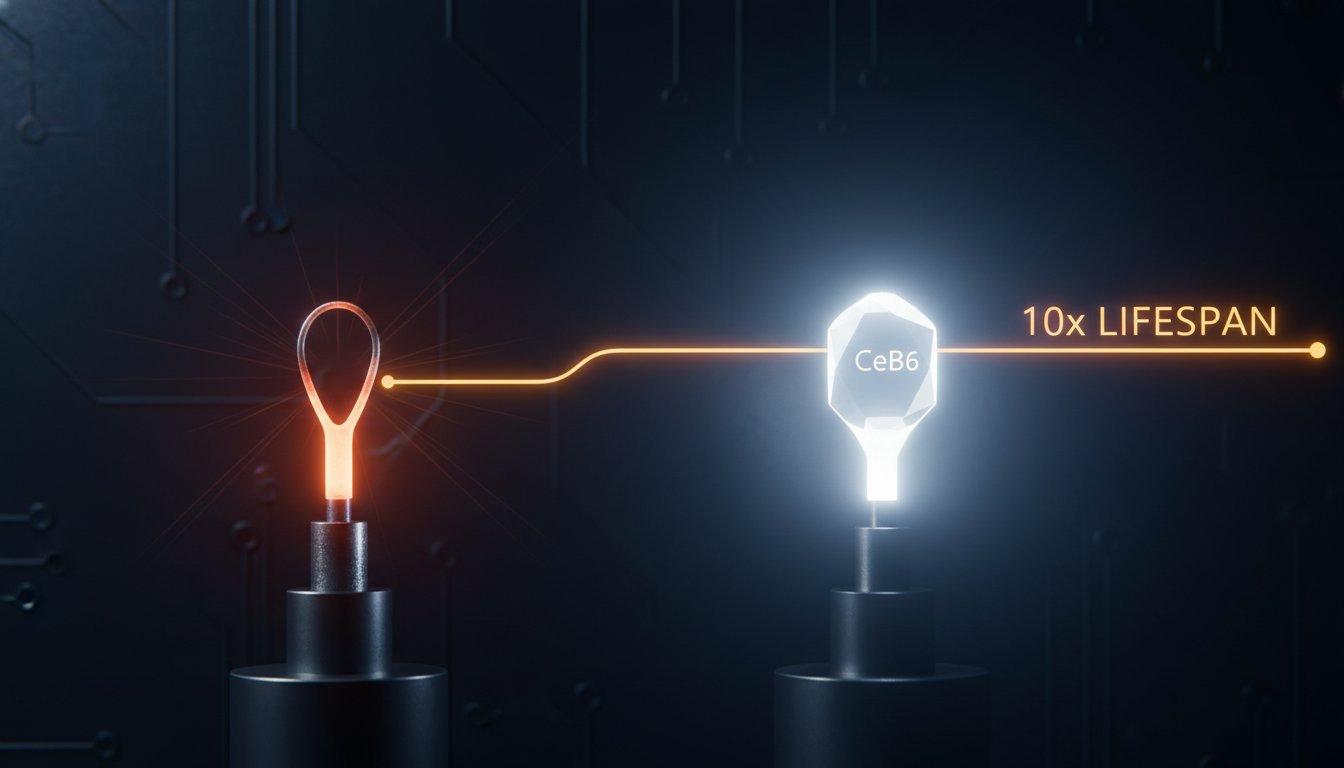
- Analyze the significant 10x longevity advantage provided by solid-state crystal architecture when comparing the tungsten vs ceb6 filament lifespan for high-duty cycles.
- Develop a more accurate ROI model by accounting for the hidden costs of downtime and the 15 to 20 tungsten changes typically required to match a single CeB6 lifecycle.
- Identify the most efficient electron source configuration for your specific laboratory requirements, balancing the needs of rapid screening with high-resolution characterization.
The Physics of Electron Emission: Understanding Thermionic Sources
The operational integrity of any Scanning Electron Microscope, from the Genesis Tabletop SEM to the Veritas HR SEM, hinges on the precise control of electron generation. At the heart of this process lies thermionic emission, a phenomenon where thermal energy provides electrons with sufficient momentum to overcome the electrostatic potential barrier known as the work function. As the cathode is heated, the kinetic energy of the electrons increases until it exceeds the binding energy of the material, allowing a stream of electrons to be emitted into the vacuum. The efficiency of this transition determines the brightness of the beam and the eventual degradation of the source itself.
The cathode serves as the primary component in maintaining a stable, high-brightness electron beam. However, the material choice for this component dictates the necessary operating temperature, which in turn influences the evaporation rate of the source. When evaluating the tungsten vs ceb6 filament lifespan, one must consider that material loss isn’t linear. It’s an exponential function of temperature. While tungsten is a robust refractory metal, its high work function requires extreme thermal excitation. This leads to a constant thinning of the filament wire until structural failure occurs, often during critical imaging sessions.
The Impact of Work Function on Source Efficiency
Work function is measured in electronvolts (eV) and represents the minimum energy required to remove an electron from a solid. Tungsten possesses a work function of approximately 4.5 eV, whereas Cerium Hexaboride (CeB6) is significantly lower at 2.7 eV. This 1.8 eV difference is transformative for operational longevity. Because CeB6 requires less energy to release electrons, it operates at roughly 1800°C, compared to the 2500°C required for tungsten. Lower operating temperatures result in reduced thermal stress and a drastically lower evaporation rate, directly extending the functional life of the cathode within the microscope vacuum chamber.
Cathode Geometry and Beam Convergence
The physical architecture of the source also plays a vital role in beam quality and endurance. Tungsten filaments utilize a “hairpin” design, consisting of a drawn wire bent into a V-shape. As the wire thins due to evaporation, the resistance changes, leading to fluctuations in beam current and eventual breakage. In contrast, CeB6 cathodes feature a solid-state, truncated crystal architecture. This solid crystal provides a more stable emission surface and maintains its geometric integrity over hundreds of hours. This structural stability ensures that the electron beam remains focused and aligned, which is essential for the high-resolution requirements of the Veritas Ultra SEM and other advanced platforms.
Tungsten Filaments: The Mechanics of the Standard Workhorse
The tungsten hairpin filament has long served as the fundamental electron source for specialized industrial laboratories, providing a reliable balance between operational simplicity and initial capital expenditure. When analyzing the tungsten vs ceb6 filament lifespan, the most striking characteristic of the tungsten cathode is its finite operational window. In standard conditions, these filaments typically offer between 40 and 100 hours of active use. While some optimized environments may push this toward 200 hours, the physics of the material ensures that failure is a matter of “when” rather than “if.”
This “hairpin” design consists of a drawn tungsten wire bent into a V-shape, a geometry that is straightforward to manufacture but inherently limited in brightness. Despite these limitations, tungsten remains the default choice for high-throughput, low-magnification environments, such as those utilizing the Genesis Tabletop SEM. The primary advantage is logistical; tungsten filaments are user-swappable and require only about 10 minutes for replacement. For laboratories managing high-volume screening, maintaining a consistent inventory of SEM Filaments and Consumables is essential to mitigate the impact of these frequent source failures.
Failure Mechanisms: Evaporation and Structural Thinning
At standard operating temperatures of approximately 2500°C (roughly 2773K), tungsten atoms undergo sublimation, transitioning directly from a solid state to a gas within the high-vacuum environment. This constant material loss is not uniform. Instead, it tends to concentrate at specific points along the wire, creating a “thin spot.” As the wire thins, its electrical resistance increases, which further raises the localized temperature and accelerates the evaporation rate. This positive feedback loop eventually leads to catastrophic structural failure. Additionally, frequent power cycling induces mechanical fatigue. The repeated expansion and contraction of the wire during heating and cooling cycles create micro-fractures that compromise the filament’s integrity long before its theoretical evaporation limit is reached.
Operational Variables Affecting Tungsten Longevity
Maximizing the endurance of a tungsten source requires a precise understanding of the trade-off between acceleration voltage and filament life. Higher voltages demand higher filament currents, which exponentially increase the evaporation rate. Furthermore, vacuum quality is a critical determinant of source health. A vacuum threshold of 10^-5 Torr is the minimum requirement for tungsten; any deviation toward higher pressures introduces oxygen molecules that react with the hot metal, causing rapid oxidation and “burn-out.” Technicians must also practice careful “saturation” during the startup phase. By slowly increasing the filament current until the beam brightness plateaus, operators prevent the unnecessary thermal shock that often leads to premature failure in routine SEM operations.
CeB6 Crystals: Engineering for Extended Operational Longevity
While tungsten remains a viable choice for routine analysis, the transition to Cerium Hexaboride (CeB6) represents a fundamental shift in electron source engineering. The technical disparity in the tungsten vs ceb6 filament lifespan is most evident in high-duty cycle environments where instrument uptime is a non-negotiable metric. Unlike the drawn wire of a tungsten source, CeB6 utilizes a solid-state crystal architecture. This structural density allows the cathode to yield upwards of 1,500 hours of operational life, providing a 10x to 15x longevity advantage over traditional hairpin filaments. This endurance is not merely a convenience; it is a strategic asset for laboratories prioritizing long-duration imaging and automated analysis.
The performance benefits extend beyond simple durability. The CeB6 source offers approximately ten times the brightness of tungsten, which translates to a significantly improved signal-to-noise ratio and finer image resolution. This enhanced brightness is particularly beneficial for the Cube II Benchtop SEM, where the source enables superior characterization of features smaller than 1 µm without the need for a large-scale footprint. Furthermore, the “flat-top” emission profile of the crystal ensures that the electron spot size remains consistent throughout its entire lifecycle. This stability prevents the gradual resolution degradation that often plagues thinning tungsten wires as they approach the point of failure.
Vacuum Requirements and Environmental Sensitivity
The superior performance of hexaboride sources necessitates a more rigorous vacuum environment to maintain crystal integrity. While tungsten can operate at 10^-5 Torr, CeB6 requires a cleaner vacuum of at least 10^-7 Torr. This requirement exists to prevent “crystal poisoning,” a process where residual gas molecules adsorb onto the emitting surface and increase the work function. If the vacuum quality is compromised, the crystal face can become contaminated, leading to unstable emission and a shortened lifespan. To mitigate this risk, high-end systems often incorporate an ion pump dedicated to the gun chamber, ensuring the pristine environment necessary to capitalize on the 1,500-hour potential of the source.
Thermal Stability and Reduced Evaporation
Thermal management is the primary driver of the extended tungsten vs ceb6 filament lifespan. Operating at approximately 1800K, the CeB6 cathode functions at a temperature nearly 1000K lower than its tungsten counterpart. This dramatic reduction in thermal stress virtually eliminates the structural warping and mechanical fatigue common in metal filaments. Because the material evaporation rate is significantly lower at these temperatures, the electron gun alignment remains stable over months of operation. This stability reduces the need for frequent recalibration, allowing operators to focus on data acquisition rather than instrument maintenance. The result is a reliable, high-performance system that maintains peak alignment integrity from the first hour to the fifteen-hundredth.
Comparative Lifespan Economics: TCO and ROI Analysis
The fiscal evaluation of electron sources requires a transition from simple procurement metrics to a comprehensive Total Cost of Ownership (TCO) framework. When examining the tungsten vs ceb6 filament lifespan, the initial acquisition price of a cathode represents only a fraction of the total operational expenditure. A standard tungsten filament is an inexpensive consumable; however, its short operational life mandates 15 to 20 replacement cycles to match the longevity of a single Cerium Hexaboride crystal. Each replacement event introduces labor costs, potential alignment errors, and substantial instrument downtime. For industrial failure analysis where image quality is paramount, the ROI of a CeB6 source is further bolstered by its superior resolution and lower signal noise, which accelerate the path to actionable data.
High-throughput laboratories must account for the secondary costs associated with frequent source failures. Beyond the price of the filament itself, the cumulative time spent venting the chamber, swapping the source, and waiting for the vacuum to reach operational levels can total dozens of hours per year. This lost productivity often exceeds the price gap between the two technologies. Organizations that prioritize long-term stability often find that the higher initial investment in CeB6 technology is recaptured within the first year of operation through reduced service requirements and increased sample volume.
Downtime vs. Consumable Investment
The Maintenance-to-Usage ratio is defined as the total hours of technician intervention and vacuum recovery time relative to the total hours of active analytical uptime. The Cube II Benchtop SEM leverages the extended CeB6 lifecycle to minimize these interventions, ensuring that industrial facilities maintain a steady operational cadence. In automated, multi-day imaging runs, a sudden filament failure isn’t merely a maintenance issue; it’s a systemic disruption that can invalidate hours of data collection and require a full system restart. By investing in a high-end hexaboride source, organizations protect the continuity of their research and production schedules.
Performance Degradation Over the Lifecycle
The economic impact of source selection also manifests in the consistency of analytical output. A tungsten source experiences a gradual drop in brightness as the wire thins through sublimation, forcing operators to constantly adjust parameters to maintain image quality. Conversely, CeB6 maintains peak analytical performance with remarkable stability until the very end of its functional life, ensuring that data collected in hour 10 matches the precision of hour 1,400. To preserve this level of accuracy, scheduling regular SEM preventative maintenance visits is essential, as even the most durable sources require optimized vacuum conditions and clean apertures to perform at their theoretical limits.
If you’re looking to optimize your laboratory’s throughput and reduce long-term operational costs, explore our comprehensive range of SEM Filaments and Consumables to find the ideal match for your instrument.
Strategic Selection: Which Electron Source Fits Your Laboratory?
Finalizing the configuration of an analytical suite requires a nuanced understanding of how specific hardware choices intersect with long-term operational goals. The decision between electron sources isn’t merely a matter of preference; it’s a strategic alignment of technology with the anticipated workload and precision requirements of the facility. While the initial electron microscope cost often dictates the starting point for procurement, savvy laboratory managers prioritize the tungsten vs ceb6 filament lifespan as a primary variable in their fiscal planning. Selecting the wrong source for a high-utilization environment can lead to a cascade of hidden expenses that quickly eclipse any initial savings on hardware.
High-utilization laboratories, particularly those involved in automated quality control or high-resolution research and development, almost always find that the transition to CeB6 is the most sustainable path forward. The extended operational window reduces the frequency of system venting and re-alignment, which preserves the integrity of the vacuum system over time. To ensure these high-end sources achieve their maximum theoretical endurance, many organizations integrate their procurement with comprehensive SEM service contracts. These agreements provide the technical oversight necessary to maintain the stringent vacuum levels and precise electronic bias required for hexaboride stability.
Application-Specific Recommendations
The choice of cathode should mirror the complexity of the samples being analyzed. Tungsten remains a logical and cost-effective selection for educational institutions, basic morphology screenings, and laboratories where the microscope is used only a few hours per week. Its simplicity and ease of replacement make it ideal for multi-user environments where the risk of user-induced failure is high. Conversely, an upgrade to CeB6 is essential for semiconductor failure analysis, nanotechnology research, and 24/7 industrial QC lines. The higher brightness of CeB6 also yields a significant synergy with Energy Dispersive Spectroscopy (EDS) accuracy; the increased beam current stability allows for more precise elemental mapping and quantification over extended collection periods.
Maximizing Filament Life through Professional Maintenance
Achieving the full potential of any electron source requires more than just high-quality hardware; it demands meticulous operational discipline. Precise gun alignment and optimized bias settings are critical to preventing localized overheating, which is a common precursor to premature failure. Providing staff with on-site technical training is one of the most effective ways to prevent user-induced filament damage and ensure consistent data quality. Professional oversight during scheduled Preventative Maintenance Visits ensures that ion pumps and vacuum seals are functioning at peak efficiency. This rigorous maintenance approach is the cornerstone of protecting the tungsten vs ceb6 filament lifespan, transforming a high-end consumable into a reliable, long-term analytical asset.
Future-Proofing Your Laboratory with High-End Electron Sources
The rigorous technical comparison of the tungsten vs ceb6 filament lifespan reveals that the choice of electron source is a fundamental driver of institutional productivity and operational stability. It’s evident that while tungsten filaments remain a cost-effective utility for routine screenings, the transition to Cerium Hexaboride technology provides a decisive advantage for laboratories requiring high-resolution characterization and minimal instrument downtime. By leveraging a solid-state crystal architecture that sustains over 1,500 hours of active use, organizations can effectively mitigate the systemic disruptions associated with frequent maintenance cycles.
As you evaluate the specific requirements of your facility, consider the long-term economic impact of your cathode selection alongside the technical precision of your hardware. With 30+ years of electron microscopy expertise, our team serves as the sole US distributor for EmCraft SEMs, providing comprehensive national service and maintenance coverage to ensure your systems perform at their theoretical limits. We invite you to explore the high-performance Cube II with CeB6 technology to transform your laboratory’s capabilities. Achieving superior imaging standards begins with a commitment to the most reliable electron source technology available.
Frequently Asked Questions
What is the average lifespan of a Tungsten filament in a benchtop SEM?
A standard tungsten hairpin filament typically provides between 40 and 100 hours of active operational life. While optimized conditions in systems like the Genesis Tabletop SEM can occasionally extend this to 200 hours, the material’s high evaporation rate at 2500°C makes regular failure inevitable. Consistent monitoring of the filament’s physical thinning is essential to prevent unexpected breakage during critical imaging sessions.
Why does a CeB6 crystal last 10 times longer than a Tungsten wire?
The primary driver of the tungsten vs ceb6 filament lifespan discrepancy is the difference in material work function and operating temperature. CeB6 has a lower work function of 2.7 eV, allowing it to emit electrons at roughly 1800K, which is 700 degrees cooler than tungsten. This lower thermal stress, combined with a solid-state crystal architecture, significantly reduces the rate of material sublimation and structural degradation.
Can I upgrade my existing Tungsten SEM to use a CeB6 source?
Upgrading from a tungsten source to a CeB6 cathode usually requires significant hardware modifications rather than a simple consumable swap. Because CeB6 requires a vacuum environment of 10^-7 Torr and specific power supply configurations, you should consult technical specifications for your Veritas Series or Genesis units. Most laboratories find it more efficient to specify the electron source during the initial procurement of advanced systems like the Veritas Ultra SEM.
How does vacuum quality affect the lifespan of an SEM filament?
Vacuum integrity is the most critical environmental factor for cathode longevity. Tungsten filaments require at least 10^-5 Torr to prevent rapid oxidation and “burn-out” caused by residual oxygen. CeB6 sources are even more sensitive, requiring 10^-7 Torr to avoid crystal poisoning, where gas molecules adsorb onto the emitter surface and increase the work function, leading to unstable emission and premature failure.
What are the primary signs that an SEM filament is nearing the end of its life?
Operators typically observe increased beam instability, flickering in the live image, or difficulty achieving saturation as a filament approaches failure. In tungsten systems, the wire physically thins, which may require higher bias settings to maintain the same emission current. For CeB6 crystals, a noticeable drop in brightness or an increase in signal noise often indicates that the crystal face has been compromised or reached its functional limit.
Is the higher cost of a CeB6 source justified for low-usage laboratories?
For laboratories with low-duty cycles or those focused on basic educational morphology, the lower upfront cost of tungsten is often the more pragmatic choice. The higher investment for a CeB6 source is technically justified for 24/7 quality control lines, nanotechnology research, and environments where the cost of instrument downtime exceeds the price of the consumable. High-throughput facilities benefit most from the reduced frequency of maintenance interventions.
How much downtime is typically involved in replacing an SEM filament?
Replacing a tungsten filament is a relatively rapid process that users can often complete in about 10 minutes, followed by 1 to 2 hours of vacuum recovery. Conversely, replacing a CeB6 source is a more complex procedure that frequently necessitates a professional service visit. The subsequent vacuum recovery for the required 10^-7 Torr environment can take significantly longer, making the 1,500-hour lifespan of CeB6 essential for maintaining operational cadence.
Does the type of filament affect the resolution of my SEM images?
The choice of filament directly impacts resolution by determining the brightness and spot size of the electron beam. CeB6 sources provide approximately ten times the brightness of tungsten, which allows for a smaller, more coherent beam and a superior signal-to-noise ratio. This technical advantage is particularly evident when imaging features smaller than 1 µm in high-performance platforms like the Veritas FE SEM or the Cube II Benchtop SEM.