
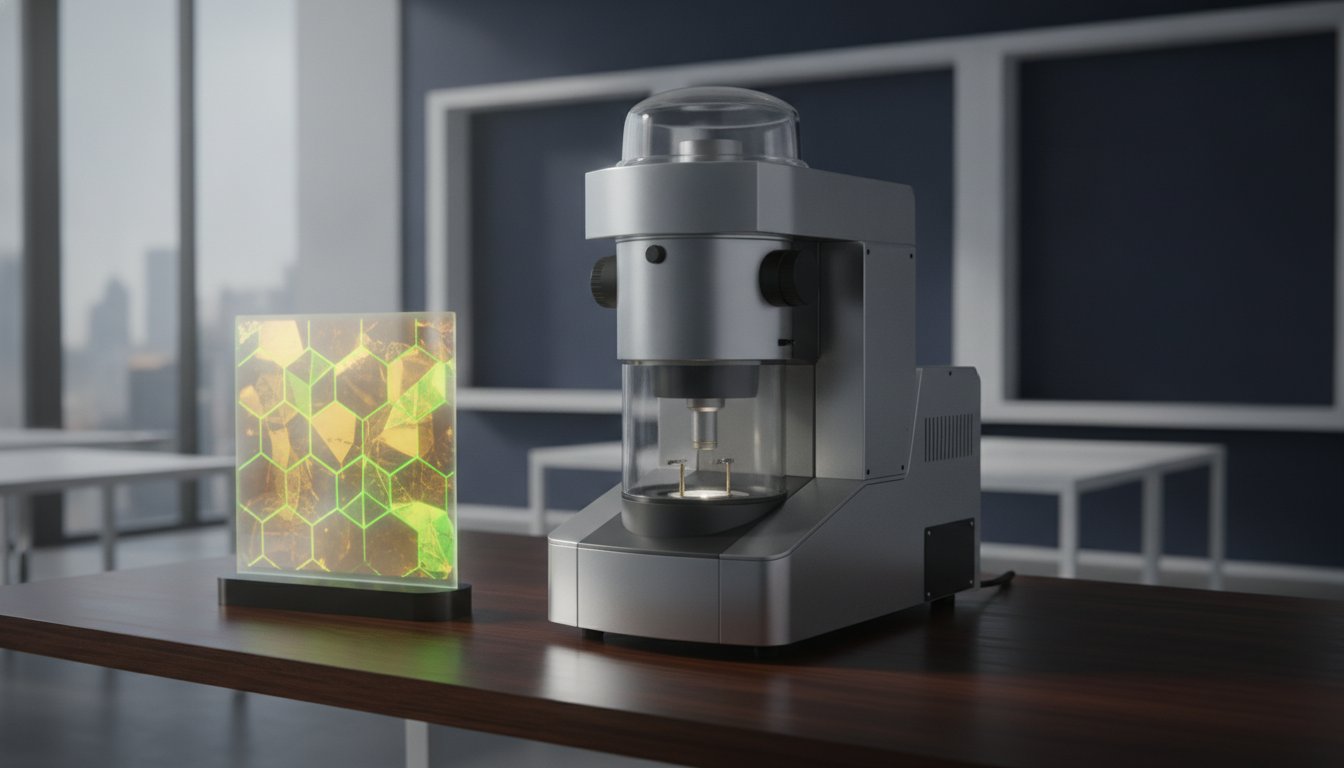
The strategic acquisition of a refurbished tabletop SEM has emerged as a superior pathway for organizations prioritizing both fiscal responsibility and technical precision, especially in environments where traditional floor-standing units frequently demand prohibitive capital investment and extensive facility modifications. You’ve likely encountered the challenge of integrating high-resolution imaging into a modern industrial research facility where square footage is at a premium and the risk of downtime remains a constant concern. It’s a recognized reality that achieving a competitive edge in material characterization requires a balance between sophisticated analytical capabilities and the grounded practicalities of facility management.
This 2026 guide evaluates the technical specifications, economic advantages, and essential lifecycle support requirements necessary to integrate a high-performance benchtop solution into your workflow. We’ll examine how the synthesis of advanced hardware, such as the Genesis and Cube II series, with integrated Energy Dispersive Spectroscopy (EDS) provides a comprehensive analytical suite. By prioritizing expert service contracts and meticulous maintenance, you’ll ensure that your instrumentation delivers long-term operational stability while meeting the rigorous standards of contemporary engineering and corporate strategy.
Key Takeaways
- Analyze the strategic transition toward decentralized, benchtop-driven R&D workflows that prioritize localized laboratory efficiency without compromising analytical depth.
- Evaluate the technical merits of the Genesis and Cube II series to select a refurbished tabletop SEM that delivers high-resolution imaging and integrated EDS capabilities.
- Contrast performance benchmarks between benchtop solutions and traditional floor-standing units to determine the precise resolution thresholds required for your specific material characterization.
- Identify the essential selection criteria for industrial applications, including the necessity of variable pressure modes for complex specimens and advanced topographical analysis.
- Understand the critical role of professional installation and customized on-site training in ensuring the long-term operational stability and accuracy of your scientific instrumentation.
The Strategic Evolution of Tabletop Scanning Electron Microscopy in 2026
The landscape of high-resolution characterization has undergone a fundamental transformation as we enter 2026. The Scanning Electron Microscope (SEM), once restricted to specialized, vibration-isolated basement facilities, has evolved into a compact, benchtop-optimized instrument capable of delivering industrial-grade precision within localized laboratory environments. It’s a strategic shift that represents a broader move from centralized microscopy cores toward decentralized, benchtop-driven R&D workflows. By integrating advanced electron optics into a smaller footprint, modern systems allow researchers in semiconductor manufacturing and materials science to perform real-time analysis without the logistical delays associated with shared facility scheduling. Acquiring a refurbished tabletop SEM provides a sophisticated entry point into this decentralized model, offering high-end imaging capabilities at a fraction of the traditional infrastructure cost.
Why Benchtop SEMs are Replacing Floor-Standing Units
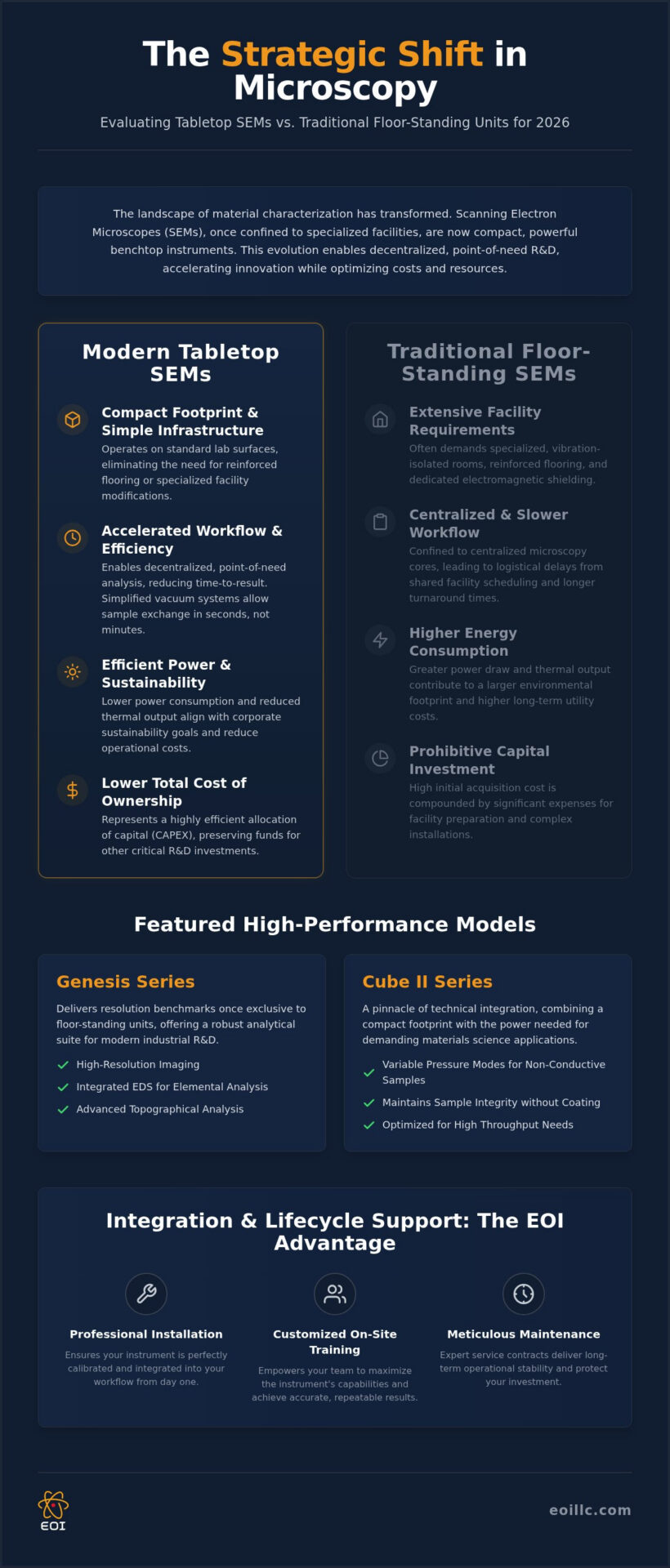
Modern benchtop configurations have largely superseded floor-standing units in many industrial applications due to their drastically reduced infrastructure requirements. Traditional installations often necessitate specialized architectural modifications, such as reinforced flooring and electromagnetic shielding, whereas benchtop units operate efficiently on standard laboratory surfaces. Organizations don’t need to invest in complex vibration isolation tables for most routine inspections. The integration of simplified vacuum systems significantly enhances operator efficiency by reducing sample exchange times from minutes to seconds. Additionally, the lower power consumption and reduced thermal output of these compact systems align with contemporary corporate sustainability goals, minimizing the overall environmental footprint of the research facility.
The Economic Rationale for Decentralized Imaging
Evaluating 2026 High-Performance Models: Genesis and Cube II Series
The 2026 market for electron optics has moved decisively beyond the limitations of legacy desktop systems. While older models often capped magnification at 60,000x, current high-performance solutions like the Genesis Tabletop SEM and Cube II Benchtop SEM provide resolution benchmarks that were once the exclusive domain of floor-standing units. These systems represent a pinnacle of technical integration, combining compact footprints with the robust analytical power required for modern industrial R&D. Selecting a refurbished tabletop SEM from these series allows organizations to access cutting-edge features, such as variable pressure modes that facilitate the imaging of non-conductive materials without the traditional requirement for extensive gold or carbon coating. This advancement is critical for maintaining sample integrity in sensitive applications.
Understanding the full scope of SEM technology and applications is essential when evaluating these models, as the choice between them often hinges on specific detector requirements and throughput needs. High-resolution imaging is no longer a centralized luxury; it’s a localized necessity.
Genesis Tabletop SEM: Analytical Specifications
The Genesis series functions as a definitive workhorse for versatile industrial applications, offering multiple acceleration voltage options that typically range from 1kV to 30kV. This flexibility allows operators to tune the electron beam for either surface-sensitive imaging or deeper elemental analysis. Acquiring a refurbished tabletop SEM within the Genesis line ensures that your facility maintains high-resolution capabilities while adhering to strict budgetary constraints. The integration of Energy Dispersive Spectroscopy (EDS) systems is a standard expectation in 2026, enabling rapid elemental mapping and line scans that provide immediate chemical context to topographical data. Refined user interface improvements have introduced semi-automated imaging routines, which reduce the technical burden on laboratory staff and ensure consistent results across different shifts.
Cube II: Precision Benchtop Performance
For laboratories requiring the highest levels of precision, the Cube II series offers specialized imaging capabilities that rival traditional architectures. This system excels in metallurgy, pharmaceuticals, and forensic science, where subtle grain boundaries or particulate contaminants must be identified with absolute certainty. Detailed insights regarding the Cube II Benchtop SEM: Features & Specifications highlight its unique detector configurations, including high-sensitivity backscattered electron (BSE) sensors and advanced secondary electron (SE) detectors. These components work in tandem with sophisticated vacuum control systems to provide a stable environment for high-magnification work. If you’re considering enhancing your facility’s analytical depth, you might find it beneficial to explore our current inventory of refurbished SEM units to identify the configuration that best aligns with your technical milestones.
Performance Benchmarks: Tabletop vs. Traditional Floor-Standing SEMs
The technical convergence observed in 2026 has effectively dismantled the outdated perception of benchtop systems as merely entry-level instrumentation. While floor-standing Field Emission (FE-SEM) units remain a technical necessity for sub-nanometer resolution in fundamental physics or advanced semiconductor lithography, the current generation of benchtop instruments has bridged the performance gap for the vast majority of industrial applications. A high-quality refurbished tabletop SEM now delivers signal-to-noise ratios and detector sensitivities that rival legacy floor models, providing the precision required for rigorous quality control and material characterization. This shift allows organizations to maintain superior imaging standards without the prohibitive infrastructure costs associated with large-scale, dedicated microscopy suites.
Resolution and Magnification Limits
Modern tabletop systems have redefined the boundaries of compact microscopy, with 2026 benchmarks demonstrating that these units satisfy approximately 90% of industrial imaging requirements. Achieving nanometer-scale resolution is no longer exclusive to traditional architectures; instead, it’s a standard feature of the Genesis and Cube II series. For a deeper analysis of how these systems achieve such precision, you can consult our guide on Advanced SEM Techniques, which explores the intricacies of high-resolution analytical microscopy. The ability to transition seamlessly from low-magnification topographical overviews to high-magnification grain boundary analysis ensures that research personnel can conduct comprehensive investigations within a single, localized workstation.
Sample Handling and Stage Automation
One of the primary distinctions between benchtop and floor-standing units lies in chamber volume and stage versatility. While traditional units accommodate massive industrial components, the 2026 benchtop generation optimizes internal space for high-volume quality assurance workflows. Modern stages offer sophisticated X-Y-Z-T-R (tilt and rotation) movement, allowing for complex sample orientation that was previously difficult to achieve in a compact format. Key features include:
- Automated Stage Control: Integrated software routines facilitate multi-point imaging and automated particle counting, significantly increasing throughput for repetitive inspections.
- Collision Prevention: Advanced chamber sensors protect delicate electron optics and detectors by monitoring sample height and tilt in real-time, preventing accidental contact.
- Versatile Mounting: Specialized stubs and holders allow for the secure positioning of diverse materials, ranging from metallurgical cross-sections to delicate forensic samples.
It’s vital to recognize the physical limitations regarding sample weight and height in benchtop configurations. While they excel at processing standard metallurgical mounts and electronic components, extremely large or heavy specimens may still require the expanded chamber capacity of a Veritas series floor unit. However, for most R&D and production floor environments, the agility and automated precision of a refurbished tabletop SEM provide a more efficient path to actionable data.
Critical Selection Criteria for Industrial and Research Applications
Selecting a high-performance analytical instrument in 2026 necessitates a rigorous evaluation of specific imaging requirements against the practicalities of laboratory throughput. Organizations must distinguish between simple topographical analysis and the complex requirements of elemental characterization. While secondary electron (SE) imaging provides detailed surface morphology, backscattered electron (BSE) detectors and integrated EDS systems are vital for identifying compositional variations within a sample. For facilities handling biological specimens, moist samples, or non-conductive polymers, the inclusion of variable pressure (VP) modes is essential to mitigate charging effects without the need for conductive coatings. Budgeting for operational longevity involves looking beyond the initial capital acquisition to account for software compatibility with modern 2026 imaging outputs and the long-term procurement of filaments and consumables.
The Case for Refurbished Tabletop SEM Units
The strategic value of a refurbished tabletop SEM is particularly evident when partnering with established US distributors who possess over 30 years of specialized industry experience. A professionally refurbished unit functions as a high-utility asset that allows research teams to bypass the long lead times often associated with new hardware production. For educational laboratories, a refurbished unit is often the most cost-effective solution because it provides graduate-level research capabilities while preserving limited grant funding for personnel and high-volume consumables. Detailed insights into the financial variables of acquisition are available in our Electron Microscope Cost Guide, which outlines the total investment required for various configurations.
Acquisition Models and Warranty Terms
Acquisition strategies must prioritize professionally refurbished instrumentation over “as-is” used equipment to ensure scientific accuracy and equipment reliability. Professionally refurbished units undergo a meticulous restoration process that includes vacuum system overhaul, column cleaning, and detector calibration. This distinction is critical for maintaining high uptime and ensuring that the instrument meets original factory specifications. Comprehensive warranty coverage acts as a safeguard against unforeseen mechanical failures, stabilizing long-term maintenance budgets. Additionally, many industrial labs leverage trade-in programs to modernize their legacy SEM equipment, facilitating a seamless transition to the Genesis or Cube II series. If you’re ready to integrate high-resolution characterization into your facility, view our current inventory of refurbished SEM units to find a system that meets your technical milestones.
Integration and Lifecycle Support: The EOI Advantage
The acquisition of high-precision hardware represents only the initial phase of establishing a robust characterization capability. Integrating a refurbished tabletop SEM into an existing industrial workflow requires more than simple physical placement; it demands meticulous calibration to ensure scientific accuracy and repeatable data. Electron Optics Instruments, LLC (EOI) leverages over 30 years of specialized industry experience to provide a seamless transition from procurement to full operational status. This expert-driven approach ensures that delicate instrumentation is installed according to rigorous factory standards, mitigating the risk of early-stage misalignment. Because EOI’s service capability extends to all major manufacturers, laboratories benefit from a single, reliable partner for their entire microscopy suite, regardless of the original equipment’s origin.
Comprehensive Service and Maintenance
Maintaining the technical integrity of a refurbished tabletop SEM involves a structured lifecycle strategy that prioritizes long-term stability. Annual service contracts are indispensable for preventing catastrophic vacuum system failures, which often stem from neglected pump maintenance or seal degradation. If you’re looking to optimize your system’s performance, you’ll find essential protocols in The Definitive Guide to SEM Maintenance. Priority field service plays a critical role in minimizing downtime for industrial production lines where every hour of inactivity translates to significant fiscal loss. By implementing a preventative maintenance schedule, organizations ensure that their benchtop solutions maintain peak precision throughout their operational lifespan and don’t succumb to avoidable mechanical wear.
Training and Professional Development
Equipment utility is fundamentally linked to the proficiency of the personnel operating it. EOI provides customized, on-site technical training designed to elevate the expertise of laboratory staff and research personnel alike. These workshops focus on advanced sample preparation and high-resolution imaging techniques, ensuring that the full analytical potential of the Genesis or Cube II series is realized. For a comprehensive overview of operational standards, researchers should refer to SEM Operation: The Professional Guide. Adherence to these operational best practices not only improves image quality but also ensures strict compliance with safety protocols regarding high-voltage and vacuum system operation. This synergy between hardware excellence and expert training forms the cornerstone of a sustainable, high-output research environment.
Advancing Analytical Capabilities with Strategic Benchtop Integration
The transition toward decentralized, high-resolution characterization represents a fundamental shift in how modern industrial facilities approach material science. By integrating a refurbished tabletop SEM into your localized workflow, you achieve technical parity with traditional architectures while maintaining the fiscal agility required for large-scale production. The Genesis and Cube II series provide the precision and integrated EDS capabilities necessary to meet rigorous 2026 resolution benchmarks without the infrastructure demands of floor-standing units.
Electron Optics Instruments (EOI) stands as the sole US distributor for EmCraft Scanning Electron Microscopes, bringing over 30 years of specialized expertise in SEM sales, service, and technical training. Our commitment to accuracy includes comprehensive maintenance support for all major electron microscope brands, ensuring your instrumentation remains a reliable asset throughout its operational lifecycle. If you’re ready to enhance your laboratory’s imaging depth, request a quote for Genesis or Cube II tabletop SEMs today. We look forward to supporting your organization’s commitment to technical excellence and industrial innovation.
Frequently Asked Questions
How much does a tabletop scanning electron microscope cost in 2026?
In 2026, the acquisition cost for a tabletop scanning electron microscope varies significantly based on detector configuration and technical specifications. While new benchtop units from major vendors typically range between $80,000 and $250,000, refurbished models offer a more accessible entry point for many organizations. Industry data indicates that refurbished legacy systems often cost 40% to 70% less than new counterparts. These figures reflect the hardware alone; organizations should also budget for installation and service contracts.
Can a tabletop SEM perform EDS elemental analysis for failure analysis?
A tabletop SEM can absolutely perform Energy Dispersive Spectroscopy (EDS) for elemental characterization and failure analysis. Modern units like the Genesis series integrate sophisticated EDS detectors that allow researchers to identify contaminants and verify material composition directly on the benchtop. This capability is vital for pinpointing metallurgical defects or particulate impurities in industrial production lines. By mapping elemental distribution, labs can conduct thorough root-cause investigations without the need for centralized microscopy facilities.
What is the difference between a benchtop SEM and a floor-standing SEM?
The primary distinction between these formats lies in their physical footprint, chamber volume, and extreme resolution capabilities. Floor-standing units typically utilize field emission (FE) sources to achieve sub-nanometer resolution, which is essential for advanced semiconductor work. Conversely, a refurbished tabletop SEM provides a compact, localized solution that satisfies approximately 90% of routine industrial imaging requirements. Benchtop units don’t require reinforced flooring or specialized vibration isolation, making them more adaptable to standard laboratory environments.
Does a tabletop SEM require a specialized laboratory environment or cooling?
Most modern tabletop SEMs operate efficiently on standard 110V or 220V power outlets and don’t require specialized water cooling or dedicated infrastructure. Their compact architecture is designed for stability on a standard laboratory bench, though a stable, level surface is necessary to minimize mechanical interference. While they are less sensitive than floor units, maintaining a temperature-controlled environment with low electromagnetic interference ensures optimal imaging precision. This simplicity allows for rapid deployment in diverse industrial or research settings.
Is it better to buy a new or refurbished tabletop SEM for a startup lab?
Annual maintenance for a tabletop SEM typically involves vacuum system verification, column cleaning, and the replacement of consumables like filaments and apertures. Preventative maintenance visits are critical for ensuring the longevity of the electron optics and preventing catastrophic pump failures. These structured service routines include detector calibration and software updates to maintain scientific accuracy. Consistent upkeep minimizes the risk of unexpected downtime, which is particularly vital for labs supporting high-volume industrial production or critical research milestones.
Can I use a tabletop SEM for imaging non-conductive samples without coating?
You can image non-conductive samples without traditional gold or carbon coating by utilizing the Variable Pressure (VP) or low-vacuum modes available in advanced benchtop units. These modes introduce a controlled amount of air or gas into the chamber to neutralize surface charging on samples like polymers, biological tissues, or moist specimens. This capability preserves the original state of the sample for further analysis. It’s a significant advancement for labs that prioritize rapid throughput and sample integrity in their characterization workflows.
How long does on-site training take for new SEM operators?
On-site training for new operators generally spans one to three days, depending on the complexity of the integrated software and the specific analytical requirements of the facility. These sessions cover fundamental electron optics, sample preparation techniques, and advanced imaging routines for integrated EDS systems. Expert-led workshops ensure that personnel can operate the instrument safely while adhering to vacuum system protocols. This professional development maximizes the utility of the hardware and ensures that the laboratory produces high-quality, repeatable characterization data.