
What if the primary barrier to your laboratory’s technical evolution wasn’t the availability of high-resolution imaging, but rather the traditional constraints of capital procurement? For many facility directors in the US, the high initial cost of a Veritas HR or Cube II SEM presents a significant hurdle that often stalls critical research during lengthy internal approval cycles. It’s a common frustration where the demand for precision engineering is met with the reality of rigid 2026 budgets. This guide provides a strategic roadmap for navigating these complexities, offering expert insights into leasing and structured capital strategies. We’ll examine how modern sem financing options leverage the latest tax advantages like Section 179 to secure a Cube II SEM with manageable monthly payments. By the conclusion, you’ll understand how Electron Optics Instruments, LLC serves as a vital partner in aligning your technical roadmap with fiscal precision.
Key Takeaways
- Contrast the long-term fiscal implications of direct ownership against the evolutionary advantages of leasing to effectively mitigate technological obsolescence.
- Evaluate diverse sem financing options including structured agreements that leverage current tax incentives to preserve critical working capital.
- Discover how deferred payment models bridge the gap between immediate equipment requirements and the cyclical arrival of institutional grant funding.
- Quantify the projected return on investment by calculating the cost-per-image reduction when transitioning from outsourced labs to in-house Veritas or Cube II systems.
- Align with EOI LLC as a strategic partner to integrate precision-driven acquisition solutions and preventative maintenance into your facility’s long-term operational strategy.
Navigating the Landscape of Scanning Electron Microscope Acquisition
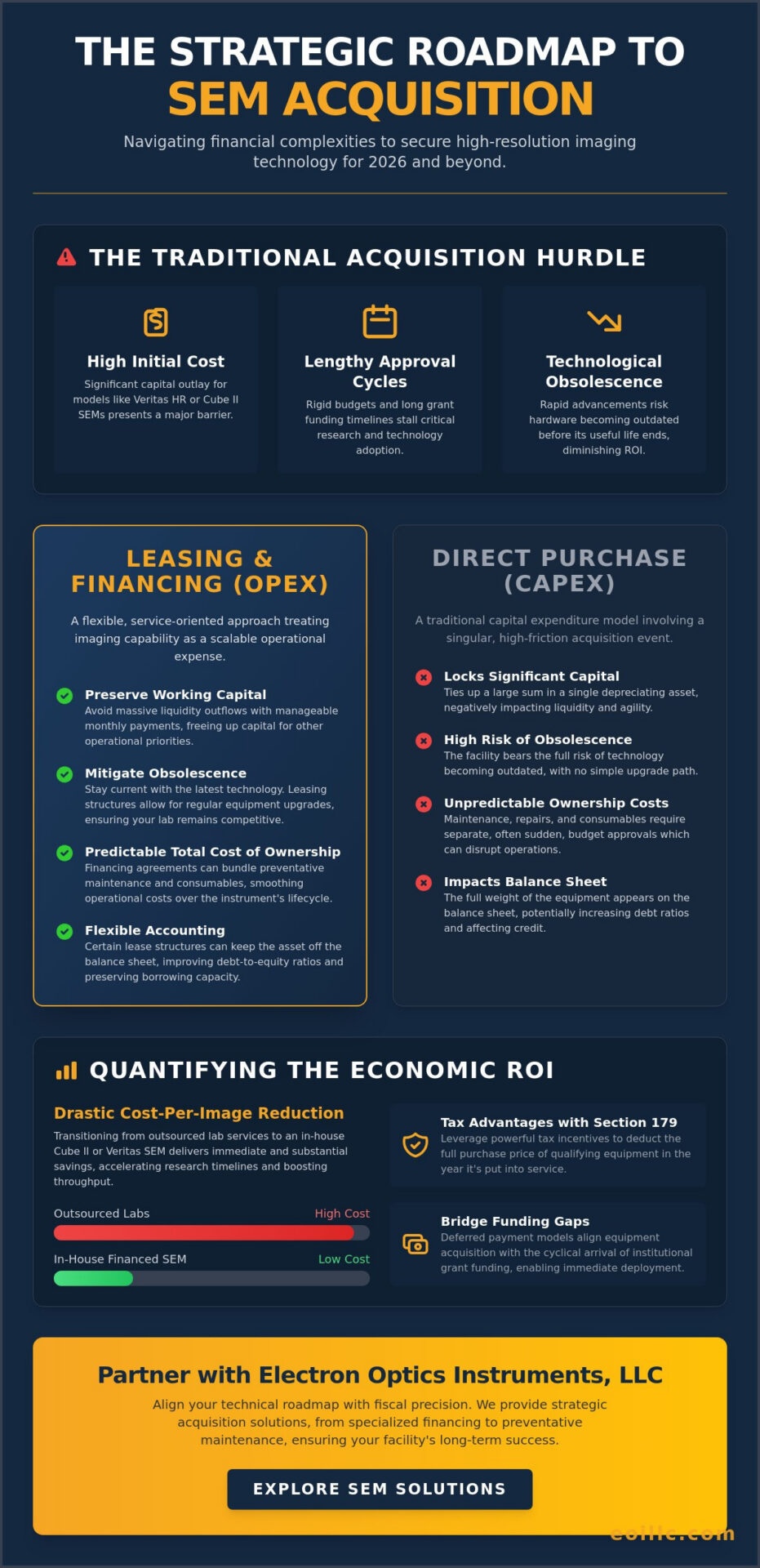
The acquisition of a Scanning Electron Microscope (SEM) has historically been viewed as a singular, high-friction capital event. In the current fiscal environment, technical leaders are redefining this process as a strategic asset management exercise rather than a simple purchase. Traditional capital expenditure (CapEx) models often struggle to keep pace with the rapid technological advancements seen in electron optics, leading to the risk of owning obsolete hardware before its useful life ends. This is where modern sem financing options provide a visionary alternative. By shifting toward an operational expenditure (OpEx) model, laboratories can treat imaging capability as a scalable service. This “Microscopy-as-a-Service” approach ensures that a facility’s analytical power evolves alongside industry standards without the burden of immediate, massive liquidity outflows. Electron Optics Instruments, LLC supports this transition by offering pathways that prioritize technical agility over static ownership.
The Evolution of Laboratory Budgeting in 2026
Budgetary frameworks have undergone a significant transformation. Rigid five-year capital planning cycles are increasingly replaced by agile technology adoption strategies that allow for rapid equipment upgrades. This shift is partly a response to persistent inflation, which has eroded the purchasing power of static grants and fixed departmental budgets. We’re observing a distinct trend where private lab financing is outpacing the traditional reliance on government funding. This transition allows for immediate procurement of essential instrumentation, effectively bypassing the lengthy and often uncertain approval timelines associated with public grant cycles. It ensures that the lab remains competitive in a global market where precision is the primary currency. By utilizing sem financing options, labs can lock in current rates and avoid the rising costs of future procurement.
Why Benchtop SEMs Demand Specialized Financial Strategies
Benchtop units represent a unique segment of the market where precision meets accessibility. While high-end floor models require substantial infrastructure and massive upfront investment, a Cube II Benchtop SEM offers high-resolution performance at a more manageable entry point. Utilizing specialized financial structures for these units allows labs to integrate advanced Energy Dispersive Spectroscopy (EDS) systems at the point of initial deployment. This ensures that the instrument is fully capable of complex elemental analysis from day one rather than waiting for future budget cycles to add critical detectors. Financing a benchtop model preserves capital for other operational priorities while securing an asset that delivers immediate ROI through accelerated research and quality control workflows. It’s about maximizing the utility of every dollar spent on instrumentation through precision-driven acquisition.
Evaluating SEM Leasing vs. Direct Purchase
Direct capital expenditure often appears attractive to established firms due to the total absence of interest costs. However, this approach locks significant capital into a depreciating asset, which can negatively impact liquidity ratios and restrict a firm’s ability to respond to market shifts. For industrial organizations, the decision to purchase outright must be weighed against the strategic advantages of modern sem financing options. Beyond the initial acquisition cost, the total cost of ownership (TCO) includes essential preventative maintenance visits and the recurring procurement of SEM filaments. Financing agreements allow these operational costs to be smoothed over the instrument’s lifecycle, ensuring that a Veritas HR or Genesis SEM remains at peak performance without necessitating sudden, large-scale budget approvals.
The choice between leasing and purchasing also dictates how the asset is represented on the company’s financial statements. A direct purchase puts the full weight of the equipment on the balance sheet, which may increase debt-to-equity ratios if the purchase is funded through a traditional bank loan. Conversely, certain sem financing options offer more flexible accounting treatments that preserve borrowing capacity for other evolutionary initiatives. Consulting with an expert partner can help clarify which model aligns with your technical roadmap. You can explore our full range of SEM solutions to determine the best fit for your facility’s long-term operational goals.
Operating Leases: Flexibility and Technology Access
Operating leases serve as a sophisticated tool for high-growth laboratories that prioritize technical agility. These agreements are typically structured with a Fair Market Value (FMV) end-of-lease option, which gives the lab the choice to return the equipment, renew the lease, or purchase the unit at its current market price. This flexibility is vital in a field where imaging resolution and software capabilities advance rapidly. It allows a facility to maintain a constant “technology refresh” cycle, perhaps upgrading from a benchtop unit to a Veritas Pro mid-cycle to meet increasing analytical demands. Because the lessor retains the residual value risk, the monthly payments are often lower than other financing structures.
Capital Leases and the $1 Buyout Option
Capital leases function as a structured pathway to full ownership and are often preferred by labs with long-term stability in their research requirements. These agreements typically conclude with a $1 buyout option, effectively transferring the title to the lessee at the end of the term. From an accounting perspective, capital leases are treated as owned assets, allowing the business to claim depreciation and interest expenses. While lease APR equivalents in 2026 generally fall between 6% and 14%, the ability to utilize Specialized Financing Structures for Scientific Instrumentation alongside federal tax incentives makes this a compelling choice. This model is particularly effective for acquiring high-value assets like the Veritas FE SEM while preserving cash for immediate payroll or R&D needs.
Specialized Financing Structures for Scientific Instrumentation
Precision in microscopy requires an equal level of precision in financial underwriting. Unlike generic business loans, specialized sem financing options are managed by institutions that recognize the intrinsic value and extended lifecycle of high-resolution imaging systems. These financiers understand that a Veritas FE SEM or a Cube II is a foundational asset for industrial evolution. For laboratories operating on the cyclical nature of public and private funding, deferred payment structures provide a critical bridge. This allows a facility to install and calibrate their equipment immediately while aligning the commencement of payments with the arrival of confirmed grant disbursements. It’s a strategic move that ensures technical progress isn’t stalled by administrative timelines.
Startups and rapidly scaling laboratories often benefit from step-up payment plans. These structures begin with lower monthly obligations that incrementally increase as the lab’s revenue or throughput matures. By integrating the cost of specialized software and hardware into a single agreement, organizations can maintain a lean balance sheet while accessing the most advanced analytical tools. This comprehensive approach is detailed in Columbia University’s guide to capital equipment leasing, which highlights how academic and research institutions manage the complexities of scientific asset acquisition. Such frameworks ensure that the focus remains on innovation rather than capital constraints.
Leveraging Section 179 and Accelerated Depreciation
Section 179 of the Internal Revenue Code serves as a powerful tax incentive that allows businesses to deduct the full purchase price of qualifying equipment in the tax year it’s placed in service. For the 2026 tax year, the maximum deduction limit has been established at $2,560,000, with a phase-out threshold beginning at $4,090,000. It’s a common misconception that equipment must be purchased with cash to qualify; in reality, hardware acquired through sem financing options remains eligible for the full deduction. Under the “One Big Beautiful Bill Act,” 100% bonus depreciation is also permanently available for 2026. This allows a laboratory to realize immediate, significant tax savings that often exceed the total of the first year’s lease or loan payments, effectively creating a cash-flow positive acquisition in year one.
Bundled Financing: Hardware, Software, and Service
The total utility of an SEM is dependent on its continued operational uptime and the sophistication of its analytical add-ons. Modern financing agreements allow for the bundling of Energy Dispersive Spectroscopy (EDS) systems and advanced imaging software into the primary monthly payment. This ensures that the lab is equipped with comprehensive elemental analysis capabilities from the outset. Furthermore, including SEM maintenance programs within the financed amount protects the asset’s long-term precision and resale value. Regular preventative maintenance visits are essential for maximizing the longevity of Veritas or Genesis systems. By consolidating these costs, labs can simplify their accounts payable while ensuring that filaments and consumables are always available for critical research projects.
The Economic ROI of Benchtop SEM Financing
Quantifying the return on investment for high-precision imaging requires a shift from viewing instrumentation as a static expense to analyzing its role as a high-throughput catalyst. When evaluating sem financing options, the most compelling metric is often the reduction in “cost per image” compared to external laboratory fees. A mid-range benchtop unit, such as those within the Genesis or Cube II series, can often be secured for approximately $1,500 per month. If a facility generates 150 high-resolution micrographs monthly, the unit cost of data acquisition drops to $10 per image; this stands in stark contrast to third-party analytical services that typically charge between $200 and $500 per hour of beam time. This fiscal efficiency allows for immediate revenue generation, particularly in sectors like failure analysis where rapid characterization is the primary billable output.
The acceleration of product development cycles provides a secondary, yet equally vital, layer of ROI. By integrating advanced imaging directly into the manufacturing workflow, organizations eliminate the logistical delays associated with shipping samples to external facilities. This immediate access to high-resolution data empowers engineering teams to iterate designs with precision, significantly reducing time-to-market for complex optical and electronic components. You can consult with our technical advisors to calculate the specific ROI for your facility’s projected throughput.
Internalizing Analysis: The Hidden Savings
Transitioning from an outsourced model to in-house SEM operation creates a closed feedback loop that’s impossible to replicate through third-party vendors. When monthly financing payments are balanced against the cumulative costs of outsourcing, the fiscal crossover point often occurs within the first twelve months of deployment. Beyond the direct savings, the value of immediate feedback during the R&D phase can’t be overstated. Real-time characterization allows for the rapid identification of structural defects or elemental inconsistencies, preventing the costly escalation of manufacturing errors. This internal capability serves as a competitive advantage, enabling a level of industrial performance that’s both sustainable and evolutionary.
Preserving Working Capital for Core R&D
Strategic sem financing options allow a laboratory to acquire a Veritas Pro or Cube II system without depleting the liquid reserves necessary for payroll, materials, and specialized personnel. The opportunity cost of a large cash outlay is significant; $150,000 spent on a one-time equipment purchase is $150,000 that can’t be invested in proprietary research or market expansion. By utilizing structured financing, firms maintain the synergy between green technology development and high-precision imaging while keeping their balance sheets agile. This approach ensures that capital remains available for the volatile realities of global manufacturing while the lab benefits from the latest advancements in electron optics.
Electron Optics Instruments, LLC: Precision-Driven Acquisition Solutions
Electron Optics Instruments, LLC operates at the intersection of technical excellence and strategic procurement. With a legacy spanning over 30 years in the United States microscopy market, we serve as a vital partner for laboratories seeking to navigate the complexities of sem financing options. Our role extends beyond that of a traditional vendor; we act as a strategic distributor that bridges the gap between sophisticated electron optics and the fiscal realities of modern industrial operations. For organizations integrating EmCraft or Veritas systems, our distributor-led financing provides a level of technical alignment that generic lending institutions cannot replicate. We ensure that every financial agreement reflects the specific operational lifecycle of the instrument, from the initial beam alignment to long-term preventative maintenance visits. This approach guarantees that the acquisition process is as precise as the imaging systems we deploy.
The transition from initial consultation to final installation is managed with a methodical focus on technical authority. We prioritize a visionary narrative that emphasizes the intersection of innovation and reliability. By working with a partner that understands the sensitive nature of electron optics, your facility avoids the friction often associated with underwriters who lack industry-specific expertise. Our internal processes are designed to be as rigorous as the global manufacturing standards we support, providing a sense of stability throughout the procurement cycle.
Customized Consultation for Lab Procurement
The path to technical evolution begins with a methodical consultation process designed to align acquisition terms with specific project milestones. We recognize that every facility has unique budgetary constraints, whether they’re established automotive manufacturers or emerging green technology startups. To support this diversity, we offer sem financing options that cover our entire portfolio, including high-performance refurbished SEM units for labs seeking maximum value. These refurbished systems undergo rigorous certification to ensure they meet our standards for precision and reliability. For baseline budget planning, professionals can refer to our 2026 SEM Price Guide to understand the current market valuation of benchtop and floor-standing models. This transparency allows for agile technology adoption without the risk of unforeseen capital demands.
Beyond the Sale: Integrated Training and Support
A financed asset is only as valuable as its operational uptime and the expertise of its users. Electron Optics Instruments, LLC mitigates the risk of acquisition by including comprehensive on-site training and technical support within the procurement package. This ensures a seamless transition from installation to full-scale analytical throughput, empowering your team to master the nuances of the Veritas FE or Cube II series. Our national service coverage acts as a critical security feature for your investment, providing rapid response for maintenance and the supply of SEM filaments. This holistic approach guarantees that your laboratory maintains its competitive edge through sustained precision and industrial performance. You can contact Electron Optics Instruments, LLC for a custom financing quote to begin your facility’s next evolutionary phase.
Advancing Your Analytical Infrastructure through Strategic Procurement
Securing high-resolution imaging systems like the Veritas HR or Cube II requires a sophisticated synthesis of technical vision and fiscal management. You’ve seen how modern sem financing options empower laboratories to bypass the limitations of traditional capital expenditure cycles. By leveraging the One Big Beautiful Bill Act’s tax incentives alongside structured leasing, your facility can maintain its evolutionary edge while preserving vital liquidity for core research initiatives. It’s a strategy that prioritizes technical agility and industrial performance over static asset ownership.
EOI LLC remains a seasoned innovator with over 30 years of electron microscopy expertise. As the sole US distributor for EmCraft Scanning Electron Microscopes, we provide an integrated partnership backed by a comprehensive national service and preventative maintenance network. This ensures your laboratory’s precision is never compromised by downtime or obsolescence. Consult with our financing experts to acquire your Cube II SEM today. We’re ready to help you integrate the next generation of optical excellence into your workflow.
Frequently Asked Questions
Can I finance a refurbished scanning electron microscope?
Yes, certified refurbished scanning electron microscope units are fully eligible for financing through our specialized partner network. This provides a cost-effective pathway for laboratories to acquire high-performance imaging technology while preserving liquid capital for other operational needs. By selecting a refurbished unit, your facility can maintain its technical edge with a lower monthly obligation, ensuring that precision-driven analysis remains accessible regardless of immediate budget constraints.
What are the typical credit requirements for SEM leasing?
Typical credit requirements for sem financing options involve a comprehensive review of the organization’s financial history and credit profile. For businesses with strong credit, lease APR equivalents in 2026 generally fall between 6% and 14%. Underwriters typically evaluate debt-to-equity ratios and established operational history to ensure the laboratory can sustain the monthly payments throughout the equipment’s lifecycle. We prioritize working with partners who understand the long-term value of scientific instrumentation.
How does Section 179 impact my SEM financing decision in 2026?
Section 179 allows your business to deduct the full purchase price of a new or used SEM in the 2026 tax year, up to a maximum limit of $2,560,000. This tax incentive applies even if the equipment is financed or leased, provided it’s placed in service during the current tax year. It creates a significant first-year ROI by providing immediate tax savings that can be used to offset the initial monthly payments of the financed agreement.
Is it possible to upgrade my benchtop SEM before the lease term ends?
Yes, many operating lease structures include specific provisions for a technology refresh, allowing you to upgrade your benchtop SEM before the term concludes. This flexibility ensures your laboratory isn’t constrained by older hardware as imaging resolution and software capabilities advance. You can transition from a Cube II to a more advanced Veritas system mid-cycle to meet increasing analytical demands without the friction of a massive capital outlay.
What is the difference between an operating lease and a capital lease for lab equipment?
An operating lease is a short-term solution where the lessor retains ownership, typically offering a Fair Market Value option at the end of the term. In contrast, a capital lease functions as a structured path to full ownership, often concluding with a $1 buyout option. While capital leases are treated as owned assets on the balance sheet, operating leases provide greater agility for laboratories that require frequent technology upgrades to maintain their evolutionary edge.
Are service and maintenance contracts usually included in SEM financing?
Yes, preventative maintenance visits and service contracts are frequently integrated into the primary financing agreement to ensure maximum instrument uptime. Bundling these costs into a single monthly payment ensures that your Veritas or Genesis system remains at peak performance without necessitating separate budget approvals for consumables. This proactive approach protects the long-term precision of the financed asset and simplifies your laboratory’s accounts payable processes throughout the year.
How long are the typical financing terms for a benchtop SEM?
Typical financing terms for a benchtop SEM range from 24 to 60 months, depending on the laboratory’s specific cash flow requirements and project timelines. Longer terms reduce the monthly obligation, facilitating easier integration into operational budgets, while shorter terms minimize total interest costs. Our consultants work to align these timelines with your facility’s projected research cycles and grant disbursement schedules to ensure maximum fiscal stability for your procurement.
Does EOI LLC offer financing for EDS systems bundled with the SEM?
EOI LLC facilitates comprehensive sem financing options that include Energy Dispersive Spectroscopy (EDS) systems bundled directly with the primary imaging instrument. This ensures that your facility is equipped for sophisticated elemental analysis from the date of installation. By consolidating the hardware and analytical software into a single agreement, you can achieve a higher level of technical integration while maintaining a streamlined financial structure for your laboratory procurement.