
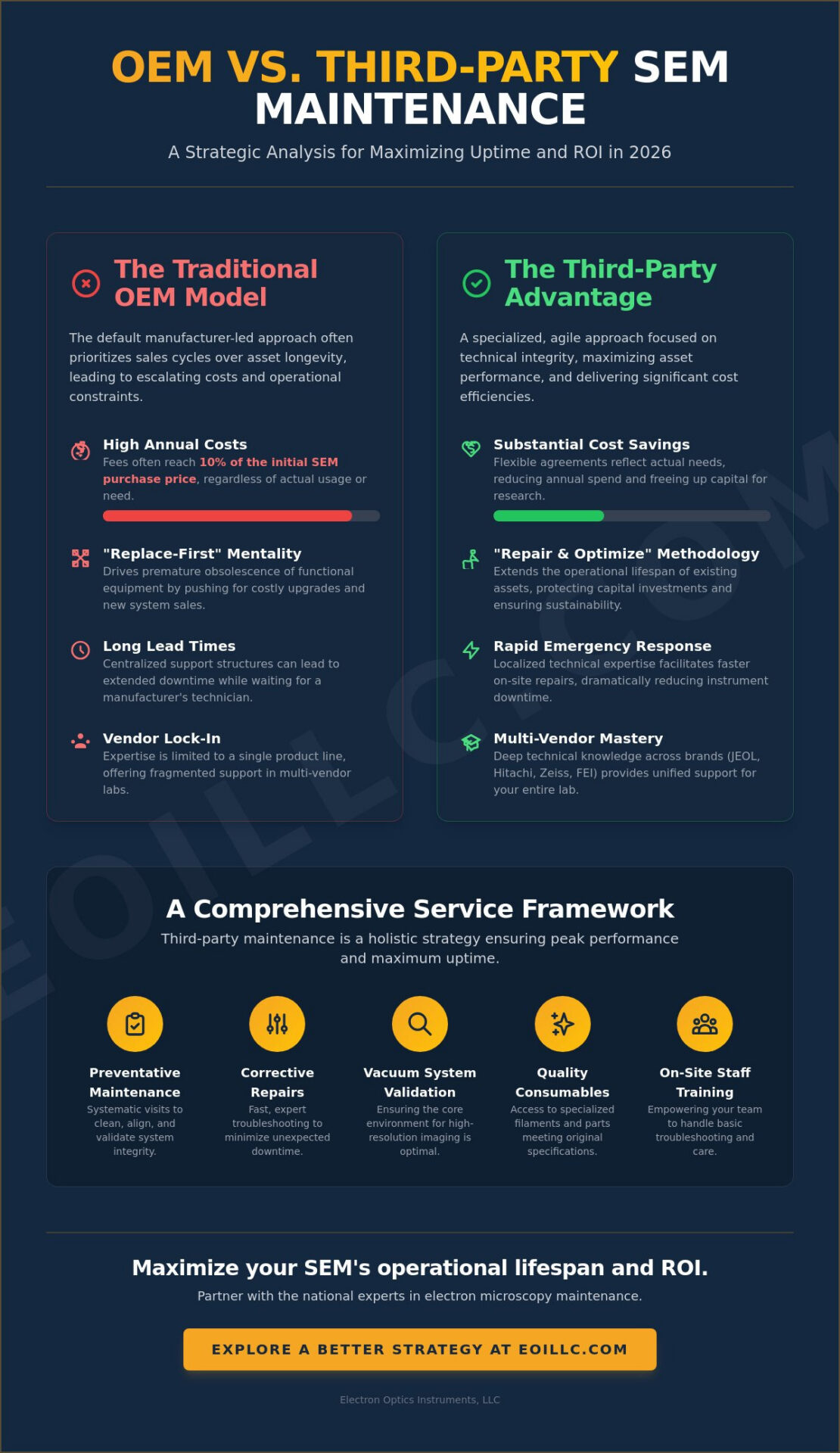
Relying exclusively on original equipment manufacturer support for high-resolution imaging systems frequently imposes an annual fiscal burden equivalent to 10% of the initial purchase price. This traditional model often forces laboratories to accept long lead times and the premature obsolescence of perfectly functional older units. You’ve likely experienced the frustration of escalating service fees that don’t align with the actual technical attention your instruments require. Transitioning to a strategic framework for third-party sem maintenance offers a sophisticated alternative that prioritizes technical integrity and operational agility over manufacturer-driven sales cycles, ensuring that your capital equipment remains a productive asset rather than a liability.
This article explores how specialized maintenance protocols provide a technically superior, cost-effective substitute for standard OEM contracts in high-precision environments. You’ll learn how this approach facilitates reduced annual maintenance spend and faster response times for emergency repairs while significantly extending the operational lifespan of existing SEM assets. We’ll analyze the methodology behind maximizing ROI through meticulous service integration and the procurement of specialized SEM filaments and consumables, providing a comprehensive roadmap for labs seeking to balance ecological responsibility with peak industrial performance in 2026.
Key Takeaways
- Analyze the economic advantages of third-party sem maintenance, which often yields substantial cost savings while bypassing the constraints of original manufacturer monopolies.
- Understand the technical rigor required for comprehensive preventative maintenance visits, including vacuum system validation and the proactive mitigation of common failure points.
- Master a systematic transition framework that utilizes asset health checks and performance baselines to ensure continuous analytical accuracy during service provider shifts.
- Discover how localized technical expertise facilitates faster response times for emergency repairs, effectively reducing downtime in high-precision laboratory environments.
- Explore the strategic benefits of a partnership that integrates the acquisition of Veritas Series SEMs with long-term maintenance and specialized consumable support.
Understanding Third-Party SEM Maintenance in the 2026 Landscape
The specialized domain of electron microscopy requires a level of technical precision that transcends standard laboratory equipment servicing. Unlike general IT hardware support, third-party sem maintenance represents a targeted asset management strategy designed to preserve the resolution and analytical capabilities of a Scanning electron microscope (SEM) throughout its entire functional lifecycle. This approach has evolved from a secondary market option into a primary strategic choice for modern research facilities. The historical monopoly held by original equipment manufacturers (OEMs) has gradually dissolved. It’s been replaced by expert-led independent organizations that prioritize technical synergy over new hardware sales.
Current 2026 institutional budget allocations are increasingly favoring flexible, multi-tiered service agreements that reflect the actual usage patterns of the laboratory. This shift is particularly evident in the management of “End of Service” (EOS) instruments. When manufacturers withdraw support for legacy systems to incentivize upgrades, specialized providers step in to maintain these critical assets. This specialized technical support, often categorized as third-party sem maintenance, allows facilities to bypass the high overhead of manufacturer contracts while preventing the premature decommissioning of perfectly viable technology.
The Core Components of a Third-Party Service Model
A robust third-party framework integrates systematic Preventative Maintenance Visits with responsive corrective repair services to ensure maximum uptime. These visits aren’t merely perfunctory checks; they involve the deep cleaning of electron columns, vacuum system validation, and the precise alignment of apertures. A holistic strategy also encompasses the provision of high-quality SEM Filaments and Consumables, ensuring that every component meets the original specifications of the system. Additionally, on-site technical training empowers internal staff to handle basic troubleshooting. This fosters a culture of meticulous instrument care that reduces the frequency of emergency interventions.
TPM vs. OEM: The Fundamental Shift in Service Philosophy
The divergence between OEM and third-party philosophies is most apparent in their approach to component failure. While OEMs frequently adopt a “replace-first” mentality that can lead to exorbitant costs and extended downtime, the third-party model focuses on a “repair-and-optimize” methodology. This approach leverages decades of engineering experience to restore existing components to peak performance whenever possible. Independent providers offer manufacturer-agnostic expertise. It’s invaluable in heterogeneous environments where multiple brands of microscopes, such as the Veritas Series SEM or refurbished legacy units, must operate in concert. This expertise ensures that even the most complex systems continue to deliver high-end results without the constant pressure of manufacturer-mandated upgrades.
OEM vs. Third-Party Maintenance: A Comparative Performance Analysis
The administrative burden of managing a heterogeneous laboratory environment often results in fragmented service coverage and inconsistent technical standards. By consolidating multiple service contracts under a single expert provider, facilities can achieve a level of operational synergy that is impossible under the traditional manufacturer-led model. This consolidation allows for a unified response strategy across diverse platforms, such as JEOL, Hitachi, Zeiss, and FEI systems. Third-party sem maintenance engineers typically demonstrate a broader technical depth, as their daily operations require them to master the intricate electron optics and vacuum architectures of various brands rather than focusing on a single product line. This multi-vendor mastery ensures that technical insights gained from one system can be applied to optimize the performance of another, fostering a more resilient analytical infrastructure.
Performance benchmarks indicate that localized or regional field service models frequently outperform centralized OEM dispatch systems in terms of response speed. While manufacturer technicians may be subject to national scheduling priorities, independent providers prioritize regional agility. This proximity significantly reduces the duration of instrument downtime during critical research phases. Data suggests that labs transitioning to a third-party framework can realize a cost-benefit ratio that includes 30% to 50% savings on annual service expenditures. These recovered funds represent a strategic opportunity to reinvest in high-performance hardware or advanced Veritas Series SEM units to enhance laboratory throughput.
The Economic Impact on Total Cost of Ownership (TCO)
A comprehensive analysis of the electron microscope cost reveals that initial capital expenditure is only one component of a much larger financial picture. TCO in microscopy is the sum of purchase price, consumables, and cumulative maintenance. By extending the operational lifespan of a benchtop SEM well beyond the conventional seven-year depreciation cycle, laboratories can maximize the return on their initial investment. This longevity is achieved through meticulous preventative care that prevents the catastrophic failure of high-value components. Utilizing third-party sem maintenance for older or refurbished SEM units ensures these assets remain productive long after the manufacturer has declared them obsolete.
Flexibility and Customization in Service Level Agreements (SLAs)
Standardized OEM contracts often force laboratories into rigid agreements that don’t account for varying instrument utilization rates. Bespoke third-party SLAs allow for a more nuanced approach, offering tiers such as “Full Coverage,” “Parts & Labor,” or “Preventative Only” based on the specific needs of each tool. For instance, a high-utilization instrument like the Cube II can be prioritized with a comprehensive plan, while low-utilization or non-critical equipment can be managed via cost-effective per-diem rates. This flexibility ensures that every dollar of the maintenance budget is allocated where it provides the greatest technical value.
Technical Scope: What Comprehensive SEM Maintenance Entails
Comprehensive technical oversight ensures that the analytical precision of an electron microscope remains uncompromised over years of heavy utilization. A standard Preventative Maintenance Visit involves a methodical sequence of vacuum system validation, column decontamination, and electronic subsystem diagnostics. By engaging in third-party sem maintenance, laboratories benefit from a rigorous technical protocol that addresses the most frequent failure points, such as vacuum leaks, filament burnout, and critical board failures. The integrity of the hardware directly influences the accuracy of EDS analysis; a stable beam and clean column are prerequisites for energy dispersive spectroscopy. Achieving ultra-high resolution requires more than just functional hardware. It demands meticulous aperture alignment and precise stigmator correction to mitigate astigmatism and ensure peak imaging performance at high magnifications.
Vacuum System Integrity and Pump Maintenance
The vacuum architecture is the foundation of any scanning electron microscope. It’s the primary barrier against beam scattering and source degradation. Comprehensive maintenance involves the regular servicing of rotary vane pumps, turbo-molecular pumps, and ion getter pumps to ensure optimal base pressure. Maintaining seal integrity is especially critical for Field Emission (FE) systems, where even minor atmospheric ingress can degrade source performance and lead to premature gun failure. Engineers utilize specialized leak detection equipment to identify microscopic breaches in O-rings and gaskets that often go unnoticed by standard pressure gauges. High vacuum quality is essential for maximizing the image signal-to-noise ratio. Residual gas molecules in the chamber scatter the primary electron beam and diminish contrast, creating a noisy background that obscures fine topographical details.
Electron Optics and Column Alignment
Precision in electron optics begins with the source. Regular source replacement and subsequent gun alignment are necessary to maintain a coherent and stable electron probe. This process includes the meticulous cleaning of objective lenses and the removal of accumulated carbon contamination, which often results from sample outgassing or residual hydrocarbons. Contamination on the final aperture or the scanning coils can cause beam drift and charging artifacts that ruin long-term mapping projects. Proper column hygiene is a foundational requirement for executing advanced SEM techniques. Without regular maintenance, the subtle nuances of high-resolution analytical microscopy are lost to technical degradation. It’s impossible to achieve the theoretical resolution limits of the instrument if the optical path is compromised by even minor debris or electronic instability.
Strategic Transition: Moving from OEM to Third-Party Support
Transitioning from a manufacturer-dependent service model to a decentralized framework requires a methodical protocol to ensure the continuity of analytical fidelity. This process begins with a comprehensive technical inventory and “health check” of all active SEM assets. Unlike standard industrial equipment, an electron microscope requires the establishment of baseline resolution and analytical performance metrics before any service transition occurs. These benchmarks serve as a technical anchor, allowing laboratory managers to audit the efficacy of the new service provider against historical performance. It’s a critical step that prevents the loss of resolution or beam stability during the handover process.
The strategic shift involves a rigorous review of existing OEM contracts, specifically regarding notice periods and data ownership clauses that might impact future software integrations. Once the legal landscape is clear, facilities should design a tiered maintenance schedule that prioritizes instrument criticality and age. For instance, a high-throughput Veritas Ultra SEM may require a more aggressive Preventative Maintenance Visit frequency than a secondary refurbished unit. The transition culminates in a formal handover PM visit, where the stability of the electron optics and vacuum subsystems is verified under the new provider’s technical oversight. This structured approach mitigates the risk of unexpected downtime during the onboarding phase.
Overcoming the Parts Availability Concern
Concerns regarding parts availability are often cited as a barrier to third-party sem maintenance, yet established providers mitigate this through expansive global networks that source both new and refurbished components. By utilizing high-quality SEM Filaments and Consumables that meet or exceed original manufacturer specifications, labs can maintain peak performance without the premium pricing associated with OEM-branded parts. This procurement strategy is especially vital for legacy systems where the original manufacturer has ceased production of critical electronic boards or mechanical assemblies. Expert providers often stock these obsolete parts to extend the lifespan of instruments that would otherwise be decommissioned.
Relocation and Re-installation as Maintenance Milestones
Physical relocation of sensitive electron optics represents a high-risk event that demands professional oversight. Moving an SEM without proper vacuum sealing and column stabilization can lead to catastrophic misalignment or internal damage. A relocation event provides a natural opportunity for a full system overhaul, where the instrument is meticulously calibrated and validated in its new environment. This process ensures that the tool returns to its peak analytical state immediately upon re-installation. If your facility is planning a laboratory expansion, you can schedule a consultation for professional SEM relocation and maintenance services to ensure your research remains uninterrupted.
Electron Optics Instruments, LLC: Your National Partner for SEM Excellence
Electron Optics Instruments, LLC functions as a pivotal technical authority in the United States microscopy sector, bridging the gap between sophisticated hardware acquisition and long-term asset management. With three decades of operational history, we’ve refined a narrative that balances technological progress with the practicalities of field performance. Unlike entities that focus solely on brokerage, Electron Optics Instruments, LLC offers a specialized advantage by serving as both a primary distributor of desktop SEM systems and a high-level service organization. This dual perspective ensures that our technical protocols are informed by the latest engineering standards, providing a level of insight that far exceeds basic component replacement.
Our organization is committed to providing manufacturer-agnostic support that allows laboratories to consolidate their third-party sem maintenance needs under a single, rigorous technical framework. Electron Optics Instruments, LLC maintains the specialized diagnostic tools and intellectual capital required to sustain a diverse fleet, including instruments from JEOL, Hitachi, Zeiss, and EmCraft. This consolidated model effectively removes the administrative complexity of managing disparate OEM agreements. To support the evolving requirements of modern, cost-conscious facilities, we offer customized on-site training and flexible per-diem service options, ensuring that every laboratory can scale its maintenance strategy to match its specific research throughput.
A Legacy of Technical Meticulousness
The operational philosophy of Electron Optics Instruments, LLC is anchored by the concept of “Innovation through Reliability,” a principle that dictates our approach to every Preventative Maintenance Visit. Our engineering team comprises field service veterans with extensive experience across multiple electron optics architectures. These SEM maintenance contracts are engineered to identify and neutralize subtle technical degradations before they manifest as catastrophic system failures. This proactive oversight ensures that Veritas Series SEM units and other high-resolution assets maintain their analytical fidelity over extended lifecycles.
Contact Electron Optics Instruments, LLC for a Comprehensive Service Consultation
Facility managers seeking to improve instrument uptime and optimize annual expenditure should consider a professional service contract audit. Electron Optics Instruments, LLC provides national reach and rapid-response capabilities for critical failure analysis, ensuring that downtime remains a statistical outlier rather than a persistent risk. For laboratories evaluating the acquisition of new technology during their maintenance review, we recommend analyzing the performance specifications of the Cube II and Veritas FE models. You can contact Electron Optics Instruments, LLC today to establish a partnership built on technical prowess and international standards of excellence.
Advancing Laboratory Performance Through Strategic Maintenance Integration
The evolution of laboratory asset management in 2026 necessitates a shift toward more agile and technically diverse service frameworks. By prioritizing meticulous preventative care and manufacturer-agnostic expertise, facilities can effectively bypass the fiscal constraints of traditional OEM contracts while ensuring peak analytical resolution. Strategic third-party sem maintenance doesn’t just reduce operational overhead; it transforms legacy instruments into reliable, long-term contributors to scientific discovery. This methodology ensures that your capital equipment remains a productive asset rather than a liability subject to manufacturer-induced obsolescence.
Electron Optics Instruments, LLC leverages over 30 years of industry experience to provide comprehensive coverage for all major SEM manufacturers, ensuring your hardware remains at the forefront of technical excellence. As the sole US distributor for EmCraft SEMs, we understand the intricate requirements of both benchtop and full-scale systems. We invite you to Request a Comprehensive SEM Service Quote from Electron Optics Instruments, LLC to begin auditing your current service protocols. Securing the future of your imaging capabilities starts with a partner dedicated to technical stability and industrial performance.
Frequently Asked Questions
What is the primary difference between OEM and third-party SEM maintenance?
The primary distinction lies in the strategic focus and technical flexibility of the service entity. Original equipment manufacturers prioritize the sale of new hardware and often utilize proprietary service structures to incentivize upgrades. In contrast, third-party sem maintenance focuses on lifecycle extension and multi-platform technical synergy, providing a more agile alternative that maintains legacy systems long after the manufacturer has declared them obsolete.
Will using a third-party service provider void my SEM warranty?
The use of an independent service provider for routine maintenance or repairs generally doesn’t void a standard equipment warranty. In the United States, the Magnuson-Moss Warranty Act protects the rights of equipment owners to utilize independent technicians without losing warranty coverage. It’s advisable to review specific contract clauses for any restrictive language regarding unauthorized hardware modifications or non-OEM software integrations before proceeding with a transition.
Can third-party providers service high-end Field Emission (FE-SEM) systems?
Specialized third-party organizations possess the rigorous technical expertise and specialized diagnostic tools required to service high-resolution FE-SEM systems, such as the Veritas FE series. These providers handle complex tasks like ion getter pump validation and field emission gun alignments with high precision. They ensure the ultra-high vacuum integrity and beam stability necessary for peak analytical performance are maintained according to the original engineering specifications.
How does third-party maintenance handle proprietary software and board repairs?
Expert providers utilize a combination of extensive component inventories and advanced engineering capabilities to repair or replace electronic boards that manufacturers may no longer support. While certain software updates remain proprietary, third-party sem maintenance includes troubleshooting hardware-software interfaces and restoring system functionality through the procurement of refurbished or equivalent-specification components. This approach effectively bypasses the supply chain constraints often associated with manufacturer-led service models.
What happens if my SEM requires a part that the OEM has declared obsolete?
Third-party providers specialize in supporting legacy and “End of Service” instruments by maintaining global networks for refurbished and hard-to-find components. When a manufacturer ceases production of a critical part, a third-party partner can often source, test, and install a functional replacement. This capability is essential for extending the operational lifespan of a microscope and maximizing the return on the initial capital investment.
Is it possible to have a single service contract for multiple different SEM brands?
Consolidating multi-vendor assets under a single service agreement is a fundamental advantage of the third-party model. A single provider with cross-platform expertise can manage a fleet comprising JEOL, Hitachi, Zeiss, and Veritas Series SEM units. This simplification of administrative processes ensures a unified standard of technical meticulousness across the entire laboratory while reducing the friction of managing multiple manufacturer-specific contracts.
How often should a preventative maintenance (PM) visit be scheduled for a benchtop SEM?
A standard benchtop SEM, such as the Cube II, typically requires a Preventative Maintenance Visit every six to twelve months, depending on the intensity of the analytical workload. High-utilization environments or those processing samples prone to outgassing may require more frequent interventions. Regular maintenance ensures vacuum system integrity and prevents the accumulation of carbon contamination within the electron column, which is critical for maintaining image contrast.
Does third-party maintenance include on-site training for lab staff?
Comprehensive third-party agreements frequently incorporate on-site technical training as a core component of the service strategy. This training empowers laboratory personnel to perform basic column alignments, filament replacements, and routine troubleshooting. By fostering a culture of rigorous instrument stewardship, facilities can reduce the frequency of emergency service calls and ensure that instruments are operated at their peak technical capacity between scheduled visits.