
The long-standing industry assumption that superior imaging resolution necessitates a massive laboratory footprint and a multi-million dollar infrastructure investment is increasingly becoming a relic of the past. While conventional wisdom suggests that larger architectures equate to more precise data, the 2026 analytical landscape tells a different story of decentralization and efficiency. When evaluating a benchtop sem vs floor model sem, the decision shouldn’t merely center on peak magnification capabilities. Instead, it must account for the intersection of operational throughput, facility agility, and the practical realities of industrial characterization.
You’re likely familiar with the logistical strain of managing specialized HVAC requirements and the steep learning curves that often stall productivity in high-end imaging suites. This article provides a strategic framework to navigate the technical and financial trade-offs between these two formats to ensure you select the optimal system for your facility. We’ll analyze how modern solutions like the Cube II and Veritas Series bridge the gap between compact convenience and high-resolution performance. You’ll gain a comprehensive understanding of how to maximize imaging throughput while minimizing the total cost of ownership through precise hardware selection.
Key Takeaways
- Identify the significant operational expenditure disparities between compact architectures and legacy floor models, specifically regarding specialized maintenance and facility modifications.
- Navigate the technical trade-offs between benchtop sem vs floor model sem by analyzing resolution thresholds and the integration of advanced analytical tools like Energy Dispersive Spectroscopy.
- Learn to align system selection with organizational throughput goals, distinguishing between the need for sub-nanometer precision and the efficiency of decentralized laboratory workflows.
- Leverage the capabilities of the Cube II and Veritas Series to achieve high-performance results within a standard laboratory footprint, effectively maximizing your imaging ROI.
Structural and Design Divergence: Benchtop vs. Floor Model Systems
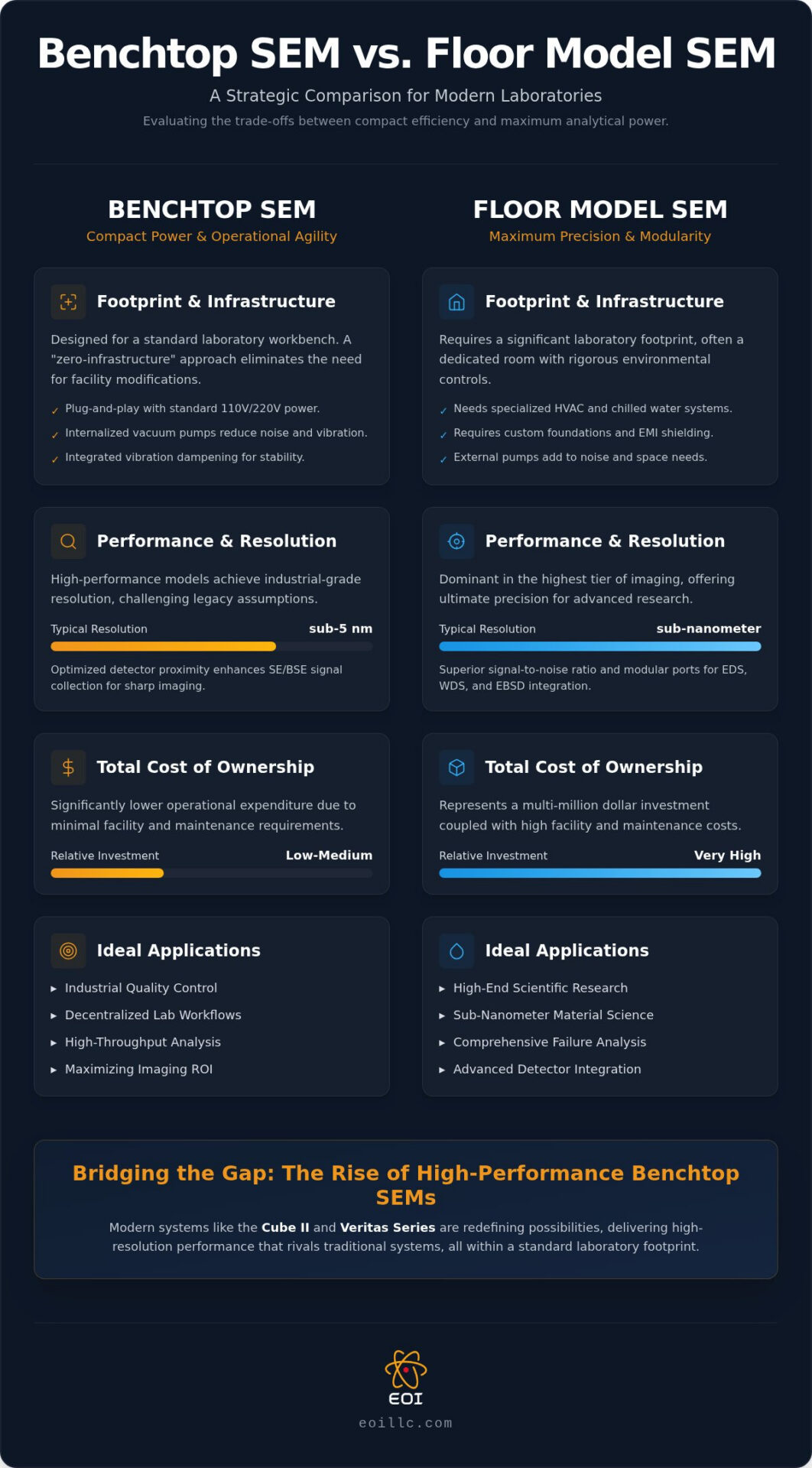
The structural divergence between these systems represents a fundamental shift in engineering philosophy. A traditional Scanning electron microscope (SEM) utilizes a tall vertical column to maintain the necessary focal length and electron trajectory for sub-nanometer imaging. This design necessitates a significant laboratory footprint, often requiring dedicated rooms with specialized environmental controls. Conversely, the benchtop sem vs floor model sem debate centers on the transition from these expansive, modular setups to compact, integrated optics that prioritize spatial efficiency without sacrificing essential analytical capabilities.
Traditional floor systems rely on external roughing and turbo-molecular pump configurations, which often introduce noise and vibration into the workspace. Modern benchtop systems, however, utilize internalized vacuum architectures that streamline the entire evacuation process. This integration allows for a zero-infrastructure approach, where the unit resides on a standard laboratory workbench rather than a custom-poured concrete foundation. For facilities with limited square footage, this architectural consolidation is a decisive factor in system selection.
The Anatomy of a Floor Model SEM
Floor model systems are engineered for maximum modularity and large-scale sample characterization. Their expansive chambers support multiple ports, facilitating the simultaneous integration of EDS, WDS, and EBSD detectors for comprehensive material analysis. The sophisticated electron optics columns feature multiple condenser lens stages, giving operators granular control over beam convergence and probe current. This structural complexity is necessary for high-end research but demands rigorous facility modifications, including electromagnetic interference (EMI) shielding and chilled water systems to maintain thermal stability during long imaging sessions.
The Evolution of Benchtop Architecture
The architecture of a modern benchtop sem vs floor model sem comparison highlights the rapid miniaturization of electron columns. Systems like the Cube II or the Veritas Series leverage optimized beam paths to achieve industrial-grade data within a fraction of the space. This structural shift reflects the broader trend toward desktop SEM adoption in quality control environments. These units feature integrated vibration dampening, which isolates the optics from the ambient tremors of high-traffic industrial environments. This design allows for plug-and-play functionality via standard 110V or 220V power sources, eliminating the need for specialized electrical infrastructure while maintaining the stability required for high-resolution topography.
Analytical Performance: Resolution, Detectors, and Magnification Thresholds
The technical evaluation of a benchtop sem vs floor model sem has shifted as high-performance field emission (FE) sources have migrated into compact architectures. While legacy floor models maintain their dominance in the sub-nanometer resolution tier, modern systems like the Veritas FE SEM now achieve sub-5nm resolution. This advancement challenges the traditional perception of tabletop units as entry-level tools. For many industrial laboratories, the ability to capture high-fidelity topography data at these levels provides sufficient analytical depth without the logistical burden of a full-scale imaging suite.
Detector synergy is the cornerstone of effective material characterization. Floor models typically offer superior signal-to-noise ratios due to their larger vacuum volumes and sophisticated column electronics. However, compact systems like the Cube II have optimized their internal geometries to place detectors in closer proximity to the sample. This proximity enhances signal collection efficiency for both Secondary Electron (SE) and Backscattered Electron (BSE) imaging, ensuring that elemental contrast and surface details remain sharp even at lower accelerating voltages.
Magnification and Resolution Realities in 2026
Determining the ‘useful magnification’ limit for your specific sample types is more critical than chasing peak specifications. While a floor model might offer extreme magnification, the practical requirements for most manufacturing quality control rarely exceed 100,000x. Utilizing advanced SEM techniques allows operators to bridge the gap between formats by optimizing beam parameters for delicate or non-conductive materials. Modern benchtop units now provide variable accelerating voltages that prevent sample charging, a feature that was previously a primary differentiator for larger systems.
Detection Capabilities and Analytical Flexibility
Chamber volume remains the primary constraint when comparing detection flexibility. Floor models support expansive multi-detector arrays, facilitating advanced analytical capabilities such as simultaneous Energy Dispersive Spectroscopy (EDS) and Electron Backscatter Diffraction (EBSD). Despite restricted volumes, the Veritas Series integrates high-speed EDS systems that deliver industrial-grade elemental mapping. These compact units often feature AI-driven software for automated feature analysis and particle counting, which accelerates throughput in routine monitoring environments. If your facility requires this level of analytical precision with a focus on rapid turnaround, the Veritas Series SEM offers a scalable solution that aligns with modern laboratory demands.
Resource Requirements: Infrastructure, Maintenance, and Total Cost of Ownership
The economic impact of instrument downtime is another critical variable, particularly in industrial quality control environments where throughput is directly tied to revenue. When a primary imaging system fails, laboratories often resort to outsourced analysis, which can exceed $240 per hour according to current market benchmarks. Establishing a rigorous SEM maintenance schedule is essential for both formats, yet the complexity of maintaining a floor model’s external chilled water systems and large-scale vacuum pumps typically results in higher service contract premiums compared to integrated benchtop units.
Facility Preparation and Installation
Floor model SEMs demand a highly controlled environment, often requiring seismic bracing and acoustic isolation to ensure imaging stability at sub-nanometer scales. These systems are essentially permanent fixtures; relocating them involves significant logistical costs and recalibration periods. Conversely, the “zero-infrastructure” advantage of benchtop units allows for rapid deployment on existing laboratory surfaces. This mobility is invaluable for facilities that anticipate future growth or floor plan reconfigurations, as benchtop systems can be relocated with minimal technical intervention and tolerate broader temperature and humidity fluctuations.
Long-Term Reliability and Serviceability
Understanding the electron microscope cost over its entire lifecycle involves balancing the price of consumables against the system’s reliability. Floor models require frequent management of filaments, apertures, and specialized vacuum oils, often necessitating a dedicated technician for routine upkeep. Many institutions now apply the “50% Rule,” a financial threshold where the maintenance of legacy hardware is no longer fiscally responsible compared to investing in new, efficient hardware. For mission-critical workflows, high-performance benchtop systems like the Cube II provide a streamlined alternative that reduces the volume of required consumables while maintaining the industrial-grade data integrity required for modern research.
Strategic Selection: Matching SEM Architecture to Specific Industrial Applications
The decision-making process for a benchtop sem vs floor model sem must prioritize the specific analytical fidelity required by the industrial sector. For semiconductor failure analysis, where the characterization of sub-10nm nodes and finFET structures is mandatory, the floor model’s sub-nanometer resolution remains the non-negotiable standard. However, the 2026 industrial landscape increasingly favors the point-of-need analysis provided by compact systems. These units, such as the Cube II, act as a strategic bridge, offering the analytical depth required for complex topography while maintaining the throughput velocity essential for modern production cycles. To further enhance operational efficiency in these high-throughput environments, you can learn more about Synovo Robotics and their autonomous solutions for material transport and facility maintenance.
High-Throughput Industrial Environments
In manufacturing sectors, the primary operational bottleneck is often sample transport latency. By deploying a desktop SEM within the production facility, organizations can achieve real-time quality control. This proximity allows for immediate feedback loops in additive manufacturing or metallurgical processing, where rapid intervention prevents costly batch failures. Modern software has simplified SEM operation, enabling technicians to generate high-quality data without the extensive specialized training typically associated with electron microscopy. These systems integrate seamlessly with Laboratory Information Management Systems (LIMS), ensuring that automated data reporting and particle counting are synchronized with broader production metrics.
Advanced Research and Development
Advanced R&D environments often require the large chamber volumes inherent to floor model architectures to accommodate complex in-situ experimentation. When research necessitates the use of bulky heating, cooling, or tensile stages to observe material behavior under extreme stress, the expansive chamber of a floor model is essential. These systems act as a centralized gold standard for secondary verification, supporting complex sample preparation techniques required for extreme magnification. While floor models provide the ultimate versatility for bulk geology samples or large forensic fragments, many academic core facilities now utilize a hybrid approach. They preserve their floor models for high-end research while using the Veritas Series for undergraduate training and routine screening to maximize instrument availability.
To determine which architecture best aligns with your specific characterization requirements, explore our full range of high-performance imaging solutions at Electron Optics Instruments today.
Bridging the Gap: Integrating High-Performance Benchtop SEMs into Modern Workflows
The evolution of scanning electron microscopy has culminated in a category of instruments that effectively dismantle the traditional hierarchy of imaging hardware. When evaluating a benchtop sem vs floor model sem, the primary objective is no longer choosing between size and power, but rather identifying the specific architectural efficiency that maximizes laboratory output. High-performance systems now provide the sub-5nm resolution and advanced analytical depth once reserved for massive, room-sized installations. This transition allows organizations to decentralize their characterization workflows, placing industrial-grade imaging directly into the hands of the researchers who require immediate data.
The Rise of the ‘Power Benchtop’
The Cube II Benchtop SEM serves as the flagship for this technological shift, delivering imaging fidelity that directly rivals the specifications of mid-range floor models. By utilizing optimized electron optics and high-brightness sources, it provides the clarity required for sophisticated failure analysis and material science research. For laboratories requiring even greater scalability, the Veritas Series SEM offers a modular path from tabletop simplicity to the high-resolution capabilities of the Veritas Pro SEM. These systems allow for the integration of custom EDS (Energy Dispersive Spectroscopy) Systems, ensuring that elemental mapping and quantitative analysis are performed with industrial-grade precision. The Genesis Tabletop SEM further complements this range by providing a streamlined solution for routine industrial utility where cost-efficiency and rapid results are the primary drivers.
Consultative Selection and National Support
Selecting the correct imaging platform requires a meticulous assessment of long-term operational goals and sample-specific requirements. Electron Optics Instruments provides a consultative approach, leveraging over 30 years of electron optics experience to help facilities navigate these technical trade-offs. Our technical specialists evaluate your specific imaging benchmarks to determine whether a new Veritas Ultra or high-quality Refurbished SEM Units best serve your budgetary and performance needs. This strategic evaluation ensures that the chosen architecture aligns with both current throughput demands and future growth projections.
Beyond the initial procurement, maintaining a national fleet of instruments requires a robust support infrastructure. We provide comprehensive Preventative Maintenance Visits and on-site training programs designed to maximize equipment utility and minimize downtime. By offering expert service for all major SEM brands, we ensure that your facility maintains its competitive edge in characterization accuracy. Whether you’re integrating a single Cube II or managing a decentralized network of Genesis units, our national support network provides the technical stability necessary for sustained innovation and logistical excellence.
Optimizing Your Characterization Strategy for 2026 and Beyond
The strategic selection within the benchtop sem vs floor model sem spectrum has evolved beyond a binary trade-off between physical footprint and peak resolution. Modern advancements in field emission technology and integrated vacuum systems have empowered compact architectures to deliver industrial-grade topography and elemental data with unprecedented efficiency. By prioritizing operational throughput and minimizing the substantial hidden costs associated with facility modifications, laboratories can achieve superior characterization accuracy without the logistical burden of legacy hardware. The focus remains on aligning system architecture with specific production benchmarks to ensure long-term laboratory optimization.
Electron Optics Instruments leverages over 30 years of electron optics expertise to guide your facility through this technical transition. As the sole US distributor for EmCraft and a provider of national preventative maintenance and repair services, we remain committed to the longevity and precision of your imaging systems. Schedule a Consultation for Your SEM Requirements today to determine the optimal configuration for your specialized industrial needs. We’re ready to help you push the boundaries of what’s possible in advanced hardware integration.
Frequently Asked Questions
What is the primary difference in resolution between a benchtop SEM and a floor model?
Floor models typically achieve sub-nanometer resolution, while modern high-performance benchtop systems like the Veritas FE SEM reach sub-5nm benchmarks. This technical gap has narrowed significantly in 2026. While floor models remain the gold standard for atomic-scale imaging, the resolution provided by a benchtop sem vs floor model sem is now sufficient for most industrial topography and failure analysis requirements.
Can a benchtop SEM perform Energy Dispersive Spectroscopy (EDS) analysis?
High-performance benchtop systems are fully capable of performing Energy Dispersive Spectroscopy (EDS) analysis. Systems like the Cube II and Veritas Series integrate advanced EDS detectors to provide industrial-grade elemental mapping and quantitative data. These compact units utilize optimized geometries to maintain high signal collection efficiency, ensuring that elemental characterization remains accurate even within a smaller vacuum chamber footprint.
What are the infrastructure requirements for installing a floor model SEM?
Installing a floor model SEM requires extensive facility modifications, including specialized HVAC for thermal stability and electromagnetic interference shielding. These systems often necessitate active vibration isolation tables or custom concrete foundations to maintain imaging integrity. Additionally, facilities must provide chilled water systems for lens cooling and dedicated high-voltage power circuits, which can add substantial costs to the initial installation phase.
Which SEM type is better for high-throughput industrial quality control?
Benchtop SEMs are generally superior for high-throughput industrial quality control because they can be deployed directly on the production floor. This proximity eliminates the latency associated with transporting samples to a centralized imaging suite. The simplified user interfaces and AI-driven automation found in systems like the Cube II allow non-expert operators to generate consistent results, effectively accelerating the feedback loop for manufacturing processes.
Is the maintenance cost significantly lower for benchtop SEM models?
Maintenance costs are significantly lower for benchtop models due to their integrated architectural design and reduced reliance on external infrastructure. Floor models require the upkeep of external roughing pumps, turbo-molecular setups, and complex cooling systems, leading to higher service contract premiums. In contrast, benchtop units utilize standard power sources and internalized components, which simplifies preventative maintenance and reduces the total cost of ownership over the instrument’s lifecycle.
Can large samples be imaged in a benchtop SEM system?
Large or oversized samples typically require a floor model SEM because of its expansive chamber volume and multi-port flexibility. While benchtop systems are optimized for standard stubs and small-scale components, they lack the internal clearance for bulky geological fragments or large semiconductor wafers. If your workflow involves characterization of samples exceeding a few centimeters in diameter, the larger architecture of a floor model remains the necessary choice.
How do Field Emission (FE) sources change the benchtop vs. floor model debate?
Field Emission (FE) sources have fundamentally transformed the benchtop sem vs floor model sem debate by bringing high-brightness electron beams to compact frames. Previously, benchtops were limited by thermionic filaments, but the integration of FE technology in the Veritas Series allows these units to rival the imaging clarity of larger systems. This advancement enables laboratories to achieve high-resolution data without the fiscal or spatial demands of a traditional floor-standing unit.
What is the typical learning curve for operating a benchtop SEM vs. a floor model?
The learning curve for a benchtop SEM is considerably shorter, often requiring only a few hours of training due to intuitive, automated software interfaces. Floor models demand a higher degree of technical expertise to manually calibrate condenser lenses, align columns, and manage complex vacuum cycles. This disparity makes benchtop units ideal for facilities with high technician turnover or those looking to democratize electron microscopy across multiple departments.