
For a high-precision laboratory, a single hour of unplanned scanning electron microscope downtime represents more than a technical failure; it’s a profound disruption of institutional momentum that often translates into thousands of dollars in lost productivity. You likely recognize that the intricate synergy between vacuum integrity and sophisticated electronic architectures frequently exceeds the diagnostic capacity of internal maintenance teams, making reliable emergency SEM repair services an absolute necessity for operational continuity. The resulting anxiety over hardware obsolescence and the availability of specialized components for multi-manufacturer fleets only compounds the urgency of the situation.
This article provides a comprehensive framework for securing expert technical support, ensuring that your facility can transition from a state of critical failure to full operational capacity with precision. We’ll explore the rigorous protocols required for immediate technical diagnosis and the restoration of imaging and EDS analytical capabilities across all major platforms. By understanding the intersection of rapid response logistics and meticulous engineering, laboratory managers can establish a definitive timeline for hardware recovery while implementing long-term strategies to mitigate the risk of future catastrophic system failures.
Key Takeaways
- Quantify the economic impact of unplanned downtime in high-throughput industrial and research settings to justify the necessity of rapid recovery protocols.
- Identify the primary technical indicators of vacuum instability and column failure to provide technicians with the data required for precise hardware restoration.
- Secure specialized emergency SEM repair services that offer national field support for major manufacturers, ensuring cross-platform technical integration and reliability.
- Implement a systematic immediate response protocol, including error code documentation and safe power-down procedures, to safeguard sensitive electron optics during a failure.
- Evaluate the strategic shift toward preventative maintenance visits to mitigate the risk of catastrophic hardware failures and reduce reliance on reactive repair cycles.
The Critical Impact of SEM Downtime on Industrial and Research Operations
Within the high-precision environment of a modern laboratory, the operational status of a Scanning Electron Microscope (SEM) serves as a critical pulse for both industrial throughput and academic discovery. An SEM emergency occurs when instrument failure directly jeopardizes production quotas or the integrity of research grants that depend on time-sensitive analytical data. When internal troubleshooting reaches its technical limit, securing professional emergency SEM repair services becomes paramount to prevent a total cessation of laboratory operations. The inability to characterize materials at the nanoscale doesn’t just stall a single project; it creates a systemic bottleneck that affects every stakeholder in the analytical chain.
Economic Consequences of Unplanned Instrument Failure
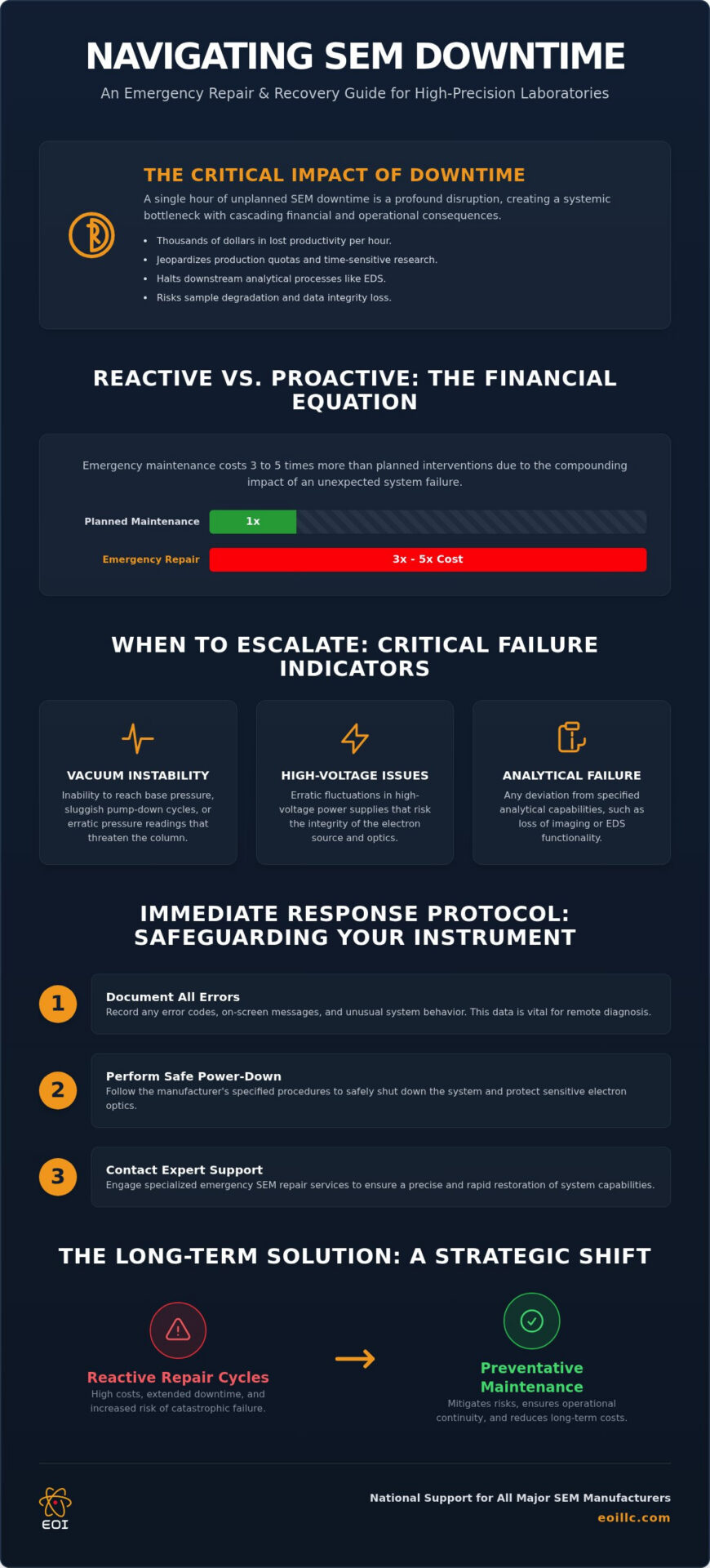
In semiconductor fabrication or advanced material science, the hourly loss associated with a non-functional microscope can escalate rapidly. While specific figures vary by facility, research indicates that emergency maintenance often costs three to five times more than planned interventions due to the cascading impact of downtime. Failure in the primary imaging system often halts downstream analytical processes, such as Energy Dispersive Spectroscopy (EDS), effectively blinding the quality control pipeline. The total cost of downtime represents the aggregate of lost production value, specialized labor redirected to non-productive tasks, and the potential forfeiture of high-stakes research funding. Prolonged delays also introduce secondary risks, including sample degradation from environmental exposure or the loss of data integrity during interrupted long-term mapping sessions.
When to Classify a Technical Issue as an Emergency
Distinguishing between minor imaging artifacts and catastrophic system failures requires a nuanced understanding of hardware architecture. Minor issues might involve slight beam drift or manageable noise, but certain red flag symptoms demand immediate escalation. These symptoms often manifest as sudden vacuum system instability, characterized by an inability to reach base pressure, or erratic fluctuations in high-voltage power supplies that threaten the longevity of the electron source. For laboratories dedicated to critical failure analysis, any deviation from specified analytical capabilities constitutes an emergency that requires an immediate technical response. It’s essential to identify the threshold for professional intervention early. This threshold is typically reached when vacuum leaks persist despite basic seal maintenance or when electronic failures suggest a breach in the column’s optical integrity, necessitating the expertise of a seasoned field engineer to restore the system’s visionary performance.
Diagnosing Critical Failure Modes in Scanning Electron Microscopy
Identifying the precise nature of an instrument failure is the essential prerequisite for effective emergency SEM repair services. Within the rigorous operational context of a University SEM Laboratory, technical anomalies frequently manifest as a complex interplay between hardware degradation and subtle environmental factors. A systematic diagnostic approach requires a methodical evaluation of the vacuum envelope, the electron optical column, and the underlying control electronics to isolate the root cause of systemic underperformance before it compromises sensitive data or mission-critical research outcomes.
Vacuum Integrity and Pressure Anomalies
Compromised vacuum integrity remains the most frequent catalyst for unscheduled instrument downtime in specialized industrial sectors. Symptoms of a breached vacuum typically include sluggish pump-down cycles or erratic pressure readings that fluctuate beyond established operational tolerances. Primary failure points often involve the degradation of fluoroelastomer O-rings, the mechanical exhaustion of turbomolecular pumps, or the saturation of ion getter pumps in high-resolution systems. Maintaining the ultra-high vacuum required for high-resolution imaging is a delicate balance. Diagnostic protocols should prioritize the following indicators:
- Detection of slow pump-down times that exceed established historical benchmarks.
- Identification of erratic pressure fluctuations specifically during high-voltage activation.
- Verification of seal integrity and ion pump exhaustion levels across the optical column.
If your current hardware, whether it’s a legacy unit or a modern Veritas Series SEM, fails to maintain the necessary vacuum-sensitive environment, professional intervention is required to prevent internal oxidation or permanent contamination of the column assembly.
High-Voltage and Beam Generation Failures
Failures within the high-voltage circuitry or beam generation assembly present distinct technical challenges that require a high degree of technical authority to resolve. While filament replacement for tungsten or LaB6 sources is a standard procedure, persistent beam instability or arcing often indicates deeper power supply fluctuations or gun assembly contamination. The diagnostic complexity increases significantly when addressing Field Emission Scanning Electron Microscopes (FE-SEM) compared to traditional thermionic sources; these systems demand meticulous alignment and ultra-stable voltage regulation to achieve superior standards of accuracy and resolution.
Beyond the physical column, board-level electronic failures and software communication errors can paralyze an entire analytical suite. These malfunctions often disrupt the integration of Energy Dispersive Spectroscopy (EDS) systems, rendering critical analytical hardware non-functional. When integrated systems like the Genesis Tabletop SEM encounter these communication bottlenecks, a specialist’s diagnostic depth is required to restore full imaging and chemical analysis capabilities. For laboratories managing complex multi-manufacturer fleets, seeking emergency SEM repair services from a provider with expert diagnostic support ensures that hardware restoration is conducted with the rigorous meticulousness your research mandates.
Emergency Repair vs. Preventative Maintenance: A Strategic Analysis
The reactive repair model, often referred to as the “break-fix” cycle, introduces inherent volatility into high-precision laboratory environments. Relying exclusively on emergency SEM repair services often results in a cascading financial impact, as emergency maintenance costs can reach three to five times the rate of scheduled interventions. This disparity arises from expedited logistics, overtime labor premiums, and the severe disruption of institutional production quotas. Transitioning to a proactive framework is a strategic necessity for facilities that prioritize operational stability and technical integration over reactive crisis management.
When analyzing the Total Cost of Ownership (TCO), laboratory managers must weigh the logistical agility of benchtop units, such as the Cube II or Genesis Tabletop SEM, against the high-throughput capabilities of traditional floor models like the Veritas Series SEM. While benchtop configurations often present lower maintenance overhead, floor-standing units require more intensive vacuum and cooling support. Regardless of the hardware configuration, industry professionals report that proactive maintenance can mitigate a substantial majority of common system failures before they escalate into catastrophic events. Consistent monitoring of vacuum levels and filament health is vital. It’s the most effective way to ensure long-term instrument reliability.
Benefits of SEM Service Contracts
Annual service contracts serve as a critical anchor for laboratory budgeting and risk management. These agreements provide priority scheduling and reduced hourly field service rates, ensuring that technical support is mobilized rapidly during an instrument failure. By formalizing the relationship between the facility and technical experts, contracts facilitate a steady flow of support and predictable hardware upgrades. Understanding the importance of SEM preventative maintenance allows organizations to shift their focus from crisis management to sustainable industrial performance and logistical excellence.
The Role of On-Site Technical Training
Reducing the frequency of user-induced emergencies is a cornerstone of operational excellence. Professional staff education minimizes hardware strain by ensuring that operators adhere to rigorous protocols for sample loading, vacuum cycling, and filament optimization. Implementing professional SEM operation best practices creates a synergy between human expertise and mechanical reliability. This educational investment acts as a preventative layer, protecting sensitive electron optics and extending the lifecycle of consumables like SEM filaments. It’s a grounded, practical approach to maintaining superior standards in high-end imaging.
Immediate Response Protocol for SEM Hardware Failure
When a critical failure occurs, the immediate actions taken by laboratory personnel determine the extent of potential hardware damage and the eventual speed of recovery. A systematic response begins with the protection of the instrument’s most sensitive components, specifically the electron source and high-voltage power supplies. Adhering to a rigorous power-down procedure prevents the risk of electrical arcing or column contamination during emergency SEM repair services. Once the system is stabilized, the focus shifts to securing the sample chamber and verifying the status of external vacuum pumps and isolation valves to prevent an atmospheric breach that could compromise the entire optical path.
Isolation of the root cause starts with a methodical check of the primary vacuum system. Operators should verify that the roughing pump is operational and that all pneumatic valves have returned to their default fail-safe positions. If the system remains under vacuum, it’s vital to keep the chamber sealed until a technician arrives, as repeated cycling during a failure state can introduce particulates into the column. These preliminary steps ensure that the hardware remains in a controlled state, facilitating a more efficient diagnostic process when expert field support arrives on-site.
Documenting the Failure for Technical Support
Precision in documentation is the most effective tool for accelerating remote diagnosis and minimizing instrument downtime. Laboratory managers should capture high-resolution screen logs, specific error codes, and any imaging artifacts that appeared immediately prior to the failure. It’s equally important to summarize recent environmental factors, such as local power surges or laboratory temperature fluctuations, that might have influenced system stability. Detailed diagnostic logs significantly reduce billable hours by allowing field engineers to arrive with the specific components required for hardware restoration. This data-driven approach allows for a visionary transition from failure to functionality without the delays associated with exploratory troubleshooting.
Preliminary Hardware Verification
Before escalating a technical issue to a full-scale field service call, certain fundamental hardware checks can rule out minor consumable failures. Verifying the integrity of tungsten or LaB6 filaments is a standard first step, as a simple burnout can often mimic more complex electronic failures. For high-performance units like the Veritas HR SEM, ensuring the cooling system’s integrity is paramount; a minor obstruction in the chiller loop can trigger a thermal shutdown that halts all analytical operations. Understanding these operational realities is a key component of calculating SEM total cost of ownership, as it emphasizes the synergy between user-level maintenance and professional technical integration. If these preliminary checks don’t resolve the issue, it’s time to contact a specialist to initiate a comprehensive national field service response.
National Emergency SEM Support for All Major Manufacturers
Navigating the complexities of a multi-manufacturer laboratory requires a technical partner capable of transcending proprietary boundaries. With over 30 years of industry experience, the provision of emergency SEM repair services has evolved into a sophisticated operation that prioritizes the restoration of analytical accuracy across diverse hardware platforms. This extensive tenure allows for a deep understanding of the mechanical and electronic nuances inherent in systems from Hitachi, JEOL, FEI/Thermo Fisher, and Zeiss. By maintaining a national field service network, technical experts provide on-site troubleshooting and component-level repairs throughout the United States, ensuring that geographic distance doesn’t become a barrier to hardware restoration.
The ability to source critical parts and perform intricate repairs on both legacy and contemporary models is a cornerstone of logistical excellence. While many providers limit their scope to specific brands, a cross-platform approach addresses the practical realities of modern research facilities where heterogeneous instrument fleets are common. This technical versatility ensures that whether a lab operates a high-resolution field emission unit or a specialized analytical tool, the path to recovery remains clear and methodical. It’s about maintaining a steady, expert-driven narrative of reliability that supports large-scale production and academic milestones alike.
Expertise Beyond Proprietary Brands
Handling the architectural variations between different manufacturers requires more than just general mechanical knowledge; it demands a visionary understanding of electron optics and vacuum physics. As the sole US distributor for EmCraft, our technical teams leverage unique insights into the integration of modern hardware systems. This expertise is particularly valuable when evaluating whether to repair a failing legacy unit or transition to high-performance benchtop SEM systems. Models like the Cube II or Genesis Tabletop SEM represent a reliable shift toward decentralized imaging, offering a strategic alternative for laboratories facing frequent emergencies with older, floor-standing equipment that has reached its end-of-life cycle.
Streamlined Repair and Calibration Process
The conclusion of an emergency service visit isn’t defined merely by the restoration of power, but by the verification of performance against rigorous international standards. Every repair cycle includes meticulous testing and the recalibration of integrated Energy Dispersive Spectroscopy (EDS) systems to ensure data integrity is fully restored. This methodical flow ensures that the synergy between imaging and chemical analysis remains intact, protecting the facility’s long-term industrial performance. If your laboratory is currently experiencing a critical system failure, contact our service department for immediate SEM repair assistance to initiate a rapid, expert-driven recovery protocol that restores your Veritas Series SEM or legacy hardware to its peak analytical state.
Securing Institutional Continuity Through Advanced Technical Integration
The intersection of rapid technical response and meticulous engineering remains the primary safeguard for a laboratory’s industrial performance and research momentum. Addressing the complexities of vacuum instability and electronic failure requires a methodical diagnostic approach that transcends simple hardware replacement. By implementing rigorous immediate response protocols and prioritizing the strategic value of technical integration, facilities can effectively mitigate the severe economic ripple effects associated with unplanned instrument downtime.
Securing reliable emergency SEM repair services is essential for organizations that demand superior standards of accuracy across diverse instrument fleets. Leveraging over 30 years of industry expertise and a national on-site service network, technical support is available for all major SEM brands to ensure that your Veritas Series or legacy hardware is restored with precision. Don’t let technical failures stall your institutional progress or compromise critical analytical data. Request Emergency SEM Service & Repair today to restore the visionary performance and logistical excellence your high-precision environment requires.
Frequently Asked Questions
What are the most common causes of emergency SEM failure?
The primary catalysts for emergency SEM failure include vacuum system compromises, such as O-ring degradation or pump exhaustion, and electron source failures like filament burnouts. High-voltage power supply fluctuations and electronic board malfunctions also represent significant failure modes. These issues often arise from environmental stressors or the natural depletion of consumables. Implementing regular preventative maintenance can mitigate many of these common hardware disruptions before they necessitate urgent emergency SEM repair services.
Can you repair SEM models from manufacturers other than EmCraft?
Electron Optics Instruments, LLC provides comprehensive emergency SEM repair services for all major manufacturers, including Hitachi, JEOL, FEI, Thermo Fisher, and Zeiss. While we are the sole US distributor for EmCraft systems like the Veritas series, our technical expertise extends to the architectural nuances of legacy and current models from other global innovators. This cross-platform capability ensures that multi-manufacturer laboratories receive consistent, high-end technical support regardless of the specific hardware in their facility.
How quickly can a field service engineer be on-site for a repair?
Response times for on-site technical support are determined by the facility’s geographic location and current field engineer availability within our national service network. We prioritize rapid mobilization to minimize the economic impact of unplanned downtime in high-throughput environments. For laboratories that require guaranteed response windows, maintaining an annual service contract is the most effective strategy. These agreements ensure that your hardware restoration is prioritized during critical system failures.
Is it possible to diagnose an SEM failure remotely before a technician arrives?
Remote diagnosis is a standard preliminary step in our hardware recovery protocol. By analyzing system error codes, diagnostic logs, and imaging artifacts provided by laboratory staff, our engineers can often isolate the root cause before arriving on-site. This methodical preparation ensures that the technician arrives with the specific components and tools required for the repair. Detailed documentation from the user is vital for accelerating this visionary diagnostic process and reducing billable labor hours.
What is the difference between a service contract and an hourly repair rate?
A service contract provides a structured, multi-tiered maintenance agreement that includes priority scheduling and predictable budgeting for annual preventative maintenance visits. In contrast, hourly field service rates involve billable labor charges for reactive troubleshooting and repairs as they occur. While hourly rates are suitable for infrequent needs, service contracts offer a strategic advantage by reducing the total cost of ownership and ensuring immediate technical integration when hardware failures threaten production quotas.
Are parts for older or refurbished SEM units still available?
We maintain a robust inventory of filaments and consumables while specializing in sourcing critical components for legacy and refurbished SEM units. Our 30 years of industry experience allows us to navigate the logistical challenges of parts availability for older models that manufacturers may no longer support directly. This capability extends the operational lifecycle of your existing hardware, ensuring that older systems continue to meet the superior standards of accuracy required for industrial and research applications.
Does emergency repair include the calibration of EDS systems?
The restoration of analytical capabilities often requires the recalibration of integrated Energy Dispersive Spectroscopy (EDS) systems following a hardware repair. Our field service engineers are equipped to perform these calibrations during an emergency visit to ensure the synergy between imaging and chemical analysis is fully restored. This comprehensive approach ensures that your system, whether it’s a Genesis Tabletop SEM or a floor-standing Veritas FE SEM, returns to full operational integrity post-repair.
What should I do if my SEM vacuum system fails to reach high vacuum?
If the vacuum system fails to reach established operational pressures, you should immediately verify the integrity of the chamber seals and the status of the roughing pump. Ensure the sample is not outgassing and that all isolation valves are in their correct positions. If basic troubleshooting doesn’t resolve the pressure anomaly, it’s essential to keep the chamber sealed and contact technical support. Persisting with high-voltage activation under poor vacuum conditions can lead to permanent column contamination.