
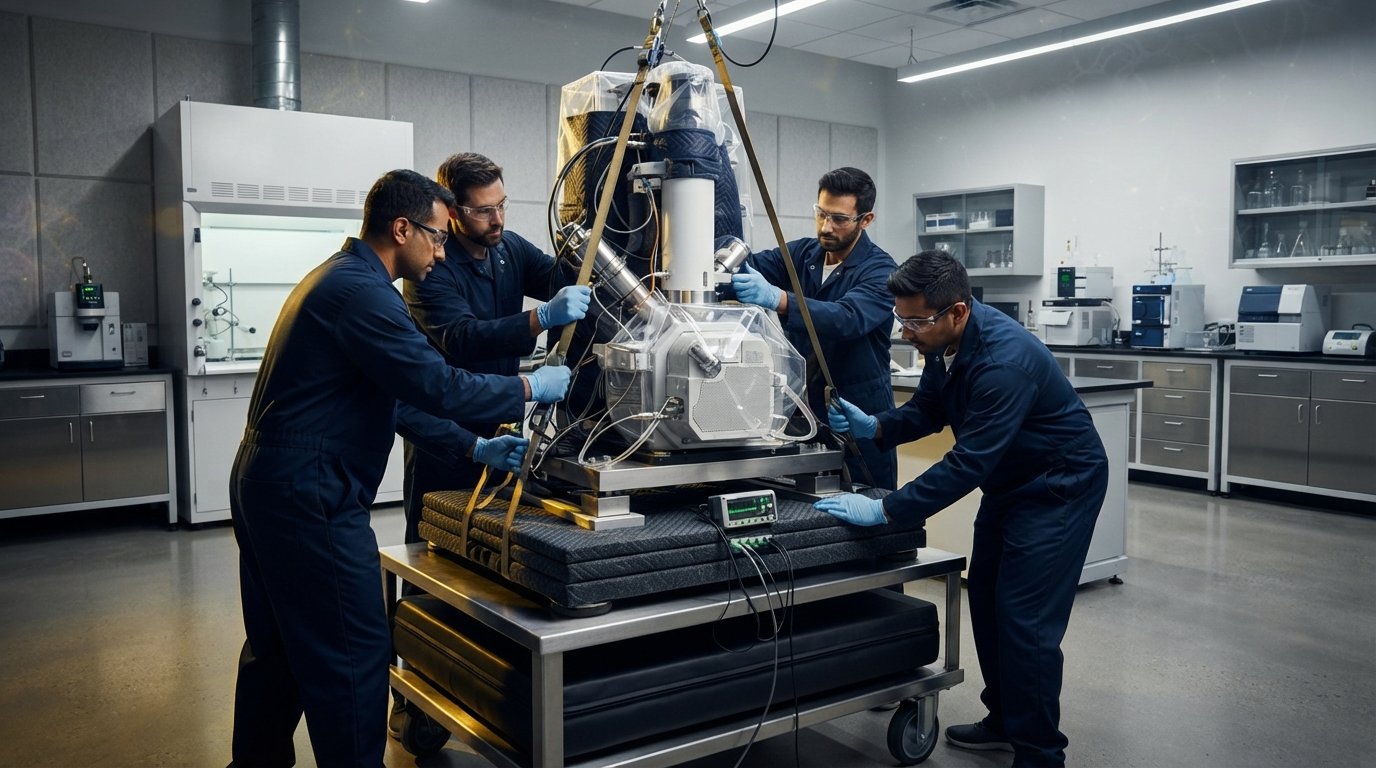
Treating the relocation of a scanning electron microscope as a conventional freight transfer is a direct path to catastrophic column misalignment and compromised vacuum integrity. In specialized scientific environments where unplanned instrumentation downtime halts vital analytical pipelines, professional sem relocation services function as an optical re-engineering procedure rather than standard transport logistics. Laboratory directors and principal investigators understand the operational anxiety: an unmitigated mechanical shock in transit or poor thermal stabilization can permanently degrade resolution and invalidate years of baseline calibration data.
Protecting nanoscale analytical assets requires technical governance long before transport rigging arrives at the facility loading bay. In this guide, you’ll master the rigorous technical protocols, environmental site readiness requirements, and meticulous decommissioning steps necessary to execute a risk-free transfer with zero optical or mechanical degradation. We examine the complete transit lifecycle, showing you how to establish verified pre-move performance baselines, isolate sensitive electron columns, and execute turnkey recommissioning to ensure documented analytical accuracy at your destination facility.
Key Takeaways
- Understand how mechanical shock loads and vibration during transit can compromise delicate electromagnetic lens assemblies and high-vacuum seals.
- Master the pre-move decommissioning protocol, from recording baseline imaging resolution and EDS spectra to executing controlled dry nitrogen venting.
- Audit destination site readiness by measuring electromagnetic interference, acoustic disturbance, and floor vibration against manufacturer specifications.
- Follow the systematic recommissioning process, including precision rigging, chamber bakeout, and documented analytical re-certification.
- Discover why engaging specialized sem relocation services safeguards high-value electron columns and prevents extensive research downtime that standard freight carriers risk.
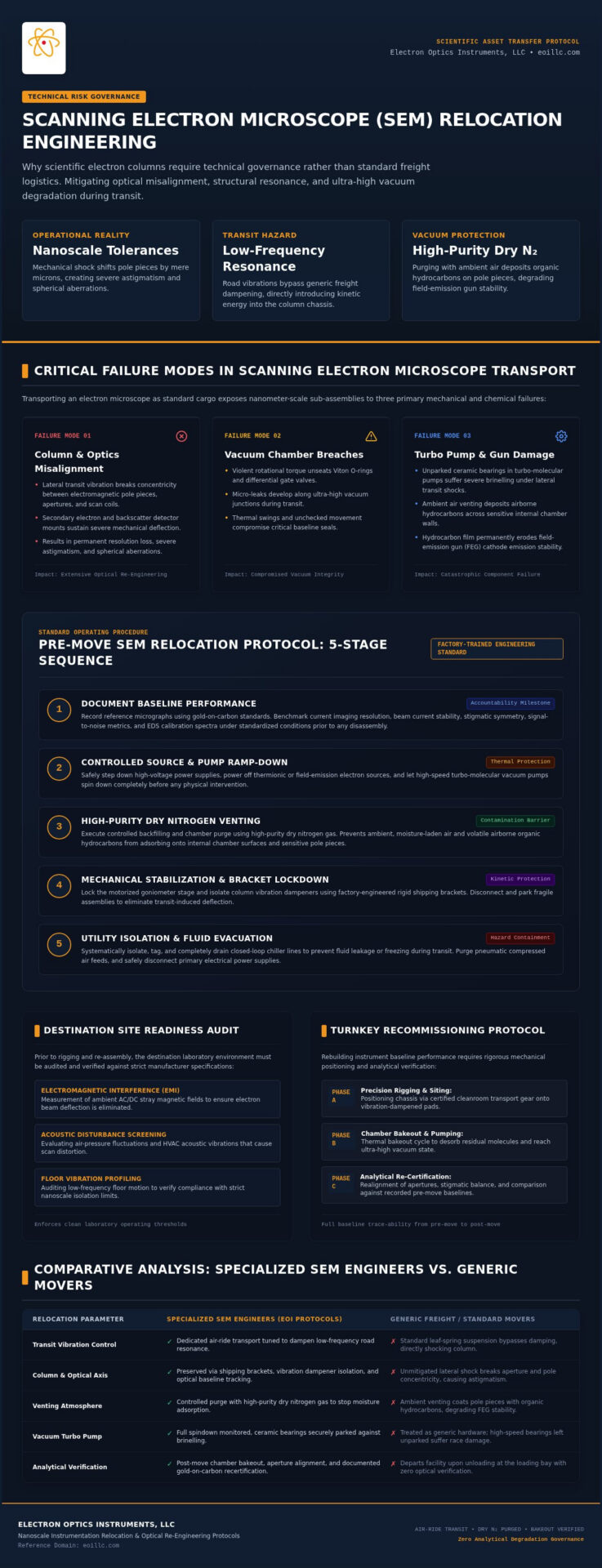
Critical Failure Modes in Scanning Electron Microscope Transport
A Scanning electron microscope (SEM) operates under mechanical and optical tolerances governed at the nanometer scale. Moving such instrumentation requires far more than basic crating; uncontrolled transit forces create irreparable structural misalignments. When road vibration directly couples to the internal architecture, sensitive electromagnetic assemblies shift. Without dedicated sem relocation services utilizing specialized air-ride transport, low-frequency road resonance bypasses standard freight dampening, transmitting destructive kinetic energy directly into the chassis.
Establishing traceable pre-move performance baselines serves as essential technical insurance. Documenting beam resolution, stigmatic symmetry, and signal-to-noise metrics prior to disassembly guarantees clear accountability, eliminating disputes between facilities teams and transport specialists once recommissioning begins.
Column Misalignment and Optical Degradation Risks
Lateral transit vibrations readily disrupt the precision concentricity between electromagnetic pole pieces, beam-limiting apertures, and scan coils. When an unmitigated shock load displaces these elements even by a few microns, the electron optical path suffers severe astigmatism and spherical aberrations. Secondary electron detectors and backscatter sensor mountings also risk mechanical deflection. These physical shifts degrade the instrument’s resolving power, rendering nanoscale imaging impossible without extensive, time-consuming optical realignment.
Vacuum Chamber Breaches and Contamination Hazards
Vacuum system integrity represents an equally fragile domain during physical transit. Dynamic road vibrations jeopardize critical vacuum boundaries:
- Elastomer and Seal Disruption: Viton O-rings and differential gate valves can unseat under violent torque, creating micro-leaks along high-vacuum junctions.
- Turbo-Molecular Pump Damage: Ceramic bearings inside high-speed turbo pumps sustain severe brinelling when subjected to lateral shocks while unparked.
- Hydrocarbon Contamination: Venting a vacuum chamber using ambient, moisture-laden air introduces volatile organic hydrocarbons. These contaminants coat pole pieces, permanently eroding field-emission gun stability.
To avoid optical contamination, engineers execute a controlled purge using high-purity dry nitrogen gas. Professional sem relocation services enforce this inert backfilling protocol alongside rigid mechanical shipping locks, ensuring both optical columns and ultra-high vacuum chambers arrive structurally intact.
Pre-Move SEM Relocation Checklist: Systematic Decommissioning
Decommissioning an electron microscope demands strict procedural adherence rather than simple disassembly. Generic movers often treat scientific equipment like heavy office hardware, unplugging cables without regard for system dependencies. In contrast, factory-trained engineers follow an exact five-step decommissioning sequence to safeguard internal components:
- Document Performance: Benchmark current imaging resolution, beam current stability, and EDS calibration spectra under standardized conditions.
- Controlled Ramp-Down: Safely step down high-voltage power supplies, power off thermionic or field-emission sources, and let turbo-molecular vacuum pumps spin down completely.
- Inert Gas Venting: Vent the specimen chamber using high-purity dry nitrogen to prevent ambient moisture and airborne particulates from contaminating the chamber walls.
- Mechanical Stabilization: Lock the motorized goniometer stage and isolate column vibration dampeners using factory-engineered shipping brackets.
- Utility Isolation: Systematically isolate, tag, and drain closed-loop chiller lines, purge compressed air feeds, and disconnect primary power supplies.
Rigorous execution across these milestones forms the backbone of reliable sem relocation services, establishing accountability before any hardware moves across the threshold.
Benchmarking Optical and Analytical Baseline Metrics
Before disconnecting any sub-system, engineers record reference micrographs using gold-on-carbon resolution standards at high magnification. They evaluate beam stigmatism, spot size stability, and signal clarity across various accelerating voltages. Simultaneously, collecting copper calibration spectra verifies Energy Dispersive Spectroscopy (EDS) detector baselines, peak resolution, and energy drift. Archiving system configurations, operating parameters, and software license files protects against operational discrepancies after transit. Reviewing the definitive guide to SEM maintenance helps facility managers align their baseline data collection with standard validation protocols.
Mechanical Lockdown and Specialized Component Crating
Physical stabilization requires deploying genuine transit brackets to lock motorized specimen stages in place, eliminating gear backlash and bearing strain. Field service teams carefully extract sensitive peripherals, including Everhart-Thornley detectors, sensitive backscatter diodes, and fragile electron emitters. Each component is sealed inside static-dissipative packaging and nestled into custom shock-absorbing foam inserts. For comprehensive equipment protection, consult industry data published via specialized relocation guidelines. Moisture-barrier barriers and ruggedized outer crates guard the optical core against atmospheric humidity and handling shocks during transit. Partnering with seasoned Electron Optics Instruments, LLC relocation specialists ensures that every phase of mechanical isolation meets original manufacturing tolerances.
Destination Site Readiness: Environmental and Utility Specifications
Flawless mechanical transit guarantees nothing if the destination room fails environmental validation. Sub-nanometer imaging capabilities require destination facilities to undergo exhaustive pre-installation surveys before crated hardware arrives at the loading dock. Rigorous sem relocation services prioritize facility qualification early, ensuring that ambient mechanical vibrations strictly adhere to standardized Vibration Criteria (VC) curves, typically targeting VC-D or VC-E thresholds for ultra-high-resolution columns.
| Environmental Parameter | Benchtop / Tabletop SEM | Conventional Floor-Standing SEM |
|---|---|---|
| Floor Vibration Limit | VC-A to VC-B standard | VC-D to VC-E (sub-micron velocity) |
| Stray Magnetic Fields (EMI) | < 0.3 µT (peak-to-peak) | < 0.1 µT (peak-to-peak) |
| Thermal Stability | ±1.5°C per hour drift limit | ±0.5°C to ±1.0°C per 24-hour cycle |
| Acoustic Noise Ceiling | < 65 dBC ambient | < 55 dBC ambient |
Electromagnetic Interference (EMI) and Acoustic Isolation
Stray electromagnetic fields represent an invisible risk to electron optics. Elevators, main power conduits, and subways generate dynamic AC and DC fields that deflect electron beams, inducing edge blurring and severe image tearing. Similarly, ambient acoustic pressure from HVAC air ducts vibrates detector mountings. When site surveys reveal stray fields exceeding standard operational thresholds, installing three-axis Helmholtz active cancellation cages counteracts the interference, preserving probe current and spot integrity.
Pneumatic, Thermal, and Electrical Power Criteria
Long-term beam stability relies heavily on disciplined utility integration:
- Thermal Regulation: HVAC ducting must diffuse airflow away from the electron column, maintaining ambient room temperature within plus or minus one degree Celsius to eliminate focus drift.
- Pneumatic Feeds: Active pneumatic vibration isolation tables require continuous, dry, oil-free compressed air regulated to prevent micro-oscillations in the chassis.
- Power Conditioning: Circuits demand dedicated isolated earth ground rods with minimal impedance, paired with online, double-conversion uninterruptible power supplies (UPS) to clean line harmonics and eliminate ground loops.
Validating these parameters before transport ensures that specialized sem relocation services transfer delicate columns into an operating space engineered for rapid, uncompromising recommissioning.
Recommissioning Protocol: Installation, Realignment, and Verification
Positioning high-resolution electron optics equipment at the destination requires specialized material-handling procedures. Rather than rolling heavy chassis across raised laboratory tiles on conventional casters, experienced rigging crews float crated hardware into place using pneumatic air-bearing skates. Once positioned, field engineers level the mainframe to precise inclinations, float the integrated vibration isolation tables, and systematically remove transit brackets. Professional sem relocation services ensure this physical handover transitions smoothly into ultra-clean vacuum restoration.
Recommissioning progresses through defined stages: mechanical stabilization, multi-tier vacuum recovery, electro-optical column alignment, and final analytical verification against pre-move records.
Vacuum Chamber Pump-Down and Degassing Procedures
Restoring ultra-high vacuum environments starts by cycling roughing lines to verify foreline integrity before engaging high-speed turbo pumps. Technicians closely monitor turbo-molecular pump current draw and bearing resonance during initial spool-up to rule out transport trauma. Once base pressures stabilize, engineers initiate a controlled chamber bakeout. This elevated thermal cycle accelerates the desorption of trapped water vapor and volatile surface molecules from inner chamber walls, lowering pump-down curves and confirming seal integrity across newly seated ports.
Column Alignment, Beam Stigmatism, and Analytical Re-Certification
Restoring optical performance demands iterative electro-optical calibration across multiple operational tiers:
- Optical Axis Realignment: Technicians center gun shift and tilt controls, ensuring the primary electron beam aligns with intermediate condenser and objective apertures without clipping.
- Astigmatism Correction: High-magnification stigmation tests across varied accelerating voltages eliminate asymmetric focus drift, restoring round beam spot geometries.
- EDS Energy Calibration: Engineers acquire spectral standards, adjusting channel gain and zero-offset thresholds to verify peak resolution and count rates.
For laboratories establishing post-relocation standard operating procedures, consult our comprehensive guide on SEM operation. After matching pre-move gold-on-carbon resolution micrographs, technicians sign off on full system validation. To safeguard sensitive electron optics hardware during your upcoming facility transition, schedule an engineering consultation with proven relocation specialists.
Selecting SEM Relocation Services: Specialized Engineers vs. Generic Movers
Commercial freight movers excel at transporting crated industrial machinery, but an electron column isn’t basic heavy cargo. General carriers operate under bill-of-lading insurance that compensates by weight rather than true replacement value. Worse, standard transit policies routinely reject claims involving internal optical distortions, aperture shifts, or vacuum leaks if the external crate shows no physical crushing. Specialized sem relocation services bridge this technical divide. A turnkey service provider assumes sole accountability across every project phase, handling initial electrical spin-down, rigging coordination, transit vibration mitigation, and final analytical sign-off.
Key Vendor Vetting Criteria and Liability Protections
Procurement teams and laboratory managers should evaluate moving partners using stringent technical and contractual criteria:
- Instrumentation-Specific Coverage: Require full-value inland marine coverage tailored to analytical hardware, ensuring protection covers internal mechanical recalibration rather than simple surface damage.
- Factory Training and Experience: Verify that on-site engineers possess formal factory training across diverse column geometries, turbo-molecular vacuum architectures, and digital control electronics.
- Contractual Performance Baselines: Demand written agreements where post-move acceptance hinges on matching the gold-standard resolution micrographs and EDS calibration curves recorded before decommissioning.
Electron Optics Instruments, LLC Turnkey Nationwide Solutions
Since 1990, Electron Optics Instruments, LLC has delivered specialized scientific instrumentation expertise, offering comprehensive nationwide support for complex laboratory transitions. Our factory-trained field service engineers average over twenty years of hands-on electron microscopy experience. They understand the mechanical tolerances and vacuum physics necessary to prevent column trauma during transit.
Our turnkey capabilities cover the entire equipment spectrum. Whether you need to transport compact platforms like the Cube II Benchtop SEM and Genesis Tabletop SEM, high-resolution workhorses like the Veritas Series SEM (including the Veritas FE SEM), or complex EDS analytical suites, our team manages every milestone. We oversee baseline recording, precision isolation rigging, clean transport, and complete system recommissioning. To protect your nanoscale research investments and eliminate costly project delays, schedule a site evaluation through Electron Optics Instruments, LLC SEM relocation services.
Safeguard Precision Imaging Across Every Facility Transition
Relocating nanoscale instrumentation demands unwavering technical governance. From capturing baseline resolution standards and executing inert nitrogen venting to qualifying destination environmental parameters, every procedural step directly impacts post-move imaging integrity. Without rigorous engineering oversight, transit vibrations and atmospheric contamination risk turning an indispensable analytical asset into an operational liability.
Engaging dedicated sem relocation services eliminates these systemic vulnerabilities. Backed by over 30 years of electron optics leadership, Electron Optics Instruments delivers nationwide support through factory-trained field engineers averaging over twenty years of hands-on technical experience. Whether your facility needs to transfer compact systems like the Cube II and Genesis Tabletop SEM or advanced Veritas series platforms, our specialists manage the entire lifecycle to preserve baseline resolution. Consult Electron Optics Instruments for expert nationwide SEM relocation services and ensure your laboratory resumes nanoscale discovery without analytical compromise.
Frequently Asked Questions
How far in advance should our laboratory schedule professional SEM relocation services?
Laboratories should engage sem relocation services 8 to 12 weeks prior to their planned move date. This scheduling window allows field engineers to conduct comprehensive environmental site surveys at the receiving facility, record baseline performance metrics, and acquire model-specific transit locking brackets. Advanced planning also ensures proper coordination for utility rough-ins like isolated ground circuits, chilled water lines, and pneumatic supplies without stalling active research schedules.
Can our internal facility team move our scanning electron microscope down the hall?
Moving an SEM internally without specialized engineering oversight isn’t recommended. Even short transfers across floor joints and door thresholds subject sensitive electron columns to unmitigated lateral forces. Without installing factory shipping brackets to lock the motorized goniometer stage and safely spinning down turbo-molecular pumps under inert gas, rolling an instrument on utility casters can knock optical apertures out of concentricity and crack vacuum seals.
What environmental site surveys are required before relocating an electron microscope?
Pre-installation surveys require multi-axis floor vibration testing measured against standard Vibration Criteria curves, typically targeting VC-D or VC-E thresholds. Technicians also perform three-axis magnetometer testing to quantify stray AC and DC electromagnetic interference from nearby elevators, subways, or electrical panels. In addition, acoustic sound pressure surveys evaluate ambient room noise, while environmental data loggers confirm that the destination HVAC system maintains temperature stability within one degree Celsius.
Does standard commercial moving insurance cover electron microscope column misalignment?
Standard commercial moving coverage rarely protects against internal optical or electronic misalignment. Most general freight policies evaluate claims purely on physical freight weight or require obvious structural crate damage before approving reimbursement. In contrast, specialized sem relocation services utilize dedicated inland marine instrumentation insurance. This specialized coverage protects high-value analytical assets, fully insuring the precision mechanical realignment, optical re-centering, and technical recalibration required after physical transit.
How long does a complete SEM decommissioning, relocation, and recommissioning project take?
Turnkey instrument moves typically require three to five business days on-site, depending on transit distance and column complexity. The first day focuses on capturing optical baseline data, controlled system spin-down, and nitrogen chamber backfilling. Physical transport and destination rigging occur on day two. The remaining days involve multi-stage chamber pump-down, controlled bakeout, optical beam alignment, and documented analytical re-certification matching pre-move resolution benchmarks.
What is the difference between moving a benchtop SEM versus a floor-model FE-SEM?
Benchtop instruments, such as the Cube II Benchtop SEM or Genesis Tabletop SEM, feature compact footprints and integrated vacuum manifolds that simplify transit rigging and room placement. In contrast, floor-standing platforms like the Veritas FE SEM utilize field-emission sources, massive electromagnetic lenses, and active pneumatic isolation tables. These larger systems demand exhaustive site readiness audits, specialized air-skate transfer equipment, and multi-day optical alignment cycles.
How is vacuum chamber contamination prevented during instrument transit?
Engineers prevent chamber contamination by executing a controlled purge using high-purity dry nitrogen gas instead of ambient laboratory air. This inert backfill prevents moisture, dust, and airborne hydrocarbons from bonding to the internal chamber walls and beam-limiting apertures. Once vented, technicians seal all ports with blanking flanges and clean Viton gaskets, maintaining internal cleanliness until recommissioning pump-down cycles begin at the destination.