

In 2026, the long-standing paradigm that equated a system’s physical volume with its analytical precision has effectively collapsed. You’re likely facing the dual challenge of maintaining sub-5nm resolution standards while navigating the logistical constraints of limited laboratory floor space and the high cost of specialized operators. The decision between a benchtop sem vs floor model is no longer a simple binary choice between budget and performance. Instead, it represents a sophisticated strategic evaluation of infrastructure agility and specific throughput requirements. This technical breakdown provides the empirical framework necessary to justify your capital equipment expenditure by examining the narrowing gap in electron optics and multi-detector integration. We will investigate the critical trade-offs in vacuum stability, chamber versatility, and total cost of ownership to ensure your selection aligns with your facility’s long-term research trajectory and operational excellence. By analyzing the synergy between high-end hardware and automated workflows, we’ll help you determine if the compact efficiency of a benchtop system can meet your rigorous imaging demands.
Key Takeaways
- Recognize how the convergence of advanced electron optics allows modern benchtop systems to deliver high-performance analytical capabilities previously exclusive to larger, traditional architectures.
- Analyze the technical trade-offs between nanometer-scale resolution in compact units and the sub-nanometer precision afforded by the sophisticated beam manipulation of floor-standing models.
- Assess the logistical advantages of infrastructure agility by considering how environmental factors like electromagnetic interference and vibration impact the integration of advanced hardware.
- Utilize a comprehensive total cost of ownership framework to evaluate the benchtop sem vs floor model based on initial capital acquisition, consumable longevity, and long-term maintenance requirements.
- Determine the optimal system configuration by aligning specific laboratory objectives with either the rapid throughput of benchtop SEMs or the extensive detector versatility of floor models.
The Evolving Landscape of Scanning Electron Microscopy: Benchtop vs. Floor Models
The industrial imaging sector is witnessing a fundamental transformation in hardware architecture. Traditionally, the Scanning Electron Microscope (SEM) was categorized into two distinct tiers: the entry-level tabletop unit and the high-performance floor-standing system. In 2026, this binary classification has evolved into a spectrum of specialized analytical tools. Modern benchtop SEMs, such as the Genesis Tabletop SEM, are no longer relegated to preliminary screening. They’ve become high-performance, compact instruments capable of executing complex failure analysis and quality control protocols directly on the production floor. Conversely, floor models like the Veritas Series continue to serve as the definitive platform for multi-detector versatility and sub-nanometer characterization. The primary decision factor in the benchtop sem vs floor model debate has shifted from raw resolution to the synergy between throughput requirements and laboratory infrastructure.
Historical Context and Modern Convergence
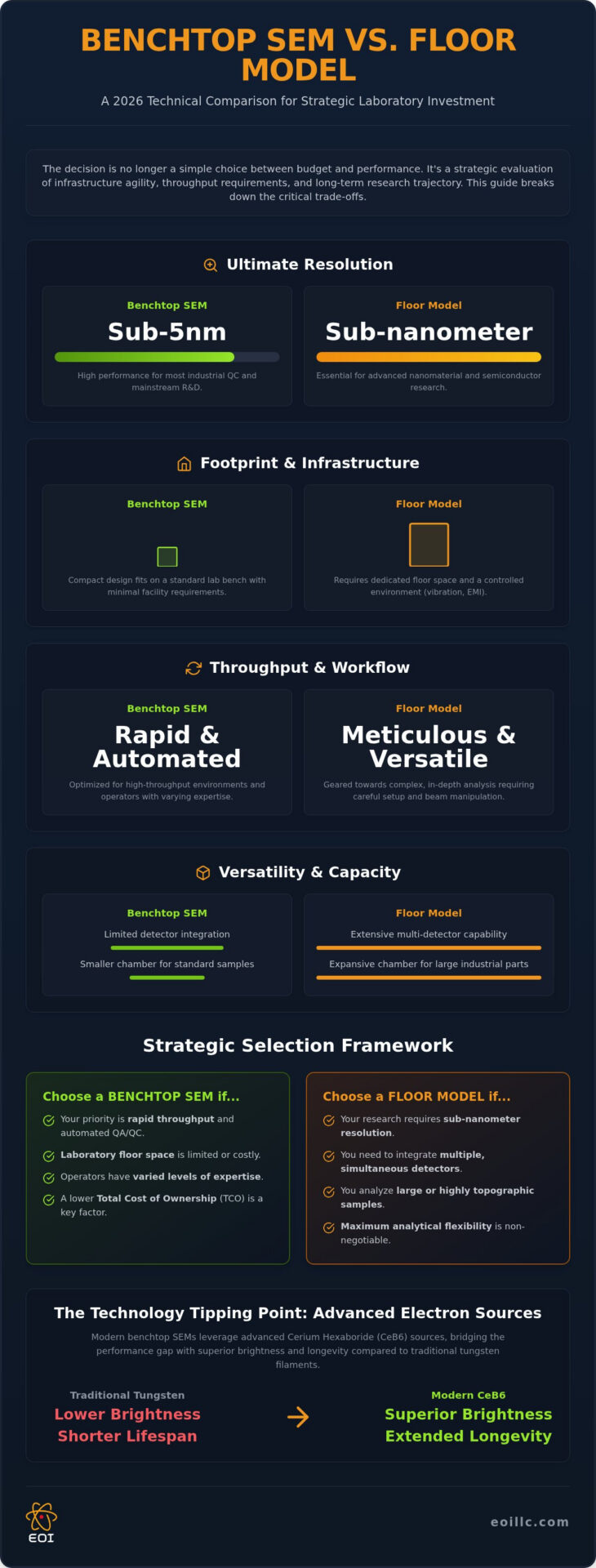
The transition from early “tabletop” devices to professional-grade benchtop instrumentation marks a significant milestone in engineering. Early iterations were often limited by vacuum stability and modest resolution, yet the 2026 landscape tells a different story. The integration of advanced electron gun technology, specifically the shift toward CeB6 (Cerium Hexaboride) sources in compact formats, has provided superior brightness and longevity compared to traditional tungsten filaments. This technological convergence means that high-performance tabletop units can now achieve sub-5nm resolution, a threshold that previously demanded a full-scale floor installation. 2026 represents a tipping point where the reduced total cost of ownership and minimal facility requirements make benchtop adoption the logical choice for mainstream R&D and industrial quality control.
Defining Your Primary Imaging Objectives
Selecting the appropriate architecture requires a meticulous assessment of your facility’s imaging objectives. While benchtop units provide exceptional speed and ease of use, a floor model becomes a technical necessity when your research demands sub-nanometer resolution or the simultaneous integration of multiple detectors. Chamber volume also acts as a critical differentiator. Industrial parts that exceed the physical constraints of a compact stage require the expansive internal volume of a system like the Veritas Ultra SEM. Additionally, high-throughput environments often benefit from the automated workflows inherent in modern benchtop designs. These systems allow operators with varying expertise levels to generate accurate data without the need for extensive specialized training, effectively decentralizing high-end microscopy within the corporate structure. Identifying the specific threshold where resolution requirements meet sample size constraints is the first step in justifying your capital expenditure.
Comparative Analysis of Electron Optics, Resolution, and Detector Versatility
The architectural divergence in the benchtop sem vs floor model comparison is most evident when examining the physics of the electron column. Floor-standing systems, exemplified by the Veritas FE SEM, utilize significantly longer columns that accommodate complex electromagnetic lens arrays and multiple adjustable apertures. These features allow for meticulous beam manipulation. This results in the sub-nanometer resolution required for advanced semiconductor research or nanomaterial characterization. In contrast, the compact column of a benchtop unit, while engineered for high-performance efficiency, inherently limits the focal range. This physical constraint becomes particularly relevant when imaging highly topographic samples where a floor model’s extended working distance provides a superior depth of field and reduced perspective distortion. Institutions like the University of Southampton SEM Facility leverage these high-end floor architectures to achieve magnification and analytical precision that remain the benchmark for specialized academic research.
Vacuum Systems and Beam Stability
Vacuum architecture dictates both imaging clarity and the longevity of high-brightness electron sources. Benchtop units typically integrate internal turbomolecular pumps that achieve operational vacuum levels within minutes. This provides the rapid throughput required for industrial quality control. However, these compact systems may face challenges with thermal stability during extended high-magnification sessions. Floor models, such as the Veritas Ultra SEM, often employ external ion-getter pumps to maintain ultra-high vacuum (UHV) environments. This superior vacuum level is essential for protecting field emission sources and ensuring the long-term stability of the electron beam. If your laboratory requires consistent performance over multi-hour mapping sessions, you might explore our Veritas Series SEM offerings to find a system that matches your stability requirements.
Analytical Capabilities: EDS and Beyond
The integration of Energy Dispersive Spectroscopy (EDS) has become a standard requirement for elemental analysis, yet the physical geometry of the chamber remains a limiting factor in the benchtop sem vs floor model debate. The Cube II Benchtop SEM provides exceptional EDS capabilities within a streamlined footprint, making it ideal for routine industrial screening. Nevertheless, the restricted port geometry of compact chambers often precludes the simultaneous use of multiple analytical sensors like EBSD or Cathodoluminescence (CL). Floor models feature expansive chambers with numerous accessory ports. This allows for the concurrent integration of diverse detector arrays without compromising signal integrity. Analytical Working Distance is the optimized distance between the sample surface and the final lens pole piece where the X-ray signal collection efficiency for detectors like EDS is maximized. By selecting a platform with a larger chamber, researchers ensure the necessary geometric clearance to optimize this distance for multiple sensors simultaneously.
Infrastructure Requirements and Operational Complexity
The physical footprint of a scanning electron microscopy system extends far beyond the dimensions of the primary console. In the benchtop sem vs floor model evaluation, laboratory directors must account for the peripheral support hardware that floor-standing units necessitate. A Veritas FE SEM, for instance, often requires external water chillers, dedicated high-amperage electrical circuits, and sophisticated vibration isolation platforms. These components significantly expand the effective footprint and the complexity of the installation. Benchtop systems like the Cube II integrate these functionalities into a streamlined chassis that operates on standard laboratory power. This elimination of specialized plumbing and high-voltage wiring reduces the initial facility preparation costs and provides superior institutional agility.
Environmental constraints such as electromagnetic interference (EMI) and acoustic noise can severely degrade imaging performance. Floor models are particularly sensitive to low-frequency vibrations and stray magnetic fields from nearby elevators or high-voltage power lines. Mitigating these factors often requires the construction of shielded rooms or the installation of active cancellation systems. Modern benchtop SEMs are engineered with internal dampening and electromagnetic shielding that allow them to function reliably in standard industrial environments. This resilience ensures that high-resolution data remains accessible without the need for expensive architectural modifications or specialized laboratory siting.
Installation and Facility Preparation
The ‘plug-and-play’ reality of modern benchtop SEMs represents a significant shift in deployment strategy. While a floor-standing system may require weeks of site preparation and professional rigging, a Genesis Tabletop SEM can be operational within hours of delivery. For organizations anticipating future laboratory reconfigurations, the ease of relocation offered by compact units is a critical strategic advantage. Before finalizing a purchase, researchers should consult our SEM installation and relocation checklist to evaluate their facility’s readiness for high-end microscopy integration. This proactive assessment ensures that the chosen architecture matches the grounded realities of your logistical environment.
User Interface and Throughput Efficiency
In 2026, the operational complexity of SEM technology has been radically simplified through AI-assisted focusing and automated stage movements. Benchtop models prioritize a streamlined ‘point-and-shoot’ workflow that reduces the time-to-data for multi-user facilities. This automation prevents user-induced hardware damage, such as column contamination or stage collisions, which are more frequent in manually controlled floor models. By lowering the barrier to entry, these systems allow technical staff to focus on data interpretation rather than instrument calibration. This shift enhances overall throughput and ensures that the laboratory’s analytical capacity isn’t throttled by the availability of a single specialized operator. The result is a more democratic access to high-resolution imaging across the entire research team.
Evaluating Total Cost of Ownership: Acquisition, Maintenance, and ROI
The strategic allocation of capital for advanced hardware requires a granular understanding of long-term operational expenses. In the benchtop sem vs floor model financial comparison, the initial acquisition price is merely the first variable in a complex Total Cost of Ownership (TCO) equation. Floor-standing systems represent a significant capital investment that often extends into the mid six-figure range, whereas benchtop units offer a more accessible entry point for organizations prioritizing institutional agility. Beyond the purchase price, depreciation and resale value also play a critical role; high-performance benchtop units often maintain robust value in the secondary market due to their “plug-and-play” versatility and appeal to a broader range of smaller research facilities.
Consumable costs vary significantly based on the electron source architecture. Tungsten filaments, frequently utilized in entry-level configurations, offer a low individual replacement cost but necessitate frequent downtime due to their limited operational lifespan. Conversely, CeB6 (Cerium Hexaboride) sources, which are standard in high-performance benchtop units like the Genesis Tabletop SEM, provide superior brightness and significantly longer longevity. This reduces the frequency of service interventions. For laboratories utilizing Field Emission (FE) sources in systems such as the Veritas FE SEM, the higher cost of source replacement is justified by the sub-nanometer analytical precision achieved. Service contracts also reflect this architectural complexity; the modular nature of benchtop units often leads to more affordable annual agreements compared to the specialized field engineering required for large-frame floor models.
Maintenance Strategies and Downtime Mitigation
Effective maintenance is the cornerstone of instrument reliability and precision. The relative simplicity of benchtop hardware allows for streamlined service protocols that minimize laboratory disruption. In contrast, floor models require meticulous on-site calibration by specialized engineers to maintain their high-resolution benchmarks. Adhering to a rigorous schedule of SEM preventative maintenance is essential for maximizing the lifespan of these sophisticated vacuum systems and electron optics. Organizations that prioritize modular hardware often see a reduction in billable labor hours, as many benchtop components can be serviced or replaced with minimal technical overhead.
Calculating ROI for Industrial Applications
For industrial quality control, the Return on Investment (ROI) is often dictated by sample throughput and the proximity of the instrument to the production line. “At-line” microscopy allows for immediate feedback during manufacturing, reducing the scrap rate and accelerating the failure analysis cycle. This proximity eliminates the logistical delays associated with transporting samples to a centralized core facility. When evaluating these financial trade-offs, laboratory directors should refer to our comprehensive 2026 price guide to facilitate detailed budget planning. This data-driven approach ensures that the chosen system matches both the technical requirements and the fiscal realities of the organization. If you’re ready to optimize your lab’s analytical capabilities, you can view our full range of SEM solutions to find the ideal match for your budget.
Strategic Selection: Aligning SEM Architecture with Laboratory Objectives
The final determination in the benchtop sem vs floor model evaluation depends upon the precise alignment of instrument architecture with institutional KPIs. Organizations prioritizing operational agility often find that the compact efficiency of systems like the Genesis Tabletop SEM provides the necessary throughput for high-volume industrial screening. Conversely, when the research objective demands sub-nanometer resolution and the simultaneous synergy of multiple analytical detectors, the robust infrastructure of the Veritas Series remains the definitive choice. The modern laboratory is increasingly adopting a hybrid methodology. In this tiered workflow, benchtop units act as an empirical triage for high-volume screening, while floor-standing models are reserved for the most demanding deep characterization tasks. This strategic distribution of resources maximizes the utility of high-end hardware while ensuring that the analytical pipeline remains free of bottlenecks.
Future-proofing your laboratory in 2026 requires a visionary approach to software integration and upgrade paths. Modern SEM architectures are moving toward decentralized data ecosystems where automated metadata collection and AI-driven image analysis are standard. While benchtop systems offer rapid deployment, floor models often provide a more expansive roadmap for hardware upgrades, such as the later integration of specialized stages or advanced field emission sources. Selecting a partner that understands these developmental trajectories is essential for maintaining a competitive edge in specialized industrial sectors.
Application-Specific Recommendations
Specific industrial personas require tailored hardware solutions to optimize their workflows. In semiconductor manufacturing, the Cube II excels at localized troubleshooting and rapid failure analysis due to its ability to be placed directly within the production environment. Academic institutions often face the challenge of balancing high-end research with student accessibility; here, a combination of Genesis units for training and Veritas HR systems for advanced projects ensures comprehensive coverage. For geology and mining sectors, the relative portability and ruggedized vacuum systems of modern benchtop SEMs allow for field-adjacent analysis, providing immediate data that can significantly accelerate logistical decision-making in remote locations.
Leveraging Expert Guidance and Support
Acquiring a scanning electron microscope is a long-term commitment that necessitates expert technical training and reliable service support to maximize the instrument’s utility. Electron Optics Instruments, LLC bridges the gap between sophisticated hardware and practical laboratory application by offering specialized preventative maintenance and a range of Refurbished SEM Units for budget-conscious facilities. Our expert-driven narrative focuses on ensuring that your chosen system operates at peak precision throughout its entire lifecycle. Before signing a purchase order, laboratory directors should utilize this final checklist to confirm their selection:
- Does the sample geometry require the expansive internal volume of a Veritas Series chamber?
- Is sub-nanometer resolution a non-negotiable requirement for your primary research objectives?
- Can your existing facility accommodate the specialized vibration isolation and cooling requirements of a floor-standing architecture?
- What is the projected daily throughput, and can the AI-assisted automation of a benchtop unit fulfill this volume?
- Does your long-term analytical roadmap require the simultaneous integration of EDS, EBSD, and other specialized sensors?
By meticulously addressing these questions, you ensure that your capital expenditure results in a system that is perfectly calibrated to your laboratory’s technical and fiscal realities.
Optimizing Your Laboratory’s Analytical Future
The technical convergence witnessed in 2026 has transformed the evaluation of a benchtop sem vs floor model from a simple comparison of resolution into a strategic assessment of operational throughput and infrastructure agility. While floor-standing architectures remain the definitive standard for sub-nanometer characterization, modern benchtop systems now deliver the high-performance imaging required for most industrial quality control protocols. By prioritizing the synergy between your facility’s logistical constraints and its imaging objectives, you can implement a workflow that maximizes precision while maintaining fiscal responsibility.
Electron Optics Instruments, LLC brings over 30 years of specialized electron optics expertise to your facility. As the sole US distributor for EmCraft SEMs, we offer unmatched access to cutting-edge hardware. We also provide comprehensive service contracts for all major SEM brands to ensure your systems maintain superior standards of accuracy. Whether you require compact efficiency or expansive versatility, our team is prepared to guide your selection with meticulous technical insight. Request a technical consultation or quote for the Cube II Benchtop SEM to integrate a new standard of analytical excellence into your laboratory today.
Frequently Asked Questions
Can a benchtop SEM perform EDS analysis as effectively as a floor model?
Modern benchtop SEMs perform Energy Dispersive Spectroscopy (EDS) with high effectiveness for routine elemental mapping and material identification. While floor models provide more accessory ports for simultaneous detector integration, systems like the Cube II utilize advanced silicon drift detectors that deliver the spectral resolution necessary for most industrial failure analysis. The primary limitation is the geometric clearance within the smaller chamber, which may restrict the optimized working distance compared to larger architectures.
What is the maximum magnification achievable with a modern benchtop SEM in 2026?
Modern benchtop SEMs in 2026 typically achieve magnifications up to 150,000x or 200,000x depending on the specific electron source and column engineering. While floor-standing units reach significantly higher magnification levels for sub-nanometer characterization, these compact instruments provide the resolution required for the vast majority of microstructural evaluations. The focus for benchtop units remains on delivering clear, actionable data at the micro and nano scales without the complexity of ultra-high vacuum systems.
Do benchtop SEMs require special vibration isolation tables?
Most benchtop SEMs are engineered with robust internal dampening systems that allow for reliable operation on standard laboratory benches. This design philosophy facilitates institutional agility and reduces facility preparation costs. However, in environments characterized by significant low-frequency vibrations, such as those near heavy industrial machinery, an external passive or active isolation platform may be recommended to preserve imaging stability at the highest magnification settings.
How often do filaments need to be replaced in benchtop vs. floor models?
Filament longevity is dictated by the electron source type rather than the physical size of the microscope. Tungsten filaments generally require replacement every 100 hours of operation, while CeB6 sources, standard in high-performance units like the Genesis Tabletop SEM, often exceed 1,500 hours. High-end floor models utilizing field emission sources offer the greatest longevity, frequently operating for several years before necessitating a source replacement by a specialized field engineer.
Is it possible to upgrade a benchtop SEM with additional detectors later?
Upgradability for benchtop units is contingent upon the initial chamber configuration and the number of available accessory ports. Many systems permit the post-installation of EDS detectors or specialized sample stages, but the physical volume of the chamber inherently limits the simultaneous integration of multiple sensors. Floor models remain the superior choice for laboratories that anticipate a future need for complex detector arrays such as EBSD or cathodoluminescence.
What are the typical power requirements for a floor-standing electron microscope?
Floor-standing electron microscopes often necessitate dedicated high-voltage electrical circuits and specialized grounding to maintain beam stability. These systems typically require 208V or 240V power configurations and may need external water chillers for the thermal management of electromagnetic lenses. In contrast, benchtop models are designed for greater logistical flexibility, generally operating on standard 110V or 220V laboratory outlets without the need for specialized electrical infrastructure.
Can benchtop SEMs handle non-conductive samples without coating?
Benchtop SEMs equipped with charge reduction or low-vacuum modes can effectively image non-conductive samples without the application of a conductive coating. This capability is particularly advantageous for polymers, textiles, and biological specimens where a gold or carbon layer might obscure delicate surface morphologies. By adjusting the internal chamber pressure, these systems mitigate the accumulation of surface electrons that would otherwise cause image artifacts and beam instability.
How does the vacuum pump-down time compare between the two models?
Benchtop systems feature significantly shorter pump-down times, often reaching operational vacuum levels in less than three minutes due to their reduced chamber volumes. This efficiency is a critical factor in the benchtop sem vs floor model comparison for facilities prioritizing high sample throughput. Floor models, which feature expansive chambers and often require ultra-high vacuum environments for field emission sources, typically necessitate longer durations to achieve operational readiness after sample exchange.