
What if the sub-nanometer resolution that once mandated a dedicated laboratory wing could now be balanced against the rapid-cycle productivity of a system that fits on a standard workbench? For years, laboratory directors have operated under the assumption that a benchtop sem vs floor model decision was a binary choice between accessibility and raw power. You’ve likely faced the mounting pressure of escalating maintenance costs for legacy floor units and the logistical constraints of specialized infrastructure requirements, such as vibration isolation and dedicated cooling systems. It’s a challenging environment where the need for high-throughput screening often conflicts with the availability of specialized operators.
This guide provides a rigorous technical and economic framework designed to help you navigate these complexities by evaluating the total cost of ownership against your specific analytical requirements. We’ll examine the narrowing performance gap between high-throughput systems like the Cube II and research-grade flagship models such as the Veritas series. By prioritizing analytical density and operational efficiency, you’ll gain the clarity needed to justify capital expenditure while ensuring your next hardware integration aligns with both your throughput targets and the grounded realities of modern industrial production.
Key Takeaways
- Modern miniaturized electron optics, exemplified by the Cube II, have reached sub-5nm resolution thresholds that redefine the traditional boundaries of tabletop microscopy.
- A comprehensive benchtop sem vs floor model assessment must prioritize total cost of ownership, factoring in the 1sqm footprint of compact units against the specialized facility modifications required for floor-standing hardware.
- Strategic selection depends on the intersection of analytical throughput and sample versatility, where the Veritas series offers the flagship resolution necessary for sub-nanometer research.
- Infrastructure requirements, including active vibration isolation and dedicated HVAC systems, represent significant capital considerations that often favor the streamlined integration of the Genesis or Cube II series.
- Customizing your SEM configuration through expert technical consultation ensures compliance with specific industrial standards while balancing ecological responsibility with high-performance requirements.
The Paradigm Shift: Benchtop SEM vs. Floor Model in 2026
The evolution of the scanning electron microscope has reached a critical juncture where form factor no longer dictates analytical potential with the same rigidity as previous decades. As we enter 2026, the industry is witnessing a structural realignment. Miniaturized electron optics, once relegated to low-magnification screening, now achieve 5nm resolution in high-performance units like the Cube II. This advancement effectively ends the era where laboratory directors had to compromise on image quality to gain laboratory floor space. The benchtop sem vs floor model decision is now driven by specific operational logic rather than a simple trade-off between power and size.
Defining the Benchtop SEM (Tabletop Models)
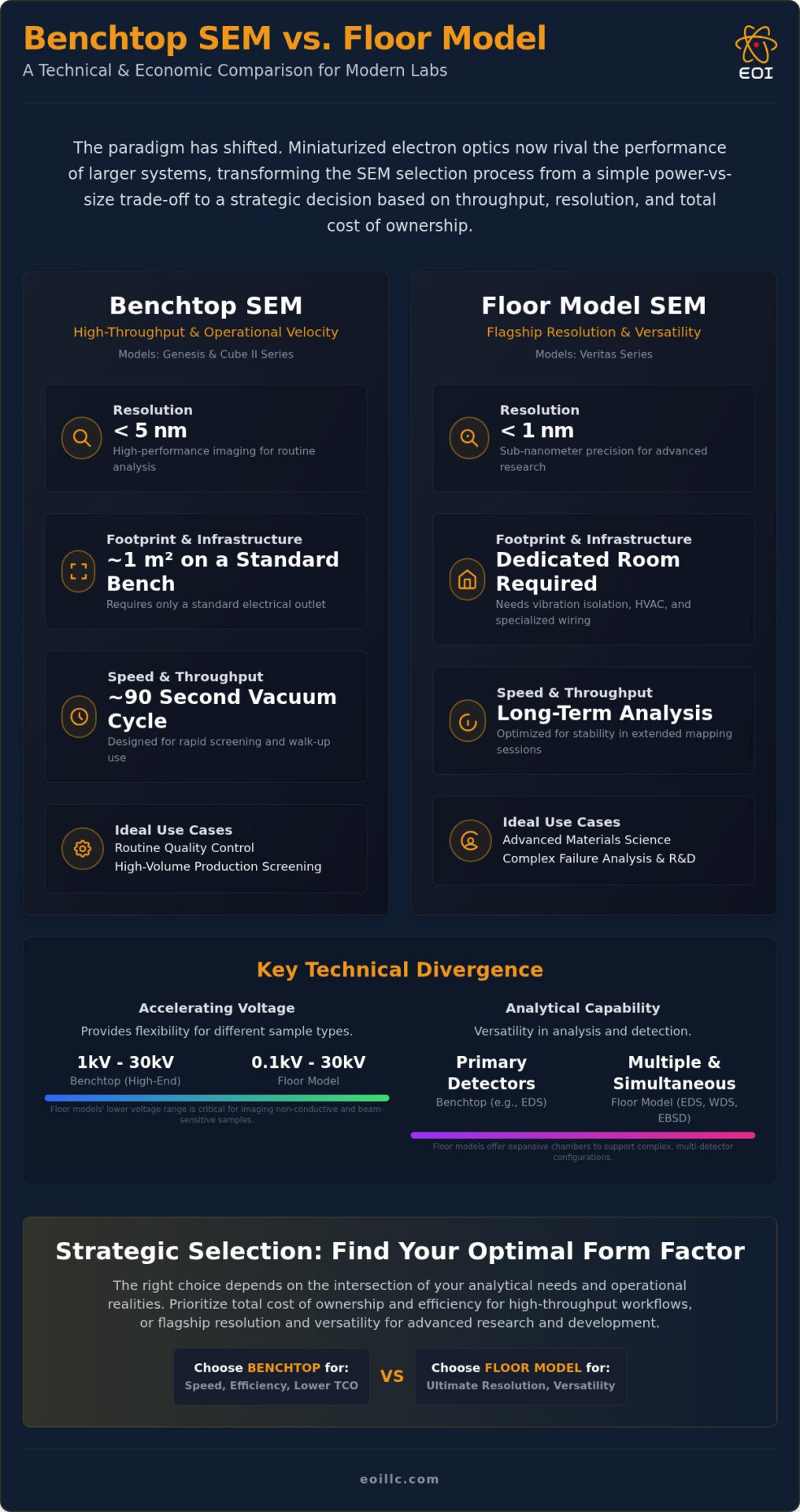
Modern tabletop systems, such as the Genesis series, prioritize analytical density and operational velocity. These units feature integrated vacuum systems and streamlined electron columns that allow for a footprint of approximately one square meter. Operation requires only standard electrical outlets. This removes the need for the specialized infrastructure that often delays installation by months. The primary advantage here is throughput. With vacuum cycle times as low as 90 seconds, these systems act as the ultimate productivity tool for rapid screening and routine quality control. They’re designed for walk-up use. Laboratory personnel can generate high-resolution data without the steep learning curve associated with legacy systems.
Defining the Floor Model SEM
While benchtops have claimed significant ground, the floor-standing model remains the flagship for specialized research and complex industrial failure analysis. Systems within the Veritas series utilize high-performance field emission (FE) sources to deliver sub-nanometer resolution at low accelerating voltages. Such capability is essential for delicate samples where beam damage is a concern. These platforms also offer expansive vacuum chambers. Large chambers allow for the non-destructive testing of bulky components that simply won’t fit in a compact unit. These systems act as versatile analytical hubs. They support multiple detectors such as Energy Dispersive Spectroscopy (EDS), Wavelength Dispersive Spectroscopy (WDS), and Electron Backscatter Diffraction (EBSD) simultaneously. The benchtop sem vs floor model debate in 2026 isn’t about which architecture is superior in a vacuum, but which one aligns with your specific sample volume and resolution requirements.
Technical Divergence: Resolution, Voltage, and Analytical Power
The evaluation of analytical performance in 2026 requires a meticulous examination of electron optics and signal processing capabilities. While historical distinctions relied on raw magnification, the modern benchtop sem vs floor model assessment focuses on acceleration voltage flexibility and signal-to-noise ratios. A standard floor model typically offers a range from 0.1kV to 30kV. This allows for superior imaging of non-conductive or sensitive samples at low voltages without the need for conductive coatings. High-performance benchtops like the Cube II excel in the 1kV to 30kV range. They provide the necessary beam energy for robust Energy Dispersive Spectroscopy (EDS) mapping and surface topography. The ability to maintain signal integrity at higher magnifications is often what separates professional-grade hardware from entry-level systems.
Beam stability acts as the foundation for accurate elemental quantification and reproducible results. Floor-standing systems generally possess superior thermal management and vacuum stability for long-term mapping sessions. However, current engineering innovations have significantly bridged this gap. The current resolution threshold where high-end benchtop systems and mid-range floor models overlap sits at approximately 5 nanometers.
Resolution and Magnification Limits
The sub-nanometer resolution offered by the Veritas Ultra remains essential for advanced materials science and semiconductor research. This level of precision is often associated with facilities like the National Center for Electron Microscopy (NCEM), where the limits of electron optics are pushed to the atomic scale. For routine quality control and failure analysis, the Cube II provides sufficient magnification for 90% of industrial applications. Laboratory directors must avoid the ‘Digital Magnification’ trap found in lower-end models. These systems often inflate magnification numbers through software interpolation without the corresponding resolving power. This results in pixelated images that lack genuine structural detail at the nanoscale.
Source Technology: Tungsten vs. CeB6 vs. Field Emission
Source brightness directly influences imaging speed and the depth of analytical data. Tungsten filaments remain a cost-effective solution for routine work, though they require more frequent sem maintenance due to their shorter lifespan and lower beam stability. Cerium Hexaboride (CeB6) sources offer significantly higher brightness and longevity, making them the standard for the Genesis and Cube II series. For the highest resolution, Field Emission (FE) sources in the Veritas series provide the beam coherence necessary for sub-nanometer imaging. If your research demands this level of precision, exploring our high-performance configurations can help you identify the optimal balance of source longevity and analytical power.
Operational ROI: Space, Infrastructure, and Total Cost of Ownership
Strategic capital allocation for electron microscopy necessitates a rigorous analysis of the five-year total cost of ownership (TCO). While the performance capabilities discussed previously are vital, the operational ROI often hinges on laboratory infrastructure and personnel accessibility. A primary differentiator in the benchtop sem vs floor model comparison is the physical footprint. Benchtop units like the Cube II require approximately one square meter of space and integrate seamlessly into existing laboratory benches. Conversely, floor-standing units require dedicated rooms to accommodate their larger vacuum systems and auxiliary components. Understanding the electron microscope cost involves accounting for these hidden facility modifications. It’s a logistical reality that can significantly delay the start of research projects.
The learning curve also impacts the ROI. Floor models often necessitate a dedicated specialist operator, which limits availability to specific shifts or personnel. Benchtop systems are designed for multi-user accessibility. Their simplified user interfaces allow any trained researcher to achieve high-quality results. This democratization of microscopy increases analytical throughput without increasing headcount costs. It turns the microscope into a shared asset rather than a bottlenecked resource.
Installation and Utility Requirements
Infrastructure requirements represent a significant portion of the initial investment. Benchtop SEMs operate on standard electrical outlets and don’t require specialized environmental controls beyond standard laboratory HVAC. Floor models, however, often demand specialized power phases and active water cooling systems. They may also require electromagnetic shielding to prevent interference from nearby equipment. These requirements increase the initial setup time and long-term utility expenses. Relocation costs for floor models are also substantial. Moving a Veritas series unit involves complex decommissioning and recalibration. In contrast, relocating a Genesis series unit is a straightforward process that offers superior laboratory flexibility.
Maintenance and Long-Term Support
Long-term reliability is maintained through structured service contract tiers. The Veritas series often benefits from comprehensive onsite support to manage its complex field emission sources. The Cube II utilizes more streamlined maintenance protocols. Modern vacuum system longevity has improved across both platforms, but the smaller volumes in benchtop units typically lead to faster pump-down times and less strain on components. Remote diagnostics have become a standard feature in 2026. This allows our technical team to identify issues before they cause downtime. This proactive approach ensures that your analytical capabilities remain consistent throughout the equipment’s lifecycle.
Strategic Selection: Identifying the Optimal Form Factor for Your Workflow
The strategic determination between a benchtop sem vs floor model necessitates an exhaustive alignment of instrument architecture with the granular requirements of your specific industrial workflow. While resolution metrics often occupy the foreground of procurement discussions, the physical geometry of the specimen frequently acts as the primary technical constraint. The chamber size bottleneck remains a decisive factor. Benchtop units are engineered for the rapid analysis of sectioned components, powders, and standard metallurgical mounts. If your analytical protocol requires the non-destructive testing of bulky industrial parts or heavy assemblies that cannot be sectioned, the expansive vacuum chambers and high-load stages of the Veritas series are essential.
Throughput logic is equally significant. It’s vital to quantify the volume of samples your laboratory processes within a standard operational cycle. A Cube II system, characterized by its 90-second vacuum evacuation time, serves as a productivity anchor for high-throughput screening environments. This is a significant efficiency gain over the 5 to 15-minute vacuum cycles typical of larger systems. Research that demands advanced sem techniques, such as Electron Backscatter Diffraction (EBSD), requires the sustained beam stability and coherence only a floor-standing system can provide. Future-proofing your facility involves a visionary assessment of whether your requirements will transition from routine topography to complex, multi-detector integration.
When to Choose a Benchtop SEM (e.g., Cube II)
Benchtop systems represent the optimal solution for laboratories prioritizing rapid turnaround and ease of integration. These units are particularly effective for:
- Rapid screening of small electronic components, pharmaceutical powders, and metallurgical cross-sections where sample preparation is standardized.
- Environments where laboratory floor space is at a premium and a plug-and-play installation on a standard bench is required.
- Facilities with multiple users of varying skill levels who require consistent Energy Dispersive Spectroscopy (EDS) data without intensive specialist training.
When to Invest in a Floor Model (e.g., Veritas Series)
Floor-standing models remain the standard for high-end research and complex failure analysis where versatility is paramount. Consider these systems if your workflow includes:
- Imaging bulky or heavy industrial parts that require a large, motorized stage with high weight capacity and extensive travel ranges.
- Research applications demanding sub-nanometer resolution and superior performance at low accelerating voltages to minimize beam damage on sensitive samples.
- Complex analytical configurations that involve the simultaneous use of multiple detectors, such as EDS, WDS, and EBSD, for comprehensive material characterization.
To optimize your laboratory’s analytical capability and ensure technical integration with your existing standards, explore our full range of SEM solutions.
Implementing High-Performance SEM Solutions
The transition from theoretical evaluation to hardware integration requires a partner with deep technical integration capabilities and a visionary outlook on industrial performance. Electron Optics Instruments, LLC facilitates this transition by leveraging over 30 years of industry experience to guide laboratory directors through the final procurement stages. Determining the ideal benchtop sem vs floor model path involves more than a simple comparison of resolution metrics. It requires an expert-driven narrative that aligns hardware capabilities with long-term corporate strategy. For many industrial sectors, customizing desktop sem configurations allows for the deployment of high-end electron optics within existing logistical constraints, ensuring that precision is maintained without the need for extensive facility modifications.
Long-term operational excellence is secured through meticulous on-site training and robust technical support. Maximizing equipment uptime is a strategic priority that relies on the synergy between reliable hardware and operator expertise. We provide specialized education to ensure professional sem operation across your entire analytical team. This methodical approach to training reduces the risk of user-induced downtime and extends the functional lifecycle of critical components, such as filaments and vacuum systems. By prioritizing technical mastery, your laboratory can maintain the rigorous standards required for international production and logistical excellence.
Expert Consultation and Demos
Technical authority is built on empirical evidence rather than hyperbolic claims. We recommend rigorous sample-testing protocols before committing to a specific form factor, allowing you to verify resolution and EDS performance on your actual materials. For laboratories seeking to balance high-end quality with budgetary optimization, our inventory of refurbished SEM units provides a high-performance alternative to new systems. Every unit, from the high-throughput Cube II to the research-grade Veritas series, is supported by comprehensive service contracts. These contracts include preventative maintenance visits that act as a recurring anchor for long-term stability and analytical accuracy.
Next Steps for Your Laboratory
Initiating the modernization of your analytical suite begins with a formal needs-gap analysis of your current imaging tools. You must determine if your existing hardware meets the increasing throughput demands of 2026. We encourage you to request a detailed technical specification comparison between the Cube II and the Veritas series to identify the precise performance threshold required for your specific failure analysis or research goals. Contacting Electron Optics Instruments, LLC for a national service quote or a technical consultation will provide the grounded, practical data necessary to justify your next capital expenditure and ensure the continued growth of your laboratory’s capabilities.
Advancing Your Analytical Standards in 2026
The strategic selection between a benchtop sem vs floor model is no longer a simple compromise between portability and power. It’s a calculated decision based on analytical density, specimen geometry, and total cost of ownership. Modern laboratories must balance the high-throughput efficiency of systems like the Cube II against the sub-nanometer resolution and expansive chamber capabilities of the Veritas series. By prioritizing operational ROI and technical integration, you’ll ensure your facility remains at the forefront of industrial innovation.
Electron Optics Instruments, LLC brings over 30 years of industry experience to your procurement process. As the sole US distributor for EmCraft and a provider of national service coverage, we’re dedicated to maintaining your equipment’s precision through preventative maintenance visits. Our expert-driven narrative focuses on reliability and meticulousness to help you navigate the intersection of innovation and practical production realities. Take the next step in optimizing your laboratory’s capabilities. Request a Technical Consultation for Benchtop or Floor Model SEMs to identify the configuration that best supports your research objectives. We look forward to partnering with you on your journey toward technical excellence.
Frequently Asked Questions
Can a benchtop SEM perform EDS analysis as accurately as a floor model?
Modern benchtop units like the Cube II integrate high-performance EDS systems that offer elemental detection limits comparable to floor models for most industrial applications. While floor models may provide better beam stability for extremely long mapping sessions, the analytical accuracy for routine quantification is virtually identical. This makes the benchtop sem vs floor model choice more about sample size and throughput than elemental detection sensitivity.
What is the maximum sample size for a benchtop SEM like the Cube II?
The Cube II is designed for standard metallurgical mounts and sectioned components, typically accommodating samples up to 45mm in diameter and 35mm in height. While this footprint is ideal for high-throughput screening of powders and small parts, it represents a physical constraint compared to the Veritas series. Large, uncut industrial components require the expansive vacuum chambers and high-load stages found only in floor-standing architectures.
Do benchtop SEMs require specialized vibration isolation tables?
Most benchtop SEMs don’t require active vibration isolation tables because their compact, rigid design is inherently less sensitive to environmental interference. They’re engineered to operate on standard laboratory benches in typical industrial settings. In contrast, floor models often necessitate dedicated rooms with specialized flooring or active isolation systems to maintain sub-nanometer resolution in the presence of low-frequency building vibrations.
How often does a floor model SEM require professional maintenance compared to a benchtop?
Both systems benefit from annual preventative maintenance visits to ensure vacuum integrity and optical alignment. Floor models, particularly those in the Veritas series with complex field emission sources, often require more frequent technical inspections to manage their sophisticated vacuum requirements. Benchtops generally offer a more streamlined maintenance profile, though they still rely on regular filament or source replacements to maintain peak imaging performance throughout the year.
Is a field emission (FE) source available in benchtop SEM models?
While most benchtop units utilize Tungsten or CeB6 sources for their balance of brightness and longevity, the Veritas FE SEM remains the flagship for true field emission performance. If your research demands the sub-nanometer resolution and low-voltage imaging capabilities inherent to FE technology, a floor-standing Veritas unit is currently the superior technical integration. Some high-end benchtops are narrowing this gap, but they don’t yet match the raw coherence of flagship floor units.
What are the typical power requirements for a Veritas series floor model SEM?
A Veritas series floor model typically requires specialized power configurations, often involving dedicated 220V lines and stable, surge-protected circuits. This contrasts with the plug-and-play nature of benchtop units that operate on standard 110V electrical outlets. Laboratory directors must account for these utility requirements during the facility planning stage to avoid unexpected installation delays or the additional costs associated with specialized electrical contractor work.
Can I upgrade a benchtop SEM with additional detectors later?
Benchtop SEMs have limited expansion ports compared to floor models, so it’s critical to define your detector requirements during the initial configuration. While EDS is a standard integration for units like the Cube II, adding secondary detectors like EBSD or WDS later is often impossible due to chamber geometry. Floor models offer significantly more flexibility for future upgrades and simultaneous multi-detector setups, providing a more versatile long-term analytical path.
How long does it take to train a new user on a benchtop vs. a floor model?
Training a new user on a benchtop SEM typically requires only one to two days because of the simplified, software-driven interfaces. These systems are designed for multi-user accessibility in high-throughput environments. Floor models are more complex and often require several weeks of specialized education to master manual alignments and advanced imaging techniques. This makes benchtops the preferred choice for laboratories that prioritize democratization of equipment and have high personnel turnover.