
What if the most critical factor in your laboratory’s five-year strategic roadmap isn’t the peak resolution of your new microscope, but the specific service infrastructure supporting it? The acquisition of advanced analytical instrumentation represents a significant capital expenditure where the margin for error remains increasingly narrow. You likely recognize that technical specifications alone don’t guarantee operational success, especially when balancing the distinct performance profiles of benchtop systems like the Cube II or Genesis against larger floor-standing units. Identifying the right questions to ask when buying an sem is the only way to safeguard your investment against rapid obsolescence and unforeseen operational bottlenecks.
It’s understandable to feel concerned about hidden maintenance costs or the complexities of comparing electron source efficiencies within a volatile market. We’ve developed this 2026 procurement guide to provide a structured vetting checklist that ensures your hardware choice delivers sustained laboratory ROI through meticulous technical integration. You’ll gain clarity on which electron source fits your specific application and learn how to evaluate long-term service support. This overview covers the technical, operational, and financial pillars necessary for a successful transition into high-end microscopy and industrial performance.
Key Takeaways
- Define the optimal form factor by assessing the specific performance synergies required between benchtop and floor-standing architectures.
- Analyze electron source technology and resolution benchmarks to ensure technical specifications align with your actual imaging and analytical needs.
- Streamline laboratory workflows by prioritizing intuitive software automation that enhances user accessibility and reduces technical barriers.
- Protect your long-term ROI by identifying the critical questions to ask when buying an sem regarding total cost of ownership and recurring maintenance expenses.
- Secure your investment by vetting the vendor’s technical authority and their ability to provide robust, multi-decade service infrastructure.
Evaluating the 2026 SEM Landscape: Benchtop vs. Floor-Standing Models
The 2026 analytical landscape has undergone a paradigm shift where the traditional hierarchy of scanning electron microscopy is being redefined by rapid miniaturization and enhanced electron optics. Historically, procurement teams viewed benchtop systems as secondary tools for screening, yet the current generation of instrumentation has effectively bridged the performance gap. This decision point represents the primary gate in the acquisition process because it dictates the entire logistical and financial trajectory of the laboratory. It’s a common misconception that a reduced physical footprint necessitates a sacrifice in imaging precision. In reality, the desktop sem has evolved into a high-performance platform capable of competing with floor-standing counterparts in many industrial applications. Consequently, the first set of questions to ask when buying an sem should focus on the synergy between spatial constraints and required analytical depth.
Choosing between these architectures requires a calculated assessment of your throughput requirements and the physical characteristics of your samples. While floor-standing models traditionally offered superior expansion capabilities, modern benchtop engineering now incorporates sophisticated detector integration and high-vacuum stability. Footprint doesn’t dictate fidelity. By addressing the specific operational demands of your facility early in the procurement cycle, you prevent the acquisition of an over-engineered system that consumes excessive resources or an under-powered unit that fails to meet resolution benchmarks.
Does our application truly require a floor-standing footprint?
Determining the necessary scale of your vacuum chamber is essential for long-term operational efficiency. Large chambers offer more stage travel, but they also increase pump-down times and facility overhead. Consider these points:
- Ask about the specific resolution benchmarks of the Cube II Benchtop SEM to see if it meets your sub-nanometer requirements.
- Inquire about sample size limitations versus floor-standing vacuum chambers to ensure your largest specimens fit without destructive preparation.
- Evaluate the facility requirements, specifically regarding vibration isolation, dedicated power circuits, and specialized cooling for each model.
What is the expected lifespan and upgradeability of this platform?
The total value of an SEM is measured by its relevance over a decade of service. A rigid hardware architecture can lead to premature obsolescence as new detection technologies emerge. When formulating your questions to ask when buying an sem, focus on modularity:
- Ask if the hardware architecture allows for future detector additions, such as integrated EDS (Energy Dispersive Spectroscopy) Systems.
- Inquire about software update cycles and guaranteed compatibility with 2026 OS standards to avoid security vulnerabilities.
- Verify the availability of replacement parts and proprietary filaments for the next decade to ensure continuous uptime.
Probing Technical Specifications: Electron Sources and Resolution
The electron source serves as the fundamental catalyst for imaging performance, determining both the brightness of the probe and the ultimate longevity of the vacuum system. When finalizing your list of questions to ask when buying an sem, the distinction between thermionic and field emission (FE) sources must be prioritized based on your laboratory’s specific analytical requirements. While tungsten filaments offer a cost-effective entry point for routine inspection, they lack the brightness and source life required for high-magnification research. Systems utilizing Cerium Hexaboride (CeB6) provide a significant leap in brightness and stability, whereas the Veritas Series SEM platforms utilize field emission technology to achieve the sub-nanometer resolution necessary for advanced materials science.
Resolution claims are frequently presented under idealized conditions that may not reflect your daily operational reality. It’s vital to understand that a high resolution at 30kV is often irrelevant if your samples are beam-sensitive or non-conductive, requiring operation at much lower accelerating voltages. To gain a more profound understanding of how these variables interact, you should review our guide on advanced sem techniques, which details the synergy between beam deceleration and image clarity. Selecting a system like the Veritas HR SEM ensures that the hardware can maintain structural integrity and signal-to-noise ratios even when the accelerating voltage is minimized to protect delicate specimens.
Which electron source is optimal for our sample type?
The choice of source dictates your maintenance schedule and the quality of your data. A mismatch here leads to excessive downtime or insufficient image detail. Consider these technical inquiries:
- Ask about the specific brightness levels and the projected longevity of the CeB6 source in the Genesis Tabletop SEM compared to standard tungsten.
- Inquire about the specialized maintenance requirements and the vacuum environment stability needed for a Field Emission (FE) source versus a thermionic emitter.
- Request empirical data on beam stability over extended imaging sessions to ensure consistent results during automated mapping.
How does resolution perform at low accelerating voltages?
Theoretical resolution maximums often mask poor performance on real-world, non-conductive samples. You must verify how the system handles charging and beam damage. These questions to ask when buying an sem will expose hidden limitations:
- Ask for comparative sample images of non-conductive polymers or biological materials at low kV to evaluate beam sensitivity management.
- Inquire about the ‘real-world’ resolution achieved at 1kV or 5kV rather than focusing solely on the theoretical maximum at 30kV.
- Verify the effectiveness of the vacuum system and the secondary electron detector’s efficiency in maintaining image clarity at low signal levels.
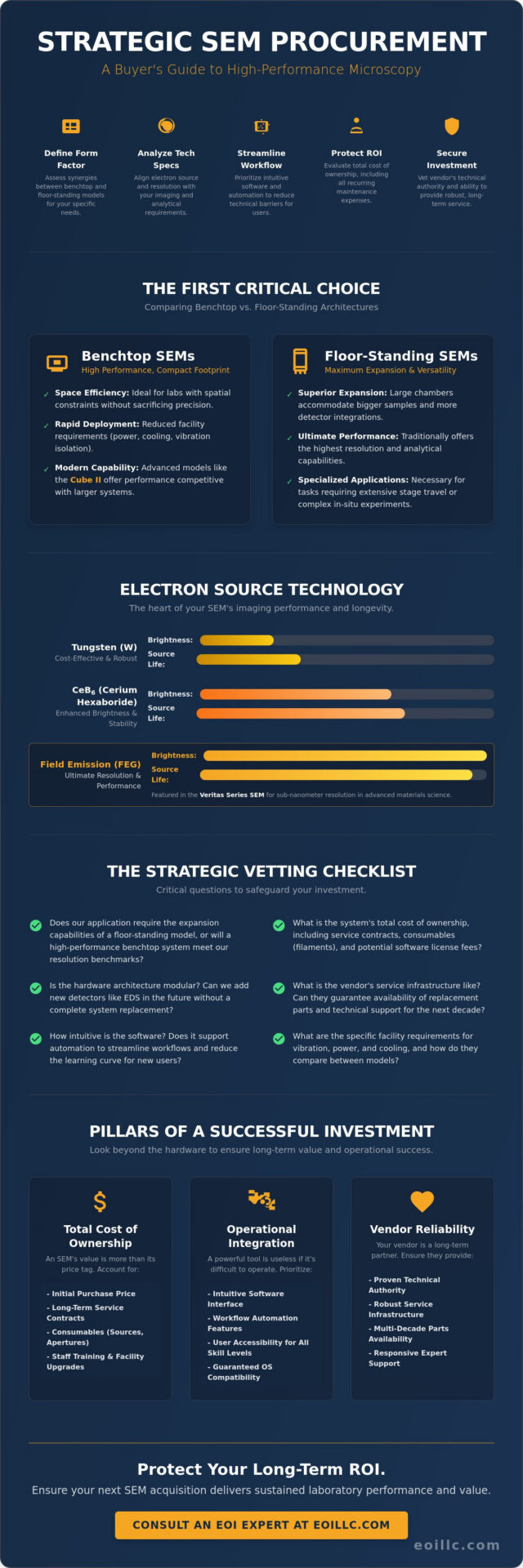
Operational Integration: Software, Automation, and User Accessibility
The functional efficiency of a scanning electron microscope is increasingly defined by the synergy between its physical column and the software architecture governing its operation. In 2026, the democratization of high-resolution imaging means that technical authority is no longer restricted to specialized microscopists. Modern interfaces now prioritize a streamlined workflow that reduces the cognitive load on the operator, ensuring that the precision of a Veritas FE SEM or a Genesis Tabletop SEM is accessible to researchers across various disciplines. When refining your list of questions to ask when buying an sem, you must evaluate how the software architecture mitigates human error through intelligent automation.
Advanced automation features, such as auto-focus and auto-stigmator routines, are essential for maintaining throughput without sacrificing data integrity. These tools allow the system to reach optimal imaging conditions in seconds, a task that once required years of technical expertise. To ensure your team follows standardized protocols, it’s beneficial to consult our comprehensive sem operation guide. This resource details the best practices for maximizing the utility of integrated EDS (Energy Dispersive Spectroscopy) Systems, which are now standard for simultaneous structural and elemental analysis within a single software environment.
What level of training is required for a novice to produce publication-quality images?
Operational complexity often leads to underutilized equipment or frequent hardware failures due to improper handling. You should investigate the user experience to ensure the platform matches your staff’s technical proficiency. Key inquiries include:
- Inquire about the UI design; specifically, is the interface icon-driven for rapid navigation or does it require extensive training in deep menu hierarchies?
- Ask about built-in safety protocols, such as vacuum interlocks and over-current protection, that prevent accidental filament or column damage during operation.
- Request detailed information on on-site technical training fees and the specific curriculum provided during the commissioning phase.
What automation features are available for repetitive analysis?
High-throughput industrial environments require systems that can function with minimal manual intervention. Automation directly influences the long-term ROI of your investment by freeing up skilled personnel for higher-level data interpretation. Consider these questions to ask when buying an sem regarding workflow efficiency:
- Ask about software modules for automated particle counting, multi-sample mapping, and large-area montaging for topographical surveys.
- Inquire about the level of integration between the SEM imaging software and the EDS analysis suite to ensure seamless data correlation without switching platforms.
- Verify if the system architecture supports remote operation or real-time monitoring via secure networking standards to facilitate collaborative research.
Total Cost of Ownership: Beyond the Initial Purchase Price
The acquisition of a scanning electron microscope is a decade-long commitment where the initial invoice represents only a fraction of the total lifecycle expenditure. Total Cost of Ownership (TCO) encompasses the original purchase price, the recurring expense of consumables, and the structural costs of technical support. Procurement officers often fall into the trap of selecting low-cost units that carry exorbitant proprietary consumable prices, effectively negating any upfront savings within the first few years of operation. For a detailed breakdown of these financial variables, consult our electron microscope cost guide. A visionary approach to procurement prioritizes systems with transparent maintenance requirements and long-term hardware reliability.
Operational continuity depends on a steady supply of high-quality components. When formulating your questions to ask when buying an sem, you must scrutinize the compatibility of the system with standard industry hardware. Proprietary lockdowns on simple components can significantly inflate your annual budget. By ensuring your chosen platform allows for flexible sourcing, you protect the laboratory from supply chain volatility and artificial price inflation.
What are the recurring costs for filaments and other consumables?
The frequency of component replacement dictates your baseline operational cost. High-utilization environments must account for the degradation of electron sources and vacuum integrity components. Consider these specific inquiries:
- Ask for the average lifespan of a filament under standard operating conditions to estimate your annual replacement frequency and associated downtime.
- Inquire if the system requires proprietary stubs or if standard third-party SEM Filaments and Consumables are compatible with the stage architecture.
- Calculate the annual cost of vacuum pump oil and filters, ensuring these maintenance tasks can be performed by in-house staff where appropriate.
What is the structure of your annual service contracts?
The stability of your laboratory’s output is directly linked to the quality of your technical partnership. Unscheduled downtime is the primary driver of TCO inflation. It’s essential to understand the vendor’s commitment to long-term performance through structured Preventative Maintenance Visits. Refine your vetting process with these questions to ask when buying an sem:
- Inquire about the difference between multi-tiered maintenance agreements, specifically focusing on what is excluded from basic coverage.
- Ask if the contract includes both parts and labor for major repairs, such as column realignments or detector replacements.
- Verify guaranteed response times for on-site troubleshooting and the availability of local field service engineers.
Ensure your instrumentation remains at peak performance by scheduling regular Preventative Maintenance Visits with our expert technical team.
Vendor Reliability and Support: Vetting the Technical Partner
The final phase of the procurement process involves a rigorous evaluation of the service ecosystem that will surround your new instrumentation. It’s a strategic error to view the vendor as a mere equipment supplier. Instead, the vendor should be regarded as a technical partner whose expertise ensures the sustained accuracy of your laboratory’s output. Selecting a distributor with over 30 years of specialized experience provides a level of institutional stability that is vital for maintaining high-end hardware like the Veritas Series SEM. The most critical questions to ask when buying an sem often center on the vendor’s ability to provide a comprehensive service infrastructure that extends beyond a single product line.
A robust technical partnership mitigates the risks associated with hardware downtime and technical obsolescence. For facilities managing multiple analytical platforms, the convenience of a single point of contact for maintenance and repair is an invaluable operational asset. To understand the full scope of sustaining equipment precision over a decade, we recommend reviewing our guide on sem maintenance. This foresight ensures that your facility isn’t just buying a tool, but is investing in a long-term commitment to logistical and analytical excellence.
Can you provide service and repair for our other laboratory microscopes?
Heterogeneous laboratory environments often struggle with fragmented service contracts from multiple manufacturers. Consolidating your technical support under one experienced partner streamlines administrative workflows and ensures consistent calibration standards across your fleet. Consider these vetting points:
- Ask about the vendor’s specific experience and technical proficiency with major manufacturers such as JEOL, Hitachi, or FEI.
- Inquire if they offer consolidated service contracts that cover multiple units, potentially including Refurbished SEM Units used for secondary screening.
- Verify the depth of their inventory regarding SEM Filaments and Consumables for various brands to prevent supply chain delays.
What is your process for equipment relocation and re-installation?
The structural integrity of an electron column is highly sensitive to the mechanical stresses of transport and the environmental conditions of its new location. Professional relocation services are essential for protecting your capital investment during facility transitions. When refining your list of questions to ask when buying an sem, focus on the logistics of movement:
- Ask about the vendor’s protocols for professional decommissioning and the use of specialized transport services designed for sensitive optics.
- Inquire about the post-move calibration process and the specific performance testing conducted to ensure the system meets its original factory specifications.
- Verify if the vendor provides pre-installation facility surveys, including EMI (Electromagnetic Interference) and vibration analysis, to identify potential site hazards before the equipment arrives.
Securing Your Laboratory’s Analytical Future
Navigating the 2026 microscopy market requires a calculated balance between immediate technical specifications and long-term operational viability. A successful acquisition isn’t defined by peak resolution alone. It’s defined by the synergy between hardware performance, software automation, and a robust service infrastructure. Refining your specific list of questions to ask when buying an sem ensures that your chosen platform remains a stable cornerstone of your research infrastructure for the next decade. By prioritizing total cost of ownership, you protect your capital investment against rapid technical obsolescence.
We leverage over 30 years of industry experience to serve as a visionary partner in your procurement journey. As the sole US distributor for EmCraft Scanning Electron Microscopes, we provide comprehensive service and support for all major SEM manufacturers. Our technical experts are prepared to assist you in evaluating the intersection of innovation and reliability for your specific application. We invite you to Request a Technical Consultation for Your Next SEM Acquisition to align your laboratory’s roadmap with the highest standards of industrial performance. Precision starts with a meticulous vetting process.
Frequently Asked Questions
What is the most important spec to look for when buying an SEM?
The most critical specification is the resolution achieved at low accelerating voltages rather than the theoretical maximum at 30kV. Many industrial samples are non-conductive or beam-sensitive, requiring operation at 1kV to 5kV to prevent charging and damage. Identifying the system’s performance under these real-world conditions is one of the essential questions to ask when buying an sem to ensure the hardware aligns with your laboratory’s actual analytical requirements.
How often does an SEM require preventative maintenance?
Most systems require professional service at least once or twice per year to maintain peak performance. Factors such as the type of electron source and the frequency of sample exchanges dictate the specific schedule. Regular Preventative Maintenance Visits are vital for verifying the integrity of vacuum seals, cleaning the electron column, and ensuring the continued alignment of the electromagnetic lenses for consistent imaging precision over time.
Can a benchtop SEM really replace a floor-standing unit for failure analysis?
Modern high-performance systems like the Cube II Benchtop SEM can effectively replace floor-standing units in many industrial failure analysis workflows. These benchtops now offer sub-nanometer resolution benchmarks that were previously restricted to larger platforms. While floor-standing models remain necessary for extremely large specimens or specialized detector configurations, the current generation of benchtops provides the necessary precision for routine inspection with significantly lower facility overhead and faster pump-down cycles.
What is the difference between Tungsten and CeB6 electron sources in terms of cost?
Tungsten filaments offer a lower initial purchase price but carry a higher long-term operational cost due to their shorter lifespan. Cerium Hexaboride (CeB6) sources, utilized in the Genesis Tabletop SEM, provide ten times the brightness and significantly greater longevity than tungsten. While the upfront investment for a CeB6 source is higher, it typically results in a lower total cost of ownership by reducing downtime and the frequency of required filament replacements.
Do I need a dedicated cleanroom for a tabletop SEM?
Dedicated cleanroom environments are generally not required for the installation of tabletop systems. These instruments are engineered to function reliably in standard laboratory or office settings provided the area is relatively free from excessive vibration and electromagnetic interference. This design philosophy allows for the decentralized integration of high-resolution microscopy, placing advanced analytical capabilities directly within the production or research environment without the need for extensive facility modifications.
How long does it take to train a new operator on a Cube II SEM?
Basic operational proficiency can typically be achieved within a single business day due to the democratization of the user interface. The software governing the Cube II Benchtop SEM utilizes intuitive, icon-driven controls and automated routines for focus and stigmation. While mastering advanced analytical techniques like EDS mapping requires additional time, the reduced learning curve allows staff members without specialized microscopy backgrounds to produce publication-quality images with minimal supervision.
Are service contracts worth the investment for a new SEM?
Service contracts are a vital investment for maintaining laboratory ROI and operational continuity. These agreements provide predictable annual costs and priority access to field service engineers for unscheduled repairs. Given the technical complexity of vacuum systems and electron optics, securing a comprehensive contract is one of the most important questions to ask when buying an sem to protect your capital expenditure against unforeseen mechanical failures and technical downtime.
What happens if my SEM manufacturer goes out of business or stops supporting a model?
Partnering with a multi-brand technical distributor provides a critical safety net for instrument longevity. Experienced service providers maintain extensive inventories of SEM Filaments and Consumables for a wide range of manufacturers, including legacy systems. Even if a manufacturer ceases support for a specific model, a dedicated technical partner with deep industry expertise can often provide the necessary parts and maintenance to keep the equipment operational for its full intended lifecycle.