
In an era where analytical precision dictates the pace of industrial innovation, the failure of a scanning electron microscope is more than a technical inconvenience; it’s a strategic liability that can stall high-value research trajectories. You likely recognize that while the initial capital expenditure for a Veritas Ultra or a Cube II Benchtop SEM is significant, the true fiscal and operational impact is defined by the technical partnership that follows. Many lab directors find that unpredictable maintenance costs and slow response times from traditional manufacturers frequently compromise the momentum of critical projects.
This guide empowers you to master the technical and logistical criteria for evaluating sem vendor support, ensuring your facility secures maximum uptime and rigorous analytical precision. By shifting the focus from a commodity-based service model to a strategic technical partnership, you can mitigate the risks associated with equipment failure. We’ll examine a standardized vetting checklist designed to guarantee long-term parts availability and minimize downtime through sophisticated preventative maintenance strategies tailored for the demands of 2026.
Key Takeaways
- Identify why it’s critical to transition from reactive maintenance models to proactive analytical ecosystems that prioritize long-term instrument stability.
- Establish a rigorous technical audit for evaluating sem vendor support by verifying engineering depth and cross-platform service capabilities.
- Analyze the financial justification for multi-year preventative maintenance visits to ensure consistent uptime for high-precision systems.
- Mitigate logistical risks by prioritizing vendors who maintain extensive domestic inventories of SEM filaments and specialized electron optics components.
- Understand how a strategic partnership with a seasoned technical authority ensures the continuous performance of advanced hardware like the Veritas Series.
The Critical Dimensions of SEM Vendor Support in 2026
The modern Scanning electron microscope (SEM) represents a pinnacle of technical integration, where the hardware’s performance is inextricably linked to the quality of its support ecosystem. In 2026, support is no longer a peripheral service but a multi-layered infrastructure that encompasses hardware maintenance, software optimization, and specialized operator training. When evaluating sem vendor support, industrial and research labs must recognize that the instrument’s longevity depends on a synergy between these elements. A failure in any single layer, whether it’s a software glitch in the imaging suite or a mechanical vacuum leak, can result in a total cessation of analytical output.
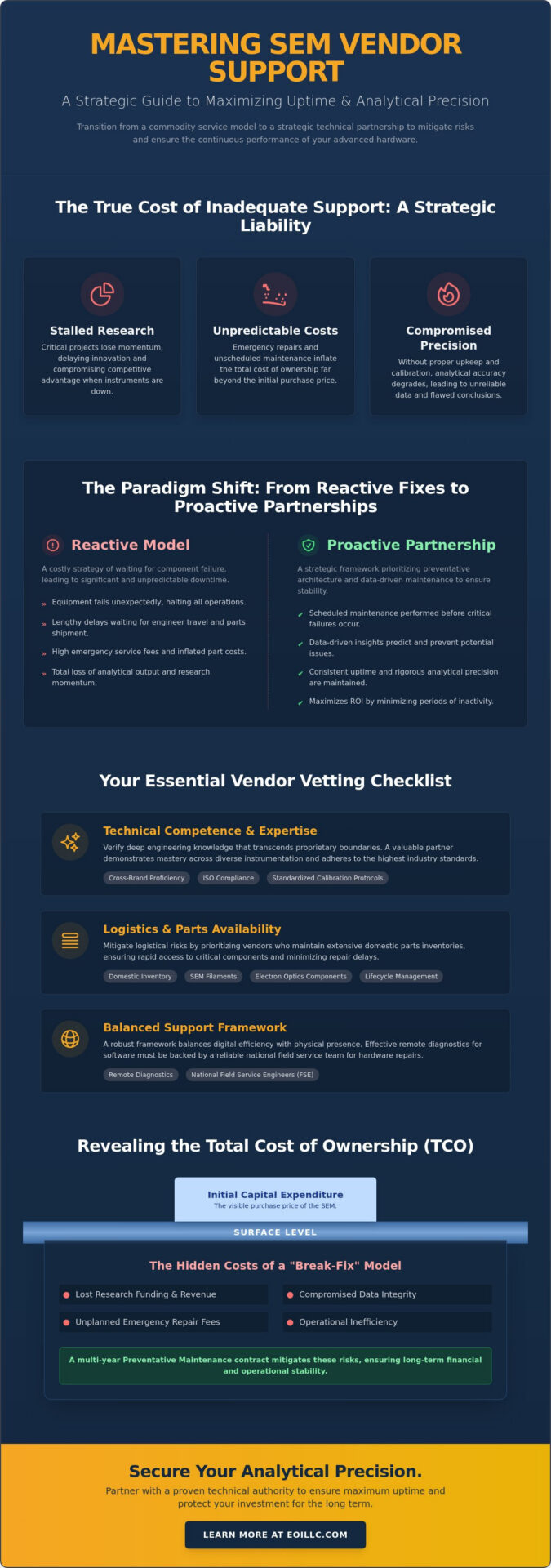
The industry has undergone a fundamental shift from reactive “break-fix” models toward proactive analytical stability. This evolution is driven by the realization that waiting for a component to fail is a costly strategy that compromises research momentum. Modern support frameworks prioritize preventative architecture, utilizing data-driven insights to schedule maintenance before critical failures occur. This shift is the primary variable when calculating the total cost of ownership for an SEM, as the true expense of an instrument includes the potential revenue or research funding lost during periods of inactivity. Distinguishing between OEM-direct support and specialized third-party distributors is essential here; while OEMs offer proprietary knowledge, specialized distributors often provide a more agile, cross-brand expertise that is vital for labs operating diverse equipment fleets.
On-Site vs. Remote Technical Support
The efficacy of remote diagnostics has improved significantly, particularly for troubleshooting complex vacuum systems and software-related imaging artifacts. Digital support tools allow engineers to verify system parameters without the delays of travel. However, remote tools can’t replace the necessity of national field service engineer (FSE) coverage for critical hardware repairs. While a software patch can be deployed virtually, the mechanical precision required for column alignments or high-voltage power supply repairs demands hands-on expertise. A robust support framework balances these digital efficiencies with a reliable physical presence, ensuring that mechanical failures don’t lead to multi-week bottlenecks.
Application-Specific Support Requirements
Support requirements vary drastically between different classes of instrumentation. For example, the maintenance needs of a Cube II Benchtop SEM or a Genesis Tabletop SEM focus on operational simplicity and rapid turnaround for routine inspections. Conversely, a high-resolution Veritas FE SEM system requires a much deeper level of technical intervention, particularly regarding the stability of the field emission source. Evaluating sem vendor support also necessitates an assessment of their expertise in EDS (Energy Dispersive Spectroscopy) integration. Proper calibration of EDS systems is vital for elemental accuracy, and a vendor’s ability to provide specialized sample preparation training ensures that the hardware’s full analytical potential is realized across various industrial applications.
Technical Auditing: Evaluating Vendor Competence and Expertise
Conducting a rigorous technical audit is the only method to ensure that a provider’s operational capacity aligns with the high-precision requirements of your lab. When evaluating sem vendor support, the superficial metrics of response time must be secondary to a deep assessment of the engineering team’s specialized competence. A vendor’s value is often reflected in their ability to maintain a diverse fleet of instrumentation, demonstrating a mastery of electron optics that transcends proprietary boundaries. This cross-brand proficiency is vital for facilities that integrate multiple generations of hardware, ranging from legacy systems to the latest Veritas Ultra configurations, requiring a partner who understands the underlying physics of various electron column designs.
In 2026, adherence to ISO compliance and standardized calibration protocols is a non-negotiable benchmark for industrial reliability. You should verify that a vendor’s internal training programs for field service engineers are continuous and documented, ensuring that technicians aren’t just following a manual but are capable of complex system optimization. If you’re seeking to expand your laboratory’s capabilities while maintaining strict budgetary control, reviewing our inventory of Refurbished SEM Units offers a practical alternative to new capital investment, provided the vendor demonstrates this level of technical mastery during the vetting process.
Questions for Vetting Technical Proficiency
Specific inquiries regarding the training certifications of service personnel reveal the true depth of a vendor’s expertise. Request case studies that detail their approach to complex repairs on legacy systems or their implementation of advanced SEM techniques. A competent partner must also demonstrate a sophisticated understanding of modern imaging software and the nuances of firmware updates, which are increasingly critical for maintaining analytical precision in automated environments. Don’t hesitate to ask for a detailed breakdown of their engineering team’s years of industry experience to gauge their ability to handle unforeseen technical challenges.
Response Times and Service Level Agreements (SLAs)
A well-structured SLA distinguishes between a “guaranteed response time” and a “best effort” clause, a distinction that often determines the outcome of a critical equipment failure. The geographic density of a vendor’s service engineers directly influences your lab’s uptime; a localized presence translates to lower latency in hardware restoration and more frequent opportunities for preventative maintenance. Ensure that your contract includes priority parts allocation to bypass global supply chain bottlenecks. In 2026, evaluating sem vendor support requires this level of contractual granularity to protect your research momentum from the logistical realities of international production and specialized component scarcity.
The Service Contract Framework: Preventative vs. Reactive Models
The selection of a service contract is a strategic decision that directly influences both the fiscal health and the analytical reliability of a high-output laboratory. When evaluating sem vendor support, decision makers must distinguish between basic preventative maintenance (PM) tiers and comprehensive full-service agreements. While a basic PM contract might only cover periodic inspections, a high-tier agreement typically encompasses labor, travel expenses, and non-consumable parts, providing a predictable expenditure model that shields the organization from the volatility of sudden hardware failures. For laboratories operating a heterogeneous fleet of instruments, the ability to consolidate SEM maintenance under a single, cross-brand provider offers significant logistical efficiencies that proprietary OEM contracts often lack.
The financial justification for multi-year preventative maintenance visits extends beyond simple risk mitigation. A structured maintenance plan acts as a preservative for the instrument’s most sensitive components, specifically the electron optics and vacuum assemblies. By maintaining these systems at peak performance, labs avoid the cascading degradation that occurs when minor misalignments or contaminants are left unaddressed. This proactive approach ensures that the instrument’s analytical precision remains consistent over its entire lifecycle, maximizing the return on the initial capital investment and preventing the premature obsolescence of expensive hardware.
Preventative Maintenance (PM) Protocols
Effective PM protocols are characterized by a meticulous attention to the physical state of the microscope. Scheduled inspections are essential for identifying early signs of filament wear and aperture contamination before they manifest as imaging artifacts or beam instability. A rigorous PM visit must also include comprehensive vacuum system leak detection and pump maintenance to prevent oil backstreaming or pressure fluctuations. Ensuring that column alignment and resolution testing are performed to factory specifications during every visit is vital for maintaining the rigorous standards required in 2026 industrial environments.
Emergency Repair and Priority Support
Even with robust preventative measures, catastrophic failures can occur, necessitating a vendor with a proven emergency response framework. Evaluating sem vendor support requires an analysis of ‘first-time fix’ rates, as repeated visits for the same issue indicate a lack of technical depth or inadequate parts inventory. Transparency in billable labor hours for repairs not covered by the primary contract is equally critical for maintaining budgetary integrity. Labs should prioritize vendors who demonstrate a clear protocol for handling failures outside of standard business hours, ensuring that critical research momentum is not sacrificed to logistical delays.
Logistics, Parts Availability, and Lifecycle Management
In the current industrial climate, logistical resilience is as critical as the hardware’s electron optics. When evaluating sem vendor support, the depth of a provider’s domestic inventory serves as a primary indicator of their commitment to your lab’s uptime. Relying on international supply chains for specialized electron optics components in 2026 introduces unacceptable risks, as geopolitical or production delays can transform a routine repair into a multi-month disruption. A robust partner maintains a comprehensive stock of SEM filaments and critical consumables within the United States, ensuring that the analytical momentum of your facility remains uninterrupted by external logistical volatility.
Strategic lifecycle management also encompasses the physical movement and evolution of the instrument. Vendor support during equipment relocation is a specialized discipline that requires meticulous decommissioning, secure transport, and precise re-installation to maintain column integrity and vacuum performance. Beyond physical logistics, future-proofing through consistent software updates and hardware upgrade paths allows your lab to integrate new imaging capabilities without the necessity of a total system replacement. To secure the longevity of your instrumentation, you should consult our definitive guide to SEM maintenance for a detailed breakdown of critical parts management.
Parts Sourcing and Inventory Reliability
Effective inventory management requires a vendor to maintain a stock of refurbished parts for discontinued SEM models, extending the operational life of legacy assets that OEMs might no longer support. You must evaluate the quality of third-party versus OEM-equivalent consumables to ensure that lower-cost alternatives don’t compromise imaging resolution or filament life. Localized parts hubs are essential for reducing shipping delays, providing a tactical advantage in high-throughput environments where every hour of downtime carries a significant financial penalty. Evaluating sem vendor support must include a verification of these localized sourcing capabilities to ensure rapid hardware restoration.
Operational Training and Staff Empowerment
Technical proficiency is a perishable asset that requires constant reinforcement through structured educational resources. The vendor’s role extends to providing comprehensive on-site technical training for new lab personnel, ensuring that the transition between staff doesn’t result in equipment misuse or data inconsistency. High-quality resources, including manuals, webinars, and professional SEM operation guides, empower your team to handle routine calibrations and complex imaging tasks independently. Customized training sessions tailored for specific industrial applications, such as failure analysis or materials characterization, further enhance the utility of the instrument, turning a standard tool into a specialized analytical powerhouse.
Partnering with Electron Optics Instruments, LLC for National SEM Support
Electron Optics Instruments, LLC leverages over three decades of specialized experience to address the complex challenges inherent in evaluating sem vendor support. Our organization occupies a unique position within the domestic market as the sole US distributor for EmCraft, providing unparalleled expertise in high-performance desktop SEM solutions. Unlike proprietary manufacturers that often restrict their focus to a single product line, our service team maintains a vendor-agnostic posture. This capability allows us to support a wide array of instrumentation from all major manufacturers, ensuring that labs with diverse equipment fleets receive consistent, high-tier technical intervention. Whether your facility utilizes the Cube II, Genesis, or the advanced Veritas Series SEM, our comprehensive service contracts are engineered to maximize analytical longevity and operational stability.
Establishing a partnership with a seasoned technical authority like Electron Optics Instruments, LLC ensures that your laboratory’s infrastructure remains resilient against the evolving demands of industrial research. We prioritize the intersection of reliability and innovation, focusing on the meticulous maintenance of electron optics to guarantee that every scan meets the highest standards of accuracy. By consolidating your support requirements with a single expert provider, you eliminate the logistical friction often associated with managing multiple OEM contracts. This strategic alignment allows your team to focus on data acquisition and material characterization while we manage the underlying technical complexities of your hardware ecosystem.
Our National Service and Maintenance Philosophy
Our field service engineers operate under a philosophy that prioritizes meticulous preventative care as the primary mechanism for eliminating unplanned downtime. By identifying potential failure points within the vacuum or electron column before they manifest as critical errors, we maintain the rigorous precision required for 2026 industrial standards. We understand that every laboratory operates under unique fiscal constraints; therefore, we provide tailored service agreements that align precisely with your specific budgetary and operational goals. This commitment to flexibility is supported by a robust logistical network that ensures rapid response and priority parts delivery across the United States, effectively mitigating the risks associated with evaluating sem vendor support in a volatile global market.
Beyond Sales: A Full-Lifecycle Partnership
The relationship we build with our partners extends far beyond the initial procurement phase, encompassing a full-lifecycle approach to instrument management. This partnership begins with professional installation and extends to expert on-site training that empowers your staff to utilize advanced imaging features effectively. As your facility grows, Electron Optics Instruments, LLC provides specialized relocation services to ensure that equipment transitions occur without compromising sensitive alignments or vacuum integrity. Additionally, our partners gain access to a reliable supply of high-quality consumables and expert EDS integration support, ensuring that elemental analysis remains accurate and repeatable over the long term. Contact our technical team to discuss a custom SEM service contract today.
Securing Analytical Uptime through Strategic Technical Partnerships
Establishing a rigorous framework for evaluating sem vendor support is essential for maintaining the operational integrity of high-precision laboratories. By prioritizing proactive preventative maintenance over reactive models, you ensure that your research momentum remains unhindered by hardware failures. A successful partnership hinges on localized logistical resilience and a vendor’s ability to provide cross-platform engineering expertise that transcends proprietary limitations. These strategic pillars allow your facility to maintain rigorous analytical standards while controlling the total cost of ownership over the instrument’s entire lifecycle.
Electron Optics Instruments, LLC offers 30+ years of electron microscopy expertise to help you navigate these technical complexities. As the sole US distributor for EmCraft Scanning Electron Microscopes, we provide comprehensive maintenance for all major SEM manufacturers, ensuring your fleet operates at peak performance. We invite you to Request a Professional SEM Service Consultation to align your facility’s technical requirements with a support structure designed for long-term reliability. We look forward to helping you achieve a new standard of analytical precision and operational excellence.
Frequently Asked Questions
What are the most important KPIs when evaluating an SEM service vendor?
Primary KPIs for evaluating sem vendor support include “first-time fix” rates, mean time to repair (MTTR), and the geographic density of field service engineers. These metrics provide a quantifiable assessment of a vendor’s technical proficiency and their ability to restore hardware functionality without repeated visits. High-performing partners prioritize these indicators to ensure that industrial labs maintain consistent research momentum and analytical accuracy.
Is it better to use an OEM for service or a specialized third-party distributor?
The choice between an OEM and a specialized third-party distributor typically hinges on the complexity of your equipment fleet and the required level of service agility. While OEMs offer proprietary depth, specialized distributors often provide a more flexible, vendor-agnostic approach that’s essential for labs managing instruments from multiple manufacturers. This consolidated service model reduces administrative friction and ensures a unified standard of care across diverse hardware platforms.
What should be included in a standard SEM preventative maintenance visit?
A standard preventative maintenance visit must include vacuum system leak detection, column alignment, and resolution testing to verify that the instrument meets its original factory specifications. Technicians also perform essential cleaning of apertures and an inspection of electron sources to identify early signs of degradation. These meticulous steps are vital for preventing imaging artifacts and ensuring the long-term stability of the electron optics.
How often should an SEM vacuum system be serviced by a professional vendor?
Professional servicing of an SEM vacuum system is generally required at least once per year to maintain the high-vacuum environment necessary for precise imaging. In high-throughput industrial environments or those analyzing volatile samples, semi-annual inspections are often necessary to prevent pump oil contamination or seal failure. Regular maintenance of these components is the primary defense against catastrophic system contamination.
Can one vendor support multiple brands of electron microscopes in the same lab?
Yes, a single technical partner can support multiple brands of electron microscopes within the same laboratory, provided they possess the necessary cross-platform engineering expertise. This approach simplifies the process of evaluating sem vendor support by consolidating various maintenance requirements under a single, comprehensive service level agreement. It eliminates the need for multiple proprietary contracts and ensures a consistent response protocol for the entire facility.
What is the typical response time for an SEM emergency repair in 2026?
In 2026, the typical response time for an SEM emergency repair is 24 to 48 business hours for facilities located within major industrial or research corridors. This timeframe is often codified within a Service Level Agreement (SLA) and depends heavily on the localized presence of field service engineers. Labs in remote locations should verify a vendor’s travel protocols to ensure that hardware failures don’t lead to extended periods of inactivity.
Does SEM vendor support include software updates and EDS calibration?
Most comprehensive service agreements include both software firmware updates and EDS (Energy Dispersive Spectroscopy) system calibration to maintain rigorous analytical standards. These services are critical for ensuring that elemental analysis remains accurate and that the imaging suite remains compatible with modern operating systems. You should verify that these elements aren’t relegated to a separate, billable tier during the contract negotiation phase.
How does a service contract affect the long-term resale value of an SEM?
A documented history of preventative maintenance through a recognized vendor significantly enhances the long-term resale value of an SEM by providing proof of its mechanical and optical integrity. Prospective buyers in the refurbished market prioritize instruments with a clear service record, as it indicates that the vacuum and column assemblies have been maintained to professional standards. This documentation transforms maintenance from an operational expense into an investment in the asset’s future liquidity.