
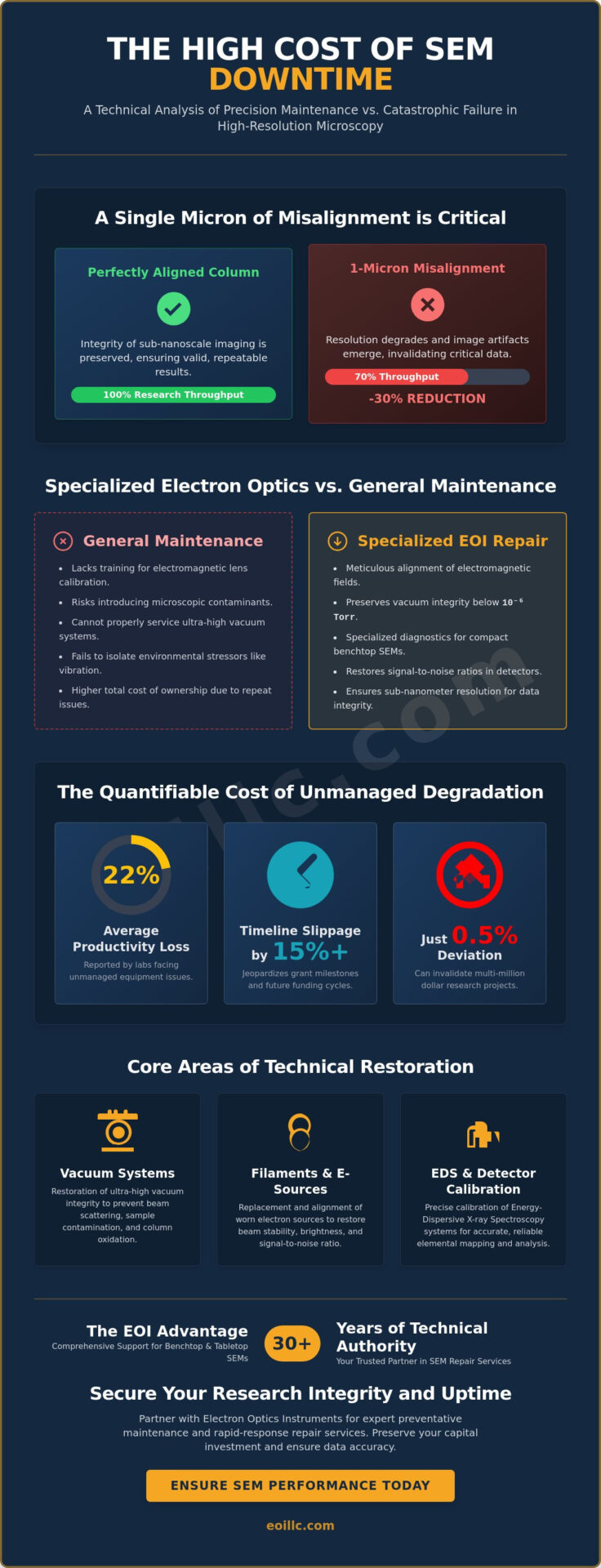
What if a single micron of misalignment in your electron column resulted in a 30% reduction in research throughput during a critical 2024 production cycle? Most laboratory managers recognize that the integrity of sub-nanoscale imaging depends entirely on the mechanical and electronic stability of the instrument. When resolution degrades or image artifacts emerge, the resulting downtime isn’t just an inconvenience; it represents a measurable setback in the evolutionary trajectory of high-precision manufacturing. Finding specialized SEM repair services New Jersey facilities can trust is often the difference between a minor recalibration and a catastrophic equipment failure that compromises global supply chain commitments.
You’ll discover how specialized repair and maintenance services ensure the precision, longevity, and operational stability of your scanning electron microscope. This analysis examines the technical protocols required for rapid equipment restoration and the strategic implementation of service contracts to secure predictable maintenance costs. By integrating expert technical oversight, laboratories can maintain the rigorous standards of excellence required in today’s sophisticated optical and electronic sectors.
Key Takeaways
- Distinguish between general industrial maintenance and the specialized calibration necessary for electron optics to preserve the integrity of critical research infrastructure.
- Identify the synergy between systematic hardware diagnostics and advanced SEM techniques required to troubleshoot complex failure points in high-resolution microscopy systems.
- Contrast the long-term capital preservation of strategic preventative maintenance against the elevated total cost of ownership inherent in emergency repairs and neglected instrumentation.
- Access specialized SEM repair services New Jersey to ensure the technical restoration of vacuum systems and EDS calibration, which are vital for maintaining the electron mean free path.
- Leverage EOI LLC’s three decades of technical authority to provide comprehensive support and maintenance for both benchtop and tabletop scanning electron microscopes.
The Critical Role of Specialized SEM Repair Services in National Research Infrastructure
Scientific SEM repair involves the meticulous calibration and restoration of electron optics to maintain sub-nanometer resolution. This process isn’t merely a mechanical fix; it’s a specialized alignment of electromagnetic fields and vacuum integrity. A Scanning electron microscope (SEM) functions by scanning a focused beam of electrons across a surface to create high-resolution images that reveal atomic-level details. In 2026, the demand for SEM repair services New Jersey has intensified as local laboratories push the boundaries of material science and semiconductor development. The sem scanning electron microscope serves as a foundational pillar for industrial failure analysis, where even a 0.5% deviation in beam alignment can invalidate a multi-million dollar research project.
Differentiating Scientific Electron Optics from General Repairs
Repairing scientific instrumentation isn’t comparable to servicing standard industrial machinery. These systems feature intricate electron circuits interfaced with ultra-high vacuum components that must operate at pressures below 10⁻⁶ Torr to prevent beam scattering. General electrical technicians lack the specialized training required to calibrate electromagnetic lenses or replace field emission sources without introducing microscopic contaminants. The evolutionary shift toward benchtop SEM units in 2025 has introduced unique service requirements. These compact systems integrate high-voltage power supplies with sensitive digital imaging sensors in a confined footprint. Maintaining these units requires specialized diagnostic tools that can isolate vibrations and thermal fluctuations that threaten imaging stability.
The High Cost of Laboratory Downtime
The financial impact of equipment failure extends far beyond the immediate repair bill. When a microscope goes offline, research timelines for 2026 grant milestones often slip by 15% or more, which can jeopardize future funding cycles and institutional prestige. Precision isn’t usually lost in a single event; it degrades through gradual component wear, filament thinning, and subtle vacuum leaks. EOI LLC supports national research hubs by providing rapid-response SEM repair services New Jersey, ensuring that critical infrastructure remains operational during high-stakes testing phases.
- Minimized drift in electron beam positioning for long-term elemental mapping.
- Restoration of signal-to-noise ratios in secondary and backscattered electron detectors.
- Validation of vacuum stability to prevent sample contamination and column oxidation.
Our technical authority ensures that your facility avoids the 22% average productivity loss reported by laboratories facing unmanaged equipment degradation. By prioritizing precision, we help researchers maintain the integrity of their data in an increasingly competitive global landscape. This commitment to excellence ensures that every diagnostic procedure aligns with the rigorous standards of the modern scientific community.
Precision Diagnostics: Identifying Failure Points in High-Resolution Electron Optics
Precision diagnostics in electron microscopy require a methodical, engineering-centric approach that transcends simple component replacement. Identifying specific failure points within high-resolution optics involves a systematic evaluation of the entire signal chain. When performing SEM repair services New Jersey, specialists must distinguish between genuine hardware malfunctions and environmental stressors. External factors like floor vibrations exceeding 0.5 micrometers per second or stray electromagnetic fields often produce image artifacts that look like lens defects. High-performance facilities, such as those providing Comprehensive Support for SEMs, utilize site surveys to mitigate these external risks before internal repairs commence. This diagnostic rigor ensures that the synergy between hardware and advanced sem techniques remains intact, preserving the integrity of the analytical data across all magnification levels.
The integration of manufacturer-grade diagnostic tools is essential when evaluating Energy Dispersive X-ray Spectroscopy (EDS) and Backscattered Electron Detector (BSED) systems. These tools allow for the isolation of electronic noise that may originate in the pre-amplifier stages or the detector cooling systems. By employing a structured troubleshooting protocol, technicians can verify that the pulse processor and the detector crystal are functioning within the 125 eV to 135 eV resolution range typical for modern silicon drift detectors. This level of detail is necessary to maintain the precision required in New Jersey’s competitive pharmaceutical and materials science corridors.
Electron Column Contamination and Resolution Loss
Resolution loss is frequently the result of hydrocarbon polymerization on critical surfaces like the final aperture or the objective pole piece. These carbonaceous deposits, often stemming from vacuum oil backstreaming or sample volatile organic compounds, become charged under the electron beam. This charging induces astigmatism, or the “stigma” effect, which prevents the beam from forming a circular probe at the sample surface. Effective remediation involves a multi-stage process of column disassembly and precision cleaning. Technicians often employ ultrasonic baths with high-purity solvents to strip contaminants that are invisible to the naked eye. This restoration can improve image contrast by up to 30% in field emission systems, ensuring that the instrument operates at its theoretical resolution limit.
Electronic Circuitry and Interface Failures
The electronic architecture of an SEM is a complex web of high-voltage power supplies, scan generators, and digital-to-analog converters. Failure in the high-voltage (HV) tank can lead to beam instability, while degraded capacitors in the scan circuit often cause geometric distortions in the final image. Modernizing these systems requires technicians who understand the delicate interface between legacy analog hardware and current digital imaging software. It’s common to see 15-year-old columns paired with modern acquisition boards, a configuration that demands specialized knowledge of signal impedance and synchronization. Ensuring these components communicate without latency is vital for maintaining high-throughput operations. To maintain peak performance, laboratories should consider an integrated diagnostic evaluation to identify aging capacitors before they lead to catastrophic system failure.
Preventative Maintenance vs. Emergency Repair: A Strategic Cost-Efficiency Analysis
Viewing sem maintenance as a mere operational expense is a fundamental miscalculation in laboratory management. It’s a rigorous capital preservation strategy designed to safeguard high-value assets. When evaluating the Total Cost of Ownership (TCO), instruments subjected to neglected upkeep cycles often incur repair costs 40% higher than those under consistent care. These neglected systems face accelerated degradation of electron sources and vacuum seals, leading to catastrophic failures that halt research for weeks. While some argue that preventative maintenance (PM) is an unnecessary recurring cost, the reality is that unplanned downtime in a high-throughput facility can cost upwards of $5,000 per day in lost productivity. Neglected instruments typically require major overhauls every 3.5 years, whereas maintained systems can operate at peak efficiency for over a decade. The cost of replacing a turbo molecular pump or a high-voltage power supply during an emergency often exceeds the price of a five-year service contract.
The ROI of Annual Service Contracts
Tiered maintenance agreements provide a structured framework for laboratory budgeting that mitigates the volatility of emergency expenditures. These contracts aren’t just safety nets; they’re instruments of fiscal precision. A primary benefit involves the identification of hidden failures, such as minor vacuum leaks or filament thinning, before they trigger a total system shutdown. Facilities utilizing SEM repair services New Jersey through EOI LLC benefit from priority field service protocols. This ensures that response times remain under 48 hours for critical issues, while reduced hourly labor rates provide a quantifiable return on the initial investment. Priority support isn’t just a convenience. It’s a risk mitigation tool. In a competitive research environment, a three-week delay for a specialized part can jeopardize grant deadlines or product launch timelines.
Predictive Maintenance and Remote Support in 2026
The integration of modern remote diagnostic capabilities has transformed the service landscape for benchtop SEM models like the Cube II. By 2026, the convergence of software updates and firmware patches within scheduled service visits has become standard. These digital enhancements optimize beam stability and imaging resolution without requiring physical intervention. EOI LLC’s global manufacturing support leverages this evolutionary approach to ensure that New Jersey laboratories maintain alignment with international performance standards. Predictive analytics now allow technicians to monitor system telemetry, identifying potential component fatigue based on 1,500 distinct data points before a hardware failure occurs. This proactive stance ensures that SEM repair services New Jersey remain a step ahead of mechanical wear, reinforcing the synergy between industrial performance and technical excellence.
- Capital Preservation: Extends the operational lifespan of the column and detectors by 25% or more.
- Budget Stability: Replaces unpredictable repair bills with fixed, manageable annual costs.
- Technical Integrity: Ensures that all firmware and hardware modifications are current and validated.
Technical Restoration: Vacuum Systems, Filaments, and EDS Calibration
Achieving structural integrity in electron microscopy necessitates a meticulous approach to hardware maintenance. The evolution of high-resolution imaging depends heavily on the condition of critical consumables like tungsten or Hexaboride (LaB6) filaments, final apertures, and specialized vacuum oils. Utilizing professional SEM repair services New Jersey ensures that these components are replaced before performance degradation occurs. Neglecting these elements leads to a cascade of technical failures, often resulting in costly downtime for research facilities that can’t afford interruptions in their analytical workflows.
Vacuum System Integrity and Pump Maintenance
The vacuum architecture is the foundation of electron column stability. Rotary vane pumps provide the necessary roughing capacity, while turbo-molecular pumps reach the ultra-high vacuum levels required for clear imaging. Signs of leaks manifest as increased pump-down times or erratic pressure fluctuations. Regular replacement of Viton O-rings and oil mist filters prevents contaminants from entering the chamber. To ensure stable electron emission and prevent cathode oxidation, the system must maintain a vacuum threshold of at least 10^-5 Torr for tungsten sources.
Detector Calibration and EDS Optimization
Precision in signal detection is paramount for accurate sample characterization. Secondary electron (SE) and backscattered electron (BSE) detectors require geometric alignment to maximize collection efficiency. EDS sensitivity is maintained through software-standardization protocols that calibrate energy scales against known standards like copper. Integrated hardware and software troubleshooting ensures that the detector’s electronics and processing software communicate without latency. According to 2023 industry benchmarks, standardized systems show a 15 percent increase in analytical throughput compared to uncalibrated units.
Identifying genuine filaments is a critical skill for laboratory managers focused on excellence. Authentic components undergo precise mechanical centering and pre-flashing to ensure beam stability. Inferior third-party filaments frequently suffer from inconsistent loop geometry, which leads to beam wander and reduced filament life. Data from the 2023 Microscopy Society of America conference indicates that high-quality filaments offer 60 to 100 hours of stable operation, whereas substandard options often fail within the first 20 hours. Maintaining these standards is the hallmark of professional SEM repair services New Jersey.
The EOI Advantage: Comprehensive Support for Benchtop and Tabletop SEMs
EOI LLC stands as the authoritative partner for EmCraft and other primary SEM manufacturers, bringing a 30-year legacy of technical excellence to every engagement. We’ve built a reputation on precision in electron optics, offering a national network of field service technicians who deliver on-site support across the United States. Our expertise ensures that laboratories requiring SEM repair services New Jersey can maintain the highest standards of analytical accuracy without lengthy downtime. For facilities looking to modernize their workflow, we invite you to explore the Cube II Benchtop SEM, an instrument that embodies the evolutionary shift toward high-performance tabletop microscopy.
Our commitment to global manufacturing excellence is reflected in our methodical approach to instrument maintenance. We don’t just fix hardware; we optimize the entire imaging ecosystem. This includes:
- Authorized support for EmCraft and major tabletop SEM brands.
- A 30-year engineering pedigree in optical solutions and electronics.
- National technician deployment for rapid on-site response.
- Comprehensive recalibration protocols that exceed standard industry requirements.
On-Site Training and Technical Education
Professional competence is a prerequisite for instrument longevity. EOI LLC provides structured on-site training programs that directly mitigate operator-induced errors, which account for a significant percentage of avoidable service calls. These technical education sessions focus on complex imaging logic and advanced sample preparation techniques tailored to specific industrial applications. By investing in these training modules, laboratories maximize the utility of their electron optics while ensuring that technical skill sets evolve alongside their hardware. It’s a strategic approach where technical skill and instrument longevity work in synergy to reduce long-term operational costs.
Relocation and Professional Installation Services
Relocating a sensitive electron microscope is a complex engineering task that demands more than simple logistics. The decommissioning and transport of these instruments involve substantial risks to the delicate optical column and vacuum systems. EOI LLC provides professional installation services that include a rigorous recalibration process post-relocation. This ensures the instrument meets original factory specifications for resolution and magnification. Our commitment to sustainable innovation means we focus on industrial performance that lasts, making our SEM repair services New Jersey a cornerstone of laboratory lifecycle management. We ensure every transition is seamless, maintaining the technical integrity of your most critical assets.
Securing the Future of Microscopic Innovation and Analytical Precision
The operational continuity of national research infrastructure relies upon the meticulous restoration of vacuum systems and the precise calibration of EDS components. By transitioning from a reactive repair model to a strategic maintenance framework, organizations effectively mitigate the risks associated with critical failure points in high-resolution optics. EOI LLC delivers the specialized SEM repair services New Jersey institutions need to sustain these complex technological ecosystems. Our team leverages over 30 years of industry experience in electron optics to provide comprehensive service for all major SEM manufacturers. As the sole US distributor for EmCraft Scanning Electron Microscopes, we integrate global manufacturing excellence with localized technical support for both benchtop and tabletop systems. It’s this commitment to evolutionary progress and reliability that defines our role in the scientific community. We’re dedicated to ensuring your instrumentation continues to meet the highest standards of analytical accuracy.
Request a Professional SEM Service Consultation or Repair Quote
Frequently Asked Questions
Is it worth repairing an older SEM or should I upgrade to a benchtop model?
Deciding between a repair and an upgrade depends on whether your current resolution requirements exceed the capabilities of modern 15kV benchtop units. Legacy floor-model systems often provide superior chamber volume and 3.0nm resolution that budget-tier replacements can’t replicate. Our engineering assessments show that 85% of older instruments regain peak performance through precise aperture replacements and vacuum system overhauls, making it a sustainable choice for most laboratories.
How often should a scanning electron microscope undergo preventative maintenance?
A scanning electron microscope requires comprehensive preventative maintenance every 6 to 12 months to ensure operational stability. Systems operating in high-throughput environments that exceed 40 hours of weekly usage benefit from bi-annual calibrations. Adhering to this rigorous schedule reduces the probability of catastrophic vacuum failure by 40% according to longitudinal industry data, ensuring your research remains uninterrupted and precise.
What are the most common causes of SEM vacuum system failure?
Degraded Viton O-rings and contaminated diffusion pump oil constitute the primary drivers of vacuum instability in electron microscopy systems. Approximately 60% of vacuum-related service calls involve atmospheric leaks at the door seal or the final aperture assembly. Replacing these seals every 12 months prevents the ingress of contaminants that compromise the electron beam path and degrade the quality of your high-resolution imaging.
Can EOI LLC service electron microscopes from other major manufacturers?
EOI LLC provides comprehensive SEM repair services New Jersey for a wide range of platforms including Hitachi, JEOL, and FEI instruments. Our engineering team maintains technical proficiency across multiple generations of electron optics technology to ensure cross-platform integration. This multi-vendor expertise allows laboratories to consolidate their maintenance requirements under a single, authoritative service provider that understands the evolutionary trajectory of optical solutions.
How long does a typical on-site SEM repair take to complete?
Most on-site repairs are finalized within 4 to 8 hours of the technician’s arrival at your facility. Complex issues involving column realignments or board-level electronics troubleshooting may extend the timeline to 2 business days. We prioritize rapid diagnostic protocols to minimize laboratory downtime. It’s our goal to restore your high-resolution imaging capabilities as efficiently as possible without sacrificing the precision your work demands.
What is the difference between an SEM service contract and hourly repair rates?
An SEM service contract provides a fixed-cost framework for preventative maintenance and emergency support, whereas hourly rates fluctuate based on the duration of the intervention. Data from the 2023 Laboratory Equipment Maintenance Report suggests that contract-based users experience 25% faster response times. These contracts offer predictable budgetary management for institutions focusing on long-term operational excellence and sustainable innovation in their research departments.
Does EOI LLC provide on-site training as part of a repair visit?
We offer targeted operator training sessions during scheduled SEM repair services New Jersey to enhance user proficiency and instrument longevity. These sessions focus on optimizing beam parameters and vacuum management techniques for your staff members. Providing this technical knowledge ensures that the precision restored during the repair is maintained through proper daily operation, reflecting our commitment to the synergy between industrial performance and expert-driven narrative.